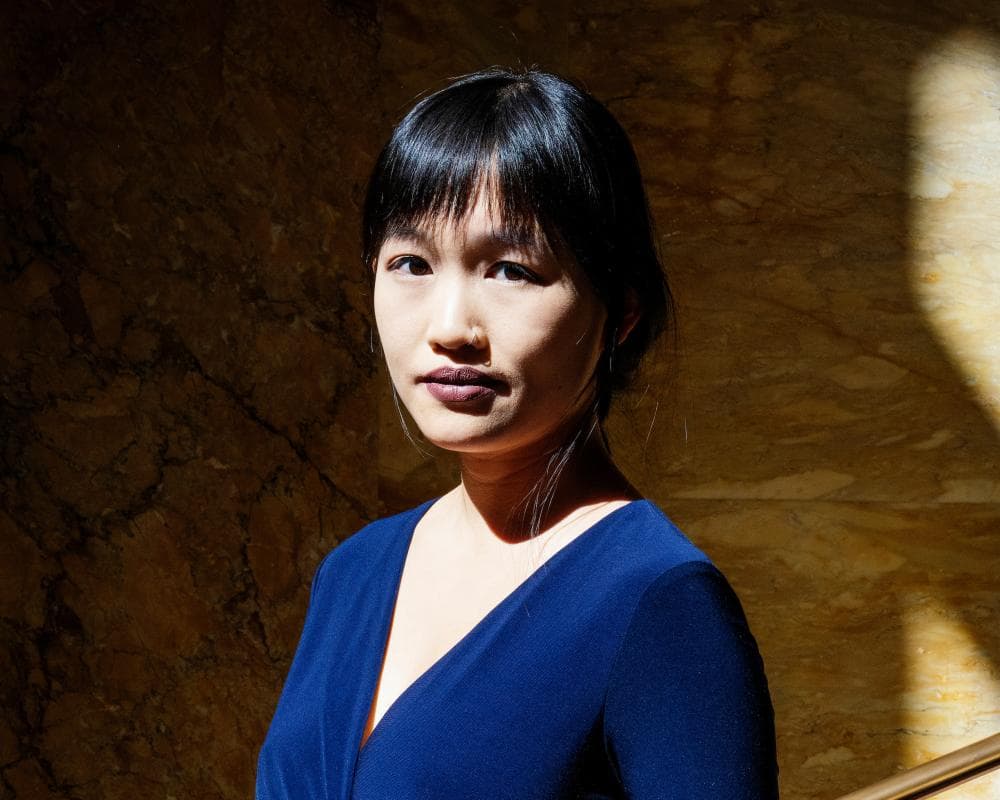
When Emily St John Mandel was a child she had a dream that would stay with her for decades. It was a nightmare in which “I was trying to find my dad in a crowd, and there were other people who looked like him but weren’t him”, she says. “It just kind of struck my imagination.”
Forty-ish years later, Mandel’s seventh novel, Exit Party, opens with a gathering in Los Angeles, 2031, where bizarre things happen. Doubles of some guests appear. Someone else disappears altogether. The novel then alternates between two potential future Americas, one riven by the chaos of civil war, the other a surveillance state.
Doppelgangers and alternative realities are having a cultural moment in our uncanny, deepfake times. Mandel says the biggest challenge western democracy faces is “the collapse of consensual reality. When you get to a situation where half the electorate disagrees on basic reality – for example, who won an election, or is Covid real? I don’t know how you come back from that.” On a more personal level, she has always been fascinated by what she calls “the counter-life – the one where you took a different job or married a different person. The way that, if we made a different decision, we would have become a somewhat different person.”
This interest comes, she thinks, from a feeling that “my life as a writer in New York City is a bit improbable”. Mandel was home-schooled on a tiny island in British Columbia, Canada, before training as a dancer. As she puts it, she was “essentially not educated until I was about 15 … I haven’t got a high school diploma.” She wrote while working office jobs until her third novel, Station Eleven, became a smash hit. The 2014 story of life after a global pandemic felt so prescient when readers rediscovered it during Covid that she developed a reputation for clairvoyance. It has sold 1.5m copies and been translated into 37 languages. Her novels since – The Glass Hotel and Sea of Tranquility – were global bestsellers too. It’s a staggering career, and, as she sees it: “There are a million ways this might not have happened.”
We meet on a sunny New York City day, in the lobby of a sleek Williamsburg hotel. Mandel, who lives in nearby Queens, wears a rose-printed shirt and comes across as warm yet precise. She’s off to have a haircut after we meet, even though her neat pixie cut scarcely looks trimmable.
One of the seeds of Exit Party was its protagonist Ari, who was the villain of Mandel’s second novel, 2010’s The Singer’s Gun. (Mandel is building a multiverse; characters reappear in Station Eleven, The Glass Hotel and Sea of Tranquility, though alas, she says, there is no Marvel movie coming.)
All these years later, “I just couldn’t stop thinking about her. I found myself thinking: what would that character be like at the other end of an 18-year prison sentence?” Ari is like a time traveller, she says; as we all are if we survive enough decades: “If you stick around long enough, you kind of become a migrant from a different timeline.”
Ari is a bit clairvoyant, something Mandel admits – with what I think may be a small wince – is based on her own experience. “I’ve had just a touch of that all my life. A tiny bit. It’s not nearly as useful as you might imagine. I absolutely cannot predict pandemics.” For example, when the March 2020 dates were announced for her Glass Hotel book tour, which was, of course, later cancelled, “I had a strange feeling: I would think about that tour, and it didn’t feel real. The best way I can describe the feeling is to say there was no life in it. When I thought about it, it was inert.” Or she might feel she needs scissors, and bring them to work – and realise she was right. “Dumb little examples like that,” she says, laughing: “Please don’t write that I’m psychic!”
Not psychic, then, but brilliant at imagining what might happen in our disaster-prone world. Even the writing process of this book was eerily predictive – though not in a straightforward way. When Mandel started writing, in spring 2022, she thought the civil war timeline was potentially “our near future. Not to be pessimistic but one reads the news.” Then she came up with an alternative, Universe B, to be “this kind of mirror image – totalitarianism instead of chaos”. By the time the book was nearing completion, with Trump’s bleak second presidency under way, “I felt like I was struggling to stay ahead of the news cycle in Universe B.” Citizens spy on one another and people are disappeared from the streets. “It’s been terrifying to see the speed with which the news cycle has caught up.”
Exit Party is Mandel’s third speculative novel. She is drawn to the form, she says, because she loves to “talk about the present by putting it in a sort of speculative cloak”. Sea of Tranquility, for example, “is absolutely a Covid-19 novel, but by setting it in the future on the moon, it was possible to write about it”. Realism would have been “frankly unbearable to write, let alone to read”. In Exit Party, too, she deftly creates emotional resonance through events that feel like a slanted take on our own times. The titular party, for example, takes place after a curfew is lifted, and has a vividly post-lockdown feel.
I'm fascinated by the counter-life – the one where you took a different job or married a different person and became a different person
Her books come about, she says, through a process of “slow development”. She compares her first draft to a sculptor’s block of clay, “the raw material in which I’ll find the novel. There is no plan and no outline. I’ll start with a scene, build it up from there.” There are always moments when she thinks the novel is irretrievably broken, but she has never yet thrown a manuscript away. “I’ve always been able to change something that isn’t working into something that does work,” she says. Increasingly, she is bringing those skills to the screen, too, whether writing adaptations of her own work (she is working on the pilot for a TV adaptation of Exit Party), or staffing writers’ rooms – recently working on Netflix’s dramatisation of the video game Assassin’s Creed. She spends about one week in Los Angeles for every six in New York, often rising to write fiction in the morning, before an 11am writers’ room Zoom, “which is great in some ways and exhausting in others”.
Mandel recently had her own inflection point. Having divorced from her husband, a fellow writer, in 2022, she married photographer Laura Barisonzi in 2025. Their wedding was the stuff of book nerds’ dreams, held in Brooklyn’s Greenlight book store, which has been “hosting my launch events since before Station Eleven – and I didn’t sell many books back then!” They had an open book bar and her daughter, now 10, was a “ring bearer-slash-flower girl. It was just lovely.”
Exit Party, like much of her work, makes the case for relishing small moments of joy, frightening as the world is. That, she says, is “something I think about a lot. And maybe there’s a way of even appreciating good moments because they’re fleeting. That state of being temporary brings its own kind of sweetness.”
• Exit Party is published by Picador on 17 September. To support the Guardian order your copy at guardianbookshop.com. Delivery charges may apply.