Imagine this. Quite by chance, your TikTok feed presents you with footage of the fascists who recently took part in highly organised shows of strength in Dover and Portsmouth (and, on Wednesday, outside the London offices of the Daily Mail, demanding a new house for the mother of their leader, Daniel “Tommo” Thomas). For as long as the images hold your attention, you see and hear flashes of explanation, but then, as usual, you scroll away to someone leaping off a tall building, a fight on the London Underground, or a trick-performing dog.
Hypothetically, TikTok users are able to skip through 260 videos in under 35 minutes. And it’s this distracted, quick-fire way that so many people receive information that may be responsible for a worrying statistic from YouGov last week. Its poll on the Dover and Portsmouth events showed that 53% of people aged 18-24 years old simply didn’t have a point of view on whether the masked demonstrations were “a legitimate way of protesting”. Further, 43% of those of all ages were either unaware of the story, or not following it at all.
Those figures probably highlight one of the most worrying aspects of the times we live in: the decline of reading. Millions of us know what that phenomenon feels like: trying desperately to keep your attention glued to a book or news article with the nagging certainty that you will be tempted back to the more ephemeral attractions offered by your phone. But a background in the pre-digital world helps people not just follow national and global events, but clarify and contextualise them. In this case, at the risk of sounding hopelessly pompous, the fear many of us felt as we watched what happened in both ports was surely full of the perspectives gleaned from years of soaking up books and newspapers – and the sense that history often either repeats itself, or rhymes.
Black-clad – let’s be honest: uniformed – men who want to “reclaim our borders, restore order and send a clear message: Britain belongs to the British”, while claiming to be protecting women and girls: the whole spectacle was pitched halfway between Oswald Mosley’s blackshirts – and, therefore, Hitler and the Nazis – and the Ku Klux Klan, with the seemingly ubiquitous balaclavas lacing everything with a flavour of the Troubles. But if you receive most of your information in the form of a distracting and seemingly infinite jumble of random moving images, what would you know about most of that?
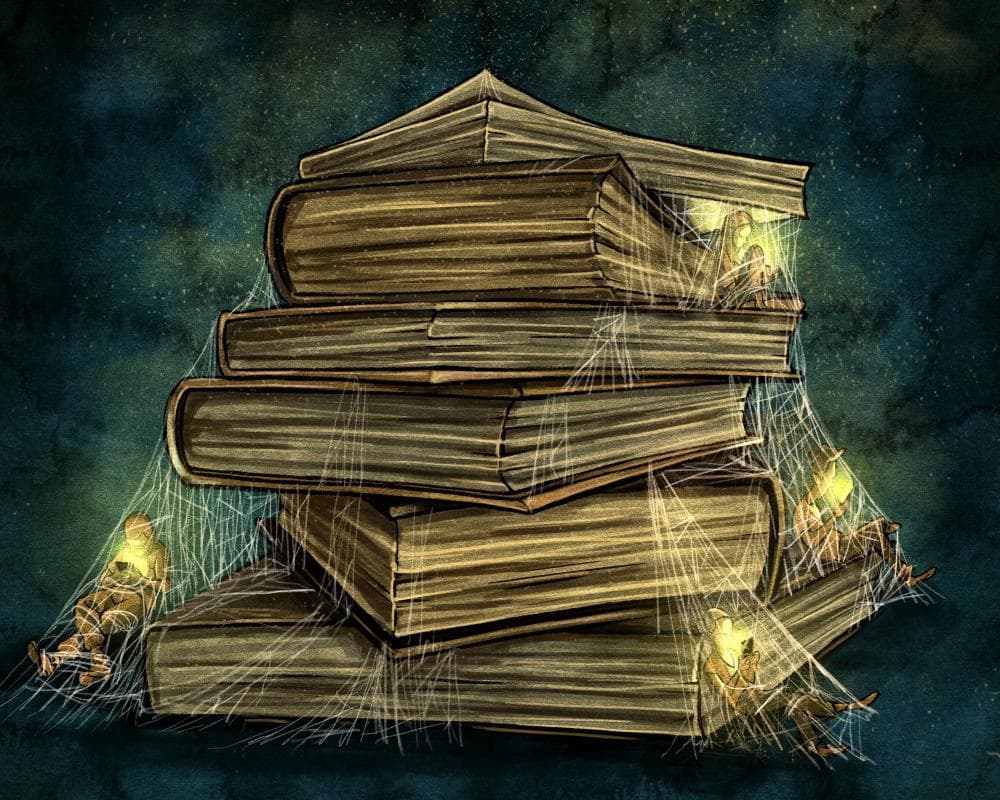
All this crossed my mind thanks to an excellent new book marking what may well be a transformative moment for societies all over the world. The New Dark Ages is the work of the Times columnist James Marriott, and subtitled The End of Reading and the Dawn of a Post-Literate Society. Presumably to accommodate itself to the changes it describes, it is short: 208 pages. But it is also full of insight and urgency.
In the 20 years since the UK’s National Literacy Trust began looking at children’s and young people’s reading, there has been a 36% fall in the number who say they enjoy reading in their spare time, to its lowest level on record. In 2024, the Guardian reported a survey by the Reading Agency charity, which found that 35% of adults said they were now “lapsed readers”, meaning that they used to regularly read for pleasure, but “rarely or never” did any more.
The Atlantic magazine recently ran an article baldly headlined The End of Reading Is Here, whose author, Rose Horowitch, made plenty of sobering claims. “The literate era will prove to be a brief interlude between the oral and digital ages,” she wrote – and drew on no end of evidence and anecdotes. A program director at the American Academy of Arts and Sciences, for instance, ran focus groups asking high-school students about recreational reading. The conclusion: “most thought of it as an alien practice”. When Marriott first wrote about this, he says, “some professors reported that it was not that the young men and women in their classes were unwilling to read, but that they seemed almost unable to”.
In Britain, more than 320 newspapers closed down between 2009 and 2019, a statistic the book follows with a stark suggestion: “It is increasingly possible to get through life without any exposure to the news at all.” In the wake of the 2016 Brexit referendum, I met people who said they had simply stopped paying attention to current affairs because they were so maddening: now, I wonder if what was really powering this switch-off was technology. The resulting ignorance – a strong word, but it feels justified – is firewalled by phone screens: it feels as if the only stuff that can break through has to be angry, paranoid and visually shocking.
And because of the decline of reading, the people who purvey all the nonsense and poison can be increasingly confident that fewer and fewer people will come across anything halfway critical or analytical. In that sense, the screen age is exemplified by – oh yes – Donald Trump, who, according to an economic adviser in his first term, “won’t read anything – not one-page memos, not the brief policy papers, nothing”. His style of speechmaking is equally non-literate: as Marriott writes, “he doesn’t supply evidence for his ideas. Rather than organising his information analytically via clauses and subclauses in the manner of literate communication, he merely piles up assertions”.
His proposed election bribe of $5,000 is one surreal example, but there are plenty of others. I recently watched an online video of Sean Duffy, the former Fox Business host who is now Trump’s secretary of transportation. He was rejoicing in the administration’s quest to do away with start-stop ignition buttons in cars – mainly, I sensed, because of some weird quasi-Freudian attachment to the phallic(ish) shape of traditional keys. Written down in an attempt at coherent argument, his case would have looked ridiculous. But folksily barked out as Duffy’s “pet peeve”, I could imagine it being warmly greeted by exactly the people it was aimed at. The same, of course, applies to any number of much more malignant Trumpian positions and passions: climate denial, brazen racism towards Somali-Americans, unapologetic Islamophobia and the idea that the US is about to be overrun by criminals and the occupants of other countries’ prisons and mental institutions.
“Mass literacy is a recent phenomenon,” Marriott writes. “So is mass democracy. We simply don’t know whether one can survive without the other.” Meanwhile, on millions of screens, fascist faux-militias, populists funded by crypto tycoons, and other merchants of loathing and absurdity blur into acrobatic skateboarders, arguments on the tube and dogs that do tricks. That strips them of context and thereby normalises their rise – and inch by inch, we move towards a future with echoes of the past that too many people will have failed to understand. And this time, there will be no books to burn, because we will have stopped reading them.
• John Harris is a Guardian columnist
• This article was amended on 13 September 2026. An earlier version misspelled Oswald Mosley’s surname.