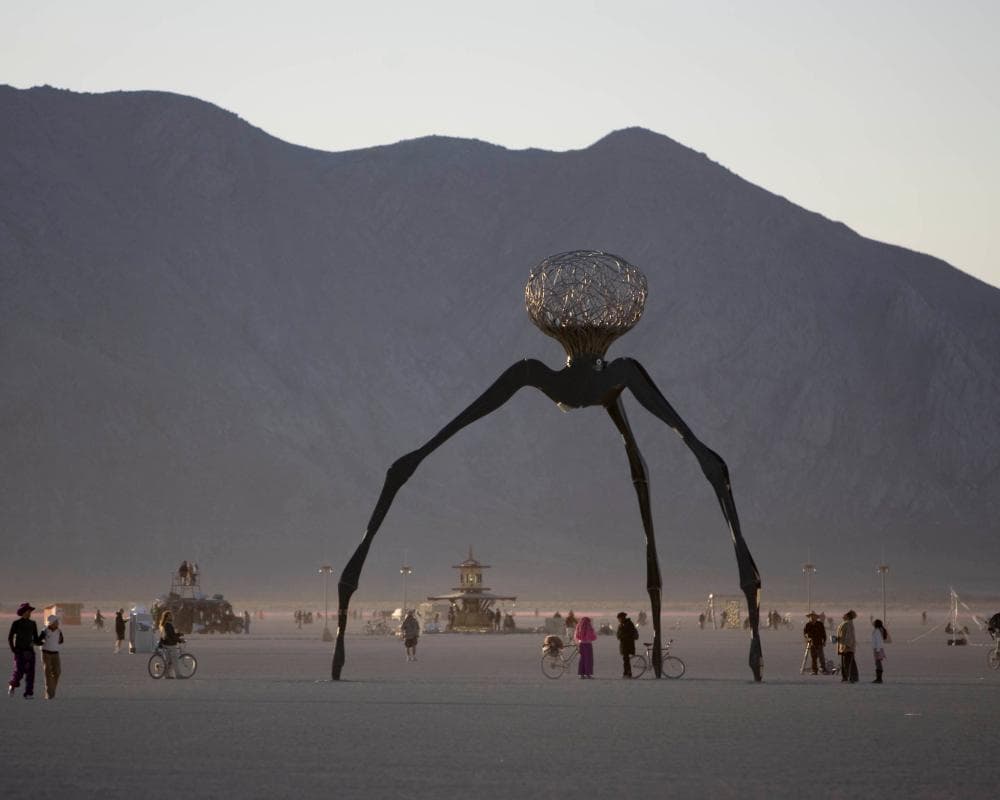
Burning Man, the infamous arts festival in the Nevada desert, turned 40 this year, and it’s showing some distinct signs of middle age.
It’s not just the tech billionaires who show up to party, the chartered flights straight to the desert or the HBO documentary about behind-the-scenes power struggles. The tens of thousands of people who assemble each year to create a tent city in the wilderness appear to be growing older, and it doesn’t seem that they’re being replaced by as many younger “burners”, as festival participants are called.
People in their 20s used to make up nearly a third of the participants in this utopian experiment, in which volunteers build a new version of Black Rock City in the desert each year, party nonstop for a week and then burn much of the art they have created, including a massive effigy of the “Man.”
Since the festival paused for two years during the pandemic, the number of attenders in their 20s has dropped sharply, falling to only 10% in 2025, according to estimates from the Black Rock City census, an annual participant survey that has been conducted in different forms since 2002. Meanwhile, the share of attenders in their 40 and 50s grew to nearly 42% last year. While data for 2026 is not yet available, the “preliminary 2026 census data suggest a slightly younger age profile than in 2025”, the organization said.
Burners are used to adapting to new circumstances, and they have weathered plenty of scorn and skepticism from what they call the “default world”. But a permanent shift in the event’s demographics could have big implications for what’s possible on the ground.
As Burning Man’s spiritual seekers age, can the festival remain an evolving experiment in radical communal living? Or is it doomed to become just another tech networking conference for the wealthy – one where almost everyone is high and a surprising number of people are naked?
Deaths in the desert
The number of deaths connected with the festival ticked upwards to three this year, all of them men over 50. Two of the men, one in his mid-50s and the other 51, died after receiving medical treatment. A third man, aged 60, was found dead in the trailer he shared with his significant other.
Local authorities said there were no signs of foul play in any of the deaths, and that more information about the causes of death would be released in about six to eight weeks, after they conducted the required autopsies and toxicology tests.
“It is premature to attribute these deaths to the age of Burning Man’s participant population,” a spokesperson for the Burning Man Project said in a statement. “The deaths resulted from separate incidents, the individual causes have not been released, and age alone does not establish cause.
“We encourage and ask people to focus on the contributions of the individuals lost and avoid speculation out of respect for the participants and their families.”
In many ways, it’s impressive that a chaotic event that draws upwards of 70,000 people annually has only typically seen about one death per year, particularly given the festival’s notoriety for drugs, cage-fighting in the Thunderdome, live flame performances and improvised vehicles careering across the dark desert – not to mention the Orgy Dome.
The physical conditions can be punishing. Since 1990, Burning Man has been held on Nevada’s Black Rock playa, a gorgeous, barren stretch of dusty land that was once a prehistoric lake. There is no vegetation, no running water – virtually no signs of life. The playa is prone to sudden, ferocious dust storms: participants are encouraged to carry dust masks and goggles. Heavy rains cause flooding and turn the ground to mud.
The social conditions can be even more dire: endless substance use, no sleep, house music pounding across the desert nearly 24 hours a day – and, if you didn’t prepare enough, intermittent access to food. The portable toilets throughout the tent city have sometimes been decorated with PSAs urging festivalgoers to “Piss clear, cowgirl!” warning them that dark-colored urine means they’re starting to become severely dehydrated.
Repeat burners tend to scoff at breathless media coverage of the festival’s weather and other disasters – like in 2023, when heavy rain and floods forced Diplo to hitchhike and left tens of thousands stranded, but many participants said they were well-prepared and simply partied on.
“In 2023, they were like, ‘There are diseases, they’re eating people,’” a person identified only as “Bone” told SFGate on another muddy day this year. “Meanwhile, I’m like dancing with beautiful European women and having the best time of my life.”
The inhospitable natural conditions are, after all, part of Burning Man’s design. In some ways, the 200-sq-mile desert playa functions as a kind of massive sauna, where the extreme desert heat helps participants enter a more relaxed and communal state. Festival participants rely on each other to meet their basic needs, from food, to shelter, to extremely brief and improvised showers. Buying or selling anything during the festival is forbidden, which means the 70,000-person tent city operates as a gift economy, with different groups of campers offering up different free activities, food or drink.
This can make Burning Man feel like a dream: it’s possible to float across the desert from campground to campground, filling a reusable mug with endless free beers and cocktails, and occasionally catching a ride on an improvised “art car”, which might be shaped like a dragon or feature a giant playground slide. Massive handmade temples, statues and monuments loom out of the dust; by the end of the week, most of them will be set ablaze.
For the times when that dream turns abruptly into a nightmare, Burning Man’s organizers have emphasized free community care. Volunteers provide first aid and quiet places where people having a bad trip on drugs can recover. The festival has its own free emergency room, Rampart, which is equipped with “X-ray machines, a pharmacy with over 100 medications, blood products, ventilators, chest tubes, arterial lines, [and] IV pumps”, SFGate reported. It treated nearly 1,500 patients last year.
One of the men who died this year at Burning Man had been found on one of the festival’s streets and was given CPR, and then brought to the hospital, the Pershing county sheriff’s office said in a statement.
“Black Rock City is a temporary, rural city of approximately 60,000 people, supported by a substantial medical and emergency-response system operating around the clock,” the Burning Man Project said in a statement. “Participants experience medical emergencies for many of the same reasons people do in any city.”
A once-edgy celebration past its prime?
Over its four decades, the festival has been nothing but resilient, but many early participants feel a middle-aged sense of disillusionment over what Burning Man has become.
It’s not just the age of the crowd. Once a dadaist experiment, an attempt to create a “temporary autonomous-zone” in the desert, Burning Man is now a marker of class status for tech bros and “creative professionals” around the globe, a kind of west coast Wimbledon for the weird.
“Early Burning Man wasn’t a ready-made escape you could buy your way into. It was an anarchistic collaboration of equals, conjured into being by a few hundred people of goodwill, far from anyone’s control,” John Law, one of the Burning Man’s co-founders, wrote in the SF Standard this August.
Today, he wrote, it’s become an “immersive spectacle built for the consumption of western elites and the middle-class creatives who service them”.
To be fair, to the art punks who built it in the first place, Burning Man hasn’t been cool for decades. Law hasn’t been back to the desert since his last burn 30 years ago.
You could argue that Burning Man has been over since 1996, when it made the cover of Wired magazine, or since 2001, when Eric Schmidt was famously selected as Google’s new CEO after a vetting trip to Burning Man with Sergey Brin and Larry Page.
Even though today’s Burning Man still relies on a “gift economy” once participants arrive, getting there is very far from cheap. The growing number of elder burners is hardly surprising, given the increasing cost of a Burning Man experience, with entry tickets alone costing between $550 and $3,000 this year, not including the costs of food, shelter, creative outfits, vehicle rental and entry fee, and the multiple stages of travel needed to reach the remote Nevada desert.
And that’s just for an ordinary camp-in-a-tent Burn, not what Law describes as the much-derided “plug-and-play” Burning Man experiences, which might involve a chartered flight directly to the playa, air-conditioned accommodation, specially prepared costumes and a private chef.
Three-quarters of Burning Man participants last year said they had a household income of more than $100,000 a year, and nearly 30% said their household income was more than $300,000, according to the census estimates.
Though one of the principles of the festival is “radical inclusion”, the event continues to attract an overwhelmingly white crowd: in many years, estimates have put it at over 80% white. This year, the figure was 75%.