Day 13 of Cop31 – recapped
That’s all for today – we hope everyone following from Antalya gets a good night’s sleep. Here are the highlights from the 13th day of the 31st UN climate summit, which is still not over:
-
Activists told the Presidency this summit could be one of the ‘most disappointing Cops’ ever
-
Carbon removal must ‘be additional, not a substitute’ for phasing out fossil fuels, a top scientist said
-
‘We will not allow obstruction to dampen our resolve,’ Tuvalu’s climate minister said
-
The EU was thought to have the backing of 130 countries to get fossil fuels back into the draft text
-
Diplomats raced to find compromise as the joint presidencies held meetings with scores of countries
-
A plenary session gavelled through a handful of less controversial decisions, but the Presidency pushed the big day till Sunday
-
Cop31 President, Murat Kurum, ended the day by announcing a new draft would be with delegates “shortly”, ahead of a new plenary at 9am local time.
Thanks for following – stay tuned for more.
“Today we have listened to you and sought to find common ground for your expectations,” said Murat Kurum, thanking the tired delegates for their “constructive approach”.
He said the third and final version of the cover decision will be “in your hands shortly”, and parties will have until 6am local time to consider the text, before plenary reconvenes at 9am. The text is currently being scrutinised by the lawyers of the secretariat, he said.
“The political will needed to complete this bridge is present in this room,” he said, declaring the end of the meeting.
Updated
Cop31 President, Murat Kurum, has arrived on the main stage, and has been immediately swarmed by delegates. The Turkish-Australian joint presidency has kept a low public profile today, on the first day of overtime, and the transparency they promised has been somewhat hard to come by for observers of the process. Still, as my colleagues have reported on this blog, they have been busy trying to find compromise between different parties.
A handful of less controversial topics have indeed gone through without issue, and the session is taking a brief break before the Cop31 President arrives.
A dispute has broken about gender – and how it is defined – with interventions from Argentina and Paraguay. The draft document “encourages” a finance committee to enhance efforts to ensure gender-responsiveness in implementing its workplan, and requests Parties to consider gender balance and geographical representation when nominating members.
This is not the first time the issue of gender has cropped up in climate negotiations. In previous years, a handful of countries have voiced objections to gender definitions that do not refer to biological sex.
Updated
Next up is a text on long-term climate finance, which has been rejected by the African Group. “This process did not provide sufficient space for negotiations,” said the negotiator for Ghana, speaking on the group’s behalf. “For now, it is not ready on our side for adoption.”
The objection is to paragraph 3, which “notes with appreciation” a report on progress towards (belatedly) achieving the goal of mobilising $100bn per year to address the needs of developing countries “in the context of meaningful mitigation actions and transparency on implementation”.
The EU, right after Ghana’s intervention, has said it “cannot accept changes to the text as we have already shown significant flexibility”.
This does not seem to be the smooth ride we were hoping. The chair has just proposed we come back to the decision later in the meeting.
Updated
The plenary session has now actually begun, and we understood that it’s only the uncontroversial topics that are to be gaveled through. However, the very first topic, on climate empowerment – helping all members of society engage in climate action – has been met with an immediate objection from Russia that has drawn consternation from other countries. The EU, echoed immediately by the UK, next expressed “surprise and disappointment” at the objection. Panama, speaking on behalf of AILEC – 8 Latin American and Caribbean countries – echoed this.
On account of the objection, the chair has requested the SBI consider the decision at its next session.
Updated
The Guardian has been leaked a submission that the countries calling themselves the “progressive coalition” – including the EU, UK and island and developing countries – want added to the cover text that is expected to be brought to a plenary at some point in the hours ahead.
It is an eleventh-hour bid to bolster the language on dealing with overshoot past the Paris agreement goal of limiting heating to 1.5C above preindustrial levels, which is a key demand of the Alliance of Small Island States and other vulnerable nations.
In full UN climate summit language, it reads:
“Also decides to hold 2 high-level dialogues, each one at the ninth and tenth session of the [Conference of the Parties serving as the meeting of the Parties to the Paris Agreement] focused on scientific findings around 1.5 C overshoot, its implications, and the complementarity between equity, science and sustainable development and the urgency of action and support, and further requests the Chair of the Subsidiary Body of Scientific and Technological Advice to prepare, with the support of the Secretariat, a report upon the conclusion of the dialogues for presentation at the Research Dialogue held in conjunction with the subsequent SBSTA session.”
The coalition is also demanding the deletion of language on the use of “carbon capture utilisation and storage technology”
The plenary has been pushed back by half an hour, into Sunday morning local time.
Many diplomats have gone home, eager to get some rest before the (assumed) progress at the morning plenary session. Others are taking rest where they can find it.
The plenary session has just begun. A few weary-looking delegates have started to file in but the main stage has not yet been occupied …
Neither of these things are necessarily anything to brag about, but is Cop31 about to go down as both the biggest and the longest Cop in history?
It is just after 11pm here in Antalya and we have been told that a plenary will commence at 11:30pm but that this will only deal with procedural issues.
We are also getting information from multiple sources that a plenary to come to a final agreement will be planned for 9am. But if previous experience is anything to go by, this could slide.
Earlier tonight, several large negotiating blocs entered the Turkey and Australia joint presidency offices to ask that a reference to a “transition away from fossil fuels” be included in any final agreement here. They also wanted to re-state a previously agreed commitment to triple finance for climate adaptation.
It seems there will be some early hours negotiating still to be done.
The longest Cop in history was Cop25 in 2019 in Madrid which finished early on the Sunday afternoon.
Nobody will want Antalya to beat that. But it might.
Why does it matter if the Cop31 deal neglects to mention fossil fuels? Here’s a quick recap. The main purpose of these annual UN climate summits is to stop the planet from heating. When world leaders signed the Paris agreement at a Cop in 2015, they bound their countries to keeping global heating by the end of the century “well below 2C” above preindustrial levels, and to “pursue efforts” to keep it at 1.5C. We are now at an alarming 1.4C and on track for a ruinous 2.8C.
All of the warming we have experienced so far is the result of human activity, and most of it comes from burning coal, oil and gas (the destruction of nature makes up most of the rest). These three fuels are the backbone of the dirty energy system on which the global economy runs.
How fast do we need to kick our addiction to them? A recent report by the UN Environment Programme shows that by 2050 we should be using at least 90% less coal, 65% less oil, and 75% less gas than in 2025. That is just 25 years away to upend everything – and governments around the world are still enthusiastically granting licences to mine more coal, drill more oil and pump more gas. Petrostates such as Saudi Arabia have put up the greatest resistance to the inclusion of “fossil fuels” in Cop texts, but they are by no means the only polluters expanding the production of dirty fuels. And to make matters worse, the money that rich countries promised poor ones to help them transition has not materialised at anywhere near the levels needed – and many of their pledges to cut emissions are conditional on getting that cash.
Updated
Three of the world’s biggest carbon polluters agreed to boost oil production this week, during talks in China that appear to have been far more fruitful than the climate summit is shaping up to be.
The fuel deal between the US, China and Russia was struck on Thursday in Shenzhen, China, just as diplomats attending Cop31 were lamenting the removal of fossil fuels from the draft text.
Earlier today, Matt Webb, a diplomacy expert at climate thinktank E3G, described it as “another symptom of the global crisis driven by our continued dependence on volatile fossil fuels”.
“With US refineries maxed out at 95% to 96% utilisation, Washington is essentially asking Beijing to mobilise its estimated 4.8 to 5.1m barrels per day of spare capacity to offset the strait of Hormuz shock – a conflict that cut global supply by 16.1m barrels per day at its peak and which the IEA’s World Energy Outlook 2026 calls the largest energy supply shock in history,” said Webb. “One would question why China, as the world leader in clean energy technology, would want to take this approach. Rather than doubling down on fragile, geopolitically vulnerable supply chains, Cop31 must accelerate the transition to clean energy – the only lasting insulation against fossil fuel volatility.”
A predicament “that never should have deteriorated so far” is how Jasper Inventor, head of the Greenpeace’s delegation, has described the current situation at Cop31, as weary delegates bemoan the lack of a new draft deal or clarity over the next steps.
“The fact that no text has been distributed and no actual negotiations between parties has been happening throughout the day is a predicament, and the situation should never have deteriorated so far,” he said. “Parties need to be sitting across the table, looking each other in the eye and negotiating the text themselves, not waiting behind closed doors for the Presidency to produce a compromise.”
He added: “The climate crisis is accelerating beyond the negotiating rooms here in Antalya and yet we are still waiting for a text that aims to address the root cause of the crisis – ending fossil fuels.”
Updated
What if too many people go home? Giuliana Viglione, associate editor at Carbon Brief, has explored the prospect of Cop31 being suspended if too many delegates leave to catch flights back to their countries.
If and when delegations start departing the country, the Cop may be in danger of losing quorum.
According to the UNFCCC’s draft rules of procedure, two-thirds of parties must be present in order for decisions to be made. (The US is technically still a party to the convention, so this means 132 out of 198 parties to the UNFCCC – and 130 out of 194 parties to the Paris Agreement.)
A loss of quorum would mean a suspension of the talks, which would have to be resumed at a later date.
Updated
While we wait for more from the presidencies, here is an interesting sidelight on this year’s Cop. Panama’s environment minister, Juan Carlos Navarro, has been one of the stars of Antalya. His blistering attack on the state of negotiations on Wednesday became a rallying call for “climate-progressive” countries and groups.
The world was “being held hostage by the petroleum mafia”, he told a press conference for the Fossil Fuel Anti-Proliferation Treaty Initiative. “We are in love with our kidnappers. We love the petroleum guys. We can’t live without them, and they are so smart they have convinced us that they are doing this for our own good.”
But in another set of vital climate-related negotiations, Panama has been playing a markedly different role.
At the International Maritime Organisation, countries are working on a potential levy on the carbon dioxide emitted from international shipping. This levy has been more than a decade in development, as shipping companies and countries reliant on maritime transport have been reluctant for many years to address the 2-3% of global emissions contributed by the industry.
Two years ago, it looked as if green voices had finally won out – IMO members had agreed a framework for cutting their emissions, and a levy on carbon dioxide emissions to help it along. Money raised by the levy – which could amount to tens of billions of dollars a year – could go to help clean up shipping, but some could be diverted to help the most vulnerable countries recover from the impacts of climate catastrophe.
Then came Donald Trump. The US president was bitterly opposed, and members of his administration started a campaign to halt the levy. Some IMO participants described being bullied by the US, while others were threatened with US visa revocation if they did not back down and change their positions.
The campaign worked: at a meeting of the IMO, enough members switched their position to allow for a postponement of the levy.
Next week, at crunch meetings at the IMO headquarters in London, the talks will resume, with a further delay possible. And this time, Panama is on the side of the delayers.
Tristan Smith, professor of energy and transport at University College London, told the Guardian: “Panama’s position moved from supporting the progressive solutions – the levy and the net zero framework [to cut shipping emissions] – in the first half of 2025, to leading the discussion on the weakest alternative to the net zero framework in the first half of 2026.”
Analysis by Smith showed that Panama’s proposals would have produced higher greenhouse gas emissions than alternative plans on the table. Another group of shipping experts told the Guardian they believed there was a “major disconnect” between Panama’s environment ministry and its Maritime and Canal Authority.
As a result, the good work done for the climate at Cop could be undone at the IMO negotiations next week, if shipping interests win out over those who want to cut shipping’s emissions and use a carbon levy to help poor countries stricken by climate disaster.
John Maggs, Coordinator and Accredited Representative to the IMO for the Clean Shipping Coalition, said: “We just hope that the Panamanian delegation that turns up at IMO next week takes heed of what their Environment Ministry is saying and supports adoption of the NZF [Net-Zero Framework].”
The Panama delegation at Cop31 was contacted for comment.
The Cop31 negotiations are an “insult” to people already suffering because of climate breakdown, campaigners have said.
“This must be the last time we allow fossil fuel interests, which are profiting so handsomely from the climate crisis, to hold us to ransom,” said Nick Dearden, director of Global Justice Now, a campaign group. “It is abundantly clear by now that we will not be able to combat climate change as long as those who control the global economy can make money from coal, oil and gas.
The group is calling for a “coalition of the willing” to come together at the second summit to transition away from fossil fuels, which will be co-hosted by Tuvalu and Ireland in 2027.
He added: “After people have experienced the impact of climate change so concretely this summer, it is an insult that a summit supposed to address climate change is struggling to even mention fossil fuels.”
Diplomats race to compromise, a full day after the scheduled end
After all the running down corridors, here is where we are:
After marching into the offices of the joint presidencies en masse and with “the whole world” as one participant put it, at about 6.10pm this evening in Turkey, the EU stayed in the meeting with the joint presidencies only briefly, leaving at about 6.30pm, while many developing countries and the UK stayed in.
The UK and the Alliance of Small Island States (AOSIS) countries remained in the meeting with the presidencies for nearly an hour.
The Guardian understands that the EU left because it needed to have a coordination meeting with its member states and the high ambition coalition, to discuss its way forward.
The issue for the EU is the text under consideration. One possible version would include a reference to the UAE consensus decision at Cop28, paragraph 28 of which contained the key resolution to “transition away from fossil fuels”. This oblique reference to the phaseout of fossil fuels was also the formulation used last year at Belem.
The Guardian understands that such an oblique reference would be acceptable to the High Ambition Coalition, which comprises many developing countries, the UK and some other allies, but there is still a question mark over whether the EU member states will agree to it, or demand something stronger and more explicit.
The EU is now consulting on that.
The Guardian also understands that Saudi Arabia refused to drop its demand for carbon capture and storage (CCS) to be strongly recommended in the text, on a par with the target for electrification, and still refuses to allow any reference to the “transition away from fossil fuels”.
If this standoff continues and if Saudi continues to hold out on CCS and to refuse any references to fossil fuels, the next step – which the Guardian understands is being actively considered by the EU – could be to force a plenary, at which Saudi Arabia would have to either go along with the consensus or publicly oppose the revised wording.
This is a risky strategy, as Saudi Arabia and its allies could hold out. But Bill Hare, chief executive of the Climate Analytics thinktank, and a longtime observer of Cops, told the Guardian it might be the only strategy left. Some believe the Arab Group is no longer as united behind Saudi Arabia as that country had assumed at the outset of these talks.
“If the overwhelming number of countries here want a strong text, referencing the transition away from fossil fuels and so on, and Saudi Arabia is on its own, I think Saudi Arabia will probably not stand against the global consensus,” Hare said.
The three key demands of the countries calling themselves the progressive coalition are now: a reference to the transition away from fossil fuels, or to the UAE Consensus decision in which that resolution appeared; for stronger wording on the tripling of adaptation finance for developing countries; and for any reference to CCS to be either removed or to be weakened and “balanced” by strong language on electrification.
The Guardian also understands that China and India, though not allied with the EU, the UK and the High Ambition Coalition and their allies, who number about 130 countries, are unlikely to stand against those countries.
Updated
Large crowds gathered outside the entrance to the Cop presidency offices after a group of leaders went in together.
One source connected to the group said it included the Alliance of Small Island States (39 low lying countries), AILAC (Chile, Colombia, Costa Rica, Guatemala, Honduras, Panama, Peru), the EU, the UK and the grouping of Least Developed Countries.
“Nearly the whole world is in there,” they said.
Two issues the group wanted to raise, the source said, was inclusion of text on the transition away from fossil fuels and to include language around the tripling of finance for climate adaptation that was agreed at Cop29 in Baku.
The EU climate commissioner, Wopke Hoekstra, and Ireland’s climate minister, Darragh O’Brien, emerged first, sparking a chaotic chasing media pack of cameras (and me) that went out on to the outside walkway and then back inside offices further up.
I asked O’Brien if he was still confident of an agreement being reached. He replied:
“We are still working on it … I don’t know.”
Who is the biggest fossil of them all?
Every day throughout Cop, the Climate Action Network, the biggest coalition of climate groups at the summit, hands out an award to the country, individual or body it sees as being most obstructive.
And then, at the end of the two weeks, they hand out the Colossal Fossil award, to the country, individual or body that has most obstructed the course of the summit overall.
This year, as the Antalya climate talks approached their scheduled end, there really could only be one Colossal Fossil. Cop31 itself.
“A colossal waste of time. A colossal distraction. A colossal injustice. And now, a Colossal Fossil,” the group said in an email announcing the award.
“This award is not for the negotiators, communities and civil society who fought day and night in good faith for agreements that protect lives, nor for the venue workers who have fed, accommodated and looked after us with such patience and warmth.
“It goes to those who made sure those agreements were never delivered.”
And who were they? Well, according to CAN, they were:
-
the developed countries, who “spent two weeks resisting finance commitments and demonstrating how efficiently international cooperation can be brought to a grinding halt”;
-
the lobbyists, a record 700 of whom stalked the halls of Cop31 Antalya, according to CAN, turning the climate summit into “a trade fair for the people causing the problem”;
-
and the presidencies, Turkey and Australia, who “fought for the privilege of leading Cop31, then dropped the ball when the world needed them most”.
CAN noted that on Thursday, Murat Kurum had said Cop31 was shaping up to be “the best Cop ever”.
“Congratulations, Cop31. You promised to be the Implementation Cop, and instead you’ve implemented a masterclass in obstruction. The best Cop ever? You’ve certainly been the best at being the worst.”
Updated
Will there be a walkout? Will the talks break down? Let’s look back at some Cops of the past.
2000: The negotiators at Cop6, held in The Hague, could not resolve their disagreements. In the closing plenary, the host Jan Pronk suspended the talks, expressing his disappointment and admitting that the expectations of the “outside world” had not been met. The talks were reconvened eight months later at a special meeting.
2009: The best-known climate summit disaster was at Cop15 in Copenhagen. After intense international buildup, and huge backlash from developing countries over the handling of the talks, the original Cop president was sidelined and the Danish prime minister stepped in to take over. The conference worked its way through eight draft texts, but talks collapsed and negotiations ended with the weak Copenhagen accord, which recognised that climate change was one of the great challenges of our time. The deal was just “taken note of” rather than “adopted”. Still, developing countries agreed to curb future emissions growth for the first time, and the commitments on emissions cuts made there by both developed and developing countries at the summit were largely achieved and on deadline.
2013: Representatives of most of the world’s poor countries walked out after developed countries sought to delay discussion over compensation for extreme climate events. They eventually returned, resulting in the creation of the Warsaw internationsal mechanism for loss and damage.
2021: Although Cop26 at Glasgow got an agreement in the end, it took many hours of negotiation and involved a last-minute intervention by India to water down language on “phasing out” coal to merely “phasing down”, a concession which left Cop host Alok Sharma visibly emotional.
2024: At Cop28 in Baku, two major sub-blocs of the G77 – the Alliance of Small Island States (AOSIS) and the Least Developed Countries (LDCs) – walked out of overtime climate finance talks in protest of an initial $250bn annual funding offer from wealthy nations, which they called inadequate and unconsulted; both groups subsequently returned to the talks. From the beginning the Baku presidency said they would have no cover text, which was controversial. As Carbon Brief put it: “Some observers expressed relief at the decision, while others questioned the can of worms that would have been opened if a cover-text negotiation had been started.”
Updated
Miatta Fahnbulleh, the UK energy minister and head of the UK delegation, marched to the presidency offices today at 6.08pm local time with some EU ministers and heads of delegation from a number of small islands and developing countries, including Fiji’s minister and Ralph Regenvanu of Vanuatu.
About 30 to 40 countries made up the group. The Guardian understands they went to call on the presidency not to backslide from the commitments made previously on fossil fuels, to include a tripling of adaptation finance for developing countries, and for any reference to CCS to be “balanced” by targets on electrification.
Updated
Cop31 President Murat Kurum has called on every country to act responsibly. “Getting bogged down in individual words and expressions and undermining this process serves noone’s interests,” he said in comments reported by AFP.
The words in question are presumably fossil fuels, which were stripped from the draft deal earlier this week.
Updated
As Cop31 drags deeper into overtime and negotiators fiddle with brackets and adverbs, out in the real world the impacts of climate change are already hitting.
Both US coasts have been facing huge tidal surges and flooding for the last couple of weeks. It’s partly due to the “godzilla” El Niño that is coming through this year which has been closely connected to global heating. But climate change and the resulting sea level rise has also made the usual ‘king tides’ far stronger, as meteorologist, oceanographer and CEO of Brizaga Alec Bogdanoff explained earlier this month:
Climate change is a force multiplier. So what’s happening, at least for sea level rise, is it’s heating our oceans. So you can think of it like an old mercury thermometer. The oceans are expanding as they warm.”
In Florida heavy rains have further worsened the problems.
Now the mayor of San Francisco, Daniel Lurie, is warning that next week the city faces a possible emergency.
We are anticipating high tides and rain that this city has never seen before. This is extremely serious, and we are acting accordingly at the city level. We are going to encourage every resident and business owner to take this extremely seriously. We are standing up our Emergency Operations Center late this weekend. Our crews are out now and will be every single day going forward.”
Countries in East and South Africa have also been hit by torrential rains connected to El Niño. At least 12 are reported dead in floods in Kenya; in Soweto, South African searchers found the body of an 11-year-old who had been swept away by flash floods a couple of days earlier.
On current trends, 2026 is likely to tie with 2024 as the hottest year in recorded history, according to Zeke Hausfather, writing in Carbon Brief.
My colleague Jonathan Watts explored some of the extraordinary weather events that this year has brought here:
Related: Choking fires, deadly heat and devastating floods: 2026 in extreme weather
Updated
Most countries back push to mention fossil fuels in deal, EU believes
The Guardian understands that the EU believes it has 130 countries allied behind its push to get a mention of fossil fuels, and the need to move away from them, into the final text.
This number includes scores of developing countries, including some of the poorest and most vulnerable countries bearing the brunt of climate damage.
As Graham notes below, the Guardian also understands that the Australian prime minister, Anthony Albanese, has not yet made any phone calls to his counterparts in capitals around the world, to try to break the impasse. The heads of delegation at Cop31 are mostly at the ministerial level, usually environment, climate or energy ministers, and many would require new instructions from their capitals to shift from their entrenched negotiating positions.
Updated
At late stages of previous Cops, there have been calls made between the country leaders and other heads of state in an attempt to break through disagreements.
We have confirmed that, as far as the Australian prime minister Anthony Albanese is concerned, there have not been any calls from him yet to his counterparts.
Consensus-driven talks to forge a global treaty with potentially existential consequences for humanity collapsed on Saturday morning. No, not the Cop31 climate summit – we’re still waiting for that outcome. These were UN talks to agree a negotiating mandate for a legally binding international treaty to control the use of autonomous weapons.
Russia led objections with obstructive stalling tactics, while other countries who have invested heavily in AI warfare, such as the US, were reluctant to commit to a legally binding protocol protecting civilians from robot drones and other such weapons. Among the military powers who wanted only a nonbinding agreement were the UK, France, Germany, South Korea, Japan and Turkey.
Related: International talks on controlling use of autonomous weapons collapse
Updated
The main sticking point now is countries, including the EU, small islands and other vulnerable developing nations, trying to get a reference to fossil fuels and the need to transition away from them reinserted in some form into the text. The Guardian has been unable to establish whether the heads of state of the joint presidencies – Recep Tayyip Erdoğan of Turkey and Anthony Albanese of Australia – have made phone calls to their counterparts in foreign capitals, to try to break the impasse.
Pelin Zorlu, senior research fellow at the Chatham House thinktank, told the Guardian: “Erdoğan or Hakan Fidan, Turkey’s foreign minister, calling Saudi will be absolutely necessary to unblock this. Otherwise, there is an increasing probability that Turkey will take the diplomatic blame, as the country that will gavel it through.”
A proposed meeting of the heads of delegations scheduled for 4pm has had to be called off because the divisions among countries are still to great to be bridged, according to people familiar with the issue, here in Antalya.
Some countries are thought to have seen the full draft of a proposed new final text of the cover decision, while other countries report being shown only segments.
At Cop27 in Sharm El-Sheikh in 2022, the Egyptian presidency drew the ire of dozens of countries on the Saturday (before the talks finally finished early on Sunday morning) when they called delegations individually into their offices to see only partial versions of a new draft text, with no one allowed to remove copies of the draft and no one sure whether other delegates were being shown the same segments of the same draft.
The joint presidencies of Cop31 are starting to come in for similar criticisms of a lack of transparency in these final stages of the negotiations.
With the heads of delegation meeting postponed, it is not known when multiparty negotiations will begin again, after this interlude of shuttle diplomacy with individual nations.
Hello, this is Ajit Niranjan, taking over the blog from my colleague Natalie Hanman. There is plenty to come in the coming hours, and our team on the ground is keeping you covered with the latest.
Updated
Not enough attention has been paid at Cop31 to the growing impacts of the El Niño weather system, former Irish president Mary Robinson has warned.
This year’s El Niño is set to be the most powerful on record, and is forecast soon to reach its peak. El Niño is a recurrent weather system in the Pacific, which brings marine heatwaves, disruption to the Indian monsoon, floods in some regions and drought in others. About 50m people could be pushed into severe hunger by El Niño, which has been super-charged by the climate crisis.
“I’m concerned about the super El Niño,” Robinson told the Guardian, speaking before the conference entered overtime. “There isn’t the sense of urgency to address these issues, which actually is present elsewhere, but not here. That to me is very frustrating. Cops should have overall responsibility [for tackling the climate crisis].”
She questioned whether Cop31 was getting enough backing from the highest level of governments around the world.
“We saw that in Paris, there was that momentum and there was leadership from France itself and leadership from [US president Barack] Obama and Xi [Jinping, president of China]. We’re in a much worse position now, and yet we have co-presidents who haven’t really been stepping up and giving that leadership.”
She added:
“I’m frustrated by an absence of a real sense of responsibility for how serious the climate and nature crises are, how urgent it is. I’m becoming more of an angry granny when I think about why we are not doing more and why at this Cop we don’t have that sense of a driving urgency.”
She pointed to last year’s Cop30 in Belem, when Brazilian President Lula da Silva attended and pushed for a stronger outcome. “We didn’t get [language in the final text pledging] the phasing out of fossil fuels but we did get the roadmaps [produced by Brazil, for a global fossil fuel phase-out and halt to deforestation],” she said.
Robinson, who was twice a UN climate envoy, as well as serving as UN High Commissioner on Human Rights, and is now taking on the chair of the Global Green Growth Institute, recalled how she had been sent by the UN to Honduras during a previous El Niño in 2016.
“I remember sitting under a tree with women on chairs out in the sun, and an older woman saying to me ‘We have no water’. How do you live without water? There were tears in her eyes. I will just never forget. That’s happening all over the world now – it’s heat, it’s drought, it’s flooding, it’s climate shocks beyond belief. And this El Niño will drive a lot of people into hunger, and destroy homes.”
Cop31 must regain its sense of common humanity, she urged.
Cop negotiations president and Australian climate minister Chris Bowen strides away from a quick meeting with the Fijian climate minister Lynda Tabuya. “How is it going minister,” I asked. “Spectacular,” came the possibly sarcastic answer, with a smile.
'We will not allow obstruction to dampen our resolve,' says Tuvalu climate minister
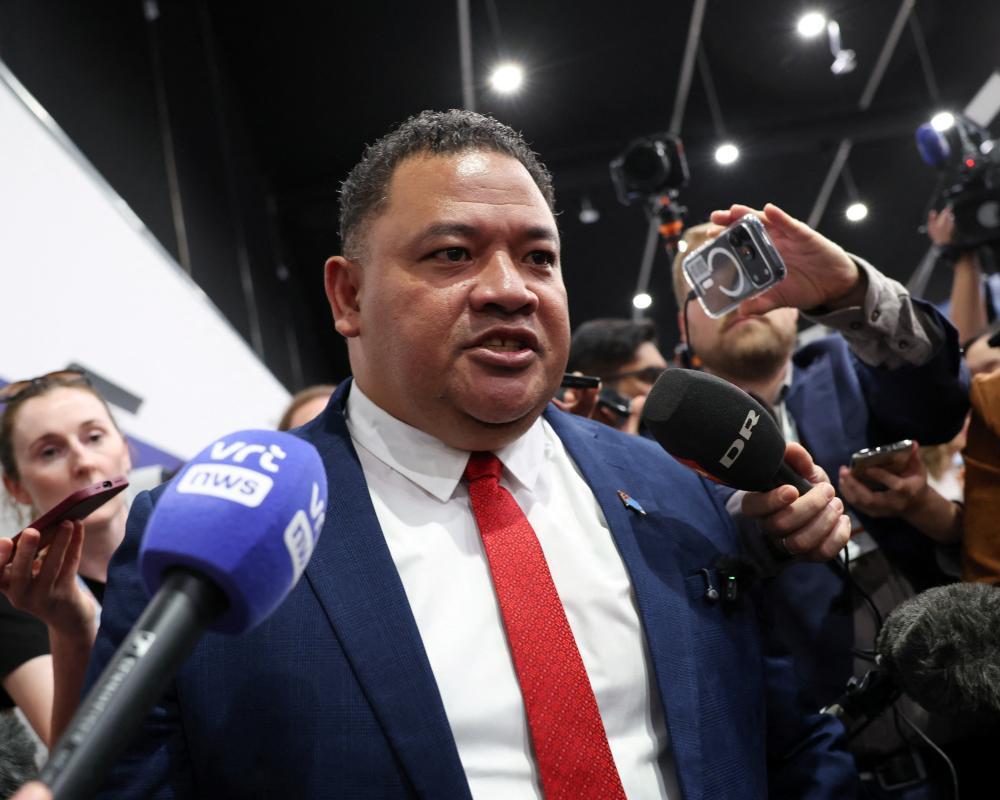
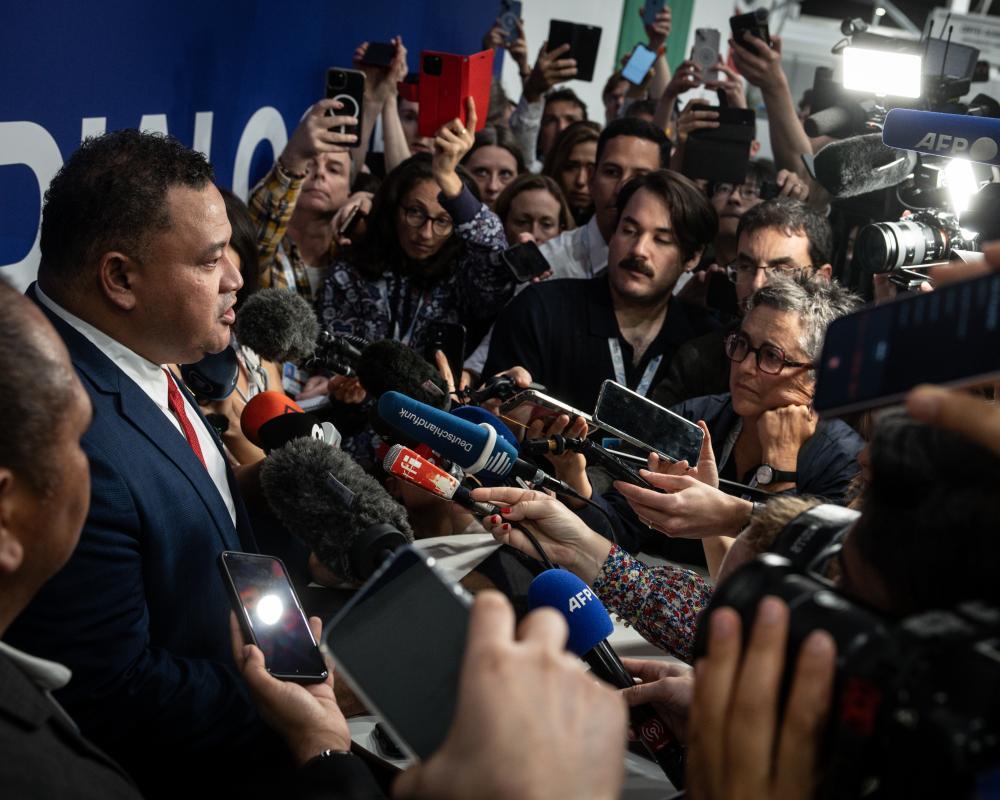
The Tuvalu climate minister, Dr Maina Talia, has just been speaking to reporters in a very tight huddle in the media centre here.
“My goodness,” he exclaimed as the microphones were thrust within an inch of his face.
But he was here to make a point.
“Every year there seems to be greater discontent, mistrust and frustration from civil society and the countries that are most climate-burdened, vulnerable, and faultless,” he said.
Talia said it was normal for Cop meetings to run into overtime, but then challenged any notion that this was just like previous Cops.
You might say, “We have been here before.” But have we? Have we been here, beyond the 1.5C safety limit in the territory of overshoot?
Have we been beyond the tropical coral reef tipping point? Have we seen thousands buried beneath a Himalayan glacier? Clearly not.”
He said the organised efforts evolving outside the Cop process where countries are lining up with roadmaps to exit from the fossil fuel era “has not given up on the [UN climate convention].”
“The [Transition Away from Fossil Fuels] forum is moving beyond debating whether fossil fuels are simply mentioned in a text, to creating detailed plans for a global transformation; governments working together in the spirit of neighbourliness, cooperation and solidarity,” he said.
Tuvalu is due to host the second TAFF meeting next year and he said it would be “a touch point for governments to come together and help each other in building a system free of fossil fuels.”
Does this mean we are happy with the state of the negotiations or accept the lack of ambition we are witnessing because we have an alternate pathway? No. Absolutely not.
It means we will not allow inaction and obstruction to dampen our resolve or slow our progress. We will advance where we can with those that are willing to show up. That is what good neighbours do. That is the spirit of tuakoi.”
Updated
Fiji’s climate minister, Lynda Tabuya, has just told me she has extended her stay in Turkey until Monday, but thinks there is a chance an agreement could be struck late tonight.
She says requests from the Alliance of Small Island States, a negotiating bloc of 39 low-lying countries, to have meetings with the Cop presidency as a bloc are not being met.
The Cop president of negotiations, Australia’s climate minister Chris Bowen, promised a “transparent” process in the run up to, and during, this meeting.
“But [Fiji] are meeting with them anyway two or three times a day. If we had blocs facilitated by the presidency then we could talk this out. We would see that as transparency, but it is not happening here. So we are doing it in our own way.”
She said there had been a proposal from the Cop president to offer some acknowledgement of the process of transitioning away from fossil fuels, but not in the main decision text.
“They should acknowledge that in the cover decision,” she said.
In more reaction to the controversial inclusion of “accelerating carbon capture, utilisation and storage (CCUS/CCS)” in the second draft of the cover text, Dr Matt Webb, associate director, global clean power diplomacy, E3G, also draws on that smoking metaphor:
“Keeping 1.5°C within reach and minimising temperature overshoot requires cutting global emissions rapidly from over 38 billion tonnes a year and it means getting our priorities right. Electrification will slash end-use emissions by 60 per cent in 2035, and wind and solar already avoid 65 times more CO₂ than CCUS can capture. By contrast, CCUS handles barely 0.1 per cent of emissions often to pump more oil out of the ground, while gas power with CCUS costs significantly more than solar. CCUS requires strict guardrails so that it is reserved only for unavoidable process emissions like cement. We must advance real dialogue on accelerating the transition away from fossil fuels because relying on carbon capture without phasing down fossil fuels is like trying to quit smoking without putting down the cigarettes.”
And Jasper Inventor at Greenpeace International has commented on the lack of mention of fossil fuels in the latest draft:
“In what alternate world can Cop31 justify deleting reference to fossil fuels when the reality of climate impacts is measured in lives lost? Blame must be laid at the feet of fossil fuel producers. To keep 1.5°C alive, we cannot omit calling out the culprit. There is no excuse for the lack of climate finance from developed countries, but debating fossil fuels away has also become the tragic reality of COPs and this must also be called out.”
Both drafts so far of the potential main outcome from Cop31 – the “cover decision” text – call for “accelerating carbon capture, utilisation and storage (CCUS/CCS)”. Civil society groups have attacked this, branding CCUS a “false solution” that opens a door to the fossil fuel industry, which has touted CCUS as a way of allowing for continued oil and gas use, while investing little in the technologies.
Countries demanding CCUS in the text include the Arab Group, led by Saudi Arabia.
CCUS is an expensive and difficult technology, which has been under desultory stop-start development in several countries for about two decades, without yet being proven as a viable long-term technology on a large scale – but it could be increasingly hard to avoid.
Scientists have warned that CCUS is likely to be needed, if the world is to end the “overshoot” of 1.5C above pre-industrial temperatures. As well as cutting greenhouse gas emissions, it will be necessary to make removals of carbon dioxide from the air, a process known as CDR (carbon dioxide removals). This includes technologies such as “direct air capture” – by which carbon dioxide is chemically “scrubbed” from the air – and also natural methods, such as growing more trees and restoring carbon sinks such as peatlands and wetlands.
CCUS – by which the gas is captured at points where it is emitted in bulk, such as power stations, then either put to other uses or stored underground in suitable geological formations – is likely to form part of this suite of methods. Calculations by the Intergovernmental Panel on Climate Change, the International Energy Agency, the UK’s Climate Change Committee, the UN Environment Programme, and other bodies show a limited role for CCUS in returning temperatures as close as possible to 1.5C above pre-industrial levels.
Johan Rockström, director of the Potsdam Institute for Climate Impact Research, told the Guardian: “This is a delicate issue. The reality is that, whether we like it or not, the fact that we have failed to bend the global curve of greenhouse gas emissions so far, and thereby consumed essentially the entire global carbon budget for a safe landing at 1.5C, even after minimising overshoot, means we have no choice but to also deploy large scale carbon removal technologies.”
He pointed to a common misunderstanding of the nature of “carbon budgets”, which describe how much carbon dioxide can still be safely emitted while staying below a particular global temperature. (CO2 sticks around in the atmosphere for as long as a century after emitted, so the cumulative global emissions are what count, rather than what a particular country might produce in a given year.) Rockström said:
“We often talk of the remaining global carbon budget being approximately 130 gigatonnes of CO2. This is correct scientifically, but this is the net budget. It is not the budget used in climate policy and economics when identifying the most ambitious ‘orderly phase-out pathways’. The most ambitious of these pathways run on global carbon budgets of approximately 400 gigatonnes of CO2, where the increase in the budget from 130Gt to 400Gt is CDR.”
This means that all of the standard models of future emissions factor in a large amount of carbon removal, partly in the form of natural carbon sinks, but also using other methods.
“So we are stuck,” says Rockström. “The only way to succeed in a ‘science-aligned and orderly’ transition is to include carbon removal technologies. Without them, we need to essentially shut down the global economy within a few years.”
He also points to the difference between CCS and CDR, but says we no longer have much choice about using either if we want to keep the “overshoot” as shallow and brief as possible.
My assessment is that both are needed. The problem is that CDR is not regulated, which it should be. And [another] problem is that both CCS and CDR are used [by some] as an offset strategy, to allow for slow or no phasing out of fossil fuels. [That is] unacceptable, completely violating the chances of coming back to 1.5C, as the scenarios clearly show that CDR needs to be additional, not a substitute [for a phase-out].”
There has been a long-running debate over whether “net zero” greenhouse gas emissions, which most countries are now at least nominally aiming for around mid-century, is truly enough, as it allows for carbon sinks and some forms of CDR. Many scientists argue we no longer have the luxury of debating whether we can do without any form of CDR, or CCS.
Rockström adds: “Many are worried that CCS and net zero allow for slower than necessary mitigation [that is, reductions in greenhouse gas emissions]. On the other hand, it is very difficult to see how we can reach absolute zero within 25 years.”
Updated
China is pushing for rapid electrification of its economy using low-carbon energy and will help other countries do the same, a senior member of the Chinese delegation at the Cop31 UN climate summit has said.
Wang Yi, a professor of energy and environment policy at the Chinese Academy of Sciences and a senior adviser to China’s government, said: “End-use electrification is a very clear direction. We can follow this direction while making the source of electricity clean. That’s the way to go forward.”
China is the biggest emitter of greenhouse gases by far, producing more than a quarter of the world’s total, so its push for electrification is significant.
At Cop31, countries are being asked to sign up to a target of deriving 35% of final energy consumption from electricity by 2035. Australia, the president of the negotiations, and the host nation Turkey have pushed the target and on Friday night Australia and China signed a joint statement endorsing the “35:35” goal.
But in the second draft text of the probably outcome from Cop31, released on Thursday, the electrification pledge was downgraded to one of a suite of voluntary options countries can take up to reduce their greenhouse gas emissions.
In an interview with the Guardian at the talks, Wang said: “China will do our best to realise clean end-use electrification, and also help other countries to improve. China has significantly reduced the cost of clean technology and products and we would like to share our experience with other countries.”
Experts have said electrification is the next vital step in the shift to a low-carbon economy, as the only way to diminish the close to 80% of fossil fuels still used for primary energy, mostly for transport, heating and industry.
While civil society organisations want any commitment made on electrification to specify that it must be met from clean sources, a pledge that leaves the choice to countries is likely to have more widespread support, as many – including China and India – are resistant to anything they feel smacks of “top down” interference in national plans.
But campaigners argue that allowing individual countries to decide risks leaving the door open to more gas-fired power plants. Some compromise language is also possible that would urge countries to decarbonise their power.
Related: China commits to low-carbon electrification and help for others to improve
Some climate scientists have been drawing on metaphors on social media to explain their view on the issues driving debate and division at the summit.
Katharine Hayhoe, referring to the second draft of the cover decision which hadall mention of fossil fuels expunged, says:
“A climate deal that leaves out fossil fuels is like a plan to quit smoking that never mentions cigarettes.”
Dr. Jeff Masters, referencing the inclusion of carbon capture in the draft, quotes climate scientist Ricky Rood:
“Imagine your bathtub is overflowing. Water is pouring across the floor. You know exactly what the problem is. But instead of turning off the tap, you announce an ambitious investment in towels. And then decide to install an even bigger tap.”
Although not quite deserted, the halls of the Cop31 conference centre are considerably less peopled today. A few people wander back and forth with their backpacks on. Young Turkish support staff walk around in groups.
It’s possible to find a seat at the tables next to the food stalls. Those, however, are closed, so there is nothing to actually rest on the table except for your laptop.
A profusion of fairly bold flies in some parts of the conference centre seem fitting for what is apparently becoming a “Zombie Cop”.
At 12pm (9am GMT) expectation for the drop of a new draft text has come and gone. That potentially puts the expected 4pm closing plenary under threat. Negotiators will be very tired. Rumour has it that the presidency was carrying out bilaterals with parties until 5am.
Hello, this is Natalie Hanman, the Guardian’s head of environment, taking over the blog from my colleague Bibi while we wait for more updates from the summit …
Civil society is a little thin on the ground in the halls of the Cop31 conference today after 17 campaigners were refused entry.
Everyone attending on a badge linked to Latin American climate organisation Colectivo VientoSur was told they could not attend the UN summit after one staged an unauthorised protest in last night’s plenary.
In the middle of comments by Murat Kurum, Turkey’s Cop president, Amalen Sathananthar, a member of the Artivist Network, stood on a table holding a noose of red rope around his neck and wearing a T-shirt with the message “You are killing the future” painted on it.
“You are killing the future,” he shouted. “Why don’t you just kill me now. The climate crisis is killing us, and you do nothing. You don’t remove fossil fuels, you are killing 1.5C.
“Today is my birthday, the same year I was born, you signed the UNFCCC treaty. Thirty four years later, nothing. The world is collapsing and you keep stalling. You do nothing because you are greedy and cruel old people.
“We inherit the future, not you! Do something! Make a radical change now! If not, take this, hang me now!
“The Global South can’t wait. Save the planet or kill me now. We will all die if you don’t make change.”
The protest has caused some problems for civil society organisations as many members who filled important roles, including coordinators, policy people and communication people, had also attended on Colectivo VientoSur badges.
While authorised protests are allowed inside the blue zone of Cop climate summits, they are tightly circumscribed and must take place at prescribed locations, for limited amounts of time.
Updated
Talks may run late into the evening
I have been talking to a few people here who are close to the negotiations and the Australian presidency about what we might expect today, and the order we might expect it in.
And this is caveated by the truth that big things can shift quickly at Cops.
But I understand a new draft text is unlikely to be released until this afternoon, Antalya time, and then there will be a period of time (this is necessarily vague) for negotiators to analyse it, and then for UN lawyers to check it, before the closing plenary meeting is re-opened.
My sense is that the Australians would prefer that the agreement is pretty much complete before the plenary starts.
This is a long way of saying that a late finish this evening is a possibility.
Updated
The conference centre is a lot emptier, my colleagues report. However the UN photographer roaming the corridors has spotted a very cuddly visitor making the most of all the space.
He (or she) checked out the Moana pavilion too.
We are expecting a third version of the cover decision today, which is likely to be a key outcome of this year’s Cop. The Guardian’s environment editor Fiona Harvey has dissected the most recent draft to help you know what to look out for when the next one drops.
Related: Cop31 draft climate text dissected: what it says and what it means
This could be one of 'most disappointing Cops' ever, warns civil society
Civil society organisations wrote to Cop31’s joint presidents, Chris Bowen and Murat Kurum, overnight to tell them they had hours left to avoid making it “one of the most disappointing Cops the UNFCCC has ever had”.
“The Global South is being abandoned,” they told the presidencies. “Developed countries have blocked progress across the negotiations and arrived with no new finance commitments.”
The draft cover text “is a gift to the fossil fuel industry”, they went on. “The major cause of the climate crisis – coal, oil and gas – fails to rate a mention.”
In sum: “It has all the hallmarks of a deal to let carbon capture through in exchange for an electrification target that does not even require renewables-based electricity or ensures access for the people who need it most. None of this is defensible.”
The letter is co-signed by 100 different environmental organisations, from the Africa Just Transition Network to Zero Waste Alliance Ireland, and including 350.org, Climate Action Network, Greenpeace International and WWF.
They called on the presidencies to remove targets for carbon capture, restore pledges to uphold the rights of indigenous peoples and include measures to make rich countries accountable for public climate finance. They called for the summit to explicitly welcome the advisory opinion by the International Court of Justice that states have a duty to protect the climate.
And they demanded that a link was drawn between the summit’s goal on electrification and the generation of energy from renewable sources and the transition away from fossil fuels.
“Without this link, the target risks supporting additional electricity demand while leaving fossil fuel dependence intact,” the letter said.
“In addition, we ask you to take forward the Cop30 roadmap on transitioning away from fossil fuels, with the Cop30 and Cop32 Presidencies, through to the second Global Stocktake external to the consensus process, as a Presidency-led dialogue.
“Otherwise Ethiopia will unfairly be left to carry the burden of your failure into Cop32.”
Updated
Summary post
A quick summary of where we are as the summit heads into overtime:
-
There have been two draft texts published. The first one included pretty much everything anyone wanted. The second one, which was just half the length, stripped most of it out again and was widely seen as a huge disappointment.
-
Panama sent a letter to the Cop presidency on Thursday warning that it would block any deal that did not include its eight requirements which include real transparency, new rules of engagement, and a cap on oil production, among other things.
-
African ministers came together to warn the summit that rich countries were undermining the process, trust and credibility of the UN climate summit process by failing to live up to their commitments under the Paris agreement.
-
Numerous countries have demanded that “transition away from fossil fuels” must be returned to the text.
-
Civil society activists called Antalya 2026 the ‘worst Cop ever’
-
China appeared to endorse the Cop Presidency’s flagship electrification pledge.
Now we are waiting for the latest draft texts to arrive to see if any progress has been made.
Updated
As the talks continue into overtime, my colleague Fiona Harvey has written this useful explainer on what is required for a final decision to go through.
When a final decision is made from Cop31, it will require “consensus” to be gavelled through and become official. But the meaning of consensus within the UN Framework Convention on Climate Change is not always well understood.
Consensus means that the result has been thrashed out by all parties and that the strong feeling in the room is that it should be accepted. Consensus does not mean unanimity. Not every country has to agree for a Cop decision to be passed.
“No country has a veto,” one Cop veteran said. “It’s wrong to think that one country can hold up everything.”
This is important: at many Cops, there have been last-minute objections by a small number of countries, which have been overridden. For instance, at the Paris summit in 2015, a handful of countries including Nicaragua, Cuba, Bolivia and Venezuela were unhappy with the deal, but it was gavelled through. India raised objections in the final plenary of Cop29 in Baku in 2024, but the final deal was done.
The convention of consensus reflects an early Cop in the 1990s when Saudi Arabia and its allies in the Arab Group strongly objected to an outcome that the rest of the world favoured. They were named in the subsequent outcome of the Cop as having objected, and the countries then realised that they preferred not to be singled out as standing against progress on the climate crisis.
Although consensus can be difficult to achieve, and some complain that the result is heavily compromised, it also gives a greater authority to the outcome than any majority decision could do. The universality of Cops is one of their key advantages – if some countries were to break away, it would diminish the authority of Cops, and make it more difficult to forge a unified global approach to a global crisis. As another Cop veteran put it: “All countries feel the impacts of the climate crisis. We are all in this together.”
Good morning. Cop31 officially ended yesterday and we are now into overtime. Last night delegates were told to go home and come back in the morning. New draft texts were expected at 0900am local time – but that time has come and gone, and there is nothing to be seen.
I’m Bibi van der Zee, helming the liveblog this morning, and we’ll be following developments this morning as they happen.