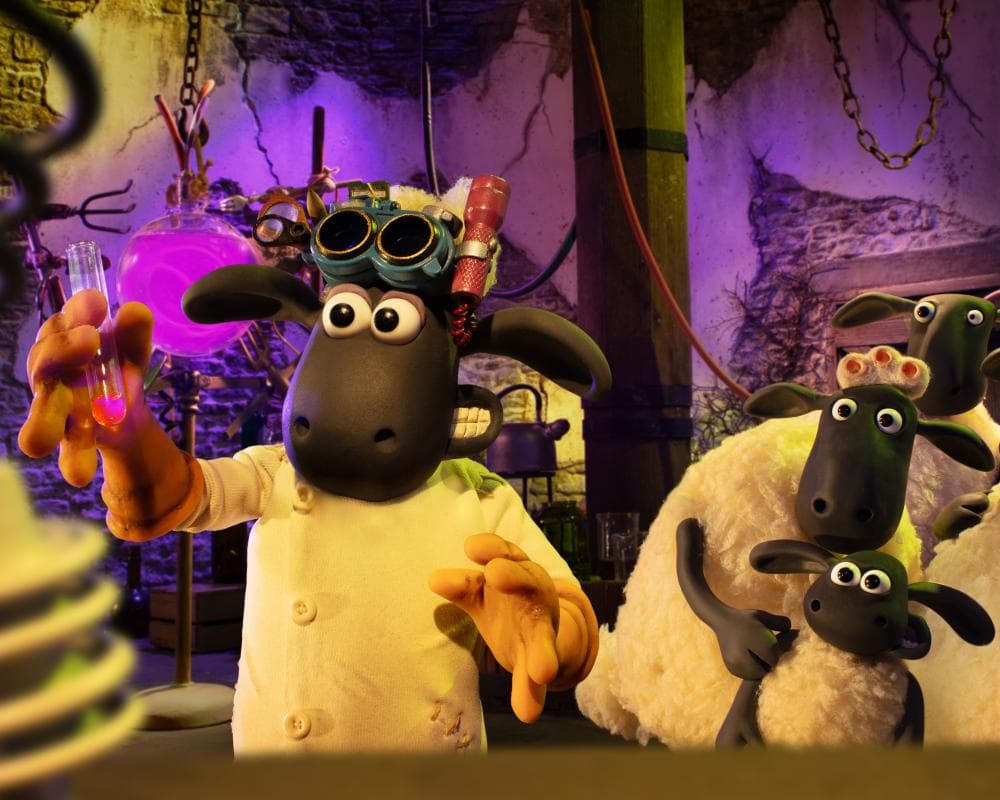
The Aztec West industrial estate in Bristol was opened by Margaret Thatcher in December 1989. One hundred and sixty acres of breeze block and mirrored glass, it is home to about 7,000 employees and 100 companies, including EDF, EE, HSBC, Co-op Legal and Spandex. It has its own gym, spa, church and morgue. Step inside Unit 1410, though, and bucolic England is magically restored. A farm complete with sheep. Rolling fields in autumn colours. A small parish town boasting post office, war memorial, chippy. It looks lush. But before you hit up Rightmove, I should say: Mossingham is only two feet tall. And plasticine.
It’s January 2026 and Aardman animations are about halfway through production on Shaun the Sheep: The Beast of Mossy Bottom. The 300-odd staff in this shed are full speed ahead – which means each of the 30 animators is rattling out almost two seconds of footage a day.
The studio’s only perk is a ping-pong table – toasties have to be paid for
They work across 40 sets, each accessed through black floor-length curtains, like a weird A&E. On trolleys lie palette knives and small suitcases containing body parts – 20 mouths that can be inserted into Bitzer the dog’s head, for instance – as well as character “bibles” with guidance on optimum ear angles and kosher nostril widths. The atmosphere is hushed but not silent. The process is to photograph 24 frames per second, infinitesimally manipulating the models between snaps. Sound comes much later. Dialogue – never. When they made the first Shaun the Sheep movie, back in 2015, Aardman had to decide whether to go full later-Tom-and-Jerry and have them talk, or fall back on decades of silent movie heritage. They chose wisely.
I’m on a tour of the studios with a group of European journalists. We observe the puppet construction process, from skeleton to wardrobe. There’s a new character in this film: a female vet, the love interest of the hapless farmer. Her dreadlocks were originally a steel scourer, but this had to be ditched for torsion reasons – a shame, as Aardman like repurposing everyday objects (clingfilm, tinfoil, lentils). Is there anything off the shelf used on Mossy Bottom? They think. Just one thing: K-Y Jelly – for tears.
We’re invited to cop a feel of the titular beast, matted orange hair stiff as a boot brush. It’s a conscious aesthetic, so the fibres don’t move between shots. This is in contrast to the stop-motion done by Wes Anderson on Fantastic Mr Fox and Isle of Dogs, which embraces “boiling”: the impression of fur being in constant movement. Any wiggle is forbidden here.
Then we mould our own Shaun heads, steered by an expert. It’s far harder than expected: much gouging, plus the clay is tough to knead. That quality with which Aardman is most associated – “thumbiness” or the imprint of actual hands – involves considerable pressing. My finished head is horrible and I don’t take it home. My son would bawl at the deformity.
Mossy Bottom is a horror movie. Or, at least, a horror for those with a 7.30pm bedtime. Scares have been softened. The first version of a home invasion sequence was, says co-director Matthew Walker, “too intense”. There remains a Psycho allusion, as the flock cower in the shower, but the Bernard Herrmann-ish strings are explained by a shot of one sheep flossing their teeth. Other inspirations include Nosferatu and Frankenstein, The Shining and Weird Science. But the makers were eager to rein in references that would only be funny if you were old enough to get them.
More careful balancing was needed when weighing the needs of the domestic and international markets. Perhaps because of its lack of dialogue, Shaun has the broadest appeal of all Aardman properties. Its seven-season TV show has sold to more than 170 territories; there are Shaun theme parks in Japan, Sweden, New Zealand and Australia, as well as an unofficial Shaun the Sheep restaurant in Dubai (the menu majors on offal).
Sometimes overseas concessions are conscious, says Giles Pilbrow, who co-wrote Mossy Bottom as well as the 2021 Christmas special, whose gingerbread house was a nod to the German fanbase (they have, apparently, co-opted the farmer as Bavarian). But there are also some very domestic gags: a sudden blast of The Archers, a scene in which ever-cautious Bitzer delays a car chase by putting L-plates on his vehicle (not every country uses them).
For Pilbrow, who cut his kids-TV writing teeth on Horrible Histories, geography is baked into sensibility. “We all grew up reading the Beano and watching Morecambe and Wise. And it’s those cultural touchpoints that give Shaun its flavour.”
Aardman – founded in 1976 by Peter Lord and David Sproxton, then supercharged by the arrival of Nick Park in 1985 – celebrates its 50th birthday this year. It is one of UK film’s most endearing success stories: four Oscars, 18 Baftas, and counting. Its first film, Chicken Run, is still the highest-grossing stop-motion movie of all time, while Wallace & Gromit: Vengeance Most Fowl became the BBC’s most-watched scripted show in two decades when it aired on Christmas Day in 2024.
A new installation is about to open in the Lightroom in Kings Cross; a retrospective at the Young V&A was a proper blockbuster. Its curators reported visitors coming to London just for these, from all over the globe. But with great soft power comes great responsibility. “We’re very rigorous in making sure Shaun is morally sound,” says co-director Steve Cox. “We’re aware that every decision we make will be seen by millions of kids and they will be influenced.” They’re scrupulous about making Mossingham modern and inclusive – notably more so than the fictional Wigan of Wallace & Gromit.
Mossy Bottom features a gay wedding, an Amazon delivery and a cast selected from what Cox calls “a library of characters of shapes and sizes and ethnicities”. The directors had a wobble when they realised one plot point involved Shaun texting the vet for help using emojis. “That was quite a big step for us,” says Walker. “But it’s how the world works.”
Meanwhile the farmhouse now boasts solar panels, although its owner’s business model seems as opaque as ever. Yes, there’s some arable pasture, occasionally ploughed, but the livestock are not visibly milked, bred or slaughtered. The odd slapstick shearing is as commercial as it gets. “I don’t think anyone knows how the farmer makes the money,” says Walker. “We’ve never really used Shaun to explore the realities of farming.”
Yet other contemporary concerns do seem to have wormed their way in. The story starts when the farmer – nervous about asking the vet out on account of his bald spot – douses himself in hair restorer (in an ominously similar bottle to Shaun’s genetically enhanced mega-grow pumpkin potion). Cox and Walker demur on whether it’s a cautionary tale about cosmetic interventions – it’s more about what happens when you mess about with nature more broadly. “Shaun is trying to grow these pumpkins using dark science,” says Walker.
And, they continue, the real problem is Shaun trying to do everything alone and not lean on the flock for support. “He’s got main character syndrome,” says Mark Burton, Pilbrow’s co-writer and an Aardman veteran. “That idea that he’s the hero and got to fix everything by himself. That becomes an obsession and he kind of goes to the dark side.” A useful message for an atomised generation prone to bedroom myopia – but perhaps also salutary for an age of strongman leaders? “Definitely,” says Walker. “There’s certainly people in the world now who don’t listen to anyone else.”
“I mean,” says Burton, “I don’t know if Pete Hegseth’s going to watch it.”
“Yeah,” says Pilbrow, “It’s a bit too intellectual for Pete.”
The film also engages with the rise of populism. The final reel involves that Hammer horror staple: a mob waving pitchforks and placards in an attempt to banish an outsider. Resonance with today’s political climate was, says Walker, “something we were aware of and discussed. We wanted the mob to feel like they’re kind of chasing this monster due to a misunderstanding. It wasn’t a deliberate pointed commentary on immigration but it was certainly something we were conscious of.”
Cox nods. “You see it all around you: people joining in without even knowing what they’re joining. So that feeling was easy to recreate.”
And how about the monster itself? Chunky, marauding, weirdly stiff hair – and there’s that colour. Pilbrow considers. “Bad hair, bit orange,” he nods. “But our monster is lovable and misunderstood. I don’t think that sums up Trump.”
My time at Aardman is at an end. It’s time to step outside, on to the tarmac, past the Perspex shelters and wet picnic benches. Time inside Unit 1410 can feel like being part of a really genial cult: a muted, tattier version of Pixar HQ in San Francisco. While that campus is all bright colours and Segways and yellowtail on tap, at Aardman there’s one ping-pong table and you pay for your toastie. Yet there remains the sort of brand immersion that makes you wonder if working there full-time could trigger an allergy to recreational plasticine.
Do they ever feel as if they’re going mad? No, no, they all insist. The building can have its “challenges”, concedes Walker. But these, says Cox, just add to the sense of achievement. “What you see on screen is only what the camera is pointing at: a beautiful set with amazing characters and lighting. And just off the edge, either side, there’s a mess: brooms, graffiti on the walls where people have scribbled notes, junk everywhere. Chaos around this little square of perfection.”
• Shaun the Sheep: The Beast of Mossy Bottom is released in the UK on 18 September