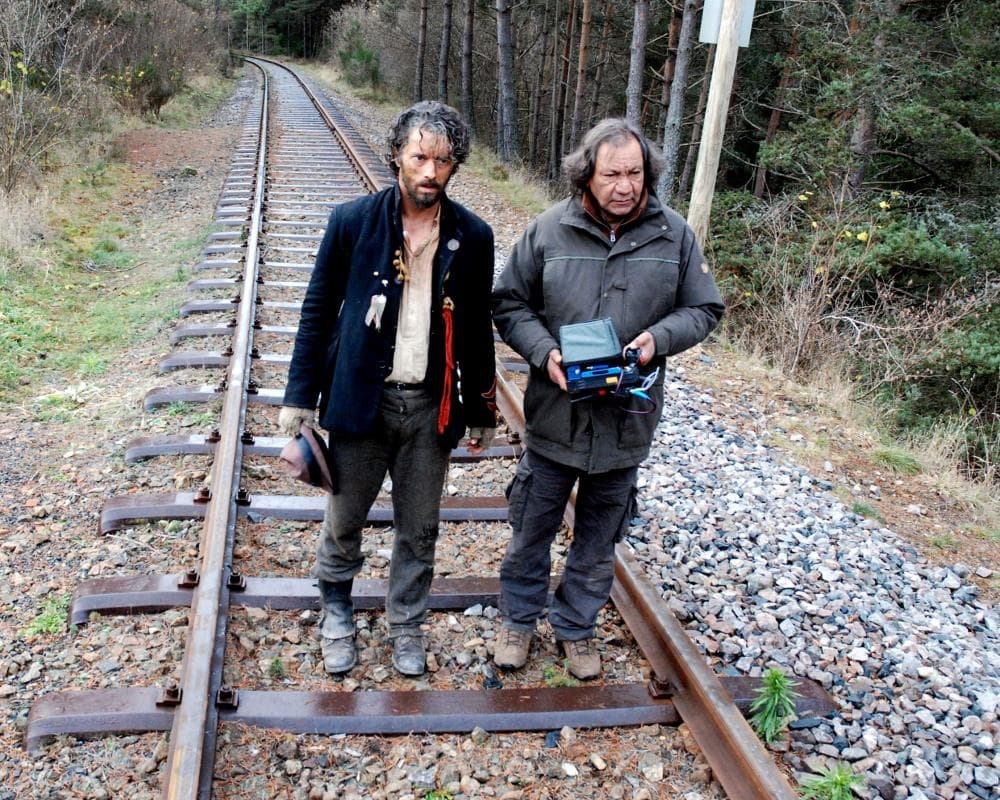
The French film director Tony Gatlif, who has died aged 77, was regularly described as “cinema’s Gypsy auteur”, so often did his films focus on Roma communities and their music. Between 1975 and 2025, Gatlif directed more than 20 films, beginning with La Tête en Ruine (The Ruined Head). That film was never released, and he struggled throughout the 1970s and 80s to get funding for his films, and then to find a distributor, before finally breaking through with Latcho Drom (1993, the title being Romany for “good journey”). An international arthouse hit, Latcho Drom is a meditative travelogue that blends footage of staged musical performances in contemporary Roma communities in Istanbul, Romania, Hungary, Slovakia, France and Spain, with historic recreations of such communities in Rajasthan and an Egyptian oasis.
Latcho Drom conveys the centuries-long migration from Asia to western Europe of a nomadic people we now call Gypsies or Roma, as a fable told entirely in images and music. There is no voiceover, talking heads or text; instead Gatlif lets the striking settings and musical performances enchant viewers. It is an idealised portrait of the Roma, not a documentary (as some labelled it), and while Gatlif portrays the discrimination and persecution Roma communities experience, his emphasis was on celebrating Roma beauty and artistry.
After the success of Latcho Drom, Gatlif went on to write and direct a feature film every couple of years, his most recent being Ange (2025). These films were all dramas and tended to focus either on a Roma community – Mondo (1995), Gadjo Dilo (1997), Vengo (2000), Swing (2001), Korkoro (2009) – or were road movies in which the protagonists drift across France, then head into eastern Europe or North Africa, seeking meaning and origins. His 2004 film Exils won Gatlif the best director award at the Cannes film festival.
He was born Boualem Dahmani in Algiers, when Algeria was a part of France, to a Kabyle (Berber) father and a mother of Spanish and Roma heritage. His impoverished family lived in a shantytown on the outskirts of the city, he said, until 1960 when, with the Algerian war of independence raging, they joined a huge exodus of French Algerians in relocating to the south of France. A troubled adolescent, he regularly got into fights and engaged in antisocial behaviour, which led to him being sent to a reform school.
He began using the name Tony Gatlif – choosing the surname from a local park in Algiers – so as to avoid the police in the Camargue region, who knew Dahmani too well. A meeting with the actor Michel Simon in 1966 led to Gatlif enrolling in a dramatic arts course in Saint-Germain-en-Laye, outside Paris, after Simon wrote a letter of recommendation.
Gatlif worked as a jobbing actor while writing scripts for his prospective features. His second film, La Terre au Ventre (The Belly of the Earth, 1978), focused on a young mother and her four daughters, all dispossessed from Algeria. His third, Corre, Gitano (Run, Gypsy, 1981), was filmed in Spain and focused on a young Roma man accused of a crime he did not commit.
Gatlif had now found his subject matter and rarely swayed from it thereafter. Les Princes (1983), about a petty, patriarchal Roma criminal living in a French housing estate, won him some attention, but it was Latcho Drom that established him as a film-maker of note. The film won the Un Certain Regard award at Cannes in 1993, and a growing interest in Gypsy music created a sizable international audience for Gatlif’s films.
Gadjo Dilo (Crazy Foreigner, 1997) focuses on a young French man who drifts into a Romanian Roma community, begins a relationship with a Roma woman, then witnesses an anti-Roma pogrom. Providing career-defining roles for Romain Duris and Rona Hartner, Gadjo Dilo did so well that Gatlif cast its two young stars in his next film, Je Suis Né d’Une Cigogne (1998, Children of the Stork), a road movie heavily indebted to Jean-Luc Godard’s 60s films, which received negative reviews and poor box office.
He returned to the Roma with Vengo and Swing, set in Spain and France respectively, films that focus on flamenco and Manouche jazz musicians, with threadbare plots tacked on. Gatlif’s skills as a scriptwriter were marginal and the narratives of these two films, and two later road movies, Exils (again with Duris, this time heading to Algeria) and Transylvania (2006), are often clunky, no matter how striking the setting and music. Korkoro (2009), a period drama about the Nazi persecution of Roma in occupied France, laboured to convey the Porajmos (the Romani Holocaust) convincingly.
Gatlif remained indifferent to such criticisms and continued making films his way, even if audiences diminished in recent years. In 2015 he was made a chevalier de la Légion d’honneur. He was taken ill and died in Arles, southern France, while working on a film.
He is survived by his wife, Delphine, and three children, Elsa, Valentin and Lucia.
• Tony Gatlif (Boualem Dahmani), film-maker, born 10 September 1948; died 2 September 2026