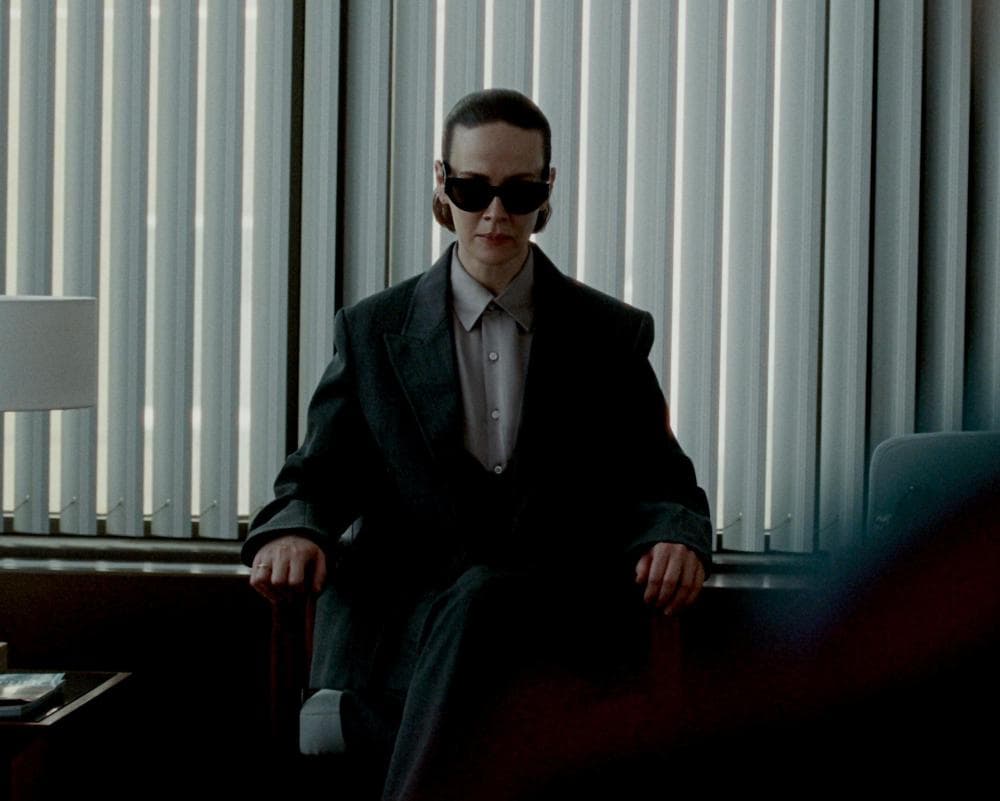
There are three relatively substantive roles for female actors over the age of 50 in actor-turned-film-maker Cody Fern’s talky drama Closing Night. It’s a sadly impressive feat even at a time when the industry has slowly become more aware that women don’t get sent to a farm upstate after their 40th birthday.
Related: Everybody Wants to F*ck Me review – Taron Egerton is hounded in sharp-toothed dating nightmare
Instead they usually get sent to work with Ryan Murphy on television and his shadow looms over Australian actor Cody Fern’s debut as writer-director. Fern worked with him on three seasons of American Horror Story and one of American Crime Story and while there are many legitimate criticisms to be levelled at Murphy and his specific brand of sensationalist television (reaching a new low with last year’s criminally awful legal drama All’s Fair), he has continued to provide sustained work for many women who had otherwise been put out to pasture by the industry. For Closing Night, Fern has recruited Sarah Paulson, who once said she owes Murphy “everything” after super-sizing her career, Naomi Watts, who has now starred in four Murphy shows, and Dianne Wiest, who despite winning two Oscars has admitted she has struggled to financially sustain herself with the amount of work she has been offered.
It’s a considerable pleasure to see them power a film premiering at Toronto, the kind of sell that might have been more common back in the 40s or 50s when women’s pictures were being routinely produced by studios. But while the women all bring their A-game, the film isn’t even close to their level, like inviting three Olympian sprinters to run laps around a gravel pit.
On paper at least, it offers the potential for fireworks. Paulson is Sandra Vale, an acclaimed actor about to kick off a Broadway run as the lead of Mother Courage. She has invited her estranged sister April (Watts), mother Diane (Wiest) and nephew Theo (Euphoria’s Toby Wallace) to watch with Theo’s secretly pregnant girlfriend Lucy (Odessa A’zion) tagging along. But Diane can’t leave the salon back in Michigan and April is already unravelling, arriving at Theo’s apartment in a state, suggesting they do anything but see the sister she still hasn’t forgiven for sleeping with her boyfriend three decades ago. Theo convinces her to go and once at the theatre, Dutch courage convinces her to stay but mid-performance, after a shaky rehearsal, Sandra forgets her lines and collapses. At the hospital the sisters reunite and while April remains in town, Sandra receives a devastating diagnosis.
There’s the initial promise of something grittier, closer to John Cassavetes’s similarly titled Opening Night, also about an actor going through a crisis surrounding a Broadway premiere, but Fern’s psychological insights are far too limited and his plotting far too creaky. One then hopes for something campier or juicier, especially given Fern’s Murphy tutelage, but there’s not enough acid to his dialogue, co-written by former child actor Devon Bostick, or bite to the ensuing confrontations which all play out closer to something from a daytime soap. It ultimately becomes something closer to a Pedro Almodóvar melodrama but without the meaningful life experience threaded through which downgrades it to something Xavier Dolan might have made back in the day, the film perhaps best described as what his remake of The Room Next Door might look like without his terrible needle drops. Like that film, it progresses into a more morose drama about dealing with illness, death and how to plan the end of a life.
Given the ingredients, it’s tempting to wonder what someone like Murphy could have done with the same material. He might be a hit-and-miss provocateur but he does know a thing or two about capturing an audience’s attention and while Fern might have inherited his respect of older female actors who might not be respected enough elsewhere but he’s learned little else. Paulson, who recently revealed she has rarely been offered major film roles even after her award-winning run as Marcia Clark, clearly relishes such a grand opportunity and even if it affords here more screentime than real emotion to play with, she does an excellent job at strenuously raising the bar for Fern’s writing to try and meet her. It’s also a great mode for Watts, an actor who works extensively yet can’t always find the way back to her sweet spot. Even at this festival, she’s miscast as a secret Nazi home-maker in The Housewife, another middling Canadian drama. As a spiraling Michigan mum, she’s a surprisingly comfortable fit and in her moments of tear-strewn, red-faced mania, she recalls one of her finest roles back in 21 Grams. But again it’s all down to her performance with very little interesting character work on paper. She’s painted in the broadest of midwest brushes and even Fern’s attempts to add idiosyncratic detail, like her random urge to steal small things, feel cribbed from the most obvious of playbooks.
Fern just doesn’t seem to know the right balance between camp theatrics and serious, of-this-world drama. As fantastically fun as Wiest might be as a cruel, fur coat-wearing alcoholic salon owner, she’s less real person and more “wouldn’t it be fun if?” future Halloween costume. If the slightly juiceless conflict-heavy family drama doesn’t cut as deep as we like, there’s at least a frantic energy to these scenes (A’zion once again is an actor who excels under that sort of pressure). But when the film leans fully into glum end-of-life territory, Fern can’t conjure the tears that such a monumentally sad story like this desperately deserves, as if the dolls we had seen him play dress-up with suddenly came to life. Closing Night is heavy-lifted by three incredible women but dragged back down to Earth by the man who brought them together.
Closing Night is premiering at the Toronto film festival and is seeking distribution