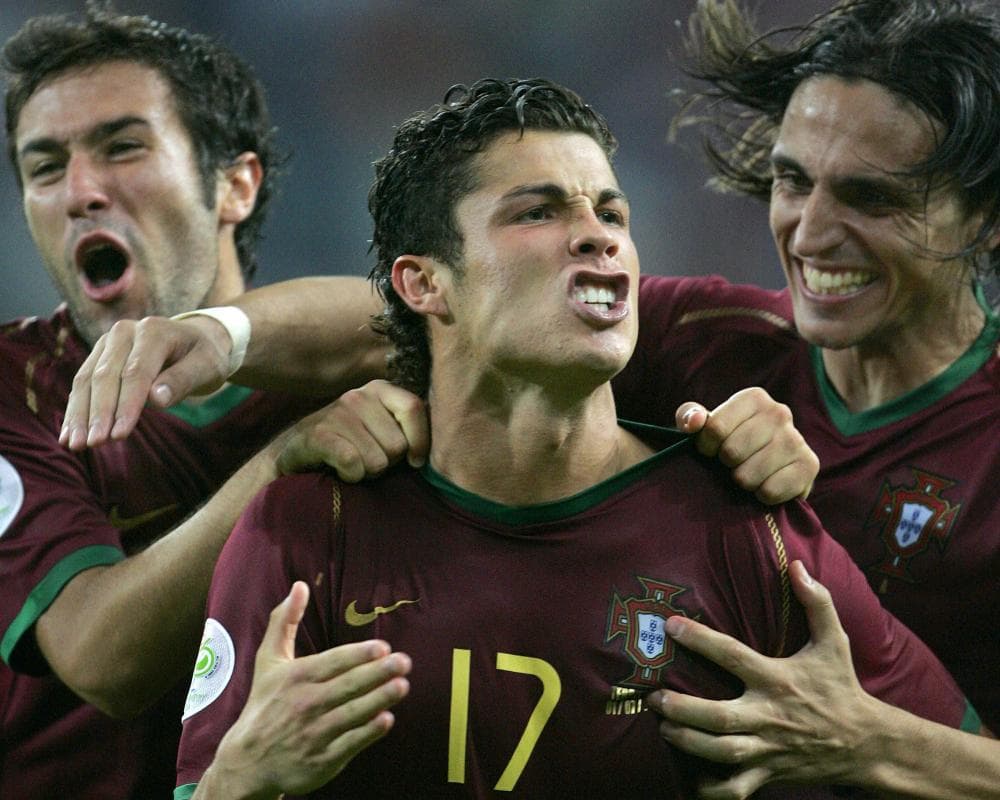
Nothing, perhaps, is quite so difficult for an elite sportsperson as timing their exit. It’s not easy for any person in any job to weigh the hope of having more to give with the desire not to linger beyond their usefulness, but it’s perhaps particularly hard for top athletes because unrealistic self-confidence is so essential to their success. It takes an almost unhealthy level of self-belief for anybody to make the sacrifices to get to the top, to dedicate themselves to such a precarious vocation, to overcome all the setbacks and injuries and failures. How can someone – whose whole life has been spent assuring themselves there are no odds they cannot overcome – accept that is it, that the time has come to say goodbye?
The news that Cristiano Ronaldo has retired from international football brings with it, inevitably, a sadness. Sadness we will no longer see him skipping past a defender, or burying a neck-thrusting header, and sadness in that the end of the career of any great is a reminder of mortality; all things in time must pass. But there is also a sadness he timed his departure so badly. For at least three tournaments, there has been a sense of Ronaldo holding Portugal back.
At the 2022 World Cup, Fernando Santos belatedly took the decision to leave Ronaldo out for the last-16 tie against Switzerland. Portugal suddenly had a fluency and fluidity they had lacked for years and the player who had replaced Ronaldo, Gonçalo Ramos, scored a hat-trick. That seemed incontrovertible evidence the end was upon Ronaldo, or at least his role might become that of an impact substitute.
But even in the final minutes of that game, half the crowd were chanting for Ronaldo. Some, perhaps, were Portuguese fans but many were tourists. They didn’t care much about the result or who went through, they just wanted to see the famous man do the famous thing. Near the end, he scored a goal that was obviously offside. He knew it was offside, but he also knew what his public wanted. So he did the “Siuuuu …” celebration and was rewarded with the biggest cheer of the night. This was like seeing late-period Elvis in Las Vegas: it didn’t matter he was no longer the singer he had been, he was still Elvis. It’s just that Elvis wasn’t also carrying Portugal’s World Cup hopes on his rhinestoned shoulders.
When a player has such celebrity status, when he is still somehow the show no matter how sluggish his movements, making that decision on when to quit must become even harder. And Ronaldo, with his status as Portugal’s greatest soft-power export, also became a political issue. A cabinet minister publicly said he couldn’t be dropped because of how much revenue he generated and what he meant for Portugal’s brand. Portugal is not a country replete with global superstars.
Ronaldo hung around at Euro 2024, weeping after missing a penalty against Slovenia, the magnitude of his fame and ego warping perception so everything became about him, no matter how many other hugely gifted players were in that squad. And implausibly he was still doing it at the World Cup this summer: gumming the mechanisms, constantly demanding the ball, occasionally drifting out to the left to get in Rafael Leão’s way. At one point against Spain in what turns out to have been his final World Cup game, Ronaldo was released on the break but, lacking pace, ended up having to turn back and play the ball to his full-back, the opportunity gone. There was something almost painful about seeing a player once so explosive reduced to this.
There needed to be some sort of intervention. This generation of Portuguese players, who really should be challenging for major honours and not just the Nations League, could not continue to struggle on with such an albatross around their necks. It came from Jorge Jesus, the admirably forthright 72-year-old national coach, who was appointed after the World Cup. He didn’t bring Ronaldo off the bench in the second half of a tight game Portugal ended up winning against Norway. Ronaldo insisted he had been promised minutes – but even if there had been an agreement, it would be absurd to refuse a coach the capacity to adapt to circumstance – and stormed out of the camp, an indication perhaps of how his self-regard had come to distort his judgment.
And, assuming this retirement isn’t some sort of power play to force Jesus out, that is where it ended, with a €255 (£212) fine and 30-day ban over a period in which Portugal had no games. Ronaldo will go back to the Saudi Pro League to continue his pursuit of a 1,000th goal. He has been an extraordinary player. He will be remembered as an all-time great, vying with Eusébio as the greatest Portugal player of all time, but his legacy is undoubtedly tainted by this protracted farewell, by the sense that a player who at his best could win games single-handed, came by the end to be a burden to his national team. His has been a great career, but it would have been greater had it been a little shorter.