Born Elaine Bookbinder in Salford in 1945, Elkie Brooks is a rock, blues and jazz singer known as the British Queen of Blues. She spent much of the 1960s on the cabaret circuit, during which time she supported the Beatles. She joined Dada in 1970, before forming Vinegar Joe with Robert Palmer in 1971. She went solo after their split, breaking through with Pearl’s a Singer and Sunshine After the Rain, scoring 13 UK Top 75 singles. A celebration of six decades in music, The Long Farewell Tour, is now on the road.
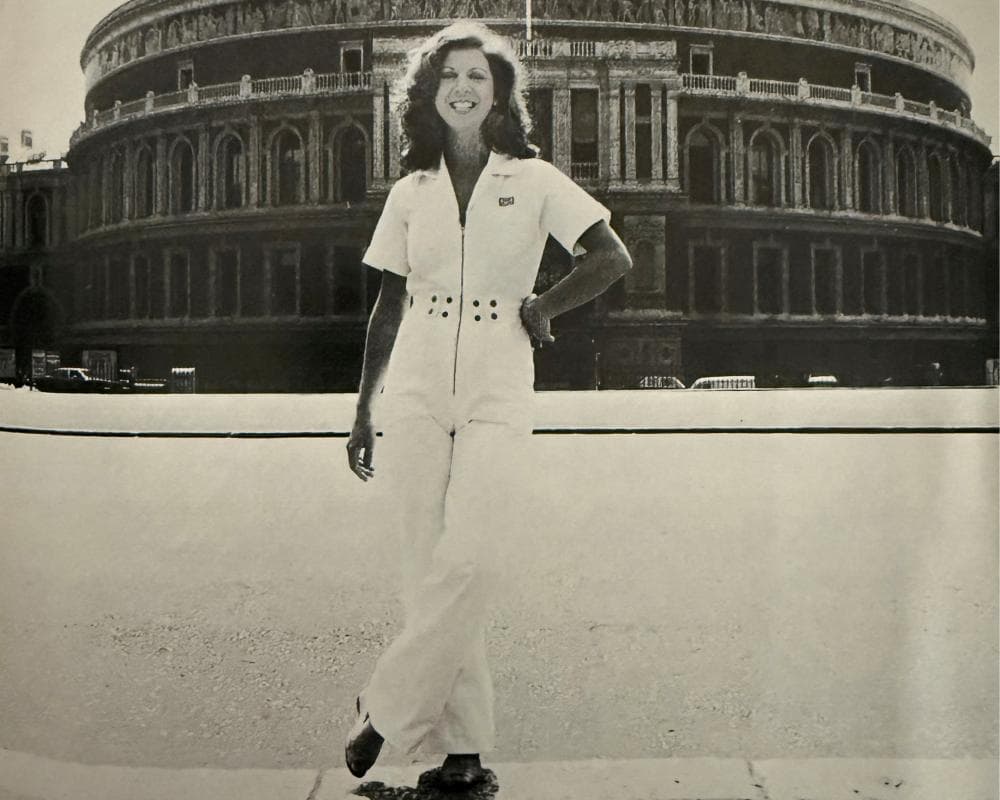
This is me in a white jumpsuit outside the Royal Albert Hall in London. I have very few memories of the gig, but I know I would have felt daunted as it’s such a large venue. To overcome the nerves, I’d have tried to focus on the music and remembered, “It’s just another gig.”
Vinegar Joe had folded three years before. We’d had a fantastic time and it broke my heart when we disbanded as I had thought that it would last for ever. But Robert Palmer decided he was going to embark on a solo career and the rest of the band said, “Oh, well, that’s it then.” It was pretty hard going for me – the only real fallow part of my life. I had a couple of months of not doing very much. Then I got asked to join a band in the southern states of the US called Wet Willie, and after that I started my own solo project. Pearl’s a Singer was released in 1977 and we went out on tour, finishing the year with this Albert Hall show. As the end of Vinegar Joe had been emotional for me, and it had taken many years to get a group of people together who all got on and were brilliant musicians, this day, that gig, would have been quite a moment.
Ever since I can remember, I have been singing, often in the bath, to my mummy. When I was seven I would get invited to sing Mr Sandman with the band that would play at weddings and barmitzvahs. As I got older, I adored Johnnie Ray and Ella Fitzgerald, then Billie Holiday, Sarah Vaughan, Dakota Staton, Esther Phillips and Aretha Franklin. The cantor at the local synagogue used to give me singing lessons, all in Hebrew and Yiddish. He was the one who taught me the correct way to project my voice.
I still train now, which is one of the reasons why I managed to get into this jumpsuit 50 years later
Even as a child I had a low voice. When I auditioned for the primary school choir, I sang All Things Bright and Beautiful. The headteacher, who used to play the piano and lead the choir, said to me, “Bookbinder – you sound like a blinking boy.” Was I embarrassed? Not really. Deep down I’ve always had a reasonable amount of confidence in the fact that I have a natural singing voice. Not the greatest singing voice in the world, but few people practise as much as I do. She let me into the choir, anyway.
My first show was at the Laurent Club on Cheetham Hill Road in Manchester, when I was just 13. I went up with a jazz trio and afterwards the owner of the club said, “Would you like to do a few little songs here every night this week?” A few years later I saw in the Jewish Telegraph that Don Arden, Sharon Osbourne’s father, was holding auditions at the Palace theatre in Manchester one Saturday morning. I went along and sang a Cliff Richard B-side. Don thought I was wonderful and put me on the show that night. When he drove me in his car to another gig, he said, “You can’t be called Bookbinder any more.” Don had Jewish heritage and was obviously concerned that people wouldn’t like me if I had a Jewish name, as there was a lot of antisemitism around. At the next gig, he introduced me as “Elaine Mansfield”, which I hated. I managed to get rid of the name years later: a friend told me that my name in Yiddish was Elkie, so I took that and shortened Bookbinder to Brooks.
For most of my career I have been in a male-dominated industry, but it was never uncomfortable – I was tomboyish and brought up around blokes, as I’ve got two big brothers. The most trying experience of being outnumbered was at the Beatles’ Christmas show in 1964. I was not only the only woman on the entire bill, but in all the production as well. About 200 men, and me. It was bad because nobody took any notice of me, which made me feel dismissed. The fans were all getting ice-creams and walking around the theatre when I played, but when the Beatles came on, the girls all screamed.
The demise of Vinegar Joe was a hard moment creatively, but personally, too, because my first husband had left me shortly before. It wasn’t an easy time and I struggled to think sensibly. I managed to pull through – I always do, because I focus on the music. Where does my strength come from? My mum. She told me she was going to have an abortion when she was pregnant with me, as she didn’t want any more children – she already had two sons and had a few serious health issues. The doctor, a lovely man, said, “It’s going to be a girl. I know you want a girl. Don’t have an abortion. You’ll be fine.” So she had me.
Being on the road in the 1970s was often rock’n’roll – before I went on stage, I used to drink Guinness and a few shots of brandy. These days I like everything in moderation; I haven’t had a drink before going on stage since my eldest son, Jay, was a baby, nearly 50 years ago. Having had so many hangovers in my youth, I now only like a little taste on special occasions. I don’t want to ruin a workout the next day. I’ve always tried to eat well, too. When I was with Wet Willie, they’d always stop off at hamburger places, but if I ate them I’d get pimples on my back, so I realised, “This is not for me.” I haven’t eaten a cheeseburger since 1974. Instead I adore hummus, and fruit and nuts.
I am very active, too. In 1995, I achieved my black belt in karate. I still train now, which is one of the reasons why I managed to get into this jumpsuit 50 years later. I fell through a stage when I was with Vinegar Joe at the Marquee Club in London, and it wasn’t until many years later, when I had an X-ray, that doctors told me I had a fractured hip. Last year I had a hip operation and, blinking heck, I have felt fantastic ever since. I did six backdrops this morning.
Aged 81, this is the best time of my life for many reasons. There were moments when I was young where people were a bit dominating in areas of my work – telling me how I should look or what I should sing – and various people, who shall remain nameless, have tried to knock my self-esteem throughout my career. I never lost it entirely, and always had a strong sense of who I was.
Not only do I feel great, but for the first time in years I’ve actually got a band I like – we all chat to each other, and performing live is a wonderful feeling. I’m thoroughly enjoying myself – and plan to keep doing so.