High above the Dead Sea’s south-eastern shore, pilgrims once climbed to a cave they believed had sheltered Lot after he fled the destruction of Sodom. For centuries the site survived in Christian memory alone, visited by occasional pilgrims such as St Stephen the Sabaite, until the Greek archaeologist Konstantinos Politis, who has died aged 67 following a series of strokes, began excavating in 1988.
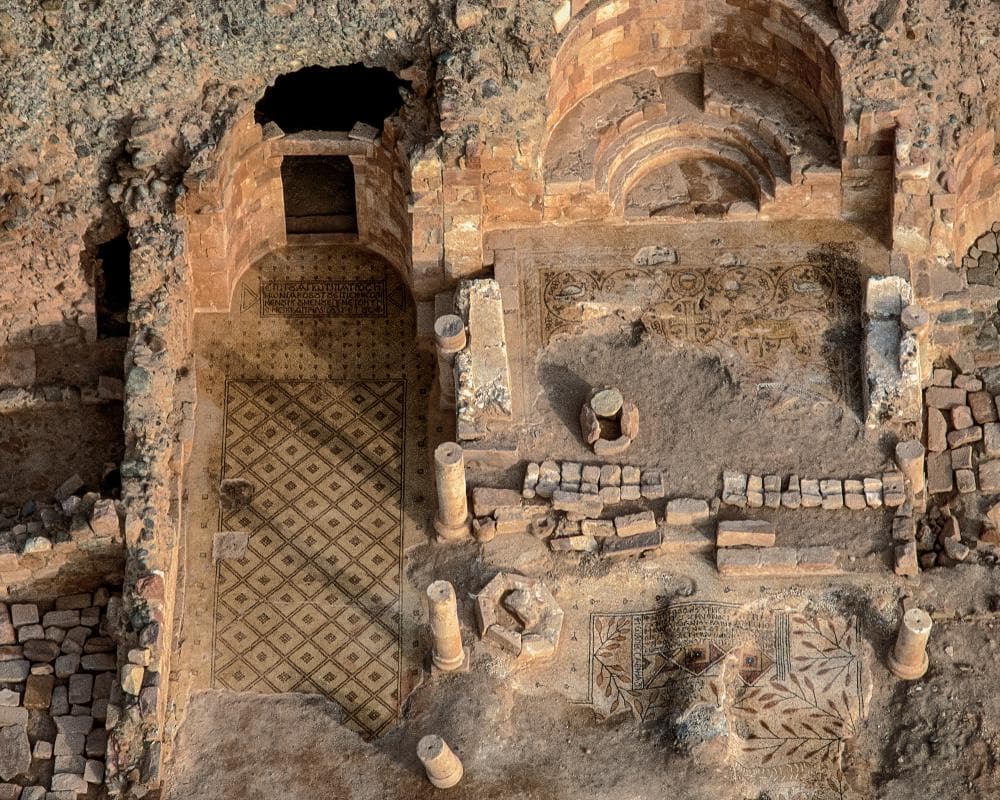
He uncovered a Byzantine basilica built over the mouth of the cave, its floors still adorned with mosaics laid in the sixth and seventh centuries CE. The discovery, at Deir ’Ain ’Abata, gave physical form to one of the Bible’s most vivid stories and set the course for a career spent excavating and protecting the archaeology of Jordan’s Dead Sea shore.
Dino, as Politis was widely known, excavated the Sanctuary of Lot over seven seasons between 1988 and 1996. The site had been identified by an archaeological survey in 1986 as matching a sanctuary depicted on the famous sixth-century mosaic map at Madaba in Jordan, whose location had eluded archaeologists for more than a century.
In a disused cistern Dino found a communal burial of 32 people, all the adults among them male and many with degenerative disease, which led him to identify them as monks and to suggest that the monastery had also served as a hospice for the sick. Beneath the church his excavations revealed evidence of almost 5,000 years of human activity stretching back to the early bronze age.
The church’s most recent mosaic was laid in 691 CE, more than half a century after the Muslim conquest. It names a local bishop, Christoforos, as well as a steward and a governor, and describes the sanctuary as a holy place. Evidently, Christians were not merely worshipping at the sanctuary under the new rulers but still embellishing their church, tangible evidence of the accommodation of Christian communities under early Umayyad rule.
Dino spent nearly two further decades conserving and studying the site, culminating in a major publication in 2012. His work gained international media attention, and featured in documentaries including with National Geographic and the Discovery Channel. In Greece, the national press dubbed him the “Greek Indiana Jones.”
He was never content simply to excavate and move on. As early as 1996 he imagined a museum that would keep the discoveries in the landscape from which they came and, with the Jordanian Ministry of Tourism and Antiquities, worked to make it a reality. The Museum at the Lowest Place on Earth opened to the public in 2012, 405m below sea level. He also helped establish a programme in the museum’s conservation laboratory, bringing international practitioners to train local staff in museological techniques, including object and mosaic conservation.
His instinct to protect threatened archaeology was immediate. In 1996, while travelling to his excavations, Dino spotted bulldozers working in a field near Khirbat Qazone, scattering human remains across the ground. Looters had discovered an enormous Nabataean and Roman period cemetery. He intervened, later recovering one particularly well-preserved body, sometimes described as a “mummy” but in fact naturally desiccated by salt and heat, now held at Yarmouk University in Jordan.
He subsequently spent years salvaging and recording what remained of an estimated 5,000 graves, some containing rare preserved textiles, and among them a woman’s tombstone that read simply: “Afseni, the pretty girl”.
From 1997 his attention widened to ancient Zoara at Ghawr as-Safi. Over the following decades he explored a landscape with a history stretching from prehistory to the Islamic periods, ultimately publishing the results in eight academic volumes. Among his discoveries was the largest known medieval sugar factory in Jordan and Palestine at Tawahin as-Sukkar. It reached its peak output during the Crusader and Mamluk periods between the 12th and 14th centuries, its mills, presses and furnaces revealing the industrial scale on which sugar was once produced beside the Dead Sea.
Even this became a community project. Dino’s research demonstrated that indigo had once been grown in the valley before and alongside sugar. This evidence provided the impetus in 2013 for a Unesco project with the Safi Women’s Association to revive indigo cultivation, which had declined after synthetic dyes reached world markets in the early 20th century. The women dyed textiles with the crop and sold them in the museum shop.
With the museologist Georgios Papaioannou, Dino turned the story of sugar and indigo into exhibitions for Jordanian and international audiences. Supported by USAID and the American Center of Research in Amman, he also trained local community members in the management, protection and promotion of the Ghawr as-Safi archaeological sites.
After Dino’s death, a local resident of Safi revealed that Dino had supported the village in another way, quietly paying for schoolbooks and schoolbags for children at the beginning of each school year.
Born in Kozani, Greece, Dino was the son of Demetrios Politis, an officer in the Greek army, and Christine (nee Biller), a schoolteacher. He was educated in Greece, the US, Belgium and Britain, completing an MA at the Institute of Archaeology, University of London, in 1984 and a PhD in archaeology at the University of Ioannina in 2004.
He first went to Jordan in 1984, working with Alison Betts and Svend Helms at Tell Umm Hammad esh-Sharqiya in the north Jordan valley, and in 1985 joined the British Museum’s excavations at Tell es-Sa’idiyeh, led by Jonathan Tubb. In 1988 he joined the British Museum as a special assistant in the department then known as Medieval and Later Antiquities, which supported his early excavations in Jordan. He also joined the museum’s excavations at Ras al-Hadd in Oman, and remained at the British Museum until 2006.
Dino co-founded and chaired the Hellenic Society for Near Eastern Studies and held research fellowships in Amman, Australia and the US. He co-ordinated a mosaic documentation training programme in Syria from 2004 to 2009, and from 2021 co-directed the Hinterland of Medieval Chalkida project in Greece. He wrote or edited around 100 academic articles and several books, among them The World of the Nabataeans (2007), Holy Footprints Across the Jordan (2010) and Sacred Heritage of Jordan (2024).
I last saw Dino at Ghawr as-Safi in early 2025, only weeks before his first stroke, striding around the excavations and jumping into trenches with typical vigour, in his element in a landscape he had intimately explored and loved for almost 40 years.
He is survived by his brother George.
• Konstantinos (Dino) Demetris Politis, archaeologist, born 18 November 1958; died 11 August 2026