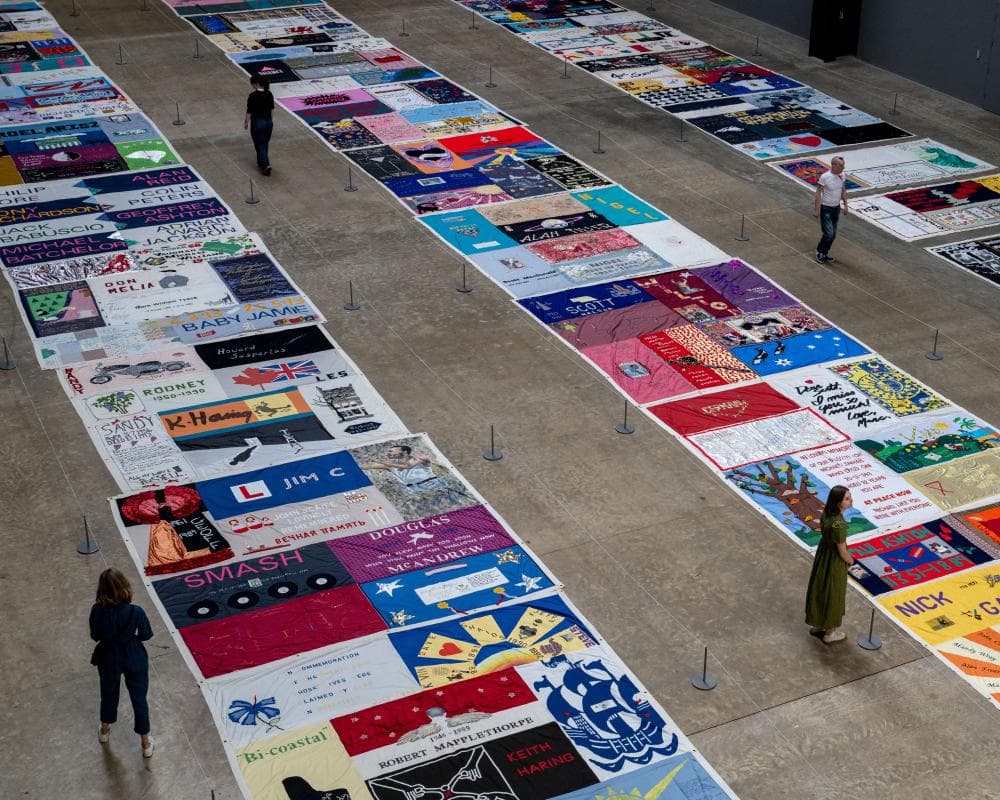
The activist Ally Van Tillo, who has died of chronic obstructive pulmonary disease aged 67, was the founder of the UK Aids Memorial Quilt. It is part of the world’s largest community art project, originating in the US and with chapters around the world, and consists of quilted panels made by friends, partners, family members or colleagues of those who died of Aids-related illness. The Quilt is for commemoration and activism, and against stigma and homophobia.
Ally was born in Gourock, a seaside town in Renfrewshire; adopted as a baby by Elizabeth Taylor, a pianist, and John Hume, an electrical engineer, he was named Alastair Hume. His first years were spent in Gourock, growing up with his younger sister, Vivienne, before the family moved to Edinburgh, where Ally went to George Heriot’s school. He was brought up to be whoever he wanted to be, and, when he was 13, his mother helped him come out.
His first jobs were in catering and bar management, and eventually he opened his own gay bar, Key West, in Edinburgh, in the early 1980s. It was there that Ally first realised regulars were becoming ill and dying.
With friends, Ally started Scots Men, an irreverent newspaper with all the latest news on HIV and safer sex. He also helped set up Scottish Aids Monitor, an HIV and Aids awareness charity, and Milestone Venture Trust, the forerunner to the charity Waverley Care.
In the US, in 1985, the activist Cleve Jones conceived of the Aids Quilt to commemorate those dying from the newly identified HIV/Aids virus, for which there was then no treatment. News travelled, and Ally helped organise quilt-making workshops in Edinburgh, and held an exhibition of panels during the Fringe. This prompted him to visit the US, meet Jones, and learn how to formally make an Aids Quilt.
On his return to Edinburgh, he started the UK chapter. It was hard work, unfunded, with Ally living off benefits. In 1990, he received an HIV+ diagnosis. He proudly appeared on the BBC daytime show Kilroy, facing down hostility from other guests.
In 1992, at a Quilt display in Birmingham, Ally met Ian Webb, who was also living openly with HIV. Their love was immediate, with Ian soon moving to Edinburgh, and the couple dedicating their lives to the Quilt. They spent up to six months a year touring the Quilt around Britain, raising awareness and funds for HIV/Aids charities, culminating in a two-day display of the Quilt in Hyde Park in 1994.
By 1995, Ian’s health was failing rapidly. Ally handed over responsibility for the Quilt, so that he could care for Ian in what seemed his final days. In 1996, new combination therapies made it possible for Ally and Ian to live a full life with their HIV diagnosis. In 2017, they married, both taking the surname of Ally’s birth mother.
In recent years, Ally’s health deteriorated, but he lived to see his work recognised, with the 2025 display of the Quilt in the Turbine Hall of Tate Modern. I was involved in the exhibit and am hugely inspired by Ally and his work. In his last conversations, he spoke passionately about the continuing fight for queer rights.
Ally is survived by Ian and their partner Tobias Allen, and by Vivienne.