At the end of another comically late night and early morning in Flushing Meadows, when the remaining spectators were departing, a familiar scene was unfolding on the US Open tournament grounds. A handful of workers had congregated directly beneath a hole in the ceiling inside one of the tournament shops as they tried to stop water from flowing out of a broken pipe and ruining thousands of pounds worth of merchandise below.
This was not a surprising sight. Upon entering Arthur Ashe Stadium this year, fans were greeted by some ominous signs: “Pardon our appearance while we write the next chapter of Arthur Ashe Stadium.” The tournament’s appearance, it must be said, was hideous. Inside the corridors and rooms at one of the biggest sporting events in the world, it felt like its main building was falling apart.
Related: Dogs, bands and pre-match outfits: best images from the US Open tennis 2026
Seemingly every other day a new leak revealed itself in the media centre, with long plastic sheets attached from the ceiling to buckets on the floor containing the splashing in various parts of the room. In the nearby workers’ restaurant, a dramatic burst of water from the ceiling caused its closure for one day. Throughout the tournament, a colleague joked that most sane human beings would not return every day to work underneath a ceiling that seemed ready to collapse at any time. Elsewhere, numerous photographers reported feeling sick after inhaling fetid fumes from the drains in the photo pit.
This was the worst grand slam tournament in recent memory for various reasons. When people look back, 2026 will be remembered as the US Open’s year of the influencers, a group united by their talent for making everything about them. It takes a special level of foolishness to bring ring lights to a tennis match, loudly film TikTok videos in the middle of games and repeatedly stand up to take selfies during points. There is a widespread belief that everyone involved in the sport should help to “grow the game” at all costs. Sometimes, though, gatekeeping is great. Meanwhile, the general conversation on Ashe was so loud at times that even Aryna Sabalenka’s screams were drowned out.
Although the 16 hours of tennis between 11.30am on Tuesday and 3.33am on Wednesday provided one of the most spectacular quarter-final days in recent history, with four dramatic final sets in four matches, it is an obvious sign of dysfunction in this sport that tournament organisers still have not prioritised finding a real solution to these early morning finishes.
In the heat of battle, though, there was still so much to enjoy. Women’s tennis stole the show again as the entire top six reached the quarter-finals and, for the first time in 51 years, the top four shut out the rest of the tour in the semi-finals. Sabalenka’s comeback victory against Linda Noskova, the 21-year-old Wimbledon champion, was one of the best matches of the year and she will eventually reflect on how well she recovered just to reach the final after such a nightmare summer.
Elena Rybakina dealt spectacularly with so many obstacles: the No 1 ranking, an achilles injury and one of the toughest possible draws to win the title. Her level on hard courts over the past year has been incredible and her quiet, reserved nature is the perfect foil to the intense extroversion of Sabalenka.
Meanwhile, Zheng Qinwen’s back-to-back comebacks from 0-5 to 7-5 in the third set of her third-round match against Madison Keys, and then in the first set of her fourth-round match against Iga Swiatek, were astonishing and she greatly deserved her dramatic return to the big stage. Iva Jovic and Alexandra Eala showed relentless competitiveness can sit comfortably with strong friendship as they battled into the night. A year after the pitiful state of her serve reduced her to tears on the court, Coco Gauff’s semi-final run was a reflection of her great progress.
Conversely, 2026 has been a miserable year for men’s tennis, primarily due to the shocking amount of injuries sustained by younger players. The difficulties of Carlos Alcaraz and Jannik Sinner are only the tip of the iceberg: Jack Draper, Holger Rune, Lorenzo Musetti, Arthur Fils and João Fonseca have all missed a significant amount of the past year. Even those who competed in New York are still working through the consequences of missing so much action.
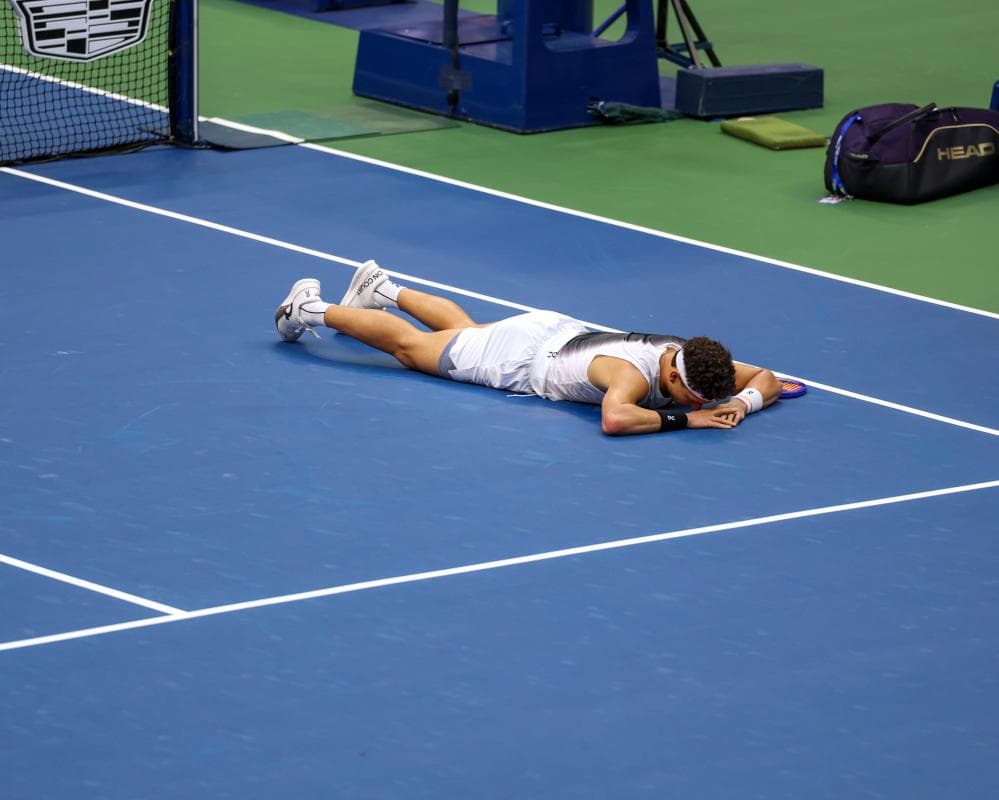
The men’s draw still produced one of the memorable sporting moments of the year courtesy of a special champion. At 3.40am on Wednesday, after Ben Shelton’s monumental victory against Alcaraz, the Spaniard finally made his exit from Ashe. He had pushed himself to the limit for 4hr 28min, vomiting repeatedly, only to lose by narrow margins in a fifth set tie-break. However, after being away for four and a half months because of a wrist injury and unsure about how his body would react upon his return, he was finally able to again participate in the sport he loves and he left the court feeling like himself. As Alcaraz walked through the tunnel leading to the locker room, a place that had seen so many tears, his face broke out into a wide, joyful smile.