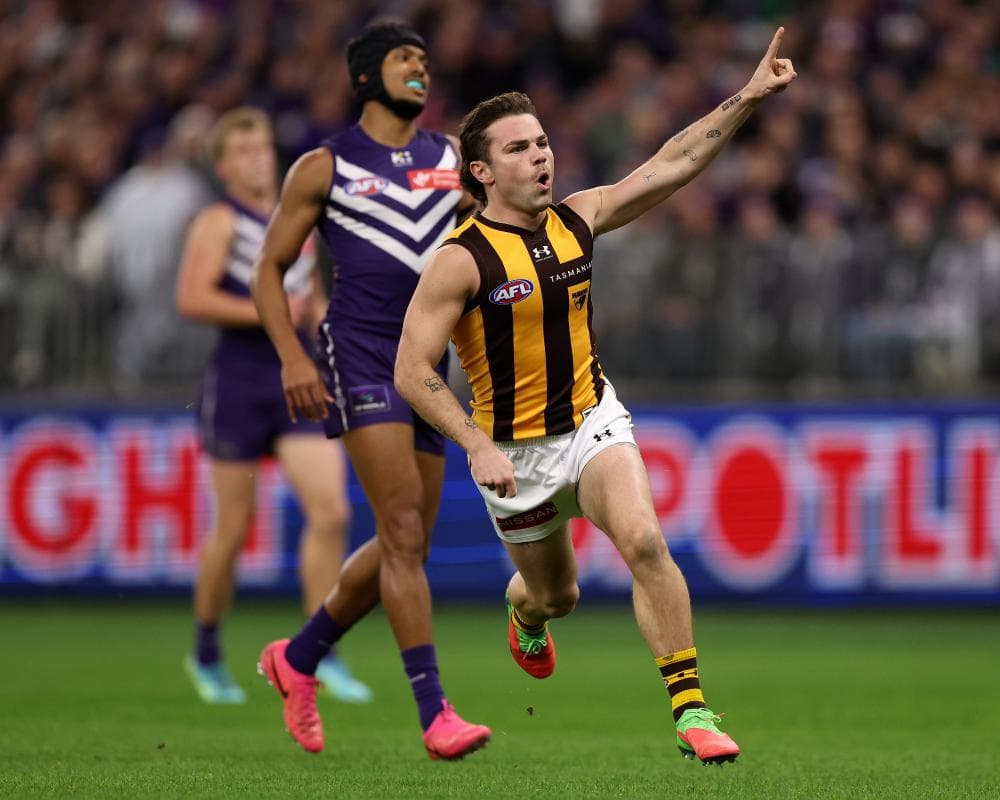
The Nick Watson moment came on Dustin Martin’s day. It was Dusty’s 300th, complete with pop-up barbers, the opening goal of the game and the final significant act of his career, when he walked to all four corners of the centre square and acknowledged his crowd. Michael Willson’s photo of Martin exiting the MCG perfectly captured the man, the moment and the mood.
It had been a rocky debut season for Watson until that day in June 2024, with injuries, tardy goalkicking and stints in the VFL. Halfway through the first quarter, he anticipated a spilling ball, collected it at full speed, took a bounce, absconded around the boundary line and hit up Dylan Moore with a perfectly weighted kick. It was one of those moments where you were left in absolutely no doubt that the person you were watching was going to be a great footballer.
But doubt had always followed him, mainly because of his height. Mark Thompson insisted Geelong should never draft any player under 180cm, a rule he reluctantly broke for Matthew Stokes. There were similar reservations with Watson. Could he play in the midfield? Would he grow? Did players like him peak at 17? Early in that 2024 season, when Hawthorn had lost six of their first seven games and Watson was injured, there was talk that they may have blown such a high pick.
Hawks coach Sam Mitchell has his own criteria when assessing young prospects – he looks for players who are equally proficient handballing with both hands, who don’t fumble below their knees, and who can turn on a dime. Watson trained at Hawthorn in the pre-season before he was drafted and Mitchell loved him straight away. All the things evident in that one passage of play against Richmond – technique, timing, speed, awareness and attitude – were evident in Hawthorn’s summer drills, and had been there through the entirety of his junior career.
Every Hawthorn game is now replete with these moments. Watson can surf a pack and he can scrounge and ferret his way at ground level. At stoppages, and especially at boundary throw-ins, he’s a predator. He circles, feints, identifies gaps, and pounces. Earlier this year on the Gold Coast, six players set off after the ball in what resembled a handicap foot race, all six from staggered starts. The backmarker Watson reeled them all in and kicked the goal. Later, in the second drawn game against Collingwood, Isaac Quaynor guarded him at stoppages like a security guard watching for shoplifters. Quaynor had the most minor of stumbles, and Watson already had 20 metres on him.
There’s long stretches where he won’t be sighted. But he’s always the dominant presence on the field. He’s the Hawthorn player who gets in the opposition’s head, whether it’s the defender seeking to exit without being mown down, or the match committee preparing for a game. A fortnight ago, Fremantle opted for the insurance policy of Brandon Walker, who hadn’t played since early March. Walker was picked for his speed, and he performed admirably. But he was unable to mitigate the Watson moments. The first came when Walker momentarily lost contact with him, Watson motored in on his blind spot, parted a pack of Dockers, and volleyed a goal at full pelt. No one else in Australia could have kicked that goal. No one else would have even attempted it. And no one could have stopped him.
Just when Fremantle had a flicker of hope, Watson cannoned on to a bobbling ball and found Jack Ginnivan with a sumptuous kick. Later, Ginnivan identified him 30 metres further afield and simply scudded the footy along the ground to him, the kind of bastard-ball that’s the hardest to take cleanly. Watson gathered it at his shoelaces, blind turned the chaser inside out, handballed to grass to extricate himself, and hit up his teammate 50 metres away, exactly as he had in that Richmond game two years earlier. By the end, his opponent was in tears on the bench, and Watson was high-fiving otherwise functional adults wearing wizard hats.
When teams of the century used to be selected and argued about, the small forward was invariably the resting or the soon-to-be retired rover. The role has become a lot more specialised in the past few decades, with Eddie Betts, Cyril Rioli and Stephen Milne generally regarded as the best of the lot. The small forward, whether it’s for defensive harassment or for all-out attack, is crucial to how the modern game is played, and has seen a recalibration of how junior footballers are ranked. Watson has “do your job” tattooed on his left hand. His job is to terrorise. At just 21, he’s well on the way to doing it better than any footballer we have ever seen.
This is an extract from Guardian Australia’s free weekly AFL email, From the Pocket. To get the full version, just visit this page and follow the instructions