What happens if you run out of trees? It is a situation cricket must face in the perfect storm of an expanding game and more precarious growing conditions due to accelerated climate change.
Cricket and willow are the sun and moon of sport. The handcrafted bat, the beautiful, insect-rich tree. But there are now 200 million regular cricketers worldwide. The UK produces half a million willow clefts a year, Kashmir between 1.5 to 3m. With one cleft equalling one bat, the numbers no longer add up.
To add to the problems, Kashmiri farmers have replaced many of the willow plantations with poplar, a faster-growing tree favoured by the wood-products industry. The price of willow has ballooned, from £60 a cleft to £120 in the past few years, leaving the finished product unaffordable to many.
So what is the solution? Not the aluminium bat that Dennis Lillee famously flourished at Perth in December 1979 until the umpires called a halt to the stunt. Lillee hurled his bat away in a fury and that was the end of that, other than a temporary surge in aluminium bat sales for Lillee’s friend’s company until cricket’s laws were changed to say a bat must be made of wood.
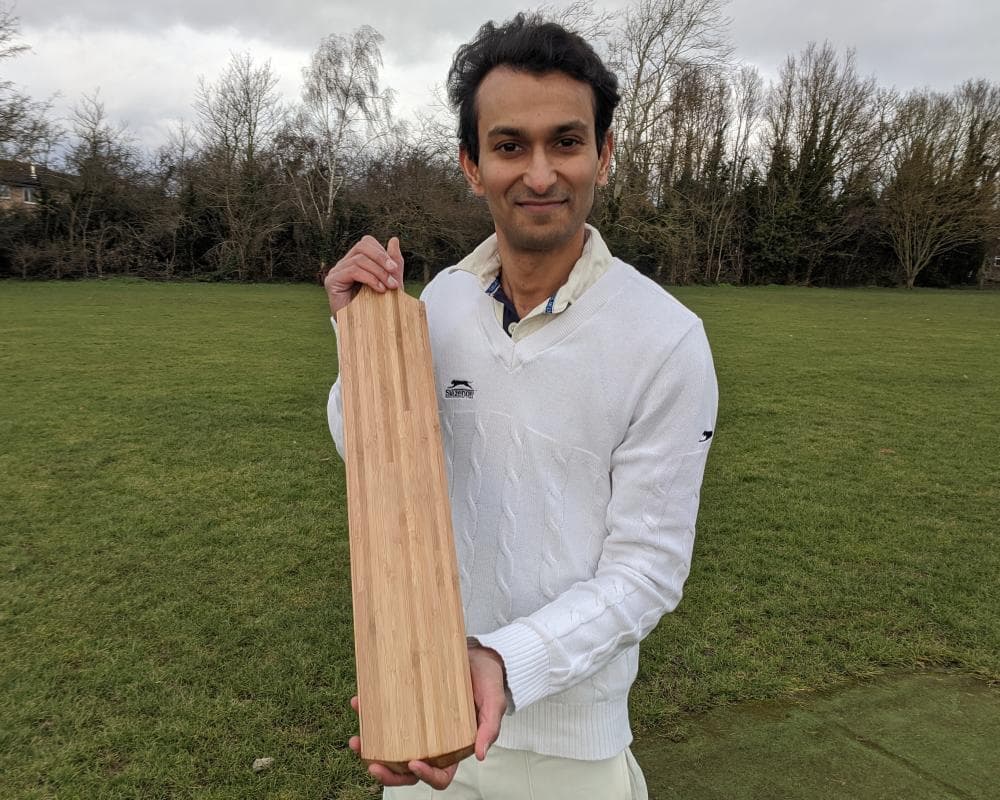
But Darshil Shah (pictured above), associate professor in material science and design at the University of Cambridge, thinks he has the answer: bamboo. He has been working on the idea since 2019, when his colleagues ran a project on laminated bamboo for buildings and he started trying out the offcuts to see how they would work as bats.
There were immediate hurdles. The initial prototypes were very heavy, and had a 30% better ball rebound than willow. Shah and his team solved that by removing material until the bat looked more like one from 1990. Durability challenges – peeling layers of bamboo – were knocked on the head by processing improvements. Shah says the performance now is fairly similar to that of a willow bat, “though we are doing a lot of work on how you test bats because at the moment, unlike, say, golf clubs, they are not tested at all”.
There was a chance to try out the bat at Shah’s Innovation Sustainability and Access in Cricket conference in Cambridge last week. Abidine Sakande was one of those to have a go. Once a professional cricketer for Leicestershire and Sussex, Sakande now works in the environmental sector. His verdict: “When you look at the bat you don’t immediately think it is going to work, and it feels quite planky. But while it is not yet a finished product, it has a noticeable sweet spot when it connects.”
Crucially, bamboo is faster-growing and a lot cheaper than willow, costing from £3 to £20 per cleft. But is it any more sustainable?
“For the first time we have done a life cycle assessment of the different bats,” says Shah. “We looked at a laminated willow bat, a traditional bat and a laminated bamboo bat. If you look at the processing alone, they all have fairly similar environmental impacts. The key thing is that transport-related emissions are double or even triple the environmental impact of the bat. It is the importing and exporting of raw material that is the issue.”
So the environmental takeaway is that bats should be made from local materials. English willow for the European and British market, Kashmir willow for Asian bats. And the great thing about bamboo is that is grown in South America, India, China, Indonesia and areas of Africa, parts of the world where the game is growing.
The custodian of cricket’s laws, the MCC (Marylebone Cricket Club), are aware of the shortage of willow and held an Emergency Cricket Bat conference in October last year. They then tweaked the laws to allow for some bat lamination – a bat for recreational cricket can now be made of up to three wooden pieces, meaning far more of a tree can be used than before – something welcomed by manufacturers. However, there is one huge hurdle for the bamboo bat to vault. It is currently banned due to it being both multiply laminated and made from a grass. But Shah is optimistic.
“For a long time the laws were applied from international games to the village green, but this has changed. I wouldn’t be surprised if more sorts of laminated bats were allowed for low-cost access areas of the game.”
He concedes that the market for a bamboo bat is unlikely to be professional cricket, but in schools, where children already often play with a plastic bat, and the recreational game. If, that is, people can be persuaded to try something new.
“Cricket and willow are so intertwined. But I am hopeful that as the sport grows in countries not as familiar with the link, they will be more open to using a bat made out of other materials. Cost is such a big issue, at the moment cricket is pricing people out of the game.”
This is an extract from our newsletter, The Hotspot. To subscribe just visit this page and follow the instructions.