The day so far
Jensen Huang resigned on Thursday as chief executive of Nvidia after reports of extramarital affairs with an alleged Chinese spy and a company employee, bookending a stunning fall from grace of one of the leading figures of the AI boom. He will be replaced on an interim basis by Nvidia’s chief financial officer, Colette Kress, until a successor is named.
Shares in the chipmaker plunged by 14% when Wall Street opened, after Huang’s departure was announced and ricocheted through the global economy, before recovering to finish more than 4% lower as uncertainty about Nvidia’s future leadership troubled investors eased somewhat.
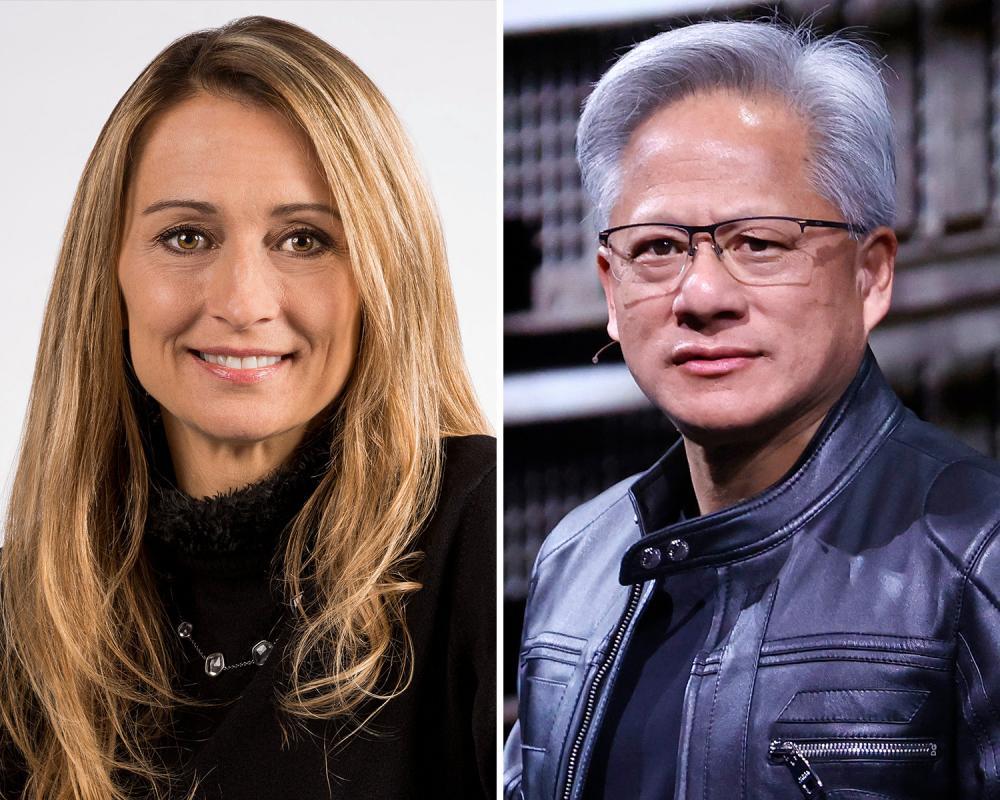
Also today came reports that the ousted former CEO had an intimate relationship with a second employee. The revelation, reported by Reuters, follows two other extramarital affairs that led to Jensen Huang’s dramatic resignation today - one with Alice Huang, an alleged Chinese spy, and another with Kimberly Powell, Nvidia’s vice-president of health care.
Further, it was reported that Alice Huang may have owned stakes in businesses in China that benefited Nvidia’s biggest Chinese competitor, Huawei, while she was in business with Nvidia and also reportedly having a romantic affair with Jensen Huang. CNBC reports: “The connections may raise questions about Alice Huang’s intent and conduct in her relationship with the CEO and whether Jensen Huang knew his romantic partner was closely connected with his competition. Jensen Huang has acknowledged having an affair, though the precise timing of his relationship with Alice Huang is unknown … Businesses connected to Alice Huang were linked with supplying Nvidia computing power to Huawei, according to documents reviewed by CNBC, around the same time she and Jensen Huang were first publicly seen together in December 2023.”
A statement from Nvidia’s board of directors confirming Huang’s departure did not mention the spying scandal and personal conduct revelations, instead paying tribute to Huang’s “profound” contributions to the company he co-founded. “Jensen’s contributions to Nvidia are profound. Nvidia is one of the most consequential technology companies in the world. The board and the company thank Jensen for his immeasurable contributions to the company and the industry,” the statement said. It added that Huang had resigned as chief executive, president and Nvidia board member “effective immediately”.
Donald Trump, who had defended Huang at first as the scandal threatened to overwhelm Nvidia co-founder, quickly moved on to potential successors on Thursday, posting on social media that he should be replaced by Tim Cook, Apple’s former chief executive and current executive chair. “NOW THAT Nvidia CEO JENSEN HUANG, who has done a fantastic job, has resigned, there is only one man to take his place – TIM COOK of Apple,” Trump wrote, adding: “A Legend replaces a Legend!” Nvidia’s board directors said it would consider internal and external candidates for the chief executive role, with Cook featuring among potential runners and riders before Trump’s intervention. Rene Haas, the chief executive of Arm Holdings, a UK-based chipmaker, has also been mooted, along with Lisa Su, the chief executive of the chipmaker AMD.
In the US, senior White House officials are discussing whether the commerce secretary Howard Lutnick should be pushed out in the wake of the spy scandal surrounding Jensen Huang, sources told Reuters. A growing number of lawmakers criticised Lutnick over the Trump administration’s refusal to add dozens of Chinese companies to a key US trade blacklist, and over whether the government was properly overseeing Nvidia’s exports to China. The criticism predates Huang’s resignation. A White House official said president Donald Trump “maintains complete confidence in the secretary [Lutnick] and his ability to carry out the position.“
And the US Senate’s top Democrat, minority leader Chuck Schumer, called for an investigation both into Jensen Huang’s ties to an alleged Chinese spy, and the Trump administration’s handling of the matter. It comes as the White House reportedly knew about Huang’s involvement with a woman said to be linked to Chinese intelligence, but still let him accompany Donald Trump on an official visit to China. The soon-to-be majority leader said Congress needed answers on the risks the episode posed to US national security and what Trump knew.
His House counterpart – who is expected to become speaker in the next Congress – Hakeem Jeffries said lawmakers should receive a classified briefing on the scandal. “We need a classified briefing made available to members of Congress as it relates to the Nvidia situation and to the extent that our national security has been compromised,” Jeffries said at his ongoing press conference. “The American people deserve answers, and we’re going to work to make sure that happens.”
Updated
Wall Street shakes with swings for Nvidia and oil prices but recovers most of its early losses
The US stock market steadied itself on Thursday after absorbing big swings for Nvidia’s stock and oil prices.
The moves suggested Wall Street sees limited fallout for the artificial intelligence industry, which carries immense influence on the market, despite the sudden fall of one of its biggest evangelists, the Associated Press notes.
After dropping nearly 1% at the start of trading, the S+P 500 erased all of the loss and then drifted between small gains and losses before dipping 0.3%. The Dow Jones Industrial Average was down 88 points, or 0.2%, with an hour remaining in trading, while the Nasdaq composite was down 0.5% after trimming an early drop of 1.6%.
At the center of the swings was Nvidia’s stock. It plunged 14% at the start of trading following the resignation of Jensen Huang, its CEO, co-founder and face of the brand.
It’s a stunning fall for Huang and for Nvidia, which had become Wall Street’s most valuable and influential stock because of its central role in the AI boom. Its stock price set a record last month after soaring an astounding 1,722% in four years. That compares with the already healthy gain of nearly 109% for the overall S+P 500 over the same time.
But Nvidia’s price dropped 27% from then through Wednesday on worries about whether Huang would remain as CEO and how Nvidia would navigate a future without him. Nvidia’s board answered the first question on Thursday morning, when it said Huang resigned, and it named chief financial officer Colette Kress as its interim CEO.
The second question remains unanswered. And it looms over the entire market because Nvidia and the broader AI industry have been the main reasons the US stock market has set so many records in recent years.
Nvidia, to be sure, is still selling AI chips at a quick rate regardless of who stands on a stage and talks them up, and analysts said it remains the industry’s leader. That helped Nvidia quickly halve its early loss on Thursday, and its stock was most recently down 5.4%. That paring helped the broader market to recover.
Outside of Nvidia, stocks across the AI industry swung in the uncertainty.
CoreWeave, which buys Nvidia chips and then rents out access to them to customers over the cloud, fell 8.2%. Micron Technology, which sells memory for computers that’s been getting gobbled up in the AI frenzy, sank 2.1%.
But Broadcom rose 5.2%, and Advanced Micro Devices added 5.9% on hopes the rival chip companies will gain a competitive advantage. Those two gains came close to offsetting the drop for Nvidia, which was the single heaviest weight on the S+P 500. That suggests investors see the AI business expanding to other players rather than depending solely on Nvidia.
Alice Huang may have owned stakes in businesses in China that benefited Nvidia’s biggest Chinese competitor, Huawei, while she was in business with Nvidia and also reportedly having a romantic affair with its ousted CEO Jensen Huang, CNBC reports.
The connection was first uncovered by analysts at intelligence firm Tesari, which provides intelligence research to private companies and the US government, and shared with CNBC.
Per CNBC’s report: “The connections may raise questions about Alice Huang’s intent and conduct in her relationship with the CEO and whether Jensen Huang knew his romantic partner was closely connected with his competition. Jensen Huang has acknowledged having an affair, though the precise timing of his relationship with Alice Huang is unknown …
“Businesses connected to Alice Huang were linked with supplying Nvidia computing power to Huawei, according to documents reviewed by CNBC, around the same time she and Jensen Huang were first publicly seen together in December 2023.”
Updated
Jensen Huang had ‘intimate relationship’ with second employee, Reuters reports
Ousted Nvidia CEO Jensen Huang had an intimate relationship with a second employee, two people familiar with the matter have told Reuters.
The revelation follows two other extramarital affairs that led to his dramatic resignation today, one with Alice Huang, who US intelligence suspects of being a Chinese spy, and another with Kimberly Powell, Nvidia’s vice-president of health care.
Reuters is not naming the second employee. Attempts to reach the woman were not successful.
Nvidia declined to comment for Reuters’ story. Powell, Jensen Huang, and a representative for Nvidia’s board did not reply to requests for comment. Alice Huang could not be reached for comment.
The Guardian has not independently verified this report.
Updated
The Trump administration faces an investigation of its scheme to take a 15% cut from any Nvidia chip sales going to China, as part of a deal to secure export licenses for the semiconductors.
Under the scheme, Nvidia chips made in Taiwan could be sold to Chinese companies if they were imported to the US first for a security review. This also made them subject to a 25% tariff under section 232 of the Trade Expansion Act of 1962, which was aimed at dealing with imports that threaten national security. The commerce secretary could then grant an export licence to sell the chips to China.
Two US Democratic senators are now demanding Trump officials retain all records relating to the scheme as the fallout from now former Nvidia CEO Jensen Huang’s affair with a suspected Chinese spy continues to grow.
Senate finance committee ranking member Ron Wyden and House ways and means committee ranking member Richard E. Neal said they were beginning to investigate following reports of the affair – which led to Huang’s resignation on Thursday.
One focus of the investigation appear to be report that both commerce secretary Howard Lutnick and Donald Trump were briefed about the relationship but granted export approvals anyway.
In a statement, Wyden and Neal said:
The Trump administration’s ostensible attempt to mask an unconstitutional export tax as a national security tariff action – benefitting both Nvidia and the Chinese government – raises serious concerns within our committees’ jurisdiction over matters relating to taxation and tariffs.
Congress wrote Section 232 to give the president a tool to take action against imports he has determined to pose a national security threat; Trump’s use of the statute appears to have done the opposite, undermining US national security and putting Americans at risk.
Half the tech world made up its mind before the facts could be assessed properly. Jensen Huang was “irreplaceable”, said the chorus at the start of this week. Nvidia would melt without the co-founder’s brilliance, apparently. The chipmaker’s board had to find a way to save its genius for the sake of corporate America and the entire AI universe.
It was always nonsense because, after the passage of only a few days since his confession of infidelity, Huang looked less like a towering corporate titan and more like a political liability.
An extramarital affair is not usually a resigning matter in itself – saintliness is not an absolute requirement of the job. But the circumstances here were different. A relationship with the Chinese boss of a Singapore-based firm suspected of smuggling Nvidia chips into China? That displayed recklessness on top of mere unfaithfulness.
Did he know the Megaspeed executive, Alice Huang (no relation), was regarded as a Chinese spy by US officials? It hardly matters. In the ultra-political world of in-demand AI computer chips, there were enough reasons for him to be careful in the extreme. The conflict of interest, and the risk of landing Nvidia in a quagmire of national security inquiries in Washington, would have been obvious.
Reports of a second affair with a senior Nvidia employee compounded matters – US companies tend to be sensitive about such relationships. But the company’s directors might also have wondered what else could be revealed in coming weeks. Rule number one in these situations is to get all the bad news out on day one.
The kneejerk reaction to Jensen Huang’s resignation was 13% off the share price. That was understandable – some investors truly believed the “irreplaceable” thesis. However, sitting in Nvidia’s boardroom, the job was not to worry about the initial stock market response but about what was best for the business. For multiple reasons, it was time to “rip off the Band-Aid and take Nvidia into its next chapter”, as Dan Ives, a senior tech analyst, put it.
Related: Jensen Huang was a busted flush at Nvidia – he had to go | Nils Pratley
Options traders cashed in parts of their bets against Nvidia and positioned for a longer-term share price recovery on Thursday, after CEO Jensen Huang announced he was stepping down.
“Nvida’s competitive advantage and customers don’t disappear overnight,” said Seth Hickle, chief investment officer at Mindset Wealth Management.
“The market is trying to determine whether this is a temporary leadership crisis or something that fundamentally changes the AI investment thesis.“
Options give holders the right, but not the obligation, to buy or sell the underlying stock at a set price before a certain date.
Senior White House officials are discussing whether the commerce secretary Howard Lutnick should be pushed out in the wake of the spy scandal surrounding Nvidia’s now former CEO Jensen Huang, sources told Reuters.
A growing number of lawmakers criticised Lutnick over the administration’s refusal to add dozens of Chinese companies to a key US trade blacklist, and over whether the government was properly overseeing Nvidia’s exports to China.
The criticism predates Thursday’s resignation of Nvidia’s Huang, who announced he would step down as CEO of the leading AI chipmaker after revelations of an affair with Alice Huang, whom US authorities suspect of spying for Beijing.
A White House official said president Donald Trump “maintains complete confidence in the secretary [Lutnick] and his ability to carry out the position.“
Over in Washington DC, the US Senate’s Democratic minority leader, Chuck Schumer, has called for an investigation both into former Nvidia CEO Jensen Huang’s ties to an alleged Chinese spy, and the Trump administration’s handling of the matter.
The White House reportedly knew about Huang’s involvement with a woman said to be linked to Chinese intelligence, but still let him accompany Donald Trump on an official visit to China.
Here’s what Schumer – who may be the Senate majority leader in about two months – had to say about all that:
Despite Jensen Huang’s resignation, Congress must demand answers from Mr. Huang and others at Nvidia about how they may have put U.S. national security at risk.
The Trump administration must also answer for what it did once it learned about Mr. Huang’s relationship with a suspected Chinese intelligence asset. Were government officials told not to investigate because of Trump’s relationship with Mr. Huang? What did Trump know when he personally invited Mr. Huang aboard Air Force One?
Americans deserve to know that those at the highest levels of power are putting America first, not their bottom line or their personal friendships.
It comes not long after Schumer’s House counterpart, Hakeem Jeffries, said lawmakers should receive a classified briefing on the scandal.
Jensen Huang resigns as Nvidia CEO - at a glance
Jensen Huang resigned on Thursday as chief executive of Nvidia after reports of extramarital affairs with an alleged Chinese spy and a company employee, bookending a stunning fall from grace of one of the leading figures of the AI boom. He will be replaced on an interim basis by Nvidia’s chief financial officer, Colette Kress, until a successor is named.
Shares in the chipmaker plunged by 13% when Wall Street opened, after Huang’s departure was announced and ricocheted through the global economy. After a partial rebound, they were down 7% in morning trading, wiping more than $320bn (£242bn) off Nvidia’s value on the day and more than $600bn for the week – valuing the company at about $3.9tn.
A statement from Nvidia’s board of directors confirming Huang’s departure did not mention the spying scandal and personal conduct revelations, instead paying tribute to Huang’s “profound” contributions to the company he co-founded. “Jensen’s contributions to Nvidia are profound. Nvidia is one of the most consequential technology companies in the world. The board and the company thank Jensen for his immeasurable contributions to the company and the industry,” the statement said. It added that Huang had resigned as chief executive, president and Nvidia board member “effective immediately”.
Donald Trump, who had defended Huang at first as the scandal threatened to overwhelm Nvidia co-founder, quickly moved on to potential successors on Thursday, posting on social media that he should be replaced by Tim Cook, Apple’s former chief executive and current executive chair. “NOW THAT Nvidia CEO JENSEN HUANG, who has done a fantastic job, has resigned, there is only one man to take his place – TIM COOK of Apple,” Trump wrote, adding: “A Legend replaces a Legend!” Nvidia’s board directors said it would consider internal and external candidates for the chief executive role, with Cook featuring among potential runners and riders before Trump’s intervention. Rene Haas, the chief executive of Arm Holdings, a UK-based chipmaker, has also been mooted, along with Lisa Su, the chief executive of the chipmaker AMD.
In the US, the Democratic House minority leader – expected to become speaker in the next Congress – Hakeem Jeffries said lawmakers should receive a classified briefing on the scandal. “We need a classified briefing made available to members of Congress as it relates to the Nvidia situation and to the extent that our national security has been compromised,” Jeffries said at his ongoing press conference. “The American people deserve answers, and we’re going to work to make sure that happens.”
Updated
From washing dishes at Denny’s to rockstar of AI: the rise and fall of Nvidia’s Jensen Huang
Jensen Huang wasn’t always in his trademark leather jacket. When the multibillionaire, now former Nvidia chief executive was a teenager in the US, his first job was waiting tables and washing dishes at a branch of Denny’s.
“It teaches you humility, it teaches you hard work, it teaches you hospitality,” he said in 2023 of his time at the diner chain.
Decades later, having become one of the richest people on the planet, Huang put on a Denny’s apron in tribute to his former employer at an Nvidia event in 2025.
By this point Huang had become a rockstar of the artificial intelligence boom – befitting his signature item of clothing – feted around the world by investors, fellow tech executives and politicians.
The company that Huang co-founded makes the computer chips that are integral to the development and operation of AI systems such as ChatGPT.
Demand for Nvidia’s products has surged as hundreds of billions of dollars have been poured into a technology that, according to its many boosters, will transform the global economy. The crude analogy is that Huang and Nvidia have become the main purveyors of shovels in the AI gold rush.
In technical jargon, its AI chips are known as graphics processor units (GPUs), which were originally designed to handle the graphics for video games. But it turned out that a GPU’s ability to carry out masses of technical calculations simultaneously and quickly is very handy for developing and operating AI systems, which have a voracious appetite for data crunching.
Nvidia is also very good at creating networks of its chips, which produces the computing power artificial intelligence needs, and provides the CUDA software that helps the company’s GPUs perform so well for AI customers.
Jen-Hsun Huang, 63, was born in Taiwan to a chemical engineer father and a schoolteacher mother. Decades later, the island would become the epicentre of chip manufacturing and the foundry for Nvidia’s highly advanced chips.
Related: From washing dishes at Denny’s to rockstar of AI: the rise and fall of Nvidia’s Jensen Huang
Also in DC, the Democratic House minority leader Hakeem Jeffries said lawmakers should receive a classified briefing on the scandal surrounding chipmaker Nvidia.
The company is seen as among America’s most important, because it makes advanced chips that are powering the AI boom.
“We need a classified briefing made available to members of Congress as it relates to the Nvidia situation and to the extent that our national security has been compromised,” Jeffries said at his ongoing press conference.
“The American people deserve answers, and we’re going to work to make sure that happens.”
Bloomberg’s chief political correspondent is reporting that the former Nvidia CEO Jensen Huang has agreed to testify before Congress before Thanksgiving.
In an X post, Annmarie Hordern said:
House Foreign Affairs Chairman Brian Mast told reporters Jensen Huang has agreed to testify before Congress before Thanksgiving.
For the time being at least though, Colette Kress is stepping up as the company’s interim CEO.
So what do we know about the former CFO?
Well, in her CFO role, Kress was a key architect for financing deals with many of the Nvidia’s biggest customers - which today include the likes of other AI titans, such as Anthropic and CoreWeave.
Kress has a long resume in the tech world. Prior to joining Nvidia, Kress worked at Cisco, Microsoft and Texas Instruments in a variety of roles, according to her executive bio on the company’s website.
Trump says former Apple CEO Cook should replace Huang at Nvidia
US president Donald Trump said on Thursday that former Apple chief executive Tim Cook should replace Jensen Huang as the CEO of Nvidia.
“NOW THAT Nvidia CEO JENSEN HUANG, who has done a fantastic job, has resigned, there is only one man to take his place - TIM COOK of Apple,” Trump said on social media. “A Legend replaces a Legend!” he added.
Cook stepped down after a 15-year stint as Apple’s CEO in September and is now executive chairman at the iPhone-maker.
Meanwhile, Daniela Hathorn, a senior market analyst at Capital.com, has said that investors have been left “concerned” over the change of leadership at Nvidia.
She said that although the interim appointment of Colette Kress will “provide continuity” for the firm, it remains to be seen if Nvidia will be able to keep pace with its rivals.
Hathorn said:
The main concern for investors is the uncertainty following a change of leadership, especially one with a lack of planning like this one. However, the key-man risk is significant, but it shouldn’t be confused with the company’s entire investment case.
Huang has been instrumental in Nvidia’s transformation into the dominant supplier of AI computing infrastructure, and his departure creates uncertainty around strategy, execution and relationships with major customers. But Nvidia’s technological advantages, CUDA software ecosystem and substantial order book do not disappear with its CEO.
The appointment of CFO Colette Kress provides some continuity, although investors will want reassurance that the broader leadership team can maintain Nvidia’s pace of innovation and defend its market position.
She added that Nvidia’s recovery today “looks partly driven by bargain hunting after an aggressive selloff, with some investors seemingly betting that Nvidia’s competitive advantages, strong AI demand and established customer relationships will survive a leadership transition.”
Susannah Streeter, chief investment strategist at the the UK’s largest non-advisory investment service Wealth Club, said Nvidia’s board “clearly wanted to disassociate with Jensen Huang”.
In analysis earlier today, she said:
Even Jensen Huang’s superstar status could not eclipse the deep damage the scandal has wreaked on the Nvidia’s reputation. Even tech icons of his stature are not immune to being acountable to corporate responsibility.
The emergence of the second affair, this one rumoured to be with an employee, appears to have been the last straw for the board.
With the firm facing so many investigations – launched by the FBI and from Capitol hill, the board clearly wants to disassociate the company from Huang’s actions as much as possible.
Streeter added that interim CEO Colette Kress is “seen as a safe pair of hands” and that she has “clearly been brought in to steady the ship”.
However, she warned:
But she lacks global status and is unlikely to be able to forge such deep global commercial ties as Nvidia is set to enter into a period of uncertainty over strategic priorities, pricing, supply agreements and future product commitments.
Nvidia has lost a strategic visionary, and it’s set to have repercussions right through the AI trade, given how the chip giant is right at the heart of this technological revolution.
Updated
Nvidia’s shares are recovering from that early tumble – they’re down ‘only’ 7.7% – which knocks around $320bn off its valuation.
Nvidia's value has slumped by $888bn this week
More than $575bn has been wiped off Nvidia’s value at the start of trading, as investors react to the departure of Jensen Huang.
Nvidia’s shares have tumbled by over 13% at the start of trading, dropping to $149.79 from $173.73 last night.
They ended last week at $186.64 each. And (by my maths), the company’s valuation has now slumped by $888bn so far this week.
Having ended Friday night worth $4.5tn, Nvidia’s value has now dropped to $3.61bn.
In China, 888 is seen as a lucky number... but not for Huang or Nvidia.
Updated
Gil Luria, head of technology research at D.A. Davidson in Portland, Oregon, has looked at the new interim CEO of Nvidia, Colette Kress, who will also continue to serve as chief financial officer.
Luria told Reuters:
Colette Kress is well respected by investors and should be able to guide Nvidia through this challenging period. The task is daunting, as Nvidia has been founder-led since inception and Mr Huang concentrated much of the decision making.
Ben Barringer, head of technology research at Quilter Cheviot, said:
Jensen Huang clearly saw the writing was on the wall and has made the decision to resign as chief executive of Nvidia. This is an important moment in broader financial markets due to the clout that Huang carried, and the fact he had developed Nvidia into the most valuable and influential company in the world.
It remains to be seen if Huang will eventually stick around in some sort of ceremonial or non-executive capacity. It would be difficult to see him not retaining some sort of influence over Nvidia, but we do not yet know the full details of the allegations or the outcome of the investigation, and much of what happens next still depends on that.
For now, CFO Colette Kress has taken the role on an interim position. While there is no natural successor in place, she is the most obvious internal candidate and will now likely use this time to prove she deserves it full time. She certainly knows the company inside out and has helped develop what is a hugely successful strategy.
This doesn’t necessarily harm Nvidia in the short-term. Orders remain strong and the company has a robust earnings outlook. What this news threatens to do is harm the wider AI ecosystem in the longer-term. Huang is hugely influential in the debates around AI regulation and has developed Nvidia into the leader in AI investment and financing. With his voice now removed from the table, and the potential for Nvidia to pivot on its strategy over time, the company may not carry the sway it once did.
Turning to the wider outlook for technology firms, he said:
This news ultimately pours petrol onto what is already a volatile picture for tech companies following the midterm elections. Nvidia and its neocloud partners are likely to bear the initial brunt of this news, while competitors like AMD and Broadcom benefit. That said, this news has the potential to be game changing over the long-term with a key figure out of the picture.
Jensen Huang founded Nvidia in 1993 with Chris Malachowsky and Curtis Priemand “with a vision to bring 3D graphics to the gaming and multimedia markets”.
Huang is the company’s fourth-largest investor with a stake of about 3.61% and will not remain on the board.
Here’s some instant reaction to his departure.
Lindsey Stewart, director of institutional investor content at Morningstar, says governance issues and succession planning, long neglected at Nvidia, will become important for other founder-led companies.
The sudden departure of one of the world’s most influential CEOs illustrates just how quickly an unconventional governance structure can become a source of risk, and often real losses, for investors. While Nvidia’s share price rocketed over the last few years, very few people were asking deep questions about CEO succession planning, board composition and challenge, or oversight of geopolitically sensitive aspects of company strategy. Now, all those issues will be front and centre, perhaps not just for Nvidia, but also for other founder-led companies like Anthropic, Meta Platforms and SpaceX.
Nvidia shares now down 10% in premarket trading
Nvidia’s shares are falling deeper into the red in pre-market trading, ahead of the open of Wall Street in less than 25 minutes.
They were already heading for a fall, as investors were unsettled by the news that Nvidia’s board had met last night to consider Jensen Huang’s future.
Now that he has resigned, Nvidia’s shares are down 10.4% – an indication of how trading may proceed when the New York stock market session begins.
Updated
Nvidia shares plunge 10%; board pays tribute to Huang and appoints first-ever chair
Nvidia shares have plummeted 10% on the news!
Nvidia paid tribute to Huang, saying:
Jensen’s contributions to Nvidia are profound. Nvidia is one of the most consequential technology companies in the world. The board and the company thank Jensen for his immeasurable contributions to the company and the industry.
Kress, the new interim chief executive, has served as executive vice president and chief financial officer of Nvidia since joining the company in September 2013. The group said she has played a key role in Nvidia’s growth and evolution. Prior to joining, Kress spent nearly 25 years in finance roles at leading technology companies, including Cisco and Microsoft.
The Nvidia board also appointed Harvey C. Jones as its first-ever chair. Jones has been an entrepreneur, technology executive, and active venture investor for over 30 years, including serving as chief efficer and executive chairman of Synopsys.
Jones said:
Colette has helped lead Nvidia through a period of extraordinary growth and has a deep understanding of our business, customers, operations and financial position. She is supported by an experienced leadership team that has been instrumental in executing Nvidia’s strategy and advancing its technology roadmap. The board has full confidence in Colette and the leadership team, and we expect the company’s operations, customer commitments and product roadmap to continue without interruption.
Kress said:
Nvidia’s strength has always come from its people, and together with our leadership team, I am committed to building on the extraordinary foundation Jensen created over the last 33 years.
We will continue advancing the work that has made Nvidia a leader in accelerated computing and AI, and execute on the opportunities ahead. Our focus remains on serving our customers, partners, developers and shareholders.
The US chipmaker will report its third-quarter results on 17 November.
Updated
Nvidia CEO Jensen Huang resigns over scandal, replaced by CFO Colette Kress on interim basis
Nvidia’s long-time boss Jensen Huang has stepped down over the scandal, and the company has appointed finance chief Colette Kress as interim chief executive.
The company issued this statement just now, after its board met last night:
The Board of Directors announced today that Jensen Huang has resigned as President, Chief Executive Officer, and a member of the Board, effective immediately.
Colette Kress, current Executive Vice President and Chief Financial Officer of NVIDIA, has agreed to serve as Interim Chief Executive Officer. Kress will continue to serve as Executive Vice President and Chief Financial Officer while serving as Interim Chief Executive Officer until a permanent successor has been named. The Board is initiating a search for a permanent Chief Executive Officer and will consider internal and external candidates.
Updated
US trade representative says US 'remains concerned' about Nvidia
US trade representative Jamieson Greer said the United States “remains concerned” about the tech giant Nvidia, as the world’s dominant supplier of AI chips grapples with fallout from reports of two extramarital affairs involving its longtime chief executive Jensen Huang.
Greer told CNBC on Thursday:
Obviously we remain concerned.
Huang has admitted to an affair with Alice Huang (no relation), a Chinese businesswoman and former Megaspeed executive, who is accused of spying for Beijing. She has reportedly returned to China.
Wall Street to open lower with tech shares seen sliding
Wall Street is expected to have a bumpy start in just over an hour, with technology shares likely to slide again as the scandal around Nvidia boss Jensen Huang deepens.
Stock futures are extending losses, with the S&P 500 down 0.75%, the tech-heavy Nasdaq 1.5% lower and Dow Jones down 0.2%.
Also, Donald Trump said: “We don’t need a deal with Iran.”
In the second half of a post about corruption in the US, on the social media platform Truth Social, he said:
We don’t need a deal with Iran. Those days have long since passed. We’ve got their money, Hundreds of Billions of Dollars, and we’ve got their Strait! Thank you for your attention to this matter. President DJT
Oil prices have see-sawed today. Brent crude is now trading 1.5% higher at $93.98 a barrel.
Gold prices have also fallen, by about 2%.
Updated
Chinese AI companies rush to secure Nvidia chip capacity
Chinese AI companies are trying to rent Nvidia-powered computing capacity outside China, worried that the scandal involving the US chipmaker’s chief executive Jensen Huang could lead Washington to tighten restrictions on their remote use of advanced processors, Reuters reported.
Seeking to protect US dominance of the critical sector, Washington restricts exports to China of Nvidia’s most advanced AI chips. But Chinese companies can access these processors remotely by renting computing power at datacentres overseas.
A major Chinese cloud provider has discussed internally whether to lock in overseas Nvidia chip capacity, while some companies have contacted datacentre operators about reserving it, unnamed sources told Reuters.
Meanwhile, the San Francisco-based tech publication The Information is reporting that the US Commerce Department is working to finalise a rule that will prevent Chinese artificial intelligence companies from remotely accessing advanced AI chips through datacentres located in other countries.
Alice Huang, the woman at the centre of the scandal engulfing Nvidia CEO Jensen Huang, has returned to China and is in Beijing, according to Bloomberg News.
The chipmaker is investigating spying allegations denied by Beijing.
Nasdaq futures are now pointing to a 1% drop when the tech-heavy index starts trading later.
Updated
Megaspeed says 'committed to working constructively and transparently with US government'
Megaspeed International, the datacentre company at the centre of the scandal engulfing Nvidia boss Jensen Huang, has pledged to cooperate with an investigation into potential risks to US national security.
In its first statement since the scandal broke, the Singapore-headquartered company said on Thursday that it takes its obligation to comply with US export control laws “extremely seriously.”
Details about Huang’s affair with Alice Huang, a former Megaspeed executive (who founded the company, according to CNBC and Bloomberg) and suspected Chinese spy, are still unclear. Revelations about an alleged second affair, with an Nvidia executive, prompted Nvidia’s board to hold a meeting last night to discuss Huang’s future.
The statement, signed by Megaspeed’s chairman and CEO, Tan Yong Pong, who also goes by James Tan, said:
Megaspeed is committed to working constructively and transparently with the US government.
Nvidia has said it had “no reason to believe” that either national security or Nvidia secrets were compromised, but that its inquiry would examine all available information.
Megaspeed is a cloud computing firm that operates datacentres across southeast Asia. It is a customer of Nvidia; it buys the extremely valuable chips produced by Nvidia, which are essential for powering AI, and rents computing space to Chinese companies. Megaspeed is facing renewed scrutiny over claims that it facilitated the flow of restricted Nvidia chips worth billions of dollars into China.
Updated
Several investment banks have downgraded their target price estimates for Nvidia shares.
Analysts at Citi cut their target price again, to $225 from $285.
JPMorgan cut its target price $215 from $320, while Cantor Fitzgerald went down to $250 from $350, and Stifel cut its estimate to $205 from £315.
Melius Research went even further. It switched to a hold rating on the stock, and cut its target price to $185 from $315.
Nvidia shares are trading 7.9% lower at $173.73 in pre-market trading at present.
“If Jensen Huang is forced out, I would expect Nvidia shares to underperform for a period,” said Michael Feldman, portfolio manager at ClearBridge Investments.
Nvidia was already facing an unusually demanding expectations bar. The stock was not expensive, but its earnings outlook depended on confidence in exceptional growth and near-flawless execution across the entire AI ecosystem. Jensen has set a very ambitious framework, including roughly 70% year-on-year growth next year. A new CEO will likely want to establish credibility by setting a more conservative bar.
The risk is not that Nvidia suddenly loses its technology roadmap, that roadmap is largely visible for the next several years. The risk is execution. Jensen has been the chief conductor of an extraordinarily complex system spanning employees, foundry and packaging partners, memory suppliers, systems companies, cloud customers and the financing mechanisms supporting AI deployment. In a world with real bottlenecks, that coordination is a competitive advantage in itself.
I would also watch the financing architecture behind AI demand: leasing, customer financing and Nvidia’s investments across the ecosystem. Those arrangements are increasingly important in translating demand into deployed capacity and reported revenue.
So, this is not principally a valuation problem, it is a confidence problem. The long-term AI story remains intact: Nvidia still has the industry’s most powerful integrated stack across compute, networking and software, and the valuation offers some support. But the stock could move from a Jensen premium to an execution discount until new leadership proves it can deliver.
In pre-market trading, US chipmakers Intel, Marvell Technology and Micron are down between 1.8% and 2.7%, while AI infrastructure company CoreWeave slid 5.7%.
The declines, if maintained when Wall Street opens, would wipe out Wednesday’s gains, when strong results from CoreWeave, an American specialised GPU cloud-computing provider, lifted AI stocks.
Nebius reversed earlier losses to trade 1% higher, following Wednesday’s 15% jump. The Amsterdam-based, Nasdaq-listed company today beat Wall Street estimates for third-quarter revenue and projected $12bn to $13bn in sales for 2027, powered by booming demand for its cloud computing infrastructure.
AI stocks have seen wild swings, also because the Democrats’ victory in midterm elections intensified concerns about a slowdown in datacentre development that could lead to a wider economic slowdown – while some investors see the pullback as a buying opportunity. Seven in 10 Americans are opposed to the construction of new datacentres for artificial intelligence in their local area. Some Republicans have also endorsed a moratorium on new datacentres, which consume vast amounts of energy and water and lead to pollution.
Last night, we reported that Nvidia appointed a leading US law firm to conduct a “thorough and independent” investigation into the relationship between its chief executive, Jensen Huang, and an alleged Chinese spy.
The $4.1tn (£3tn) chipmaker’s board has hired New York-based Wachtell, Lipton, Rosen & Katz for the investigation, which will be led by the Wachtell partner Joon Kim. The firm’s website describes Kim, a former government prosecutor in New York, as a specialist in areas including internal investigations, white-collar criminal and regulatory defence, and crisis management.
A committee of independent board directors, assisted by Kim and Wachtell, will oversee the investigation.
Related: Nvidia hires leading US law firm to investigate Jensen Huang’s relationship
Updated
Global markets are struggling to maintain yesterday’s attempted recovery, with renewed uncertainty surrounding Nvidia weighing on sentiment towards technology stocks, said Daniela Hathorn, senior market analyst at capital.com.
Wall Street enjoyed a strong session on Wednesday supported by improving confidence in AI demand. However, US futures have turned lower this morning, with Nasdaq futures particularly vulnerable as investors reassess the risks surrounding one of the most influential companies in the AI investment cycle.
Asian markets were also down, highlighting how fragile the recovery remains despite encouraging signs of demand for AI infrastructure.
The biggest development is the escalation of the controversy surrounding Nvidia CEO Jensen Huang. Reports that Nvidia’s board is considering his future at a board meeting last night have transformed what initially appeared to be a reputational issue into a significant leadership risk. Nvidia shares fell more than 8% in after-hours trading, raising concerns about the potential disruption to the company’s strategy.
Hathorn said:
Huang has been central to Nvidia’s growth and its relationships with major AI customers, meaning an unexpected leadership change could create uncertainty at an already sensitive moment for the sector. However, no departure has been confirmed, and Nvidia’s board has previously stated that it has no reason to believe company secrets were compromised.
The wider concern is that Nvidia’s leadership uncertainty could undermine confidence in the AI trade just as investors were beginning to regain some optimism about its fundamentals.
Recent developments at CoreWeave and strong demand surrounding Anthropic’s potential IPO suggest appetite for AI investment remains substantial. However, the controversy raises questions about governance, succession planning and potentially US-China technology relations. If the investigation uncovers evidence of compromised intellectual property, the consequences could extend beyond Nvidia to semiconductor manufacturers and cloud infrastructure providers.
For now, this remains a potential risk rather than an established outcome. With Nvidia’s earnings approaching on 17 November, investors face the unusual challenge of assessing strong underlying demand alongside uncertainty over the company’s leadership.
US stock futures are down, pointing to a lower open on Wall Street later.
The S&P 500 is seen opening 0.4% lower while the tech-heavy Nasdaq is set to fell 0.85%, and Dow futures are flat.
Nvidia shares are now down about 7% in Frankfurt. About $600bn have been wiped off the US chipmaker’s market value since the board announced an investigation into longtime boss Jensen Huang’s relationship with a businesswoman, Alice Huang, who is alleged to be a Chinese spy. On Sunday, he admitted to cheating on his wife with the mysterious Shanghai executive.
Under the company’s bylaws, Jensen Huang can be removed “with or without cause” by a majority vote of directors. Nvidia has 11 directors and considers all but Huang independent.
Meanwhile, the US news website Axios is reporting that Donald Trump on Thursday authorised a crackdown on companies suspected of diverting Nvidia’s advanced AI chips to China for the third time this year — and he even consulted Elon Musk before giving the go-ahead.
But one administration official repeatedly stood in the way: Commerce secretary Howard Lutnick, Axios reported.
Related: Thursday briefing: What we do (and don’t) know about Alice Huang and the Nvidia affair
The Nvidia board met last night after the second revelation about Jensen Huang.
In a sharp shift from Sunday when it expressed confidence in Huang and his leadership team, the board met to discuss his future after it was reported by the New York Times that Huang had a separate extramarital affair with a company employee called Kimberly Powell.
She was Nvidia’s president of healthcare and was reportedly captured on video being affectionate with Huang at a hotel during a company conference in March.
Farewell Jensen, said Chris Beauchamp, chief market analyst at the investing and trading platform IG.
One of the most impressive careers is set to end. Huang might have been able somehow to cling on at Nvidia after one revelation (though news about chip shipments made that doubtful), but after two, one of which involving a direct report, his fate is sealed.
Nvidia’s shares are moving rapidly to price in a post-Jensen world, and this is weighing on tech stocks globally. Nvidia is much bigger than one man now, but this isn’t the way anyone thought it would happen, and denies the company the chance to set up an orderly transition. The question is now whether this news torpedoes the renewed tech rally.
Germany’s Dax also reached a new all-time high, climbing more than 1% in early trading.
The Frankfurt exchange surged 283 points to 26,944, up 1.06%.
Updated
Nvidia shares have fallen nearly 6% in Frankfurt, after reports that its board has met to decide whether to oust its longtime chief executive Jensen Huang.
However, European shares hit a record high, lifted by strong financial results from companies for the third quarter, and the recent sharp drop in energy prices.
While Brent crude is up slightly today at $93.27 a barrel, 0.55% higher on the day, it’s well off the highs seen in recent weeks above $100 a barrel.
The Stoxx 600 index rose 0.3% to hit a fresh all-time high, beating its previous record set in August.
In London, the FTSE 100 index is 28 points ahead at 10,863, up 0.26%.
Updated
Who could potentially replace Jensen Huang if Nvidia ousts him?
Jensen Huang has led Nvidia since it was founded in 1993, but with the CEO now unexpectedly on the backfoot, and with no known successor in the wings, the field is wide open should the board decide to oust Huang.
Agence France-Presse has looked at some of the names being suggested most frequently as Huang’s potential successor.
Internal hire
With more than 40,000 employees, Nvidia could opt to go with an in-house pick to take the helm, including one of Huang’s dozens of direct reports.
Tech publications frequently cited Nvidia’s chief financial officer Colette Kress as an easy choice. Another longtime Nvidia executive is Ian Buck, who oversees the company’s datacentre clients.
Business magazine Inc. also lists Nvidia’s vice-president of applied deep learning research, Bryan Catanzano, as a possible pick.
A family affair
Huang could also try to position a member of his own family as his replacement. His daughter Madison Huang is currently the senior director of product marketing at Nvidia and is among the names most suggested by analysts.
His son Spencer Huang could also be a potential successor. He currently works at Nvidia as the director of product management in the company’s robotics division.
Huang’s cousin, Lisa Su, could also be a viable candidate for selection; she is the longtime CEO of semiconductor giant AMD.
Tech CEO swap
Su is not the only tech chief being bandied around as a possible replacement for Huang.
Rene Haas, CEO of UK chip design firm Arm, is another candidate being suggested by the tech press.
Speculation runs wide in Silicon Valley: former Apple CEO Tim Cook – who stepped down from leading the tech company in August after 15 years at the helm – is another person insiders say could be tapped.
Nvidia shares plunge nearly 9% in pre-market trading, reverberating across Asian markets
Global stocks are in decline, as a near-9% plunge in Nvidia shares in extended trading sent waves across Asian markets, on news that its board may oust longtime CEO Jensen Huang.
Nvidia shares fell as much as 8.8% in pre-market trading in New York, wiping another $360bn off the company’s value. That takes losses this week to $640bn, a 14% decline.
Asian stock markets are a sea of red. Japan’s Nikkei is down 0.7%, Hong Kong’s Hang Seng lost 1.3% and South Korea’s Kospi fell nearly 0.6%, while Taiwan’s benchmark index tumbled 2.6%.
In China, the Shenzhen Composite slid 1.6% and the CSI 300 dropped 0.87%.
Charu Chanana, chief investment strategist at Saxo Bank in Singapore, said:
Nvidia sits at the centre of an increasingly interconnected AI ecosystem. Its turmoil comes when financing, hyperscaler capex, valuations and returns on AI investment were already under scrutiny.
Nvidia’s board reportedly met late Wednesday to decide whether to oust Huang, after he admitted to an affair with suspected Chinese spy Alice Huang. Beijing has rejected the spying allegations.
The New York Times has reported that Huang also had an affair with a company executive who reported to him.
Jake Dollarhide, chief executive at Longbow Asset Management in Tulsa, Oklahoma, told Reuters:
It looks bad from every single angle. I believe the board won’t oust him until they have an all-star, a known entity in the tech sector, to replace him.
At the end of the day, let’s not forget that the Nvidia chip is the centrepiece of the AI story.
It’s not yet clear who might replace Huang as CEO. In the meantime, Chinese domestic GPU makers surged on Thursday amid expectations that Nvidia’s troubles could help local chip suppliers win greater market share.
Chinese AI firms are reportedly rushing to secure Nvidia chip capacity, fearing that the US could cut them off in the wake of the scandal.
Updated
Good morning, readers. Julia Kollewe in London is now taking over from Jonathan Yerushalmy in Sydney.
A Chinese university with close ties to the country’s defence bodies recently bought advanced AI chips made by Nvidia, procurement notices show, despite stringent US controls.
Agence France-Presse reported that Northwestern Polytechnical University in the city of Xi’an purchased two Nvidia H200 chips from Shaanxi Bosuan Network Technology – not Nvidia directly – for $131,200), according to a procurement notice dated 21 October.
H200 chips are subject to US export controls that limit direct shipments to China and apply certain restrictions on their resale globally.
The spotlight is already on Nvidia’s relationship with China this week after the news of Jensen Huang’s extramarital affair with a woman accused of spying for Beijing.
China and the United States are locked in a fierce competition for supremacy in the AI field, and Nvidia’s market-leading products have become a major point of contention.
We’re pausing our live coverage now – but you can read the latest report on Nvidia and Jensen Huang’s future as CEO here.
Related: Nvidia board reportedly deciding whether to oust CEO Jensen Huang as stock price plunges
SpaceX and Tesla CEO Elon Musk has said that it would “be an honour” to hire Jensen Huang, in a response to a poster making the suggestion on X.
Musk has been among the more prominent supporters of the embattled Nvidia CEO, after it was revealed he was facing an internal investigation over a romantic relationship with an alleged Chinese spy.
On Wednesday he indicated that he agreed with a suggestion from AI investor Gavin Baker that Nvidia’s board should “wait for the results of the investigation before ousting Jensen.”
More now on the call from two Democratic Senators for the Trump administration to preserve all documents tied to Nvidia’s chip exports to China.
As first reported by the Wall Street Journal, Elizabeth Warren and Chris Coons wrote in a letter to commerce secretary Howard Lutnick, secretary of state Marco Rubio and White House chief of staff Stephen Miller:
This incident raises significant concerns about the federal government’s ability to effectively enforce our export controls and protect our national security.”
Questions also remain regarding whether or not prudent defensive counter-intelligence action was taken or national security recommendations were overruled.”
Warren and Coons also requested a congressional briefing on the national security risks posed by the suspected intelligence operation.
Nvidia CEO Jensen Huang has been one of the poster boys for the AI revolution, because his company’s chips are essential for the technology. But the $4tn company had more humble beginnings.
Huang was born in Taiwan and then spent some time in Thailand because his father moved the family there for work. His parents then sent him to live with an uncle in the US when he was 9, along with his older brother. Huang’s parents later came to the US and the family reunited in Oregon, where he attended high school, graduating early after skipping two grades.
At Oregon State University, Huang studied electrical engineering in a class that had about 250 students, only three of whom were women, including his future wife, Lori, who was on his lab team.
The couple went on to work as chip designers in Silicon Valley, with Huang earning his graduate degree from Stanford University in 1992.
Nvidia got its start when three engineers – Huang, Chris Malachowsky and Curtis Priem – gathered in 1993 at a Denny’s diner in San Jose, California, in what is now the heart of Silicon Valley.
Huang worked at a Denny’s restaurant when he was young and has spoken about how working there helped him overcome his shyness and to learn the value of hard work. On his LinkedIn profile he lists only two work experiences – as Nvidia’s founder and CEO, and as a dishwasher, busboy and waiter at Denny’s.
At that first meeting, the three men discussed building a computer chip that would make graphics for video games faster and more realistic. That conversation, and ones that followed, led to the founding of Nvidia.
Nvidia’s specialised graphics processing units (GPUs) were designed to rapidly process computer graphics for video games, but are now also widely used to power the booming spread of artificial intelligence systems.
Huang is now one of the world’s wealthiest people, with a personal fortune that Forbes estimates at more than $150bn.
Alice Huang – the woman accused of spying for Beijing during an affair with Jensen Huang – visited Taiwan a total of eight times in 2024 and 2025, a Taiwanese government minister said Thursday.
Chiu Chui-cheng, the Mainland Affairs Council (MAC) minister, made the remarks in parliament in response to lawmakers’ questions about a New York Times report that the US had advised Taiwan as early as 2024 to monitor her movements.
Taiwan, a dominant player in the global semiconductor industry, sits at the centre of strategic competition between the US and China, which claims the self-ruled island as part of its territory.
Huang has admitted to having an extramarital affair, reportedly with Alice Huang, a former executive at Singapore-based Megaspeed who US officials believe was working for Chinese intelligence. Beijing has rejected the spying allegations.
Alice Huang, who is also known as Huang Le, used a Hong Kong passport to enter Taiwan “under a standard business visitor status” and there were “no special flags” about her at the time, Chiu said.
“At least we at the Mainland Affairs Council did not receive any relevant information,” Chiu said.
If we had, we definitely would have stepped up our entry screening and border flow management. If we had any of the kind of critical intelligence … we would have definitely flagged her for heightened review,” Chiu said.
The government has said Taiwan’s security agencies are investigating the incident.
Opinion: Nvidia’s board needs to do some succession planning – sharpish
Too big – and too well-connected – to sack?
Huang does not enjoy the supercharged voting rights that are par for the course elsewhere – his shareholding is a plain vanilla 3.6%. On the other hand, Nvidia’s board does not appear to have spent much time worrying about succession planning and “key person risk” or other standard concerns of corporate governance wonks outside the US.
There isn’t even a Nvidia board member with the title of chair. Instead, a “lead director” is “designated annually by a majority of the independent directors”, which sounds like a formula for ensuring the attention remains wholly focused on Huang, the sole executive member.
It’s the American way, of course: the cult of the superstar founder or chief executive runs deep and there is a fair argument that such set-ups encourage adventurous risk-taking in pursuit of grand corporate visions. But such governance arrangements look unsuited to situations where the behaviour of the boss is under scrutiny and the role of the board itself is being examined.
Related: Nvidia’s board needs to do some succession planning – sharpish | Nils Pratley
The scandal surrounding Nvidia chief Jensen Huang has been closely followed and widely reported in Chinese media. Much of the coverage, however, has framed the affair as a celebrity style scandal while dismissing allegations linking it to Chinese espionage.
The state-run Global Times has published commentaries this week accusing American media of manufacturing a Chinese spy narrative without sufficient evidence.
“Whenever US-China relations begin to improve, there always seem to be people taking potshots from behind the scenes,” the Global Times wrote on Monday, with US president Donald Trump and Chinese leader Xi Jinping expected to meet in Shenzhen next week.
China’s foreign ministry has repeatedly dismissed the espionage allegations as baseless smears.
The Communist party-linked Hunan Daily also argued that the affair was being exploited in US domestic political battles.
By turning an extramarital affair into evidence of ‘Chinese infiltration’ … what they really care about is votes, power and building higher walls as globalisation retreats.”
Commercial and financial media in China have gone into more detail about Alice Huang, known in Chinese as Huang Le. Meanwhile, the hashtag “Jensen Huang could be ousted as Nvidia CEO” has attracted over 61m views on China’s microblogging platform Weibo.
Why is Nvidia so important to the AI sector?
Jensen Huang has built up Nvidia to be one of the world’s biggest and most important companies, designing advanced chips crucial to the AI buildout that has helped drive stock markets to record highs and boosted economies around the world.
US tech companies are collectively planning to spend $750bn this year on AI infrastructure, a significant portion of which will be spent on Nvidia chips for datacentres.
The CEOs of OpenAI and Anthropic have said Nvidia’s infrastructure – and ability to keep pace – is key for their ability to run powerful models safely and at scale.
So with a valuation of more than $4tn, any serious knock to Nvidia’s share price could have ramifications for valuations of US tech stocks.
“Nvidia is huge and at the heart of the AI supply chain, so what happens to this stock matters to the rest of the market. There is the potential for this story to knock sentiment, which is already pretty fragile,” said Neil Wilson, an analyst at the investment platform Saxo UK, earlier this week.
A major portion of Nvidia’s revenue comes from its datacentre business. In May, the chip maker reported 92% year-over-year growth in this are to a record $75.2bn. But the company is facing some competition in producing chips from other tech companies such as Amazon and Google.
“Nvidia has spent years convincing investors that it is one of the most important companies in the AI revolution,” said Charu Chanana at Saxo Markets on Wednesday.
But when so much of a company’s success is associated with one individual, leadership becomes an investment risk … Nvidia has a deep management team, but no publicly identified successor to Huang. An unexpected departure could create uncertainty around strategic continuity, customer relationships and execution.”
US Democratic Senators Elizabeth Warren and Chris Coons are asking Donald Trump’s administration to preserve all documents tied to Nvidia’s chip exports to China or Jensen Huang’s affair with an alleged Chinese intelligence asset, the Wall Street Journal (WSJ) has reported.
The request was made in a letter to commerce secretary Howard Lutnick, secretary of state Marco Rubio and White House chief of staff Stephen Miller, the paper reported.
The WSJ reports that Democrat and Republican lawmakers are calling for an investigation into US chip exports and policy decisions involving Huang – while other US lawmaker have already indicated a subpoena could be ahead for Huang.
John Moolenaar, chair of the House select committee on the Chinese Communist party, told Fox Business on Wednesday that there “will likely be subpoenas” for Huang to appear on Capitol Hill if the Nvidia CEO doesn’t respond by day’s end to a request to meet with lawmakers.
Moolenaar, House foreign affairs committee chair Brian Mast and House intelligence committee chair Rick Crawford sent a letter last week to Huang, requesting a closed-door briefing on Nvidia’s security protocols and Huang’s interactions with Alice Huang, the businesswoman accused of spying for China.
Moolenaar told Fox Business that the Republican lawmakers wanted to know if Beijing was able to access “privileged information” and if it was able to influence US national security policy.
“I think transparency is very important for him at this point,” Moolenaar said.
Donald Trump said on Monday he was “amazed” after the revelations concerning Jensen Huang – one of his closest allies in Silicon Valley – came to light. The president’s close ties with the Nvidia CEO have come under renewed scrutiny after revelations about the billionaire executive’s affair with an alleged Chinese spy were revealed.
Trump said on 9 November that Huang had told him he had no idea that the woman was a spy. The president added that he believed the CEO.
I asked him that question ’Did you have any idea that she was a spy?’ He said ’I had no idea that she was a spy’ and I really believe him.”
I know the FBI is looking into it … I think that he’ll be in good shape.”
Over the past two years, Huang has voiced support for the Trump administration’s AI agenda and met the Republican leader many times as Nvidia sought to sell advanced chips to the Chinese market and lobbied for looser restrictions on Chinese access to Nvidia’s sophisticated AI chips.
In May 2026, Huang was among a delegation of tech CEOs who joined Trump during his visit to China to meet Xi Jinping, as the Republican leader urged Beijing to “open up” to US business.
Then in September, as the Trump administration and AI companies faced increasing scrutiny over risks posed by advanced AI, Trump announced that Huang was among a number of tech CEOs who had signed a voluntary safety pact and backed data center expansion.
Trump, who had argued previously that the US does not need new AI-specific regulations, said the pact was “morally binding,” prompting criticism that it was “toothless’” regulation.
In the previous week, Huang had attended a high-profile state dinner for Xi Jinping at the White House, accompanied by his wife.
In early October, Trump awarded the National Medal of Science, the United States’ highest honour for scientists and engineers, to the Nvidia CEO and some other tech industry leaders.
As recently as Tuesday, Nvidia was saying that Jensen Huang would continue to lead the business he co-founded “without interruption”. That statement was made as the company announced it had appointed a leading US law firm to conduct a “thorough and independent” investigation into the relationship between its chief executive, Huang, and an alleged Chinese spy.
The $4.1tn chipmaker’s board has hired New York-based Wachtell, Lipton, Rosen & Katz for the investigation, which will be led by the Wachtell partner Joon Kim.
Under Nvidia’s bylaws, Huang can be removed “with or without cause” by a majority vote of directors.
“The market is starting to price Nvidia without its founder as the likely outcome, not a tail risk,” said Armina Rosenberg, portfolio manager and co-founder of Minotaur Capital, which holds Nvidia shares.
Losing Jensen would be a real blow.”
Bloomberg reported on Wednesday that Nvidia’s board has been working with an outside firm to identify potential replacements for Huang, citing a person familiar with the situation.
Rosenberg said Chief Financial Officer Colette Kress, who has held the role for more than a decade, would be the natural choice as an interim CEO, but said the bigger question was who would lead Nvidia longer term.
How did we get here?
Reports that Nvidia’s board is weighing Jensen Huang’s future at the company mark a dramatic escalation in events that began last week, when it was revealed that the CEO had been engaged in an affair with an alleged Chinese spy who was involved in facilitating shipments of Nvidia chips to Chinese firms.
The chip mogul is alleged to have had a relationship with Alice Huang, a businesswoman that US intelligence services suspect of spying for the Chinese government.
US intelligence agencies believe Alice Huang, acting on behalf of Beijing, pushed Jensen Huang to lobby Trump for relaxed export controls on Nvidia’s sales in China, which he has done multiple times publicly. Nvidia said in a statement that neither trade secrets nor US national security had been compromised.
The affair and alleged intelligence operation involving Huang could have far reaching implications for Nvidia and the tech industry, which are already enduring a period of high market volatility. Huang’s leadership of Nvidia, which is deeply financially intertwined with other leading tech companies like OpenAI, has long been viewed as crucial to the company’s success and stability.
Huang’s defenders framed his affair as a personal lapse in judgment rather than evidence of treachery against the US, which has imposed strict limits on what chips Nvidia can sell to China.
Huang, who has been married to his wife, Lori, since 1985, admitted in an email to employees on Sunday that he had an affair and that he would cooperate with an internal investigation. Nvidia’s board of directors put out a statement the same day that the company was launching a probe regarding reports that Huang was the target of a foreign intelligence effort.
The probe is being overseen by independent directors with outside legal counsel. At the time it was announced, the board expressed confidence in Huang.
Donald Trump has said he had not discussed the allegations with Huang but voiced support for the Nvidia chief, calling him “an honourable guy” who had “done an amazing job for our country.”
Updated
Nvidia share price plunges 8% in after-hours trade
Nvidia’s shares plunged in after-hours trading on news that its board may oust longtime CEO Jensen Huang, with the chipmaker losing about $600bn in stock market value this week since the board announced its investigation into his relationship with a Chinese businesswoman.
Shares in Nvidia slid more than 8% after close of trade.
Strategists said investors were still digesting the implications of the midterm elections, which resulted in Democrats taking control of Congress, but also now, the news surrounding Nvidia.
Jensen Huang “was the one who led the marvelous rise of Nvidia,” said Bruce Zaro, managing director at Granite Wealth Management in Plymouth, Massachusetts. “I guess the question would be, can someone step up if Jensen has to resign or is forced out?“
“It looks bad from every single angle,” said Jake Dollarhide, chief executive officer at Longbow Asset Management in Tulsa, Oklahoma.
“I believe the board won’t oust him until they have an all-star, a known entity in the tech sector, to replace him,” said Jake Dollarhide, chief executive officer at Longbow Asset Management in Tulsa, Oklahoma.
At the end of the day, let’s not forget that the Nvidia chip is the centrepiece of the AI story.“
Analysts have suggested that with no obvious successor, the Nvidia board has a difficult decision to make on whether to remove Jensen Huang as CEO.
“Huang being removed immediately could be challenging for Nvidia since it does not have a succession plan in place,” Gil Luria, head of technology research at DA Davidson, said.
Huang’s potential departure would leave a leadership vacuum at the roughly $4tn chipmaker he co-founded and built over more than three decades to become the top supplier of AI chips at the center of the global artificial-intelligence boom and US-China technology rivalry.
Investors and analysts said while demand for Nvidia’s chips would be unlikely to drop in the near term, the broader universe of companies backed by the company might suffer.
“Nvidia is also at the centre of the circular financing which is providing capital to the investment boom,” said Nick Ferres, chief investment officer at Vantage Point Asset Management in Singapore.
They are financing their customers. In these types of booms or bubbles, sometimes all it takes is a slowdown to shift it into the bust phase.”
Jensen Huang's future rests in the balance as Nvidia board reportedly meet
Nvidia’s board is meeting to decide whether to oust CEO Jensen Huang, a source familiar with the matter told the Reuters news agency, as the world’s dominant supplier of AI processors grapples with reports of two extramarital affairs involving its longtime leader.
The reports mark a sharp escalation in a controversy that began with revelations about Huang’s relationship with Alice Huang, a woman US intelligence has said was involved in facilitating shipments of Nvidia chips to Chinese firms.
In a memo to employees on Sunday, Huang acknowledged being unfaithful to his wife and took “full responsibility,” but gave no details about the relationship.
Huang, 63, has no obvious successor and owns about 3.6% of Nvidia’s stock. He also has dozens of direct reports, underscoring the tight control he maintains over the company.
The company’s shares slid about 8% in after-hours trading after the Wall Street Journal first reported that Nvidia was preparing to oust Huang. Including Wednesday’s after-hours selloff, Nvidia has lost about $600bn in stock market value this week since the board announced its investigation into his relationship with a Chinese businesswoman.
Earlier in the day, the New York Times reported that Huang had also had an extramarital affair with a company executive who reported to him.
Updated