For 20-year-old Pierre Damas Bel, the humiliation of starting college last month with an electronic ankle bracelet – attached by ICE agents this summer – was deeply traumatic.
“I’m walking through the streets of the United States with a GPS monitor on my leg, carrying a feeling of shame and humiliation that I never imagined I would experience,” he wrote on Instagram in July.
Until recently, the world for Bel, who was born in Haiti, was opening up.
He was given the coveted number 11 shirt for the Springfield Wildcats high school soccer team, scoring two goals and providing three assists during last fall’s season – one of a growing number of skilled Haitian student athletes putting the city’s sports teams on the map. In high school, he had received an award from the US army’s junior reserve officer training corps.
But on Monday morning, police reports say Bel pulled his 20-year-old Toyota off the side of Interstate-70 outside Springfield and started walking into traffic. He was killed by a passing semi-truck. Police are investigating his death as a possible suicide.
His father, Pierres Ronal Bel, said in a written statement: “After my son was outfitted with an ankle monitor, he felt like he was treated like an animal.” He went on to describe how wearing an ankle bracelet interfered with his son’s ability to play soccer and had led to bullying and taunts of being “a criminal”.
Bel’s experiences of life under the Trump administration’s anti-immigrant crackdown illustrates the wider crisis Haitians now face in Springfield, Ohio, a struggling, rust belt city of 60,000 people. In June, the supreme court revoked temporary protected status (TPS) for 350,000 Haitians, taking away their ability to legally reside in the US.
Related: US supreme court allows Trump administration to strip Haitians and Syrians of protected status
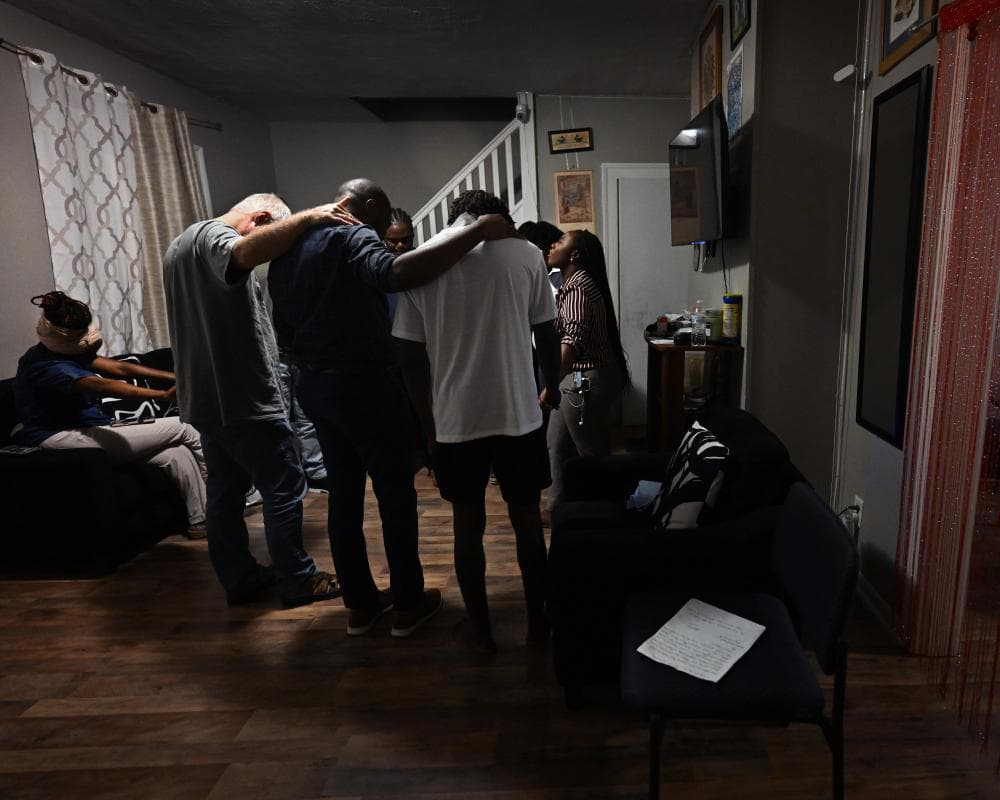
In Springfield, ICE officers have now become a common presence along the city’s main streets and in parking lots where Haitian-owned businesses operate. Haitian churches have seen a huge attendance fall-off and at least 30 Haitians, including two church pastors, have been detained by ICE in recent weeks. For the most part, agents are stopping Haitians driving on the streets or taking them directly from their homes.
“ICE is getting increasingly aggressive. On Saturday, they boxed in a car around the corner from my house and detained the man driving it,” says Marjory Wentworth, a community advocate for Haitian immigrants in Springfield. She later confirmed that the man was a Haitian national. “It’s frightening.”
In a single day last month, 57 people, including children, were deported from the US to Haiti, according to the Miami Herald.
What awaits them there, say those already deported by the Trump administration, is a hellscape.
William came to the US in 2023 after crossing the border with Mexico with an I-94 entry document and headed straight to Springfield. He asked the Guardian not to use his real name as he was attempting to mount a legal case to be returned to the US.
In Ohio, William worked two jobs – at an Amazon warehouse and at a metal fabrication company an hour’s drive from his home. Last March, he married a woman from Springfield, whom he met at a local church.
At his regular ICE check-in last May, however, William was detained by agents, shackled, put on a plane and flown back to Port Haïtien in northern Haiti alongside more than 160 other Haitian men.
“They wouldn’t tell us where they were taking us. All we had to eat was bread and water,” he recalls of his detention and deportation flight.
“I kept telling them: ‘Please don’t send us back to Haiti; anywhere else.’”
In Haiti, the security situation has worsened in recent weeks. Forty-seven people were massacred and 50 more were kidnapped from a farming community outside Haiti’s capital Port-au-Prince on 23 August in the worst single violent incident in several years.
Once back in Haiti, William immediately realized he would be targeted by the growing presence of gang members hunting returnees from the US: On its social media channels Ice has prominently displayed promises of returnees receiving $2,600 in return for self-deporting. In February three people were killed in Ouanaminthe, a border town of 115,000 people in Haiti’s north-east and William’s hometown, by a machete-wielding man, before the attacker was lynched.
“It was so bad that I had to leave again. My mother pleaded with me to get out of Haiti,” said William, who now lives in an unadorned room in the Dominican Republic.
Within weeks, William fled Haiti for a second time, despite widespread persecution and the deportation of over 100,000 Haitians there.
“When I spoke to him over the phone from his mother’s house, I could hear gunfire in the background,” said his wife.
The couple’s troubles haven’t stopped at the Trump administration’s deportation policies. They have spent around $11,000 on immigration lawyers whom they hoped would help William.
“We paid the attorney – one that charged us $8,000 – they were supposed to meet us at the ICE check-in on 21 May. At 11pm the night before, we got a call saying that [the attorney’s] flight was delayed and she would send another attorney on her behalf,” she said.
“This person was from a law office we never heard of, she knew nothing about our case; she was just a stand-in. When we got there, she did nothing. She didn’t tell them that we were married and had an I-130 immigration application.”
Being married to a US citizen does not prevent a non-US spouse from being deported.
In Springfield, the Haitian-owned Keket restaurant, where just months ago people crowded together to watch their national team play in the World Cup for the first time in 52 years, is now shuttered “due to ICE activities”, says a former worker who asked not to be identified. The large strip malls around Springfield that once bustled with Haitians picking up food from cafes and groceries are once again quiet.
Pastor Gilbert Joubert Adrien and a second Haitian man were detained at a gas station on 20 August. Adrien’s wife and children – aged seven and 15 – are now without a breadwinner. He was being held at the Butler county jail, an hour’s drive south of Springfield, that has been criticized for receiving large amounts of federal dollars in return for holding hundreds of detainees for ICE.
A second, unnamed pastor who was detained on 25 August and has been transferred to a facility out-of-state, according to local activists.
Neither man had criminal records at the time of their arrests.
According to his Instagram account, Bel was in the first month of studying physiology and neuroscience at Wright State University, a suburban college 20 minutes from Springfield. Before his death, he worked part-time at a Texas Roadhouse restaurant and had hoped to go on to medical school.
In the UK and Ireland, Samaritans can be contacted on freephone 116 123. In the US, you can call or text the 988 Suicide & Crisis Lifeline at 988 or chat at 988lifeline.org. In Australia, the crisis support service Lifeline is 13 11 14. Other international helplines can be found at befrienders.org