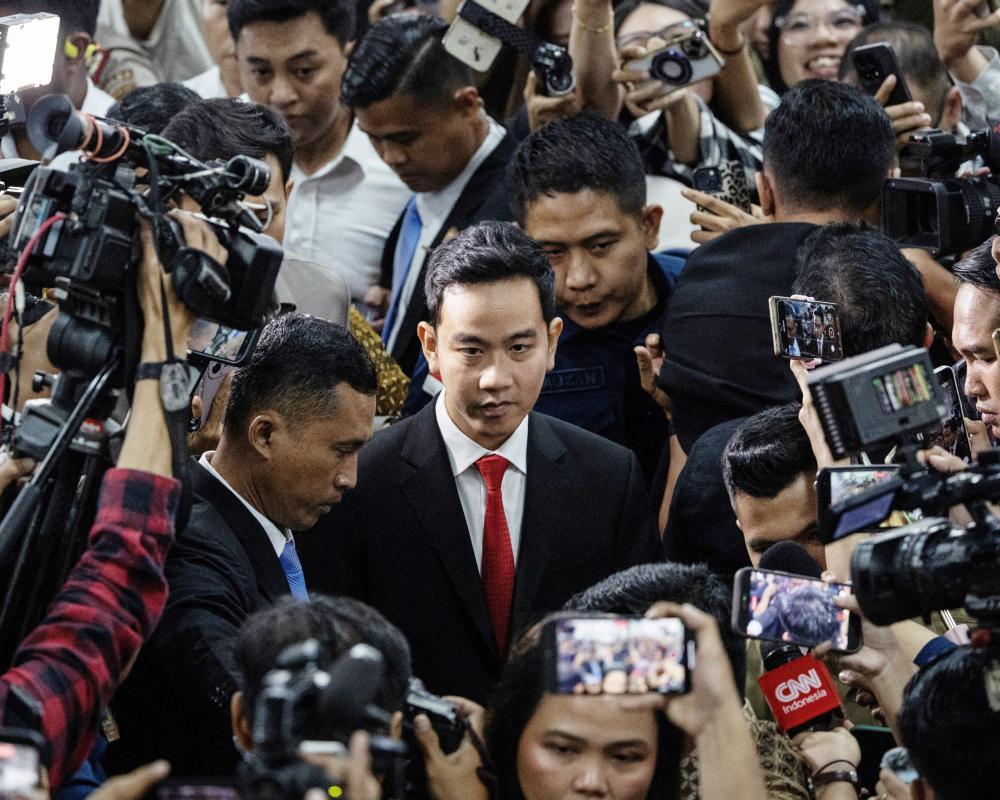
It has been a turbulent few weeks in Indonesia, with claims the president’s phone was tapped, an uneasy political alliance seemingly in tatters, and now the vice-president resigning after a court ruled he never finished high school.
On the face of it, the drama centres on the educational achievements of vice-president Gibran Rakabuming Raka, but there is more to it than that.
Here we explain what happened, why and the deeper political machinations at play in the world’s third-largest democracy.
What led the vice-president to resign?
Gibran, 39, has for months faced questions about his education credentials, including most recently in Indonesia’s constitutional court.
Responding to a petition filed in an attempt to unseat him, the court ruled last month there was “no convincing evidence” that Gibran possessed a diploma, certificate or degree from abroad that could show he ever finished high school.
However, the court said it could not annul the results of the 2024 election, which saw him elected, even though Indonesian law stipulates that having a high school certificate is a prerequisite to run.
Gibran attended Orchid Park secondary school in Singapore and UTS Insearch in Australia, before earning a bachelor’s degree through the Management Development Institute of Singapore.
But this was not enough to quiet his critics.
The millennial leader has struggled to capture the heart of the masses like his father, the wildly popular former president, Joko Widodo, widely known by his nickname Jokowi.
Galvanised by the court ruling, this week the parliament intensified efforts to impeach him.
Gibran met president Prabowo Subianto on Tuesday and offered to resign.
By Wednesday evening, he had stepped down, according to a senior aide.
What is the vice-president’s backstory?
Gibran is a controversial figure, and not just because of his schooling.
Jokowi’s eldest son showed little interest in politics until he ran for mayor of Solo in 2019. Previously he ran several food related businesses, including one selling pancakes filled with chocolate and cheese.
When it was initially suggested he may run for vice-president, there was another eligibility requirement he did not pass: he wasn’t old enough.
However, before the registrations closed the constitutional court created a last-minute exception to the age limit, allowing candidates under 40 to run.
The chief justice of the court at the time was Anwar Usman, who was Gibran’s uncle and Jokowi’s brother in law. He was later found guilty of ethical violations for hearing the case despite the conflict of interest.
Anwar was removed but the ruling remained.
How did we get to this crisis?
In short, it has a lot to do with the deteriorating relationship between Prabowo, a once-disgraced military general, and his predecessor Jokowi.
In 2019 and after a decade in power, Jokowi was looking for ways to continue his influence after stepping down. One way was through his eldest son Gibran, whom he guided onto Prabowo’s presidential ticket.
Prabowo, who had already lost the presidency twice to Jokowi, accepted Gibran as his vice presidential running mate knowing that he could leverage Jokowi’s popularity.
It worked and analysts later said his 2024 victory was in part due to the “Jokowi effect”.
But the alliance has always been tenuous.
Analysts said it was likely only a matter of time before it would break down, and that Gibran would be sidelined.
In another sign of a momentous split, last week it was alleged that Prabowo’s chief of staff, Listyo Sigit Prabowo, who is a longtime Jokowi ally, had wiretapped the president’s phone.
Indonesian police said on Thursday they were investigating treason charges against four suspects in a case, including Listyo, who has not commented publicly about the allegations.
So what happens now?
Things may continue to be rocky.
“I wouldn’t read this as a one-off resignation,” says political analyst Kennedy Muslim.
In the short term the People’s Consultative Assembly (MPR), Indonesia’s top legislative body, will choose the new vice-president from two names the president nominates, within 60 days of the vacancy.
The events will allow Prabowo to clear any Jokowi loyalists from his inner circle and consolidate power around his Gerindra party, but that also carries a risk.
“The more power concentrates in Prabowo and Gerindra, the more discontent has a single address,” says Muslim, noting that president’s popularity plummeted to 44.5% this October, down from 81.2% in November last year.
Facing streets protests, economic turbulence and dissatisfaction with his key policies, such as his free meals program, Prabowo has multiple challenges ahead.
“If his popularity keeps falling, coalition partners who look solid today will start hedging for 2029 behind his back,” says Muslim, of the next election.