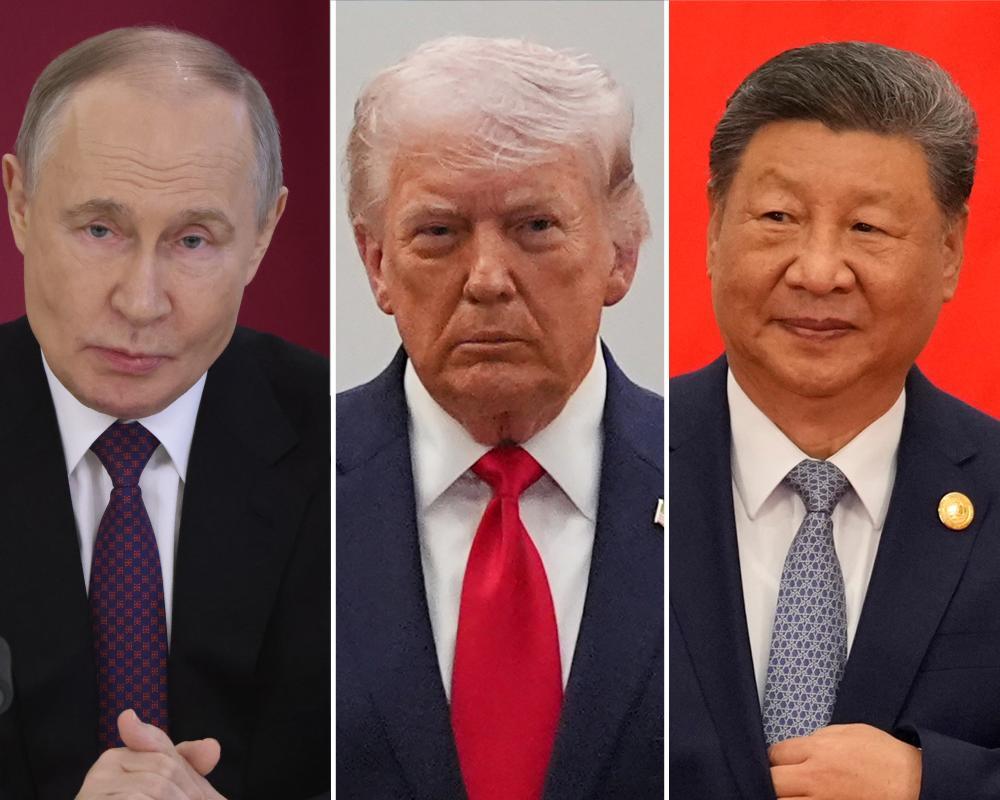
The meeting of Xi Jinping, Donald Trump and Vladimir Putin in Shenzhen this week will cover topics of “groundbreaking significance” including “safeguarding world peace”, the Chinese foreign ministry has said.
The confirmation of Thursday’s trilateral talks, the first of their kind, will take place on the sidelines of the Asia-Pacific Economic Cooperation (Apec) summit and cement Xi’s status as a global power broker as he presides over events in the glittering southern tech hub of Shenzhen.
At the White House, Trump told reporters he would be speaking to his Chinese and Russian counterparts about denuclearisation, the war in Iran, economics, trade and “my favourite subject, Ukraine”. US officials had earlier indicated that Trump would not discuss Russia’s war in Ukraine during the trip.
Trump also said he may meet North Korea’s Kim Jong-un in what would be their first meeting of his second term. “We may meet with Kim Jong-un also,” Trump said. “So that will be good … we have a chance to accomplish a lot.”
Asked whether Kim would be there, Trump said that he “may come”. “I don’t know,” he said. “That’s up to president Xi.”
Many, including the UN secretary general, António Guterres, had hoped the trilateral talks would be used to discuss reductions in nuclear arms between the world’s three largest nuclear powers.
In a call this week, China’s top diplomat, Wang Yi, and the US secretary of state, Marco Rubio, “agreed on the importance of meaningful leader-level conversations to advance goals such as peace and denuclearisation”, the US state department said.
China was the last of the three powers to confirm the trilateral meeting was happening, and its statement stopped short of confirming specific agenda items.
“[The leaders] will exchange views in-depth on safeguarding world peace and promoting strategic stability in major-power relations, which is of groundbreaking significance,” said its foreign ministry spokesperson, Mao Ning. “Stronger communication among China, Russia and the United States, along with managing differences and stabilising relations, serves the interests of all three countries.”
The Kremlin said: “The significance and symbolism of this meeting are hard to overestimate.”
Separately, the Kremlin spokesperson Dmitry Peskov reportedly said on Monday that Putin would meet Kim, too, were he to be invited. “Of course, if he is at the APEC summit,” Interfax quoted Peskov as saying. Peskov made his comments as Putin met a delegation in the Kremlin from North Korea’s ruling Workers party.
Guterres said that if the three leaders “really commit themselves to a meaningful denuclearisation, it will be a great achievement for the world”. However, many analysts have warned to temper expectations of a major breakthrough.
Xi will “bask in the glow of China serving as the convener and agenda-setter”, wrote Brookings’ Ryan Hass in one such take. However, “symbolism may prove more enduring than the substance of this meeting”.
The three leaders would be approaching the talks with very different priorities, Xiaoyu Pu from the University of Nevada told the Guardian.
Related: Yalta became a byword for betrayal. Will Trump, Xi and Putin enact another carve-up?
China has rebuffed previous attempts to become embroiled in nuclear arms talks with Russia and the US, which have the larger stockpiles. Trump, though, has said he wants to talk about denuclearisation, as well as the US-Israeli war in Iran. China, a top economic partner of Tehran, has sought to mediate in the conflict and says avoiding a return to hostilities is a “top priority”.
Trump’s remarks that he wanted to discuss Ukraine could stoke fears voiced by the Ukrainian president, Volodymyr Zelenskyy, that the trilateral talks could turn into a “Yalta 2, 3, 4 with a redistribution of influence”. Zelenskyy was referring to the 1945 pact between the US, UK and Soviet Union that created spheres of influence in Europe after the second world war.
“Ukraine-Russia is losing 25,000 soldiers a month, so we’ll be talking about that,” Trump said. He also deflected criticism of Putin in his remarks, saying the Kremlin leader could be “a lot tougher” in Ukraine and that he was already “backing down”.
US officials had said Trump was not expected to raise the issue, and the German president, Frank-Walter Steinmeier, said Xi showed “irritation” in a recent meeting when the idea of the trilateral talks covering Ukraine came up.
For Xi, much of the political benefit will be simply in “the ability to bring Putin and Trump to the table”, Peter Alexander, the Shanghai-based managing director at Z-Ben Advisors, told CNBC.
The Wall Street Journal reported last week that the Trump administration had pushed back against Beijing’s demands that the summit be tightly scripted, with prepared statements and not much room for discussion.
Sari Arho Havrén, of the Royal United Services Institute thinktank, wrote on X: “China dislikes surprises and wants to ensure neither Trump nor Putin steals the limelight from the host. Moreover, Xi doesn’t want to be dragged into a discussion about Ukraine or anything else he is not prepared for.”