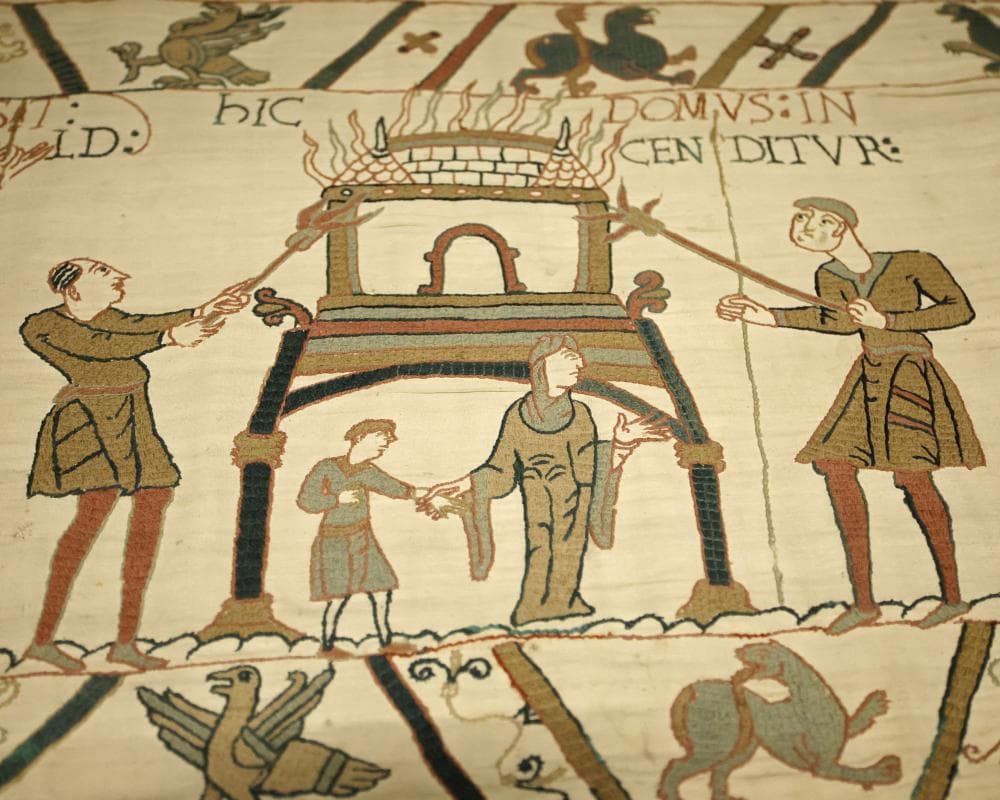
I enjoyed your photograph of Andy Burnham, Macron and King Charles admiring the Bayeux tapestry and the king’s comment about the “entente amicale” between France and the UK (Bayeux tapestry loan symbolises ‘entente amicale’ between France and UK, says King Charles, 2 September). I also enjoyed Burnham’s wry reference to a tapestry that “shows a new leader emerging from a northern territory, travelling to the south of England in search of the crown. Something clearly that couldn’t happen today.”
There is a certain irony, however, in there being, I gather, 93 penises portrayed in the tapestry, and six women – three known and three anonymous. Yet all the beautiful and exquisitely observed needlework was done by women. Observation, detail and creativity – significant and often unremarked.
It would be good to hear more about the women involved and less about male leadership, power grabs and violence. Surely we are living too much with this legacy of an over-concentration on only one half of the world’s population?
Jane Kearey
Bristol
• This exchange of treasures is indeed a welcome symbol of friendship and cooperation – at least for now – between our respective elites. Yet the tapestry itself, and the history around it, portray the recurrent theme of history shaped by (pretty much exclusively) male ego, greed and lust for power; thence deceit, treachery, war, massacre, misogyny and psychopathic levels of inhumanity. Looking around the world today, one muses (perhaps in a Norman accent), “Plus ça change, plus c’est la même chose.” I wonder if we’ll ever find a solution.
Richard O’Brien
Highbridge, Somerset
• Let’s hope Jonathan Jones’s vivid review of the Bayeux tapestry will encourage people to engage with English and British history (The Bayeux tapestry: a stupefying, thrilling, horrifying masterpiece that shakes the earth, 3 September). However, discussing the invasion by the Normans, he states that “William succeeded where those later would-be cross-Channel invaders – Philip II of Spain, Napoleon and Hitler – would all fail.”
True (although the Germans did occupy the Channel Islands during the second world war), but he overlooks the successful invasion of 1688 when another William, the Dutch William of Orange, or William III, invaded with 500 ships and 20,000 soldiers and after some skirmishes forced James II to flee to exile in France, with profound consequences for the religion, constitution and monarchy of England and later Great Britain.
Jones is not alone in forgetting, or misunderstanding, what happened in 1688. In an editorial (28 August), you quoted Nigel Farage as saying, in 2014, that the Bayeux tapestry depicted “the last time we were invaded and taken over”). Let’s hope such ignorance is not widespread and that the loan of the Bayeux tapestry leads to a revival of interest in the study and teaching of history.
Richard Ross
London
• Have an opinion on anything you’ve read in the Guardian today? Please email us your letter and it will be considered for publication in our letters section.