Closing summary
And, on that note, we will be closing the blog for today.
Earlier,
-
Ukraine’s Volodymyr Zelenskyy has asked the leaders for another €70bn next year to fund Ukraine’s defence against Russia as he joined a key EU summit in Brussels (10:10, 13:44, 15:13, 15:26, 16:00).
-
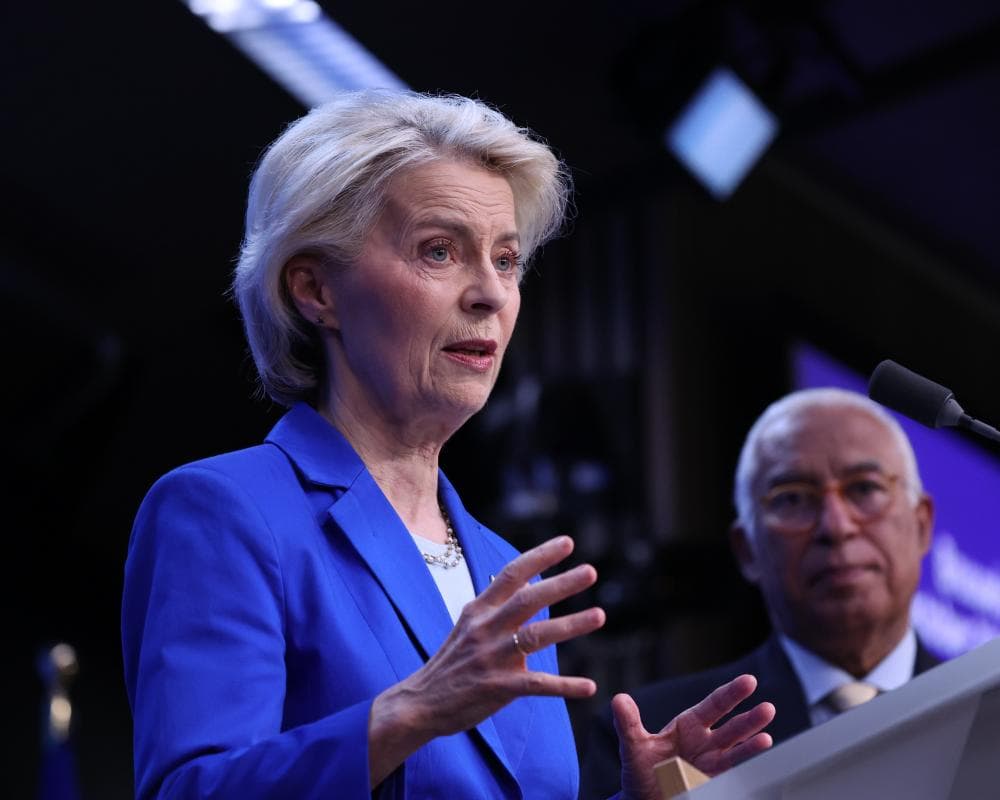
EU’s Ursula von der Leyen and António Costa confirmed the bloc will look at the request (19:01, 19:14, 19:20), as they said the EU’s support to Ukraine “matters more than ever” given growing pressures from Russia.
-
During a press conference in Brussels, Zelenskyy responded to US president Donald Trump’s criticism of his actions (13:51, 13:56, 14:04), and confirmed that Starlink satellite systems were back up, but with speeds not completely restored to previous levels (13:42).
Related: Starlink access still not fully restored for Ukraine’s military, says Zelenskyy
-
Zelenskyy smiled but offered no response to a suggestion he was being used as a “scapegoat” for Donald Trump’s domestic problems ahead of next month’s midterm elections (14:06).
-
German chancellor Friedrich Merz said there was a “broad consensus” on the EU’s need to keep supporting Ukraine throughout this coming winter, acknowledging Kyiv’s request for further financial assistance (16:45), and appearing to back retaliatory strikes against Russian communication and energy supply systems (16:49, 16:54).
-
Several other EU leaders offered their backing for Ukraine, (10:10, 10:21, 10:25, 10:36, 11:09, 11:23), with top EU figures saying the bloc would not lift any sanctions on Russia unless it stops the war (10:10), and criticising Trump’s diesel deal with Russia (10:10, 19:32).
-
Zelenskyy declined to say if Ukraine will be targeting Russian refineries (13:47).
Related: Power plant attacks reflect Russian blueprint to make Ukrainian cities unliveable
-
EU’s Costa insisted the new EU budget needed to be agreed by the end of the year, despite calls to delay its adoption considering a number of big elections in the EU (19:27).
-
The European Commission president, Ursula von der Leyen, insisted the bloc needed a bigger budget with “flexibilities” to respond to various crises (19:12).
-
Germany’s Merz conceded there were still “significant differences” between EU capitals on the budget, with talks expected to continue until the end of the year (16:43, 16:54, 16:59).
Separately,
-
Pope Leo spoke with the Russian president, Vladimir Putin, this afternoon, expressing his grave concern for the humanitarian situation in the Russian-occupied Ukrainian city of Oleshky (17:36).
-
The Kremlin said Putin expressed his support for Leo’s ideas, but blamed Ukraine for the situation in the city (18:22).
If you have any tips, comments or suggestions, email me at jakub.krupa@theguardian.com.
I am also on Bluesky at @jakubkrupa.bsky.social and on X at @jakubkrupa.
Updated
Speaking at the same time, France’s Emmanuel Macron told reporters that he did not consider a diesel deal struck by Trump with Russia as useful.
“This decision is not good for anyone. It sends a negative signal. It a an element of division and doubt,” Macron said after an EU summit in Brussels, Reuters reported.
After some concluding comments on the bloc’s response to the growing sales of Chinese electric cars in Europe, von der Leyen and Costa wrap up their press conference.
Trump insists Starlink restrictions not imposed by the US
Elsewhere, US president Donald Trump insisted that neither him nor Elon Musk was responsible for Ukraine losing Starlink access.
Related: Starlink access still not fully restored for Ukraine’s military, says Zelenskyy
He claimed the restrictions was not imposed by the US, and that he has a good relationship with Ukraine’s Zelenskyy, Reuters reported.
Costa gets asked if he is more confident that a deal can be found by the end of the year.
And there is also a question about Marine Le Pen’s suggestions that the budget should not be decided this early given so many key elections in Europe next year that are likely to reshape the political landscape of the continent.
Costa repeats Merz’s point from earlier that it usually takes about a year to implement a budget (16:59), and anything that would threaten to delay its entry into force from January 2028 puts it a risk altogether.
“This has nothing [to do] with elections,” he says, and adds if that was a consideration, there would never be a good moment as there are always elections somewhere.
“But unfortunately, the life is not only elections. We are talking about our farmers, our companies, our students, our researchers, our universities – and they are waiting for new European funds.”
Asked about Ukraine’s new financial needs, von der Leyen says that 2026 is covered, but confirms the gap for 2027 is around €70bn euros.
Updated
On migration, von der Leyen says all leaders recognise “enormous progress” made on this issue in recent years, but more needs to be done.
He says the number of illegal crossings has gone down by over 56% in the last two years, and down by 34% in the first nine months of this year.
Asylum applications are also falling, she says.
“These trends need to continue to remain successful.”
She says there is a “new phenomenon” of state and non-state actors trying to “engineer sudden mass movements of people … to overwhelm the authorities.”
It will come as news to the likes of Poland and Lithuania that it’s anything new given the pressure from Belarus for years.
Updated
EU's support to Ukraine matters more than ever, von der Leyen says
Von der Leyen then turns to Ukraine.
She says the EU’s support “matters more than ever.”
She says the bloc “is doing a long, but the reality is simple: as long as this war continues, Ukraine’s financing needs will keep growing.”
“Right now, the European Union and its member states account for 80% of external aid to Ukraine, and we will continue to lead. But we urgently need also other partners to step in.”
She ends:
“As throughout these five years of war, no one wants more peace than the people of Ukraine, and it is our duty to support them, to be in the position to find a just and sustainable peace for Ukraine.”
Updated
Von der Leyen also mounts a defence of the commission’s proposal on the next EU budget, effectively saying that as leaders keep coming to the EU asking it to fix things, it’s understandable that it’ll need more resources.
“If there’s one lesson we have painfully learned over the last seven years, that is the lesson that we are in a very fast changing and volatile world and that there will be more crises. We just don’t know what is going to be happening. … I could only act in these crisis because of the flexibilities in the budget … and in each crisis, everybody was calling for Europe to step in.”
He says the new proposals have “even less flexibilities,” and so the commission is not happy with them.
“The question before us is not which priorities we should abandon, but how to finance these priorities.”
Commission president von der Leyen speaks next.
She points out to high energy price increases since the start of Trump’s war against Iran.
“This is the reality we have to deal with today, and we discussed this intensively with the member states. Because of the fact that the member states have very different energy mixes, we know there is no silver bullet as a solution.”
She says the G7-agreed release of oil and diesel, the EU’s extension of temporary state aid framework, and some other technical changes should provide some relief.
“For the mid term, it is important that as long as Europe depends on imported oil and gas and our prosperity remains exposed to the events beyond our control, it is important for us to stay the course of the transition; that is a transition towards affordable, clean and homegrown energy sources, … nuclear and renewables.”
She talks about the need to “modernise and improve our grid network” in Europe.
She also briefly discusses proposed changes to the ETS system and the EU’s trade with China, saying there was a “remarkable unity” on the latter point to reduce the “unsustainable” bilateral trade deficit.
Updated
Finally, on migration, Costa says the system is “working but … must still be improved.”
“Migration remains a very political issue where there are different political visions which are known to all of you. The European Council will continue to work on this issue,” he says.
'Ukraine remains a central priority for Europe,' EU's Costa says
On the next EU budget, Costa says the negotiations will need to conclude by the end of the year, and there was some progress made.
But with lots of diplospeak, he admits that there are still some differences between different countries, and so he needs to “accelerate” the work on this issue.
On Ukraine, he says “Ukraine remains a central priority for Europe.”
“Our resolve to stand by Ukraine and its people is as strong as ever. At the same time, every genuine step towards peace matters and we support all genuine efforts towards it. Unfortunately, Russia’s action point the other way.”
He calls for “more pressure on the aggression, not less,” and for more financial support for Ukraine, with a request to the commission to propose new funding.
He warns:
“Supporting Ukraine has never been more relevant as Moscow is intensifying its hybrid campaigns across Europe. We see acts of sabotage and repeated violations of member states airspace in territorial waters.”
Updated
EU’s Costa opens the presser.
He talks about good discussions on cutting red tape and competitiveness of the bloc, and confirms what Merz said earlier about a special meeting on this issue in February next year (16:43).
On energy, he says that “current volatility on energy prices [is] putting intense pressure on households and businesses.”
“This crisis is triggered by events far beyond our borders, but we are also paying the price of our dependency on fossil fuels and the lack of a single market for energy. Given the urgency of the situation, there cannot be business as usual.”
He says there will be a united EU response to this issue.
He also talks about discussions on trade policy, with “total unity among the member states” on supporting the bloc’s efforts to diversify trade routes. Again, he references Merz’s proposals for a new trade instrument.
“Still someone here,” von der Leyen jokes as she gets to the podium.
Just about, Ursula. Just about.
EU's von der Leyen and Costa brief the media after two-day EU summit - watch live
Finally!
I will bring you the key lines here, but you can watch along here:
More leaders are now (finally) leaving the room, so hopefully not long now before we get that closing press conference with von der Leyen and Costa.
Kremlin says Putin told Pope he is supportive of ideas to help civilians in Oleshky
For what it’s worth, the Kremlin says that Vladimir Putin supported Pope Leo’s initiative.
“The Vatican’s intention to help create the conditions necessary to ensure the safety of the town’s population and to organise vital supplies has been supported,” the Kremlin said in a statement.
“It has been agreed to cooperate on this matter.”
But it stressed that Putin “offered a comprehensive explanation of the Kyiv regime’s responsibility for the difficult humanitarian situation there.”
Let’s see if they follow through on this.
Updated
Pope Leo urges Russia's Putin to allow first aid into Russian-occupied city, allow evacuation
Oh, that came out of nowhere?!
The Vatican says Pope Leo – still in hospital after his lung surgery earlier this week – spoke with Russian president Vladimir Putin this afternoon, expressing his grave concern for the humanitarian situation in the occupied city of Oleshky.
Related: ‘Hell on earth’: last residents eat weeds to survive in Russian-occupied Oleshky
He asked Putin to allow entry of first aid and food supplies and to permit a voluntary evacuation of the civil population in the town.
The full statement reads:
“Today, His Holiness Pope Leo XIV spoke by telephone with His Excellency Mr Vladimir Rutin, President of the Russian Federation.
During the conversation, the Holy Father expressed his deep concern shout the grave humanitarian situation in the city of Oleshky, in the Kherson region, and called for a ceasefire to allow the delivery of food and medical assistance, and the voluntary and safe evacuation of the civilian population.
Finally, the Holy Father reaffirmed the Holy See’s commitment to promoting dialogue and peace. “
Updated
EU’s von der Leyen and Costa are also expected to brief the media about today’s talks at some point… Let’s see.
Merz stresses urgency of getting political agreement on EU budget
Finally, Merz gets another question on the next EU budget and competing interests, claims and demands from various countries, including from Marine le Pen, who leads the polls ahead of next year’s presidential elections in France.
Merz says it has been a good practice to agree the financial deal “roughly a year before” it kicks in, and says this time is needed to prepare its implementation at the technical level – more so than political discussions linked to various elections.
Aaaand with that, he’s gone.
He is off to Bonn next I think, where he is expected to attend a big meeting of the youth arm of his CDU party as he continues to face domestic criticism over his style of governance.
Merz gets asked if he had any words of advice for Zelenskyy.
He says he wouldn’t offer any advice publicly as the two talk regularly to each other.
He says he is aware that the Americans have other interests as well, but the Russian invasion on Ukraine is “an assault on the political order across all of Europe.”
He also takes note of Russia’s own actions to place European companies in Russia under state-mandated administration, and says the government will examine these cases closely.
But he says the leaders also discuss a further restrictions on “a very large number of visas still being issued to Russian citizens travelling to the EU.”
“There is certainly room for us to restrict this type of travel … If Russia chooses to respond, we will be ready with a reply,” he says.
He also gets a question on migration, and he says this discussion is still ongoing – but reveals that other leaders, including the Greek PM, noted “enormous progress” made in recent years.
Back to the question of further financial support to Ukraine, he says no decision has been made on the form in which this could be offered.
Merz backs Ukraine's strikes on Russia's communications, energy infrastructure in response to attacks
Merz gets asked about the fallout between Zelenskyy and Trump, and what can be done about it.
He says he is in regular contact with Trump by phone, and will see him in person “by December at the latest.”
But focuses on saying that he sees “no willingness on the Russian side to end this war,” with all indications actually going in the opposite direction as “the escalation continues.”
“Against this backdrop, I believe it is appropriate, logical, and understandable for Ukraine to strike targets within Russia that hinder the war effort of the Russian government and the Russian army – including both communication and energy supply systems.”
He says that’s “the only means Ukraine has to signal to Russia that it is prepared to defend itself.”
'Broad consensus' to keep supporting Ukraine, but details on funding yet to be agreed, Merz says
Germany’s Merz gets asked about the discussion with Zelenskyy and his request for more money for Ukraine.
He says it was more of a discussion with no formal decisions, but says “we are all very concerned about the situation in Ukraine.”
He says there is “a broad consensus” to keep supporting Ukraine “through the winter and into the coming year,” with the commission “assessing the financial requirements,” acknowledging the €90bn loan from last year may not be enough.
He says further discussions on this are expected in November and December.
Updated
'Significant differences' on EU budget, but broad support for new trade instrument, new proposals for automotive industry, Merz says
German chancellor Friedrich Merz is the first national leader to leave the room, and he’s now briefing reporters on today’s talks.
He begins by saying the talks are “not quite finished yet,” but gives a bit of a readout from the discussions.
He says the leaders discussed the issue dear to his heart, namely how to improve the bloc’s competitiveness, and agreed that “only an economically strong and sovereign Europe can hold its own in today’s world.”
He says the leaders will meet to discuss in again in early February.
He also says there was “unanimous, unequivocal” support for a proposal put forward by Macron and Merz on trade policy, with a new instrument to “allow for rapid response” to any imbalances (as covered on the blog on Wednesday).
On the EU budget, he says there are “significant differences” in how countries look at this issue, as “a smaller group” calls for the budget to be reduced, and “a larger group” want it to be expanded further.
“We are all facing the need for substantial fiscal consolidation at home; it is simply not tenable for the European budget to increase by around 50% during the same period,” Merz says.
He says there will be likely an extra council in November with a “multi-day session” in December to discuss this further. He hopes for a deal before the end of the year, but is not sure if that’s going to happen.
Merz also welcomes a new German-French deal on the future policy on automotive industry, concerning certain technologies and climate targets.
“To put it simply: the phaseout of internal combustion engines is now off the table. We are receiving a great deal of support for this,” he says.
The focus is on “technology neutrality,” he says, adding that Italy is “largely in agreement” with the proposals, too.
“This now needs to be integrated into the formal legislative process, but I believe we will be able to reach a final decision at the European level quite quickly. If the European Parliament follows this path, then we will have solved this major problem together,” he says.
Updated
EU talks move on from Ukraine to migration and Ceuta
in Brussels
EU leaders have finished their talks on Ukraine and hybrid threats in Europe in the last half hour, according to an EU source. They now move to the topic of migration, where sudden influx of arrivals in Ceuta is likely to be in focus.
Zelenskyy asks for another €70bn to fund Ukraine's defence against Russia - snap analysis
in Brussels
Ukraine’s president Volodymyr Zelenskyy has asked the EU for another €70bn next year to fund Ukraine’s defence against Russia.
According to a transcript of his remarks, he told EU leaders that the war will cost €155bn in 2027 (15:13).
“And we need at least €70 bn more from you – for defence, for weapons, and for our resilience. This is a realistic amount.”
The EU is currently giving Ukraine regular payments from a €90bn funding plan agreed last December that was intended to cover two-thirds of Kyiv’s civilian and military needs for 2026-27. The remaining third was to be filled by other “international partners”, such as the UK, Canada, Norway and Japan.
The realisation that Kyiv again risks a financial crunch has put Russia’s €210bn assets frozen inside the EU back on the table. The EU takes the profits from those assets to support Ukraine, but last year decided against using the funds themselves, instead opting for an EU-backed €90bn loan.
Belgium, which hosts the vast majority of the Russian funds, remains strongly opposed to using the frozen assets, fearing it will be left to carry the financial burden if the plan went wrong. But Zelenskyy said there could be an alternative.
“We need something like a special EU-controlled custodian to reduce the risk of them being unfrozen and divided up among those who clearly do not want what is best for Europe or an end to this war.”
The European Commission, a strong backer of last year’s failed frozen assets plan, has been reluctant to propose new variants – such as an EU-controlled custodian – because it fears running into same opposition from Belgium and other sceptical member states.
Ahead of the summit Belgium’s prime minister Bart De Wever said Zelenskyy would “probably look everybody straight in the eye and say, thank you for the 90 billion, but that money is going to run out because a war is a very costly thing”.
De Wever said:
“So are you, as a European family, still willing, ready and able to put your money where your mouths are and support Ukraine and keep Ukrainian society and Ukrainian defence up and running?”
Updated
Zelenskyy warns against Putin using energy to 'tempt the world into looking the other way'
The full text of Zelenskyy’s address, released by his office, also includes some further interesting nuggets.
Describing Putin’s Russia as an existential long-term threat to Europe, he explained:
“Some of today’s European leaders, some of today’s people running in elections and taking part in politics in your countries were still at school when Putin was already waging war. And even back when Bill Clinton was still President of the United States, Putin was already waging war. Against the Chechens. And that war taught Putin a lesson.
If he uses oil and gas to tempt the world, many politicians look the other way – even when cities are turned to rubble and villages are burned to the ground. That is exactly how Putin has been running things ever since. And he always has some “excuse” for why he can’t live in peace with one country or another.”
He also tried to set out a pan-European logic for fighting Putin, saying:
“That is why the EU – and your unity, and every truly independent European country – is a target for him.
Not because you are doing something wrong. Not because someone once offended Russia or failed to give Putin something he wanted. Putin only gets along with those who want to wage wars themselves and have no respect for human life. If he wins, everything that holds you together and keeps your people living in peace will simply be gone. Look at what he has been saying all these years. He has a problem with everything that happened after 1985. We don’t want to go back there.
It’s important that people understand this across the whole European Union – from Poland and Finland and all the Nordic countries to France, Spain, and Italy.
We may argue and disagree on politics. Sometimes we have serious disagreements over decisions. And that’s normal for democracies – I’m sure.
Despite all our differences, we all want the same thing – a security system that really works and can deal with today’s threats.”
There is also a nice touch as Zelenskyy paid tribute to Italy’s Giorgia Meloni – although she is not mentioned by name – after she delivered a rousing speech in the Italian parliament, explicitly warning about Russia.
Speaking in the Senate on Wednesday, Meloni said:
“If Ukraine stopped defending itself tomorrow, as many are hoping and proposing, we would not have peace. We would be discussing the occupation of a European nation and the return of the Soviet-style imperialism that Europe has known for half a century.
Personally, I don’t miss those years. I don’t miss the Russian tanks that repressed the uprisings in Prague and Budapest. I don’t miss the Berlin Wall.”
Zelenskyy responded to that in his speech:
“I am grateful to every one of you who does not miss the tanks that crushed the uprisings in Prague and Budapest – or the Berlin Wall.”
You may think it’s a small detail, but be in no doubt: everyone in that room knew what he referred to.
Updated
Zelenskyy's address to EU leaders includes targeted praise for 'people with good hearts' in America and request for further funding for Ukraine
Ukraine’s Zelenskyy has just released five clips from his earlier address to the EU leaders, delivered behind the closed doors, and there are some really striking bits there.
He started with general praise for the EU …
“Unity in defence is always built by many, many standing together, and without a determined European Union capable of making strong decisions, Putin would have gone much further by now.
The European Union has not fallen apart, and it has not backed down or given in to fear when it came to defending the European way of life, and that mattered just as much as the courage of Ukrainians.”
… before turning to the most controversial issue of Ukraine’s relations with the US under Trump, and seemingly making a direct reference to the upcoming midterm elections in the US.
“I am grateful to all of you who are trying to keep Europe and the United States together. There are so many people with good hearts in America who sincerely want evil to lose and Ukraine to stand strong, and these are the very hearts that helped Europe defend its freedom and that fought on D-Day, won the Cold War and won want is best for Europe, Hearts that want to be allies, not to divide or humiliate Europe, and I believe most Americans still feel this way.
And at the end of the day, the American people will have their say.
Putin will listen to America if America really turns up the heat on him and makes one thing clear: either he chooses peace or he gets no more money for his war.”
Zelenskyy also specifically criticised the US-Russia diesel deal once again, warning that lifting any sanctions anywhere will create incentives for Russia to try and get them removed elsewhere – just as what is needed is exactly the opposite.
“We warned that if sanctions are eased … anywhere in Europe, others will quickly … take advantage of it, and now we can see how cash will start flowing back into Russia through the diesel deal.
This diesel deal will never be enough to offset the impact of the Strait of Hormuz on global markets, but it will put more money straight into Putin’s pocket to fund this war.
And we need a strong 22nd package, EU sanctions package, please. And please, we need real sanctions against every company and every person involved in making Russian ballistic missiles, advanced communications systems, and drones, and those involved in Russia’s financial system.”
He also laid bare Ukraine’s pressing financial needs, asking for this issue to be included in planning for the EU’s next budget:
“The war will cost 155 billion euros next year, and we need at least 70 billion euros more from you for defence, for weapons, and for our resilience. This is a realistic, yeah, a realistic amount.
And I ask you to find this support. It will help us hold Russia back.
And there are some very simple facts. We stop most Russian assaults on the frontline thanks to drones, and we cut Russian supply lines with these technologies. Our drones are helping to weaken Russia’s economy.
Right now, we could produce two or three times more drones, depending on the type. But we simply, simply, don’t have enough money for that. It’s true. Just imagine if we could put two or three times more pressure on Russia than we do today.
We believe this war will be over as soon as possible, but Putin plans to stick around much longer.
He is building a Russia that looks like North Korea, where children are raised from an early age for war and to die for their leader.
So Russia will not stop being dangerous, and it’s our Ukrainian strength, our army, our technology that help guarantee also European security, your security.
These security guarantees are not yet reflected as we think in your budget from 2028 onward. So let’s get serious about it. Let’s work out exactly how Ukraine’s defence capabilities should be included in that budget.”
Updated
That’s a brave response from Zelenskyy, but I’m not sure he had any better option available to him. We all know the answer to this question.
Zelenskyy smiles at suggestion he's a 'scapegoat' for Trump's problems ahead of midterms
Oh, that’s tasty.
Zelenskyy got asked by Sky News if he feels he’s being treated as a scapegoat for Trump’s domestic problems ahead of the tricky midterm elections.
In response, he pauses for 15 seconds, and eventually smiles before saying:
“This is my answer.”
Ouch.
And the press conference immediately wraps up after that.
Updated
Putin 'wants to destroy us' as he questions Ukraine's 'existence,' Zelenskyy warns
Asked again if he’s feeling some pressure among European leaders or fearing potential changes in European politics with big elections coming up next year, he says that he “feels full support from Europe now.”
“Europe is very united and it’s cognisant of all of the risks,” he says.
He says the war clearly shows “major risks for Europe” as he recalls recent incidents in Bulgaria, Germany, Poland, Romania.
“Europe understands as long as Ukraine stands, there will be fewer escalation with Russia,” he says.
He says Russia’s demands are not about Donbas or any part of its territory, but about “our country’s existence.”
“We’re now standing and fighting. What’s the alternative? Annihilation.”
He says Putin “wants to destroy us,” and “does not respect our sovereignty and territorial integrity.”
“So you really trust that he needs only a part of our country?”
He also warns that any further progress in Ukraine could also trigger a wave of Ukrainian migrants in Europe.
Zelenskyy says that he often hears from Trump that he just wants to “stop the killings.”
“Yes, [but] Russia is killing us, on our territory. They came on our land and further pushing further. They don’t want to stop. They even don’t want to freeze [the conflict], as you see. And what will be after that? On what borders will he [stop]?”
Visibly frustrated, he says that more than 1,000 drones were sent to Ukraine yesterday, but the American side “said that it’s difficult to speak with Zelenskyy.”
'I’m only standing up for Ukraine’s interests,' Zelenskyy says after Trump's comments comparing him with Putin
Zelenskyy gets asked about Trump’s comments that he is more difficult to deal with than Putin (11:09).
He says that in his meetings with Trump he always found topics for discussion and decisions.
“I’m only standing up for Ukraine’s interests,” he says, responding to Russian attacks.
“And no matter how Russia would like to limit all of our rights, it’s clear that we do have a right to defend ourselves.”
He says Putin “does not seek negotiations in any format,” but only “playing these games of words.” “He does not want the war to end,” he says, saying Putin’s actions are a “parody” of efforts to end the war.
He says that’s why he cannot accept any diesel deals with the US, because they will then be followed by gas agreements or other attempts to lift sanctions on Russia or its frozen assets, banking system, chemical industry, certain Russian individuals.
“If I don’t stand up to this, if I don’t defend it, who else will do this diplomatically?”
Updated
Zelenskyy praises 'very good' meeting with Hungary's Magyar
Asked about his relationship with Hungary’s Magyar (13:08), Zelenskyy says it was “a very good meeting” on the economy, logistics, energy.
He says he is “not against” meeting the Hungarian PM in Budapest next.
Zelenskyy says he heard 'only support' from EU leaders despite his clash with Trump over diesel deal
Zelenskyy gets asked if he heard any criticism from fellow leaders to his response to the US deal with Russia on diesel.
He says he “heard … only support,” and he is “grateful to them for this.”
He says the diesel deal caught Ukraine by surprise, and he believes Ukraine “should be aware of these things.”
He says despite all of that Ukraine is ready to support an energy ceasefire, but “it all depends on Russia and they do not want it.”
“And if there is no energy ceasefire, give us anti-ballistic missiles so that I can protect my energy facilities – … not too many, but for the period … of the diesel deal.”
He says Ukrainian negotiators are in touch with their US counterparts, and “in the coming days, they will arrange a meeting at a certain level,” and they will keep discussing it.
Zelenskyy declines to say if Ukraine targets Russian refineries
Zelenskyy gets directly asked if Ukraine is hitting refineries in Russia.
He says he “usually don’t communicate” the details of Ukraine’s military operations, but says “the main rule of our operations is to respond.”
Earlier he said Europe is “making certain steps” to have its own track in peace negotiations, but he didn’t offer more details on that.
Europe has enough interceptors to help Ukraine get through winter, Zelenskyy says
Zelenskyy says that Ukraine’s requests for further help ahead of this winter cover “the bare minimum” needed.
He says it’s unclear what Ukraine could get, but he is confident that European countries have enough interceptors to share and “go through this winter.”
He also says the focus is on producing a new anti-ballistic system and make it “quicker to produce, cheaper to produce” and then share with the rest of Europe.
Updated
Zelenskyy says Starlink speeds not completely restored, Ukraine struggling with air defence
Zelenskyy then gets asked about media reports that Ukraine is running out of Patriot interceptors and its reliance on Starlink.
He acknowledges that Ukraine is “not a priority destination” for deliveries funded by Europe, but thanks for all help it can get.
“We are picking them up where we can: one or two here, five there, ten there, arranging all of this and bringing them to Ukraine,” he says.
On Starlink, he says Ukraine “is working with some countries, including France” on additional capabilities.
Zelenskyy also addresses the issue of intelligence sharing with Ukraine.
He says “many countries are sharing their intel with us, … dozens of countries.”
But he then gets asked again for a straight clarification on what is the status of both Starlink (or its military version, Starshield) and US intel.
On Starlink, he says “certain speed levels are needed” for its military to work properly – not for “deep strikes inside Russia,” but for its defence operations, particularly against Russian jet-powered drones.
“This is why it was a very dangerous and unpleasant surprise,” he says.
“Starlink was not turned off, but the speed limits were lowered … and we were incapable of shooting down some Shahed drones, and were no longer able to use one of the tools to protect our population,” he says.
Jet-powered Shaheds move at 400 km/h, and the speed limits were reduced to 70 km/h, he says.
He says the technology is also used for “mid-range strikes against military targets,” and for logistics deliveries.
“Our defence ministry is in touch and my partners, they told me that there were signals from the White House that they would return these capabilities. Have they returned to the previous speed limits? No. But is it coming back now? Yes.”
Updated
Ukraine expects additional F-16s by the end of the year, Zelenskyy says
The briefing kicks off with Zelenskyy getting a question about Russian frozen assets and Belgium’s opposition to the issue.
He says by thanking Belgium for hosting the summit and for his meetings with PM de Wever and the Belgian king, Philippe. Ukraine expects additional F-16 from Belgium to be delivered by the end of the year.
Turning to frozen assets, he says “of course” he is raising this issue again.
He says Ukraine “would want to receive these funds in a certain format” and wants them to be safeguarded from Russia, “because we know very clearly that they want to bring these assets back.”
Zelenskyy holds press conference after talks with EU leaders - watch live
Zelenskyy is finally here to brief the media after his EU talks in Brussels.
I will bring you all the key lines here, but you can also watch along here:
Hungary's Magyar hopes for new opening with Ukraine after talks with Zelenskyy
We are still waiting for Zelenskyy to show up to his press conference, but in the meantime we have just heard from Hungary’s Péter Magyar after his first meeting with the Ukrainian president.
The pair have a long list of tricky topics to discuss given Hungary’s tense relations with Ukraine under the previous government of Viktor Orbán, including the issue of minority rights for Hungarians in Ukraine, which is critical to Kyiv’s ambitions of joining the EU.
But the noises coming from that meeting are positive.
In a statement after the talks, Magyar welcomed the Ukrainian parliament’s adoption of a new law on minority education as “a first step towards restoring mutual trust,” and the two sides will “continue consultations … at the ministerial level.”
“We agreed that it is in the interest of both countries to place their political and economic relations on a new foundation,” he said.
In sharp contrast to his predecessor, Magyar also declared his strong solidarity with Zelenskyy “in the face of inhumane Russian aggression against his country.”
“Hungary stands ready to provide assistance, through all available diplomatic means, towards achieving an immediate ceasefire and a lasting peace,” he said.
Updated
Back to Brussels, we are expecting to hear from Ukraine’s Volodymyr Zelenskyy shortly, as he is about to deliver a press conference after his talks with EU leaders.
I will bring you all the key lines here when he steps up to the podium.
Italy sees air traffic disrupted by data issues, but rules out 'malicious activity'
Separately, Italy is struggling with technical issues affecting the data transmission network for air traffic control, with lengthy delays at airports across the country affecting thousands of passengers.
Transport minister Matteo Salvini is “monitoring” the situation closely, his ministry said, with particular focus on ensuring the safety of operations, La Repubblica reported.
The air navigation operator ENAV ruled out any “malicious activity,” and said the disruption was due to technical issues with the system managed by telecom operator TIM, Corriere della Sera said.
Italy, Spain reportedly close to dropping post-Ceuta temporary border controls
Italy and Spain are reported to be close to dropping temporary border controls, introduced after the migration crisis in Ceuta in late August.
The move, reported in the Italian and Spanish press, was reportedly discussed on the sidelines of the ongoing EU summit in Brussels, with Spanish PM Pedro Sánchez and Italian PM Giorgia Meloni meeting on Thursday night.
The current thinking includes Italy extending its measures for seven days to align their expiry date with the Spanish restriction, when both would get lifted simultaneously on 22 October, El País reported.
Italy first suspended Schengen arrangements with Spain in late July, much to criticism from Spain.
EU leaders call for progress on European Starlink rival
In their doorstep comments, EU leaders also called for Europe to do more on reducing Ukraine’s dependence on the US Starlink satellite communications system.
The bloc’s foreign policy chief Kaja Kallas said Europe did not have a readily available alternative to technology controlled by Elon Musk’s SpaceX, AFP reported.
“Starlink is really necessary for Ukraine and unfortunately in (the) short term Europe can’t replace this capability,” Kallas said before the talks.
“Starlink is the key for Ukraine actually to fight or fight back,” Latvian prime minister Andris Kulbergs told reporters.
Dutch prime minister Rob Jetten said he had discussed with French president Emmanuel Macron “how we, as Europeans, can provide more of these kinds of services in the not too distant future”.
Bloomberg reported that the European Union will look to fast-track antitrust approvals for a rival European project.
'European leadership needed to ensure people are ... protected from Russian terror,' Zelenskyy says
Ukraine’s president Volodymyr Zelenskyy said he discussed financial support for Ukraine with the presidents of the European Commission and European Council on the margins of the EU summit in Brussels.
In a post on X, he said:
“I had a good meeting with the President of the European Council, António Costa @eucopresident, and the President of the European Commission, Ursula von der Leyen @vonderleyen.
Right now, there are no signals from Russia that it is ready to end its war. The signals it is sending point to something entirely different and certainly do not bring peace any closer. After overnight Russian strikes on energy infrastructure, Russia carried out a horrific strike on Kharkiv this morning. Two people have already been reported killed. My condolences to their families and loved ones. Seventeen others were injured. Russia also struck a shopping mall in Rivne and energy facilities in four regions.
European leadership is needed to ensure that people’s lives are sufficiently protected from this Russian terror. We appreciate that everything we agree on is implemented promptly. Today, we discussed further assistance, first and foremost for our energy and air defense needs. We talked about support for our financial resilience, including for next year, and coordinated our work on the European integration track. It is important that new negotiating clusters were opened this week. We are working to open the remaining two by the end of the year. Thank you, António! Thank you, Ursula! Thank you, EU!”
Zelenskyy gets warm welcome from EU leaders ahead of his summit address
Several leaders offered Zelenskyy very friendly welcome or, in some cases, simply a big hug as he walked into the room before the formal part of the meeting got under way.
Updated
Frederiksen rejects Trump's suggestion Zelenskyy is 'more difficult to deal with than Putin'
Speaking to Newsmax last night, Donald Trump repeated his views of the two leaders involved in the conflict.
“I’m not a big fan of Zelenskyy,” Trump said. “I think they actually both would like to see it end, but I think I find Zelenskyy to be more difficult to deal with than Putin.”
Related: Trump calls Ukraine’s renewed strikes on Russian oil refineries a ‘disgrace’
But Denmark’s influential PM Mette Frederiksen has made it clear in her doorstep comments that she did not agree with that view.
“I disagree with what was said last night; fundamentally, I do not believe Putin can be trusted nor that we should be cooperating with Russia.”
“So, our perspectives on this differ significantly. It is crucial that everyone in the Nato alliance understands that when Europe is attacked, European security – and by extension, the security of the entire alliance – is under threat. Therefore, we must continue to defend ourselves, while also continuing to build up our military capabilities.”
Denmark's Frederiksen calls for further support for Ukraine
Denmark’s prime minister, Mette Frederiksen, has also acknowledged the situation is very difficult given tensions with the US just as winter is “fast approaching.”
“We must continue to support Ukraine. Otherwise we are making things far too easy for the Russians,” she said.
She warned that Ukraine is running out of funds as “fighting a war is expensive,” adding that in many cases the country cannot produce the equipment it needs, particularly for air defence.
“As a result, you can see that the Russians are striking Ukrainian society much, much harder than they were not that long ago,” she said.
Frederiksen stressed that the EU must ensure there is sufficient funding in place for 2027.
She also pushed back against any suggestions on closer relations with Moscow, warning that Russia continues to “seek to seize parts of Europe” and “wages war against Europe every single day, directly in Ukraine and through a hybrid war against the rest of us.”
“If Russia wanted peace, they could simply stop the war,” she said.
She also dismissed media reports that some European leaders had asked Zelenskyy to tone down his criticism of Donald Trump. “I haven’t heard any European leaders say that,” she said.
Situation in Ukraine 'really grave' and talks with US are 'very difficult,' EU foreign policy chief warns
EU’s foreign policy chief Kaja Kallas warns on arrival that the situation in Ukraine is “really grave” with “no signs from Russia that they want to stop this war or into any sort of truce or peace.”
“We need to support Ukraine, also to get through the winter, because winter is going to be harsh,” she warns. “And that’s why we really need to help Ukrainians to survive, to defend their country.”
Kallas says she expects the issue of frozen Russian assets to be raised again today.
She says “we have agreed that we will not return the frozen assets, unless Russia pays reparations for Ukraine.”
She says the EU is “trying to convince also our American partners” that more pressure needs to be put on Moscow.
“But you can see that with our American allies, it’s very difficult at the moment.”
Irish PM calls for 'a European response' to Ukraine's needs and outreach to the US
Irish PM Micheál Martin got asked about Ukraine on his arrival, too.
He said “the very severe pressure that Ukraine is under needs a European response,” with the opening of the accession clusters, and the deploying of the EU’s €90bn loan to Ukraine as soon as possible.
He also says there needs to be a “clearer landscape” on what the EU can offer Ukraine in medium term, “whether it’s immobilised assets or other mechanisms.”
“I am conscious on the last occasion, we strongly supported the issue of the seizure, the seized assets and whether they could be deployed. But that came to nought in the end.”
He says Europe needs to “maintain the pressure on Russia.”
But he also notes that he wants to see “a continuing outreach from Europe to the United States,” making representations that “as far as Europe is concerned, Russia has been the aggressor from the beginning.”
“What is happening now is, really, without any sort of regard for innocent civilian life, Russia is simply bombing civilian infrastructure, and endeavouring to kill as many people as possible in Ukraine and to put as much pressure as possible on the civilian population in Ukraine to try and force a Ukrainian climbdown. The stakes are high and the situation is of considerable concern.”
If Europe wants to eat croissants, drink coffee and not think about threats - support Ukraine, Latvian PM says
Latvian PM Andris Kulbergs drops an early quote of the day contender, as he explains the stakes on Ukraine in direct and practical terms:
“It is a super important moment because, well, if we want comfort in Europe and [be able to] eat croissant, drink coffee in the morning, and don’t think about the threats, then we have to support Ukraine.”
He says Russia “was pulled out from under the water” by Trump’s war in Iran and the crisis in the strait of Hormuz, which increased its oil revenues, “and that is not helping.”
“Ukraine needs financial support and military support in order to have to go through this harsh winter … ahead of us.”
Zelenskyy thanks for support from 'real leaders' as he stresses need to prepare for winter
In what definitely feels like a swipe at some other leaders (*waves across the ocean*), Zelenskyy begins his remarks by saying he is happy to have “huge support” from “leaders, real leaders.”
He says Ukraine wants the war to end as soon as possible, but sees “no signals from the Russian side that they are ready to end this war.”
“That’s why we have to prepare for the winter,” both on energy and defence, he says.
'We will not lift any sanctions unless Russia stops the war,' EU's von der Leyen says
Commission president von der Leyen also delivers a pretty unequivocal message, as she blames Russia for violating Donald Trump’s energy ceasefire and says Moscow “escalated” its attacks instead.
She makes it clear that the EU will not offer Russia any concessions, despite pressure from the US.
“One thing is absolutely clear: we will not lift any sanctions unless Russia stops the war.”
She says the talks today will also focus on defining Ukraine’s path to the European Union by opening two further “negotiating clusters” as they are known before the end of the year.
The leaders will also discuss how to support Ukraine during the winter.
'This is no time to withdraw support to Ukraine,' Costa says
Arriving with Zelenskyy and von der Leyen, Costa is very clear in his message on Ukraine as he declares the EU’s support to Ukraine “remains as strong as ever.”
In what feels like a targeted message to Ukraine, Russia, but also the US, he says:
“This is no time to withdraw the support to Ukraine. This is no time to relieve Russia’s sanctions.”
He adds “this is essential to bring Russia to accept a real ceasefire, to bring Russia to the table of negotiations and to stop this war.”
Costa also signals his intention to move on the accession prospects for Ukraine, saying:
“You can count on us not only to support you in war, but most important for your future as a member of the European Union.”
Morning opening: EU leaders meet to discuss Ukraine
EU leaders and Ukraine’s Volodymyr Zelenskyy are meeting today in Brussels to discuss the latest in Russia’s war against Ukraine amid worsening relations between Kyiv and Washington.
Zelenskyy is expected to arrive any moment now, alongside European Commission president Ursula von der Leyen and European Council president António Costa.
Overnight Ukraine was once again affected by Russian attacks, which killed at least three in the eastern city of Kharkiv. 370,000 people were left without power in the Volyn region bordering Poland.
Today’s talks come at a critical moment as Ukraine increasingly struggles with repelling Russian air attacks as a result of acute shortages of interceptor missiles, with Zelenskyy also involved in a very public series of disagreements with Donald Trump at White House.
The EU leaders will discuss what the bloc can do to support Ukraine during the upcoming winter and beyond and whether any substantial progress can be made on the key issue of its plans to join the European Union.
Separately, the leaders will also talk about migration and foreign policy more broadly.
I will bring you all the key updates here.
It’s Friday, 16 October 2026, it’s Jakub Krupa here, and this is Europe Live.
Good morning.