Closing summary
And, on that note, we will be closing the blog for today.
-
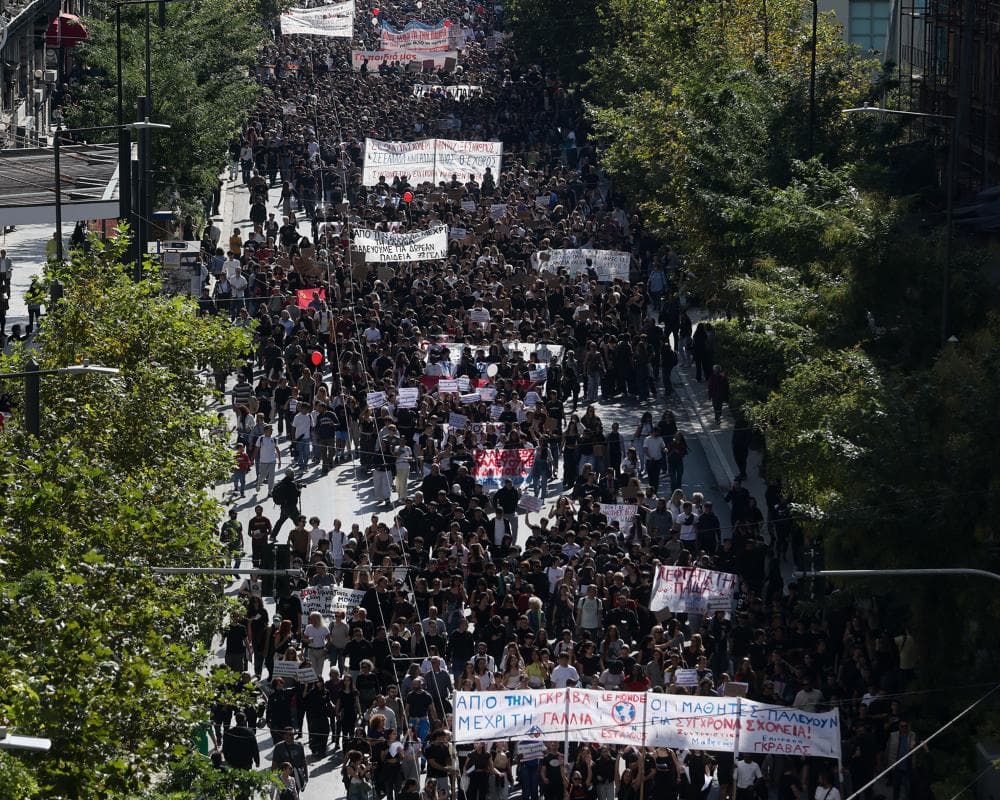
Thousands of people joined education protests across Greece, calling for better classroom conditions and higher pay for teachers, in demonstrations echoing demands seen in France (14:42, 16:00).
-
Two airports have run out of jet fuel, supermarket shelves across southern Italy are standing empty and pharmacies are running short of medicines as Italian lorry drivers continue to blockade roads in protest against soaring fuel prices caused by the war in Iran (13:49).
-
French president Emmanuel Macron blasted “unacceptable” and “stupid” comments on the protests and riots in France from foreign leaders, accusing them of “campaigning at our expense” (12:22).
Related: Macron accuses Trump and other foreign leaders of ‘stupid comments’ about France unrest
Related: Europe’s far right seizes on protest violence to push authoritarian anti-immigration agenda
-
More protests in France are expected this Saturday and on Thursday, 5 November.
Related: ‘A powerful warning’: will Europe’s angry protests lead to real political change?
In other news,
-
Russia has signalled its readiness to restart trilateral talks with the US and Ukraine on ending the war, despite calling the new proposals emerging from yesterday’s discussions in Oslo as lacking substance (11:19, 12:22, 16:15).
-
This signal came hours after US envoy Steve Witkoff met with Russia’s president Vladimir Putin in St Petersburg (14:06).
-
On the margins of the meeting, Russia released a US citizen held by Moscow on allegations of fighting as a mercenary for Ukraine (11:24, 13:24).
Related: Putin orders release of jailed American as he meets Trump envoy for Ukraine talks
If you have any tips, comments or suggestions, email me at jakub.krupa@theguardian.com.
I am also on Bluesky at @jakubkrupa.bsky.social and on X at @jakubkrupa.
US, Ukraine discussed the worsening situation in Oleshky, Kyiv's negotiator said
Ukraine and US negotiators discussed the situation in the Russian-occupied town of Oleshky, Davyd Arakhamia – a member of Kyiv’s negotiating team – was quoted by local media via Reuters as saying.
“We discussed it yesterday, and the informal outcome of this meeting is that there should be some good news next week,” he told media outlet RBC-Ukraine.
Residents of the Ukrainian town, occupied by Russian forces since February 2022, have reported a deepening food crisis as roads in and out are heavily mined and saturated by drones.
Related: ‘Hell on earth’: last residents eat weeds to survive in Russian-occupied Oleshky
Last week, Pope Leo urged Russia’s Vladimir Putin to allow humanitarian aid to the city.
'Ukrainian conflict heading towards its conclusion,' Kremlin aide says, as trilateral talks earmarked for mid-November
We are still getting more lines from the Kremlin, with Interfax news agency reporting that a new round of trilateral Russia, US, Ukraine talks could take place in Abu Dhabi in mid-November.
Curiously, despite his less enthusiastic comments earlier, Interfax also has Kremlin’s Ushakov saying that “the Ukrainian conflict is heading toward its conclusion.”
One to watch.
Government, popular websites go dark as developers race to patch newly-discovered vulnerability
There is also a fascinating story unfolding online, as government websites in Europe and elsewhere went offline after the disclosure of critical vulnerabilities in a widely used programming language sent website operators scrambling to protect their systems, Reuters reported.
Developers of the PHP programming language said Tuesday they had identified two critical vulnerabilities and urged users to update their sites as soon as a fix was released. They said on Wednesday that a new version fixing the vulnerabilities was live.
But with reports that hackers were exploiting the flaws to break into websites, government agencies in the Netherlands and Finland were among those that took sites offline ahead of the fix as a precaution.
PHP underpins large parts of the internet, raising concerns that a significant number of websites could be vulnerable to attack.
Updated
Russia open to restarting trilateral talks with Ukraine and the US, but 'not much substance' in Oslo proposals, Kremlin says
Meanwhile, we now have a longer reaction from the Kremlin to the proposals US peace envoy Steve Witkoff relayed to president Vladimir Putin, warning they were “lacking substance.”
“Steve Witkoff briefed Vladimir Putin on the substance of the talks held in Oslo,” Kremlin aide Yuri Ushakov told reporters, referring to talks Witkoff held in Norway with Ukrainian and European officials on Tuesday.
“He mentioned some new aspects in the approaches of the Europeans and Kyiv... but there wasn’t really much substance in them.”
(That’s very much not what Zelenskyy and the Europeans said last night.)
“Our president informed Steve Witkoff that we are, in principle, ready to resume the mentioned (trilateral) talks,” he added, saying they could take place in mid-November.
Updated
More than 10,000 join education protests in Athens
in Athens
Back again to Greece where tens of thousands of students have joined the burgeoning youth movement demanding better education better prospects amid an ever worsening cost of living crisis in the Mediterranean EU member.
Greece is no newcomer to protests. The massive demonstrations that roiled the country at the height of its debt crisis are still remembered vividly by the parents of the Gen Z protesters now out on the streets.
But for the tens of thousands who marched through Athens, Thessaloniki and other cities today, it was France, as well as the perceived shortcomings of a long under-funded education system, that had spurred them into action.
“From Greece to France we’re fighting for public and free education,” proclaimed a giant banner erected above a stage in front of the Athens parliament in Syntagma Square.
Singing French partisan songs, Greek students participating in the Athens rally, said the French protests were not only admirable but had been an inspiration.
“No one is doubting their message or concerns, even if [media] coverage is mostly focused on the violence,” said Fotini, enrolled at a university in the capital.
“We’re here to say we’re with French youth. Our parents endured so many hardships, so much sacrifice, and they feel really upset and enraged that we, too, have so few prospects. A lot of us are still forced to live with our families, even after we graduate, because the cost of living and house rents are so high.”
The protests, which included a one-day ‘solidarity ‘ strike by teachers, have seen students erect tents infront of the Greek parliament to protest against the soaring costs of education.
Many have privately run colleges – a trend that has included British universities establishing branches in the capital – in their sights. “No to private universities. Free and contemporary studies for all,” read another boldly painted banner erected in the plaza.
Updated
Will Europe’s angry protests lead to real political change?
European community affairs correspondent
Much of the news coverage in recent days has focused on the violence that played out on the fringes of the protests in France and Italy.
The protests themselves, however, point to what seems to be a diverse response to a common crisis: the growing perception, particularly among younger generations, that governments are unable, or unwilling, to deliver when it comes to affordable housing, social equality and robust public services.
“This is the most powerful warning from Europe’s angry youth today, in France and across the continent,” the policy analyst Alberto Alemanno said.
The framing stands in sharp contrast to the many rightwing and far-right voices who have sought to exploit the violence in France and Italy, linking it without evidence to migration while brushing over protesters’ wider demands.
Related: ‘A powerful warning’: will Europe’s angry protests lead to real political change?
A student protest movement has gripped Serbia for two years. This weekend it will try to take power
in Belgrade
On Sunday, a mass student movement, Student List, will represent the most serious challenge Aleksandar Vučić has faced in his 12 increasingly authoritarian years in power, by putting forward their own candidates in parliamentary elections.
They hope to emulate the defeat of Vučić’s ally, Viktor Orbán, in neighbouring Hungary six months ago, in a domino effect that could bring a democratic resurgence to central Europe.
Opinion polls have varied wildly, but many expert observers say a close race is quite possible, with neither side prepared to accept a loss as a legitimate result, raising the risk of post-election unrest and clashes.
In order to win, the students’ list of 250 candidates would have to break the mould of Serbian politics, along with Vučić’s grip on the country.
He stepped down as president last month, five months before the end of his second and last term in office under the constitution, but only with the aim of extending his hold on power as prime minister at the head of his Serbian Progressive party (SNS).
Related: A student protest movement has gripped Serbia for two years. This weekend it will try to take power
Updated
Thousands march in Greece over public education failures and cost of living
Crowds are also marching in cities across Greece right now calling for better classroom conditions and higher pay for teachers.
Thousands of students, teachers and civil servants have shown up in Athens, with demonstrations also in Thessaloniki and other cities. Some protesters say they’ve been inspired by the rallies in France and Spain.
The primary school teachers union has launched a 24-hour strike while the high school teachers’ federation has also announced a three-hour stoppage, local media report.
Updated
Macron arrives in Saudi Arabia as he continues his Gulf tour
The Elysée has just announced that the French president Emmanuel Macron has arrived in Saudi Arabia.
As we’ve been reporting, Macron is facing major protests at home, but has embarked on a wider tour of the Gulf, arriving in Qatar yesterday.
His Saudi Arabia stop had not been advertised but it’s not a major surprise – France has recently pledged more military support to the kingdom which is currently fighting the Iran-backed Houthi rebel group in Yemen. France has committed some assistance to protect the state’s oil production facilities.
Updated
Witkoff's meeting with Putin ends
We are getting a line from Russian news wires that the meeting between Putin and Witkoff has just ended.
Let’s see if we get more detail from either side.
Updated
Q&A on French protests, riots on Friday - ask your questions
By the way, this Friday Guardian Europe’s France-based columnists Rokhaya Diallo and Alexander Hurst will be live taking questions from our readers about the riots and protests in France.
You can send your questions by email now to conversations@theguardian.com, or join the discussion on Friday.
Related: Reader Q&A: What’s next for France after a weekend of riots? Ask our Europe columnists
Southern Italy running out of jet fuel, products, medicines as lorry protest continues
in Palermo
Meanwhile, two airports have run out of jet fuel, supermarket shelves across southern Italy are standing empty and pharmacies are running short of medicines as lorry drivers continue to blockade roads in protest against soaring fuel prices caused by the war in Iran.
Italy’s air traffic management agency, ENAV, said on Wednesday that airports in Crotone and Reggio Calabria had run out of aviation fuel because of disruptions to supplies caused by the protests. It warned that pilots would have to refuel at their departure airports or earlier stops, carrying enough fuel for subsequent flights.
The protests began last week, with lorry drivers blocking roads and slowing traffic across the country, particularly in the south, following strikes and sit-ins by farmers and fishers. The disruption has left supermarket shelves empty in several regions, with photographs showing entire aisles stripped of goods.
A video of a lorry driver’s teenage daughter breaking down in tears has gone viral after she said her family could no longer afford to go out at weekends because they were struggling to pay their bills.
Italy’s infrastructure minister, Matteo Salvini, has proposed €430m in financial support, but the motorway blockades and lengthy traffic jams continue, putting the government under growing pressure as anger over the cost of living mounts.
The protests have also sparked criticism of Italy’s public broadcaster, Rai, which has been accused of giving greater prominence to violent student demonstrations in Milan than to the economic hardship facing families and lorry drivers in the south. Critics say the coverage plays into the government’s increasingly hardline approach to protests while diverting attention from the growing cost-of-living crisis.
Trump hails 'unprecedented' release of US citizen by Russia
Meanwhile, back to Witkoff’s meeting with Putin in St Petersburg, the US president, Donald Trump, has just welcomed the release of Stephen Hubbard, a US citizen held by Moscow on allegations of fighting as a mercenary for Ukraine (11:24).
In a post on Truth Social, he said:
“Stephen Hubbard, taken four years ago by Russia during the Biden Administration, was just released from prison, at the request of President Donald J. Trump, made directly to President Vladimir Putin in a telephone conversation last week.
Stephen is on his way back home and will soon be with his family. The United States, out of respect for President Trump, was not required to give anything in return - an unprecedented situation for Russia. There was no “swap” necessary for this release.
This major return should have taken place long ago through the Biden Administration, which got nowhere in its negotiations with the Kremlin. Stephen is on his way back home. “Welcome home Stephen, it’s great to have you back,” stated President Trump.”
Why are French police so violent? Their job is to protect the state, not the people
Europe correspondent
Familiar images of teargas clouds drifting across Paris squares, police baton charges against masked protesters and terrified teenagers floored – and worse – by stun grenades have once again focused the world’s attention on France’s policing methods.
While most of its western European neighbours generally favour police tactics that prioritise crowd containment and de-escalation, France has long responded to social movements that take to the streets with, at times, shocking physical force.
The reasons why are a complex mix of history, politics, state organisation and a particular security culture that has become deeply ingrained over decades, if not centuries, and whose limits continue to be pushed today.
French policing policy is rooted in Napoleon’s ultra-centralised state and in the political philosophy of the Republic. In France, the police are an instrument of the state. Their core task is to protect it, enforce its laws, and maintain public order.
Conceptually, that is a far cry from, for example, the UK, where since the early 1800s the police have been considered servants of the public, whose authority derives from public consent and whose chief responsibility is to keep the peace.
French police officers are agents of state authority. That means protests, blockades and mass disorder are not just civil nuisances, but direct challenges to the authority of the republic. The police’s priority is to reclaim the streets, not to negotiate.
That explains the aggressive tactics, such as systematically encircling and trapping crowds, and their continued use of “intermediate” or less-than-lethal weapons, many of which are banned or heavily restricted elsewhere in Europe.
Related: Why are French police so violent? Their job is to protect the state, not the people
Macron blasts 'unacceptable' and 'stupid' commentary on French protests from other leaders
Meanwhile, French president Emmanuel Macron blasted “unacceptable” and “stupid” comments on the protests and riots in France from foreign leaders, accusing them of “campaigning at our expense.”
Speaking to reporters from Doha, visibly annoyed Macron said he was frustrated by “visible manipulation of information” about the events in France, “that were unacceptable and stupid from many quarters, including from foreign leaders.”
“For instance, we saw images generated by artificial intelligence depicting scenes that never actually occurred in France. Some people even claimed that we had been overrun by hordes of migrants and Islamists – which is completely false.”
(US president Donald Trump explicitly suggested that, repeatedly, and several EU leaders sort of said similar things, linking the protests with migration, including Hungary’s Péter Magyar and Poland’s Donald Tusk.)
Related: Trump attacks ‘migrants and communists’ as he tries to exploit France unrest
Macron said he was particularly annoyed by political leaders “whether in our own region or on the other side of the Atlantic, gullibly repeating claims generated by AI or echoing narratives that certain circles with to propagate … it is clear that they are campaigning at our expense.”
He said these comments “reveal who loves France and who does not.”
Macron said he would hold a meeting with ministers and intelligence officials on his return on Thursday to get a “detailed account” of what happened and preparations for this weekend’s protests.
Updated
Russia will analyse US proposals, but it's on Ukraine to make progress, Kremlin says
We are getting some first lines from the Kremlin saying that Russia will analyse the US proposals, but “much depends on Ukraine.”
“If Ukraine does not make necessary decisions, situation for them will be worse,” a quote attributed to the Kremlin and posted by the Interfax news agency said.
I will bring you more when we have it.
The picture above is from Russian state-owned Sputnik news agency.
Updated
During their initial exchange, relayed via the Russian state news agency Tass, Putin reportedly said that he was interested in restoring ties and economic cooperation with the US, as he praised the diesel deal with Trump.
He also recalled Trump’s comments on the need to end the Russian war of aggression in Ukraine to stop the loss of human life, and asked about the talks in Oslo.
In turn, Witkoff said he hoped Putin would consider resuming peace talks with the US and Ukraine for “technical discussions,” and said the Oslo meeting was productive, with “a foundation in place to move toward a ceasefire.”
Let’s see if we get any more detail after the meeting.
Updated
Russia releases American man imprisoned for fighting in Ukraine
It looks like the hosts had something special lined up for the US guests…
Russia has released an American man imprisoned on charges of fighting as mercenary in Ukraine, US envoy Witkoff says.
Agencies identify him as Stephen Hubbard, arrested in 2024.
Related: Russian court sentences 72-year-old American for fighting for Ukraine
Witkoff meeting Putin in St Petersburg
Witkoff is now talking to Putin, according to Russian state media.
The pair is meeting in Saint Petersburg’s Konstantinovsky Palace. Putin is joined by Dmitriev, who picked up Witkoff from the airport earlier.
We will no doubt hear and hopefully see more from the meeting shortly.
Republicans push back on Donald Trump’s wavering support for Ukraine
Overnight, a handful of Republicans have spoken out against Donald Trump’s softening stance on Russia, threatening to pull financial support for his agenda over his “embarrassing” handling of the Ukraine war.
Don Bacon, an outgoing congressman in Nebraska, condemned Trump’s actions – which include a stunning agreement to buy Russian diesel and the pausing of sanctions on Moscow – as “absolutely disgraceful” and accused the US president of cozying up to a “war criminal” in Vladimir Putin, his Russian counterpart.
“It really is disgraceful, and the Republicans that I associate with, there’s a lot of us, can’t stand it,” Bacon told CNN on Monday. “I think the president’s leverage in this Congress is shot.”
Last week, Trump waived sanctions imposed on Russia through a law named after his longtime ally and late senator Lindsey Graham. The legislation, which he signed only last month, was intended to increase financial pressure on Russia, more than four years after it invaded Ukraine.
Instead, Trump announced he had struck a deal with Putin to import diesel fuel, which has become more expensive for Americans largely due to Trump’s war with Iran. Trump has previously blamed Ukraine’s strikes on Russia.
Related: Republicans push back on Donald Trump’s wavering support for Ukraine
Ukraine's anti-corruption police search National Bank premises
Meanwhile, Ukraine’s anti-corruption police said that detectives were searching the premises of the National Bank of Ukraine and also the home address of one of the central bank’s employees, Reuters reported.
The anti-corruption police said in a statement on the Telegram app that no one has been detained or issued a suspicion notice. The central bank did not immediately respond to a request for comment.
Morning opening: Witkoff meets Putin in St Petersburg for talks on Ukraine
US special envoy Steve Witkoff arrived in Saint Petersburg early morning for talks with Russian president Vladimir Putin about Ukraine, a day after holding discussions with Volodymyr Zelenskyy and the leaders of Norway and Finland.
Witkoff was met at Pulkovo Airport by the Kremlin’s advisor for international economic cooperation, Kirill Dmitriev.
Let’s see how much of the positive tone expressed by Zelenskyy and the two European leaders after yesterday’s talks will hold at the end of the day.
But managing out expectations, Kremlin aide Yuri Ushakov said he “didn’t know if any agreement will be reached today,” Russian news agency Interfax said.
Related: US has resumed sharing intelligence with Ukraine about Russian strikes, says Zelenskyy
Elsewhere, I will be looking for updates from France and Italy, as both countries step up their response to recent protests and riots that disrupted everyday life.
Related: Italy to deploy 500 troops to Milan after days of protests and looting
Lots to cover.
It’s Wednesday, 21 October 2026, it’s Jakub Krupa here, and this is Europe Live.
Good morning.