The day so far
-
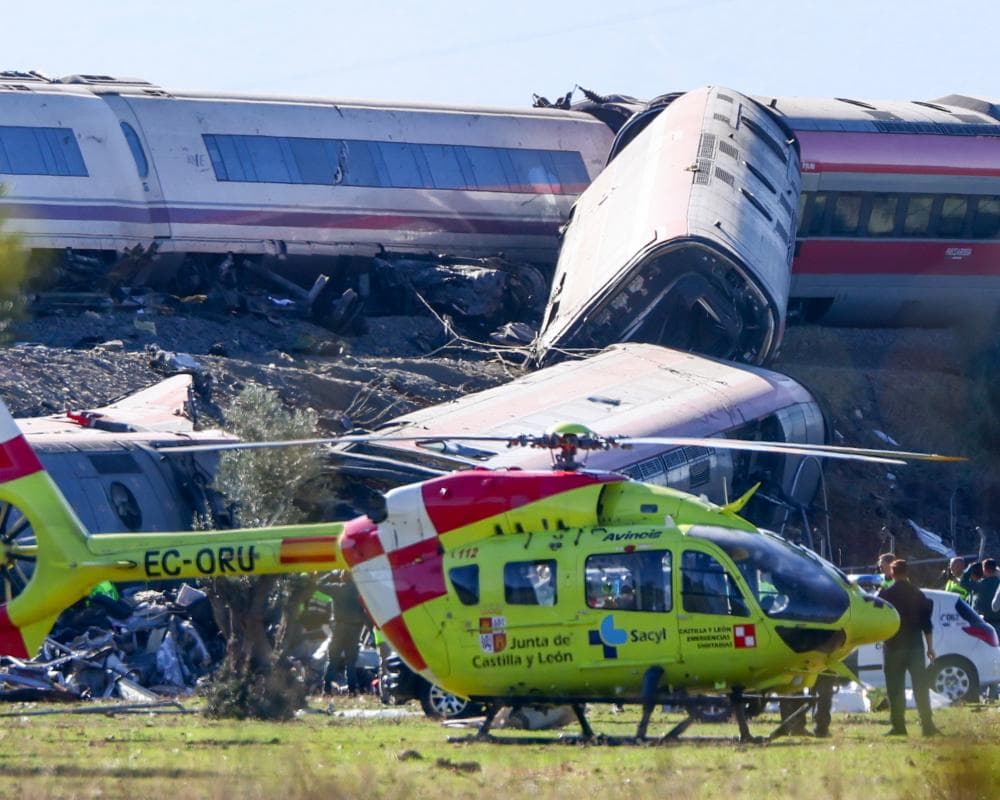
At least 68 people have been killed and dozens more injured after two passenger trains collided in Toledro province in central Spain. The Spanish prime minister, Pedro Sánchez, has declared three days of mourning in the wake of the disaster – the second high-profile train crash in Spain this year and the third deadliest incident on its railway in the last 50 years. Sánchez said his government would act with urgency to “clarify what has happened, why this tragedy occurred.”
-
The two trains with 544 people on board in total were travelling in the same direction on the high-speed line from the Spanish capital, Madrid, to Seville in the south-west of the country. One of the trains ran into the tail of the other that had stopped, knocking several carriages off the track. Video footage from the scene showed extensive damage to both trains.
-
Sánchez insisted his government would get to the bottom of incident and address potential safety failures with “utmost firmness”. The government, he said, “must further strengthen safety to rebuild confidence in our high-speed rail network”. He added: “This is essential, as it is unacceptable for a country like Spain to experience two high-speed rail accidents in a single year.”
-
Transport minister Óscar Puente said initial review of the evidence pointed to an “inexplicable” decision to order trains to go ahead after a signalling failure, implying a human error. The investigation is likely to focus on 17 minutes between the trains were halted and the crash. Spanish media reported that the controller responsible was questioned by investigators this afternoon. But, as my colleague Gwyn Topham wrote earlier, the Spanish public will want to know what led to the initial outage of a signalling system that was due to be phased out – and what circumstances or daily experience could have pressed someone to urge the trains to continue regardless, however tragically wrong that decision proved to be.
-
Both main parties suspended their campaigning activities ahead of next month’s parliamentary election, but the far-right Vox party continued with its rallies. Spain’s football federation also postponed all 24 Copa del Rey games scheduled for Wednesday.
Thank you for following our live coverage. I’ll leave you with this report from our colleagues Sam Jones and Ashifa Kassam.
Related: Spain’s Sánchez declares three days of mourning after at least 68 killed in Toledo train crash
The Health Department of Castilla-La Mancha has reduced the number of people in hospitals in the region to 53, after 56 were discharged, El Pais reported.
King Charles has contacted King Felipe of Spain.
The British monarch, who is currently out of the country visiting the Bahamas, “sent a private message of condolence” to his Spanish counterpart earlier today, a Buckingham Palace spokesperson said.
The CSIF civil servants’ union has called for the resignation of Transport Minister Óscar Puente following Wednesday’s train accident.
“The minister is shamefully using a worker as a scapegoat instead of taking responsibility,” the union said, adding: “The minister has evaded all responsibility despite the initial computer system failure that triggered the events.
“Throughout this year, CSIF has demanded increased investment in the maintenance of the railway sector: safety, review and updating of safety protocols, and greater investment in infrastructure maintenance, as well as in railway workshops.”
Elsewhere, around twenty riot police officers are guarding the main entrance to the Ministry of Transport, the original location for a demonstration which was later moved to the neighboring Plaza de San Juan de la Cruz, El Mundo reported.
Spain’s Civil Guard said one of its officers, Jose Manuel, died in the train crash.
The national law enforcement agency expressed its “deepest condolences” to his family, friends and colleagues.
Key event
The number of people in hospital has risen to 107, The Emergency Services of Castilla-La Mancha said.
Updated
The president of the Andalusian Regional Government, Juanma Moreno, has demanded the central government conducts a “ complete review of the railway lines “ in Andalusia and in particular the high-speed line connecting the region with Madrid.
“The AVE high-speed train that links Madrid and Andalusia is no longer a safe means of transport,” Moreno added in comments reported by El Mundo.
Josimar Medina woke a little before 9am on Wednesday to find himself airborne and hurtling through his carriage on the fast train from Madrid to Seville.
“I remember flying through the air and looking for my girlfriend, who was also shooting through the air,” said Medina, a 37-year-old tourist from the northern Peruvian city of Chiclayo.
Once he landed, he looked around and realised just how lucky he and his girlfriend, Vitoria Maia, had been.
“I saw people with cuts, people covered in blood, people missing limbs, and I saw one person who had nothing left below the chest,” said Medina. “I saw people with their heads crushed and people with mutilated arms.”
The Peruvian stood recounting the details of Wednesday’s deadly rail crash, in which at least 68 people were killed and dozens more were injured, wearing a light brown T-shirt stained with the blood of a young American man he had helped move to safety.
Medina and Maia had been in the seventh carriage of the state-operated Renfe train that smashed into the back of a train run by the private Iryo company on the same line from the capital to the south of Spain. Had they been any further forward, they could well have been among the accident’s fatalities.
As it was, the couple climbed out of the train and helped the injured while they waited for medics and Guardia Civil officers to arrive at the scene of the crash, which took place amid vineyards and olive groves near the small town of Urda in the central region of Castilla-La Mancha, near the city of Toledo.
Within hours of the crash, Urda had been transformed into a frantic emergency response centre, with a local sports centre pressed into service as a triage post for the walking wounded. Cars, vans and trucks from the emergency services in Castilla-La Mancha and neighbouring Madrid crowded the streets.
A total of 36 people who were traveling on the trains involved in the Toledo train crash received medical attention at Atocha station, El Pais reported.
At the same location, around 40 relatives of those affected by the accident also received mental health support.
The death toll remains at 68 as rescue teams work to remove the two worst-damaged carriages of the Iryo train.
But sources at the Advanced Command Post told El Pais they expected more bodies will be found.
Three large cranes are currently working on the rescue operation.
Ana San Emeterio Freire told El Mundo she has no information about her brother, José Ángel, 54, who went to the station to assist with the search.
She said: “Why don’t they fix the tracks?”, adding she had planned to go to Madrid.
“I’m going to cancel my ticket right now.”
There are no more injured people requiring medical attention at the site of the accident involving the AVE high-speed train and the Iryo train, sources told El Pais.
Spain’s health minister Mónica Garcia said of the nearly 80 people taken to four hospitals across the Toledo province, 15 are seriously injured.
Updated
Minister's comments show attempt to get ahead of growing anger over rail infrastructure - snap analysis
Transport correspondent
The speed with which Spain’s transport minister has laid out the broad circumstances of the crash appears unusually fast for the aftermath of an accident, where politicians and industry leaders are anxious not to pre-empt investigations.
That may be due to the scale of the crash and the nature of the findings – but also owe much to the growing anger and concern about the state of the nation’s railway infrastructure. And perhaps a desire to demonstrate that, for this second horrific crash this year on the Madrid-Seville line, the circumstances were apparently very different.
Although the official investigation is yet to come, Óscar Puente has pointed towards human error as the predominant cause (15:01) – an “inexplicable decision” to tell trains to continue operations when the outage of the signalling system had brought services to a standstill.
That makes the crash – on one level – move from the narrative where the trains are literally coming off the rails, and the country metaphorically so, as elections approach.
But questions will remain. The recent collision in Bedford in Britain was similar in its rarity: a train likewise hit the back of another stopped on the same line, albeit at a lower speed and with only one fatality. That crash continues to be investigated, but first findings show that while human error may have been the biggest cause, it arose from a set of unusual circumstances and a technical failure in the automated warning system which has yet to be fully explained.
Spain has identified individual culprits in past disasters: prosecuting the train driver who sped recklessly round a corner in 2013 in Galicia, killing 79 people. Police are apparently questioning the line controller today.
But the public will want to know what led to the initial outage of a signalling system that was due to be phased out – and what circumstances or daily experience could have pressed someone to urge the trains to continue regardless, however tragically wrong that decision proved to be.
What we know so far - summary
-
At least 68 people have been killed after two passenger trains collided in Toledro province in central Spain, and the death toll may rise further.
-
A similar number of people remain hospitalised, including 15 in serious or critical state (15:44).
-
The two trains with 544 people on board in total (10:46) were travelling in the same direction on the high-speed line from the Spanish capital, Madrid, to Seville in the south-west of the country.
-
Video footage from the scene showed extensive damage to both trains (12:23, 13:52).
-
Spain’s prime minister Pedro Sánchez said the country was “in mourning” as he insisted the government will get to the bottom of incident and address potential failures with “utmost firmness” (15:49).
-
Transport minister Óscar Puente said initial review of the evidence pointed to an “inexplicable” decision to order trains to go ahead after a signalling failure (15:01), implying a human error.
-
The investigation is likely to focus on 17 minutes between the trains were halted and the crash.
-
Spanish media reported that the controller responsible was questioned by investigators this afternoon (16:40).
-
Today’s collision is the second high-profile train crash in Spain this year (11:00), and the third deadliest incident on its railway in the last 50 years (12:55).
-
Spain is expected to declare three days of mourning later today (15:54).
-
Both main parties suspended their campaigning activities ahead of next month’s parliamentary election, but the far-right Vox party continued with its rallies (12:11).
Updated
Spain's Civil Guard questioning traffic controller as part of investigation - report
Spain’s Civil Guard is questioning the traffic controller responsible for the stretch of track where the crash happened, according to the Europa Press news agency.
Their inquiries are part of an investigation opened by Spain’s railway accident investigation commission, CIAF, Europa press said.
Earlier today, Spain’s transport minister Óscar Puente pointed to an “inexplicable” call to resume traffic at full speed after a signalling failure, implying a potential human error behind the crash (15:01).
Spain 'will be rightfully asking questions,' opposition leader says, as he calls for investigation, review of rail infrastructure
In the last few minutes, the opposition People’s party (PP)‘s leader Alberto Núñez Feijóo responded to the incident near Urda.
In a sombre speech, Feijóo expressed his solidarity with all affected and their families, and thanked emergency services for their response.
But he said that “our grief does not compel us to remain silent,” as he said the Spanish people will be “rightfully asking questions – and they deserve answers.”
He called for an immediate government investigation and a judicial inquiry into the crash, “utilising all available resources and free from interference.”
He also demanded a response to growing concerns about the state of infrastructure, as he called for “a comprehensive, independent review of the entire railway network.”
“This can no longer be delayed; the public has a right to full accountability for every euro.”
He also confirmed that his party has for now suspended all campaigning events ahead of next month’s parliamentary election as a sign of respect for the victims and their families (unlike the far-right Vox party).
Updated
PM Sánchez says will declare three day of mourning in Spain after train crash
Sánchez also says he will declare three days of mourning – starting tomorrow, 29 October to 31 October.
“Spain is in mourning and embraces the victims; the government of Spain – and the entire State – stands with the victims and their families.”
He doesn’t take any questions.
Updated
Spain is in mourning after rail crash, PM Sánchez says, as he calls to strengthen safety to 'rebuild confidence' in high-speed trains
PM Sánchez speaks next.
He says “Spain is in mourning” as he expresses “solidarity and empathy” with all affected.
He says the government’s first priority is to focus on helping the victims and their families.
He also thanks all emergency services for their work.
He says the government needs to “clarify what has happened, why this tragedy occurred,” working alongside the independent railways accident investigators and judicial authorities.
“If there has been any negligence, it will come to light. And if there have been failures in the safety system, they will be addressed with the utmost firmness,” he says.
Sánchez points out that the two high-profile high-speed train crashes of recent months – this one and in Adamuz in January – seem to have different causes.
But he says the government “must further strengthen safety to rebuild confidence in our high-speed rail network.”
“This is essential, as it is unacceptable for a country like Spain to experience two high-speed rail accidents in a single year,” he says.
Updated
But first, the Castilla – La Mancha president Emiliano García-Page speaks about his “deep, profound” sorrow over today’s incident.
He says the latest data suggest at least 68 fatalities.
There are also some 15 people with severe or critical injuries, and 53 people who required hospitalisation for moderate injuries.
PM Pedro Sánchez is about to speak.
I will bring you the key lines here.
During his visit to the site of the crash, Spanish PM Pedro Sánchez will be accompanied by interior minister Fernando Grande-Marlaska and local government president Emiliano García-Page.
We are expecting a press statement at some point.
Astonishingly, Puente suggests there was more than one incorrect order; a similar instruction to resume was also ordered to at least one other train, with the train driver going back to the traffic control to push back on the order.
That ends this press conference, but we will no doubt hear more about the circumstances of the incident later today.
Puente says that while a signalling failure “can happen”, there are strict standard procedures for how to proceed in such cases, as he once again heavily hints at a combination of technical and human errors.
He says the order to restart traffic should not have been issued, and that even if it was taken, the train in question should have been instructed to restart “on sight” – meaning driver should only move very slowly, under strict restrictions, at maximum 40km/h, and not at normal speed.
He says the person responsible for the decision is now under investigation.
He does not answer a question if he intends to resign.
Spanish transport minister confirms signalling issue; says 'inexplicable' traffic decision preceded crash
Puente begins by paying tribute to all affected by the crash.
“We are absolutely devastated; as you can well imagine, this is one of the most difficult moments one could ever face,” he says.
He says a rear-end collision is an unusual thing on the Spanish network, which is why his enquiries focused on understanding what happened.
He has he has been able to see a full reconstruction of the incident and review audio recordings of all communications between the affected trains and the traffic control.
He says that around 8:30am this morning, the LZB controlling system failed due to communications issues, leaving no coverage for just over 60km of the track, which in turn triggered an automatic stop for six trains on that stretch.
But around 8:36, the Adif control centre issued a manual instruction to override the warning and let the traffic resume.
He heavily suggests that this “inexplicable” decision should not have been made, as trains should have remained under strict orders not to move.
During the next 25 minutes, the second AVE train travelled 25 kilometers and eventually collided with a stationary Iryo train.
“This is the account of events that I can provide,” he says.
Updated
Spanish transport minister briefing the press
Spanish transport minister Óscar Puente is speaking now, but he’s having some audio issues with his microphone that they are trying to sort out.
Once that’s resolved, I will bring you his key lines here.
Updated
UK ambassador to Spain Alex Ellis expressed his concern about the incident and support to all affected.
“If you are a British national and you or a family member have been affected by the train crash and require consular support, call the nearest British Consulate on 0034 91 714 6300.”
Train crash survivors arrive at a makeshift emergency reception - in pictures
We are also getting some first pictures from emergency reception areas supporting those affected by the crash.
Andalusia declares three days of mourning
The Andalusian regional government has declared three days of mourning. “We are devastated,” its president, Juanma Moreno, said.
“All of Andalusia stands with the victims of this latest train accident,” he added.
Earlier today, the mayor of Seville, José Luis Sanz, also announced three days of mourning and suspended all official events.
We are still expecting to hear from Spain’s transport minister Óscar Puente shortly. I will bring you his comments when he shows up.
64 dead, 58 injured in Spain train crash, local authorities say
The latest local government update confirms 64 dead, and 58 injured in today’s crash.
40 of the dead were travelling on the Iryo train, and 24 on the AVE high-speed train, it added.
Updated
Spain's Sánchez expected to travel to crash site later today
Spanish prime minister Pedro Sánchez is expected to travel to the scene of the crash later today.
The government said:
“The President of the Government, @sanchezcastejon, is traveling to Urda to support the work of the emergency teams and convey his support to those affected and their families.
The priority is to attend to the victims and ensure the maximum coordination between administrations.”
Updated
Death toll from Spain train crash rises to 64
Death toll from the train crash has gone up to 64, sources in the local government in Castilla la Mancha told RTVE, El País and Reuters.
It makes it a deadlier incident than this January’s Adamuz crash (11:00), and the third worst train disaster in Spain since the seventies (12:55).
The death toll is still likely to change.
Updated
Latest pictures from the scene - video
Latest pictures from the scene of the crash
Latest dramatic pictures from the scene show the scale of devastation and appear to show a piece of broken rail going through the roof of one of the affected trains.
Updated
Signalling system likely to come under close scrutiny - snap analysis
Transport correspondent
The signalling system used on the high-speed line between Madrid and Seville will come under scrutiny as investigators seek to understand Spain’s latest horrific rail crash.
The rear-end collision between two trains, whose death toll already looks likely to exceed the disaster in Adamuz on the same line in January, should, theoretically, be a remoter risk than other types of accident.
The LZB signalling system should automatically stop a train if the line ahead is occupied, even if the driver failed to apply the brakes.
The technology, used previously in Germany before being installed on the Spanish high-speed line, translates as “linear train control” and uses continuous electronic communication between the track and train to control speeds.
That should make it safer than, for example, the stretch of the Midland main line in the UK where a rear-end collision occurred earlier this year – the first fatal crash of its type between two passenger trains in Britain for more than 40 years.
In that part of the railway, there was no technology to automatically stop the second train, whose driver failed to apply the brakes when passing a red light that warned of danger ahead.
Spain has had another high-speed disaster, in Galicia in 2013, under a system where the driver was able to ignore speed warnings.
This should not have been possible under this system – a different scenario for investigators than the faulty rails identified in the head-on Adamuz crash.
According to early, unconfirmed reports from Spain (12:30), the first train, an Iryo service, may have stopped after flagging a failure in the LZB system.
Spain, like all European operators of high-speed lines, is transitioning its various signalling systems to a standard ERTMS service.
We are expecting to hear from Spain’s transport minister Óscar Puente at the top of the hour, at 2pm local time (1pm UK).
Spain’s former labour minister Fátima Báñez was reportedly on one of the trains caught up in this morning’s crash.
Speaking just now on RTVE, Antonio Sanz, the Andalusia government’s emergency minister, confirmed she is believed to have been on board and has not yet been reached since the incident.
Death toll from train crash rises to 31
The death toll from today’s train collision has risen to 31, according to the latest information from local government in Castile-La Mancha.
All Spanish Cup football games cancelled as mark of respect
All games of the first round of Spanish Copa del Rey football competition planned for today have been postponed as a mark of respect following the train crash in Urda, Spanish football federation said in a statement.
“The great Spanish football family remains united in grief over this tragedy, offering its support to the authorities to help the victims of this devastating accident,” the RFEF said in a statement.
A revised schedule will be published in due course.
EU 'ready to support' Spanish investigation into train crash
The European Commission has offered to help with the investigation into today’s train crash in Urda.
EU chief spokesperson Paula Pinho said:
“Our thoughts and our feelings are with the victims, their families and friends, and all those affected, and the Commission, together with the European Union Agency for Railways, is closely following the situation, and we stand ready to support the Spanish authorities in any way that may be needed.”
But she noted it was “too early, absolutely too early, to draw any conclusions” as the emergency response continues.
Von der Leyen has not yet spoken with Spain’s PM Pedro Sánchez this morning, the spokesperson said, who also pointed reporters to her message of solidarity on social media (11:32).
Today’s crash is already the fourth worst train accident in Spain recorded since the seventies – and the death toll is still expected to rise.
In 1972, 86 people died and 112 were injured in a head-on clash between two passenger trains in El Cuervo (Sevilla).
In 2013, 80 people died and more than 140 were injured in Angrois, Santiago de Compostela (A Coruña) after a high-speed train detailed outside the station.
Related: Spanish rail crash: why was train travelling so fast on bend?
And earlier this year, 46 people died and 152 were injured after two trains collided in Adamuz (Córdoba).
Related: ‘We had to remove the dead to get to the living’: train crash shocks Spanish town
At least 30 dead, 80 injured, with concerns death toll could rise further - what we know
-
At least 30 people have died and 80 have been injured after two high-speed trains collided in Spain’s Toledo province, with fears the death toll could still rise higher (12:22).
-
The number of people affected is still expected to rise (10:46, 12:04), local authorities said, with growing concerns about a “major tragedy” (11:03).
-
The affected trains are understood to be Iryo 7076 with 146 passengers plus one baby on board, and AVE 2080 with 397 passengers on board, making it 544 people in total on board of both train (11:00).
-
Early inquiries point to a possible signalling failure that contributed to the crash, Spanish media reported (12:32).
-
The incident comes less than a year after a similar crash in Adamuz, the province of Córdoba, which killed 46 and injured 152 in January this year (11:00).
-
Spain’s high-speed railway network ranks as the largest in Europe and the second biggest in the world after China, carrying 25 million passengers in 2024.
-
Spain’s prime minister Pedro Sánchez said he was “shocked” by the accident (11:05), with transport minister Óscar Puente working at the emergency control centre to “obtain all possible information about what happened” (11:16).
-
The Spanish king Felipe VI expressed his sorrow and solidarity with all affected (11:38, 12:07).
Updated
Meanwhile, El Mundo is reporting that the Iryo train flagged a failure in its LZB signalling system shortly before the crash, but the train behind did not receive the information due to a potential human error.
Investigators believe the AVE high-speed train travelling behind crashed into the stationary Iryo service, according to the newspaper.
Updated
Aerial footage from the crash scene - video
At least 30 dead, 80 injured, but numbers likely to rise, local president says
The president of Castilla-La Mancha region, Emiliano García-Page, is now briefing the reporters.
He confirms the latest figure of 30 dead – 24 in the AVE train and six in the Iryo train – but says the authorities expect this number to rise further as emergency services are yet to reach the most affected parts of the wreckage.
He also says some 80 people were injured, with 30 people with minor injuries, and 50 with moderate and more serious injuries of varying severity.
He thanks all emergency services for their help.
Updated
Unlike other party leaders, the far-right Vox party’s Santiago Abascal appears to be going ahead with his political plans for today as he continues campaigning ahead of next month’s parliamentary election in Spain.
In his comments, he repeatedly attacked Spain’s prime minister Pedro Sánchez for “constantly putting the Spanish people at risk.”
He explicitly rejected calls to suspend the campaign, insisting that would only to “exploit the grief and mourning to silence complaints and protests regarding the decay of our infrastructure.”
Updated
Spanish King Felipe VI appeared in front of cameras on his visit to Bétera, where he is attending some military exercises.
His brief reaction was largely in line with his earlier written statement.
Visibly shaken, Felipe VI said he wanted to “express my deep regret over this horrific incident,” acknowledging “a high number of fatalities and many injuries.”
“My primary concern is to express my sorrow over this terrible tragedy and to convey our condolences, sadness, support, and affection to the families during such an incredibly difficult and painful time.”
He also thanked emergency services responding to the incident for their help.
Death toll may rise further, local government spokesperson warns
Esther Padilla, spokesperson for the Castilla-La Mancha region, has just appeared on RTVE again, confirming at least 30 dead, and saying the number may rise even further.
Local government spokesperson Padilla said the focus at the moment is on ensuring all affected get the medical help they need.
Most people are being transferred to a hospital in Toledro, but three other hospitals were also put on high readiness to support the emergency respond when needed, she said.
Updated
Another passenger on one of the trains reported that their Renfe AVE train came to a brief stop and was held up for a few minutes shortly before the crash, with the explanation given being “heavy traffic in the area.”
After it moved off again, it collided at speed with the other train, causing a “violent impact” on the passengers.
Talking to RTVE, Fernando Seco said passengers in his carriage – at the back of the train – were able to get out of the train and down the embankment, when they realised the scale of the disaster and damage to front carriages.
He said there had been no sign that anything was wrong with the train beforehand.
Miguel, a passenger travelling with several colleagues in the rear car of one of the trains, described to COPE radio the moment of the accident.
“We heard a massive roar, a truly enormous thud that went on for 10 seconds, as if the train were about to derail. Through the right-hand window, we could see a wrecked train – I imagine it must have been the other one.”
His comments were relayed by Reuters.
At least 30 dead in Spanish train crash, local government confirms
Castilla-la Mancha regional government said the death toll had risen to 30 from 10, in line with their previous warnings that the number could rise (10:46).
This also is in line with earlier media reports (11:29).
Updated
Early indications suggest that a Renfe AVE train from Madrid to Sevilla – the larger of the two (11:00) – collided with the Iryo train ahead of it.
Spanish news agency EFE reported that at least three carriages derailed, with some falling off the embankment, fuelling concerns that the death toll could still rise further.
The investigation will look into what caused the incident and look at both the driver’s reactions and the operation of the signalling system.
The incident took place in the Urda area of Toledro province.
Updated
Spanish royals express concern for and support to all affected by train crash
The Spanish royal household has just issued their statement too, expressing their concern and support for all affected.
It reads:
“We are moved and concerned by the train accident in Urda (Toledo). We share in the sorrow of the families and loved ones of the deceased and send our affection to the injured and those affected.
Our support also goes to the emergency teams and all those working in the area to help as much as possible under these circumstances.”
Updated
The emergency service of the Castilla-La Mancha government set up a hotline for all affected by the crash: 900 122 112.
Both affected train companies also set up their hotlines:
Iryo: 900 001 403
RENFE: 900 101 020
'Europe mourns in you,' EU's von der Leyen responds to train collision in Spain
European Commission president Ursula von der Leyen responded to the train crash in Spain.
In a statement, she said:
“Just received the devastating news from Toledo on the collision of two high-speed trains. My heart goes out to the victims’ families and loved ones.
Today, Europe mourns with you.”
Madrid’s blood bank has issued an “urgent appeal for blood donations” given “possible increase in unforeseen healthcare needs” for all blood groups.
Spain’s public broadcaster RTVE is reporting at least 30 dead, quoting government sources.
This has not been at this stage formally confirmed by the authorities.
At least 30 dead after two train collide in Spain - what do we know
-
At least 30 people are believed to have died after two high-speed trains collided in the province of Toledo in Spain, with concerns the death toll could be much higher.
-
The number of people affected is expected to rise (10:46), local authorities said, with growing concerns about a “major tragedy” (11:03).
-
The affected trains are understood to be Iryo 7076 with 146 passengers plus one baby on board, and AVE 2080 with 397 passengers on board, making it 544 people in total on board of both train (11:00).
-
The incident comes less than a year after a similar crash in Adamuz, the province of Córdoba, which killed 46 and injured 152 in January this year (11:00).
-
Spain’s high-speed railway network ranks as the largest in Europe and the second biggest in the world after China, carrying 25 million passengers in 2024.
-
Spain’s prime minister Pedro Sánchez said he was “shocked” by the accident (11:05), with transport minister Óscar Puente working at the emergency control centre to “obtain all possible information about what happened” (11:16).
-
Updated at 10:50am UK to reflect the new death toll
Updated
Spain's transport minister working to 'obtain all possible information'
Spain’s transport minister Óscar Puente has only issued a brief holding statement for now:
“In the [emergency] control center since 9:40 trying to obtain all possible information about what happened.”
We will no doubt hear from him later today.
The two affected trains are understood to have been travelling on the high-speed Madrid–Seville line.
Esther Padilla, spokesperson for the Castilla-La Mancha region, told RTVE it appeared that one of the trains may have stopped before the incident.
The cause of the incident will be obviously thoroughly investigated.
Spanish PM, opposition leader 'shocked' by train crash in Toledo
Spanish prime minister Pedro Sánchez responded to the crash on X:
“Shocked by the serious train accident in Toledo. I remain in constant contact with the Minister of Transport, @oscar_puente_, and with the president of Castilla-La Mancha, @garciapage.
Emergency services are working on the ground to assist those affected and ensure their safety, in coordination with all the involved administrations. My affection, solidarity, and support to all the victims and their families.”
Opposition leader Alberto Núñez Feijóo on X:
“Very concerned about the information we are getting about a new rail accident. The priority now is to attend to the victims and support their families. My full support to the emergency teams working on the ground.”
Spanish health minister fears 'major tragedy' after train collision in Toledo
Spain’s health minister Mónica García just appeared on RTVE Noticias with a brief update on the incident.
She said there are no further details regarding the number of fatalities and affected, as the focus is on ensuring proper care to all injured, with hospitals freeing up resources whenever possible to allocate them to this incident.
But she conceded – and repeated twice - that it was “a high-impact accident, and we fear this will turn out to be a major tragedy.”
Updated
Toledo crash brings back memories of deadly crash in Adamuz
Today’s accident evokes grim echoes of this January’s tragedy in Adamuz, where 46 people killed and 152 were injured after two high-speed trains crashed in Adamuz, the province of Córdoba.
Related: ‘We had to remove the dead to get to the living’: train crash shocks Spanish town
A few days later, a driver was killed and 37 people injured when a train was derailed by the collapse of a retaining wall near Gelida in Catalonia.
Related: Commuter train near Barcelona hits collapsed wall killing driver and injuring nearly 40
Following the Adamuz train crash earlier this year, Spain’s largest train drivers’ union called for a three-day nationwide strike as it demanded more thorough safety checks and “the restoration of safety standards on the railway system.”
Related: Spanish train drivers call three-day strike after deadly railway crashes
But with almost 4,000km of track, Spain’s high-speed railway network ranks as the largest in Europe and the second biggest in the world after China, according to the Spanish infrastructure administrator Adif.
The network is tremendously popular, competitively priced and generally considered a safe mode of transport. In 2024, Renfe said more than 25 million passengers had travelled on its high-speed trains that year.
But in another major incident in 2013, 80 people died after a train derailed in the country’s north-west near Santiago de Compostela. An investigation concluded the train was travelling at 179km/h on a stretch of the line with an 80km/h speed limit when it left the tracks.
Updated
We are getting first pictures from the scene now…
Death toll likely to rise, local government spokesperson warns
Local government spokesperson told TVE that the death toll “will almost certainly rise.”
Esther Padilla told the broadcaster:
“We know that the number of fatalities and injuries will continue to rise. We are prepared to provide the best possible care as quickly as we can, but the situation … is likely to worsen.”
She said the affected trains are likely to be Iryo 7076 with 146 passengers plus one baby on board, and AVE 2080 with 397 passengers on board, El País reported.
Updated
At least 10 feared dead after collision in Toledo province
At least 10 people are feared dead and many more injured after two high-speed trains collided in Toledo province in central Spain.
Spain’s state rail infrastructure authority said services between Madrid and the southern region of Andalucía had been suspended “following a rear-end collision between two trains” on Wednesday morning.
A spokesperson for the regional government of Castilla-La Mancha region, where the crash occurred, said the cause and number of injuries were yet to be determined.
Government sources told El País at least 10 people had been killed, and that the crash could be worse than the Adamuz rail disaster in January in which 46 people were killed.
We will bring you all updates here.