It hit me like a thunder clap. One moment I was bored and irritated by the official speeches before the unveiling of Tschabalala Self’s sculpture on the fourth plinth, which so insisted on its sociopolitical worth it sounded like Soviet propaganda. Then the covering slid off and I was in love with the Lady in Blue.
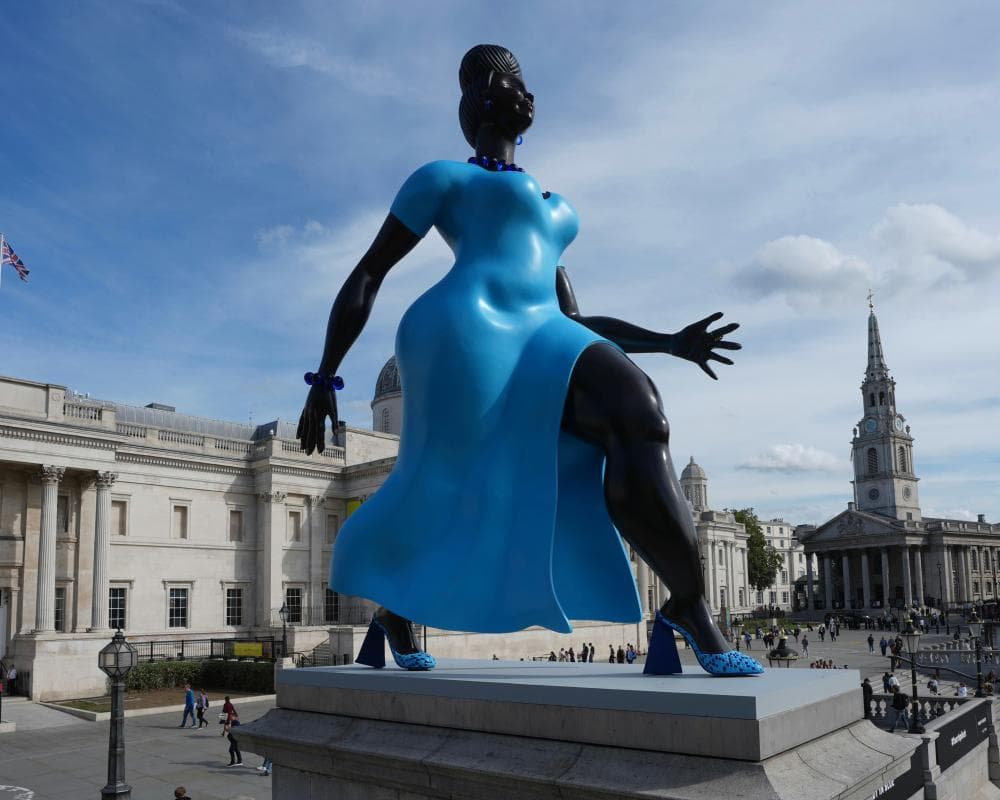
Self has created one of the most beautiful sculptures put on Trafalgar Square’s empty plinth – and I don’t mean that in a cool, formalist way. There is a serious danger of traffic accidents as drivers passing the square stare a little too long at the Lady’s generous proportions, her long stride in platform shoes, her intensely physical, confident being.
Lady in Blue brilliantly exploits the potential of the long rectangular plinth, built in 1841 for an equestrian statue that was never erected, to encompass a lolloping human gait. This is a homage to walking, and to Umberto Boccioni’s futurist strider Unique Forms of Continuity in Space, with Self’s figure extrapolated upward from her wide and fast walk, a massive curved leg thrusting forward out of her draping blue skirt, her head held high, but not absurdly high.
This is no colossus but a statue that takes its scale and life from the surrounding city. There, I’ve said it: statue. The most memorable works on the fourth plinth, ever since it became a site for temporary art works back in 1999, have usually been human figures. To Mark Wallinger’s Ecce Homo and Marc Quinn’s Alison Lapper Pregnant, we can now add Self’s Lady as proof that what we really want and maybe need to see on a plinth is the human form, alive, profound and sexual.
What you first notice is the sheen of this polychrome woman: sunlight glints on her polished, plasticky surface as if she were covered from head to toe in nail varnish. Then your eyes adjust to the glare and you feel the luscious collision of brown flesh and heavenly blue. The blue is that of lapis lazuli, the rare mineral mined in Afghanistan that for millennia was coveted for jewellery and, then, for the most ethereal and expensive painter’s blue: ultramarine.
It connects Lady in Blue with the paintings in the National Gallery behind it, many of which use ultramarine, maybe most of all with Bronzino’s brazenly erotic Allegory With Venus and Cupid, which sets hard flesh against silky blue. Self’s statue has the same provocatively fetishistic power.
But this Lady is not a vulnerable object of anyone’s gaze. She swaggers in space with commanding girth, her bottom facing the National Gallery with flamboyant magnificence. This is the opposite of smooth classicism or catwalk perfection. In fact, it may be the opposite of traditional western sculpture. For all its apparent simplicity, Self’s figure seems rooted in African wood carvings, with their free transformations of the human body. On top of that is a head whose beauty and grace recall the bronze faces of the medieval queens of Ife.
Lady in Blue appears at the heart of a London where we’ve seen Tommy Robinson supporters march for a mono-racial, white nationalist UK. For all my impatience, it’s hard to disagree with the speeches at the unveiling – that we urgently need to uphold diversity and equality and reject intolerance.
The question is how a work of art can help. Just putting up a positive image of a Black woman won’t silence racists, and might even offer them another horrible talking point in the culture wars. But Self’s achievement goes beyond good intentions. You can view it as a seductive and funny comment on our big, beautiful, multicultural world.
Or you can just enjoy Lady in Blue aesthetically as a stonking sculpture that manages to meld multiple art histories to fill the fourth plinth with humour, fun and life. This is a carnivalesque masterpiece. But in a frightening world it also throws us a lifeline, something human to hold on to.