Closing post
Time to recap…
The UK government has ordered an inquiry into how the details of its tax raid on UK banks were leaked before last month’s budget was delivered.
Bank of England deputy governor Clare Lombardelli has warned that Britain’s ‘low-hire, low-fire’ labour market is hurting young people.
She was speaking at a conference which also heard warnings that the UK faces a ‘lost decade’ for living standards.
Living standards in the US are being squeezed, with new data showing monthly inflation rose to 0.4% in October, higher than forecast.
Nvidia and its chief executive, Jensen Huang, have been accused of misleading shareholders in a lawsuit over the Chinese spying scandal engulfing the $4.3tn (£3.2tn) company.
The legal action came as Donald Trump said the FBI was investigating Huang’s affair with an alleged Chinese spy.
Related: Nvidia and Jensen Huang sued in US over affair with alleged Chinese spy
ECB's Lane: Framework guidance works best when rate are above lower bound
Finally at the Bank of England and its Watchers conference, the eurozone’s chief economist is riffing about central bank guidance.
Philip Lane is explaining that “framework guidance” – the strategic approach that central bankers take - is more effective than rate forward guidance when policy rates are away from their lowest point (the ‘effective lower bound’).
He also points out that communicating with households and firms presents different challenges to communicating with markets.
This, Lane explains, is made harder because their attention to inflation rises and falls with inflation itself!
He says:
Unlike professional market participants, most households do not closely follow central bank communication.
And even when they do encounter central bank messages, they may interpret their implications differently to market analysts.
Former Bank of England policymaker Martin Weale stirs things up at the BoE and its Watchers conference, by suggesting the current UK fiscal rules are inadequate.
Wouldn’t it be better to be aiming to cut the national debt by 2% of GDP a year for a decade or two, he suggests, to put the national debt at a “more sustainable level”.
[that would imply rather more rapid pace of consolidation than under the current fiscal rules!).
Resolution Foundation’s Ruth Curtice points out that the UK is already consolidating faster than other advanced economies.
Yes, it could try to lower debt faster. But she’s not sure you could do it and win an election (a reminder of the political constraints on the public finances…).
The next UK fiscal event, the spring statement, may look more like a budget.
Ruth Curtice, head of the Resolution Foundation, suggests it will be a March budget “unless you think fuel duty will go up by 5p per litre in July”, and the temporary zero rate of VAT on electricity will suddenly finish at the end of March.
So it may not be called a budget, but it may well include fiscal measures to allow an extension of the freeze on fuel duty and VAT on electricity.
The government must then choose whether to conduct its next spending review then, or later, – and that, Curtice believes, will depend on how the forecast looks.
Former UK chancellors Kwasi Kwarteng and Rachel Reeves are both responsible for pushing up UK borrowing costs, the Bank of England Watchers conference is hearing.
Theo Morris Clarke of Rokos Capital Management is showing us a chart which shows that the gap between expected borrowing costs, and what the UK ended up actually paying, widened after the 2022 and 2024 budgets.
And here it is:
As you may remember, Kwarteng was chancellor during the mini-budget fiasco, when Liz Truss’s government planned unfunded tax cuts and a major energy bill support package, without allowing the Office for Budget Responsibility to calculate if they would have breached the government’s borrowing rules.
Reeves was less radical in 2024, but did change the UK fiscal rules to focus on the PSNFL debt measure, letting the government borrow more.
Morris Clarke says his calculations show there are “some costs to goverments” when fiscal rules are changed, or ignored.
UK facing 'lost decade' for living standards
Back at the Bank of England Watchers conference, delegates are being warned that the UK is facing a lost decade for living standards.
And we don’t need a leak inquiry to understand why!
Instead, Ruth Curtice of the Resolution Foundation is here to warn that the 2020s look to be even worse for living standards than the years after the financial crisis.
Curtice explains that disappointing productivity is absolutely part of the cause of the post-financial crisis collapse in living standards growth.
But the difference between the 2010s and the 2020s is “most strikingly” due to net taxes and benefits, Curtice says.
They were adding to incomes before the pandemic, but in the 2020s will take away from incomes, she explains.
Treasury: We tightened our security measures, but...
James Bowler also defends the security measures implemented before this autumn’s budget.
He says the Treasury introduced a new security marking and much stronger digitally enforced access controls for sensitive material.
These included encryption and restrictions on printing, downloading and forwarding.
The management of access on a need-to-know basis was also tightened, which was meant to prevent sensitive details from leaking.
But, Bowler adds, information was made available to a wider circle on Budget Day.
I would note that, on the day of the Budget and immediate preceding period, there is a necessary widening of the circle of knowledge within government to prepare for its delivery.
Such access remains subject to strict confidentiality requirements including on not disclosing to the media or market participants.
Chancellor John Healey can expect to be quizzed about the leak when he appears before the Treasury Committee at 2.15pm on Wednesday.
Chair Meg Hillier says:
“The Treasury still has questions to answer on how market sensitive information which was likely to affect the share price of banks was circulating around newsrooms before it was given to Parliament.
I will be pushing for those answers when the Chancellor appears in front of the Committee tomorrow afternoon.”
Dame Meg Hillier, who chairs the Treasury Committee, is not terribly confident that this leak inquiry will root out the culprit.
Hillier says:
“I suspect that yet another inquiry into the leak of Budget measures will turn up no evidence of a breach but plenty of reassurance that next time it will be even more secure. And so the cycle continues.
“We cannot continue to accept this doom-loop of dead-end investigations in which everybody in the Treasury throws their hands up in despair, but nobody is ever found to have done anything wrong.
Inquiry launched into UK budget bank tax leak
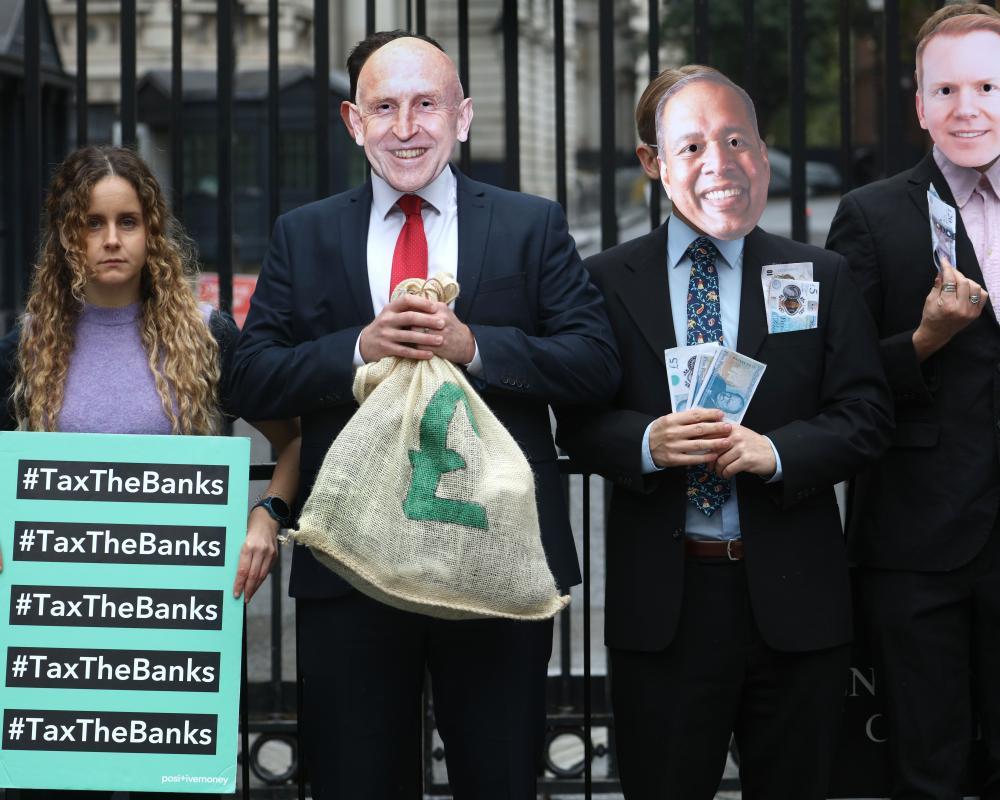
Newflash: the UK government has launched a leak inquiry into how the media reported details of its bank tax hours before last month’s budget.
James Bowler, Permanent Secretary at the Treasury, has told parliament’s Treasury Committee that a probe is underway.
This inquiry will, presumably, examine how Bloomberg reported at 10.45am on budget day that chancellor John Healey would hike bank taxes less steeply than feared, and only increase the bank surcharge by 3%.
That was at least two hours before Healey did indeed announce this in his budget speech.
Bloomberg’s report caused bank shares to rise (as we blogged here) – so it is a classic example of a market-moving leak.
Bowler told the Treasury committee in a letter, just released:
I have been assured that no banks, their representatives or their trade bodies were briefed by Treasury on the details of the changes to the Bank Corporation Tax Surcharge before the publication of the Budget and the Chancellor’s statement to the House.
However, I can confirm that an investigation, lead by the Government Security Group (GSG) in the Cabinet Office, is underway. The Treasury is supporting that work. I won’t prejudge its findings.
Wall Street falls in early trading
As feared, the US stock market has opened with losses after today’s higher-than-expected inflation reading.
The S&P 500 index, a broad measure of US stocks, has dropped by 0.75%, while the Nasdaq Composite tech index is down 1%.
ING economist James Knightley reports that the markets are now fully pricing in a December increase in US interest rates, saying:
Following on from Fed Governor Chris Waller’s comments earlier today that he backs a 25bp hike in December and could even opt for a 50bp hike, Treasury yields have pushed higher, with the 10Y and 2Y up 6bp and 13bp, respectively. Markets are now fully pricing in a 25bp hike at the December Fed meeting, in line with our own forecast, versus 20bp from before Waller’s comments.
Wall Street to drop after inflation data
Wall Street is not happy that US monthly inflation rose faster than expected in October.
The futures market shows that the US stock market is going to drop at the open, in under 40 minutes.
The S&P 500 share index is forecast to drop by 0.75%, and the tech-focused Nasdaq is on track for a 1.3% fall.
That’s because higher inflation makes interest rate rises more likely.
Fed policymaker Christopher Waller spelled this out to the Bank of England Watchers conference today,
Waller warned that a half-point hike in US interest rates might be needed, saying:
If the October CPI inflation data out later today are similar to the past two monthly readings—with core CPI inflation around 0.3% or even higher—then a stronger policy move may be needed.
In that case, I believe a 50 basis point hike in the policy rate should be considered at the December meeting.
Traders will be noting that US core inflation did indeed come in at 0.3% (see previous post).
What was US annual inflation? Good question!
Disappointingly (and frankly embarrassingly) we don’t have a new official estimate of US annual inflation.
This is because of the disruption caused by the US government shutdown a year ago.
The BLS explains that it did not collect its usual pricing data in October 2025 “because of a lapse in appropriations”, adding:
For most CPI series, BLS could not publish October 2025 indexes.
As a result, BLS cannot publish 12-month percent changes for October 2026 for indexes where October 2025 data are unavailable.
US inflation rises faster than forecast
Newsflash: US inflation rose faster than expected last month, as Americans continued to suffer from rising food and energy prices.
The US Bureau of Labor Statistics has reported that the Consumer Price Index rose 0.4% on a monthly basis, higher than the 0.3% rise forecast by economists.
The report found that food prices rose by 0.5% in October, while energy prices jumped by 0.7% month-on-month.
The index for shelter (housing) rose 0.3%.
Core US inflation, which strips out food and energy, rose by 0.3% for the third month running.
Indexes that increased over the month include recreation, medical care, motor vehicle insurance, household furnishings and operations, and education.
But used car and truck prices, and communication costs, decreased month-on-month.
Lombardelli: AI will make junior economist jobs much more interesting
Q: Does the Bank of England agree with US economist Jason Furman who gave a provocative estimate last week that AI could displace at least half of analytical economics jobs?
Clare Lombardelli agrees that Furman’s piece was “very provocative.”
She then explains that it’s “quite astonishing” what AI can do.
She says it will fundamentally change what economics jobs are, and make them rather more interesting.
It will mean that junior economists doing a lot less chart formatting, and more time thinking about the economy.
Does it mean fewer people? Or does it mean people doing much better work?
Lombardelli says there will be “a balance between the two”.
Q: How restrictive is the current Bank rate of 4%, given rising R* around the world and the UK’s solid economic growth?
[R* is the neutral rate of interest, where it’s neither restricting growth nor stimulating it. Central bankers can be reluctant to estimate it too precisely…]
…and Lombardelli sticks to that position! She explains that the Bank has quite a wide range for its estimate of R*.
4% is just above the top of that range, but only just.
Lombardelli says her estimate is higher than some other members of the comittee.
She adds that interest rates have been less restrictive than the Bank expected.
Asked about the risks of an AI bubble bursting, Clare Lombardelli replies that we are “likely to see lots of changes” around the valuations of AI companies.
But while there may be a lot of volatility, that doesn’t mean AI won’t be transformative.
Lombardelli won't rule out back-to-back rate hikes
Q: You said there are reasons to proceed gradually – is that an indication that you wouldn’t support another interest rate rise in December?
Lombardelli says we shouldn’t take that comment as a signal!
She will not rule out back-to-back increases, and points out that the MPC will have more information by the Bank’s next meeting in mid-December.
I wouldn’t rule December in or out, or February in or out, Lombardelli states firmly. Every meeting is live.
Onto questions!
Q: Why has the UK labour market showed resiliance, despite recent economic shocks?
Clare Lombardelli suggests the Bank may be “systematically underestimating” the economy’s ability to respond to shocks.
The BoE’s economic models may underestimate the ability of companies, and households, to react.
Another possibility is that the economy’s resilience is being eroded – with companies eating into their profit margins, and households running down their savings.
Updated
Lombardelli: likely to be a case for another rate rise
Clare Lombardelli then turns to UK interest rates.
She explains that the Bank of England is continuing to learn about the size of the energy shock from the Iran war, and the way it is passing through the economy.
She tells her audience here at the BoE Watchers conference:
Since our assessment in July the energy price shock has proved larger and more persistent.
That has increased the direct pressure on inflation, raised the prospect of greater indirect effects as higher costs pass through supply chains, and increased the risk of second round effects through wages, prices and inflation expectations.
That led the Bank to raise interest rates to 4% last week.
And looking ahead, Lombardelli explains that she believes the balance of risks to inflation remains to the upside.
And signalling that she could vote for another rate rise at future meetings, she says:
In the absence of evidence of weaker inflation pressures, I continue to think there is likely to be a case for a further increase in rates in the near term.
But, this decision will depend on how the Middle East conflict plays out, and how it affects price and wage setting across the economy, she concludes.
[that also fits with what she told my colleague Richard Partington in his article today]
Related: Young people in UK hit by ‘low-gear economy’, warns Bank of England deputy
Updated
Four reasons UK youth employment deteriorating faster than elsewhere
The UK labour market is behaving very differently for young people than it is for the wider population, Clare Lombardelli then warns.
She cites data showing that youth unemployment is unusually high in the UK, when compared to unemployment among prime-age workers.
That gap has widened over time, she points out, and faster than in other advanced economies
Lombardelli says four factors help to explain why job opportunities for young people in the UK have deteriorated by more relative to the national labour market than in other countries.
The first is the “low-hire low-fire” pattern we’re seeing in the UK economy.
But there are three more:
the concentration of weaker hiring in sectors that employ many young people;
the deterioration in young people’s health;
the rising cost and perceived risk of employing inexperienced workers.
On the drop in vacancies in industries that have traditionally relied on young people, Lombardelli says:
There is a relative undersupply of jobs in the accommodation, wholesale and retail sectors – the parts of the labour market with the highest concentration of inexperienced job seekers.
Those industries matter because they provide many of the starter jobs through which young people acquire workplace skills and start to build an employment history
Young people are bearing the greatest cost from the changes in the UK jobs market, BoE deputy governor Clare Lombardelli continues.
She produces data showing that that the UK’s youth unemployment rate is now more than three times the aggregate rate, its highest relative level since the early 1990s.
Lombardelli tells the Bank of England watchers conference:
Despite accounting for only around 12.5% of the labour force, 16 to 24-year-olds account for more than half of the rise in aggregate unemployment since mid-2022
Health
Updated
Clare Lombardelli then turns to the “unusual stability” in the jobs market.
Basically, people are moving jobs less often – be that into, out of, or between jobs.
She says that there is a clear downward trend in the data:
Thirty years ago, more than 3% of employed people changed jobs each quarter. Over the past year, the quarterly rate has been a little above 2%.
This is not too far off global financial crisis lows despite much less cyclical weakness.
Clare Lombardelli then reminds her audience that there were widepread shortages of workers after the Covid-19 lockdown – which may still have repercussions today.
She says:
As the economy reopened from the pandemic, acute labour shortages were widespread. The furlough scheme and wider fiscal and monetary support prevented large-scale unemployment. The rapid expansion in demand then left firms struggling to attract the skills they needed.
Bank Agency intelligence and a range of business surveys repeatedly reported acute recruitment difficulties and skills shortages, leading many firms to place a high value on retaining experienced staff.
Memories of recent labour shortages may have led employers to be more hesitant to make workers redundant, concerned that they will struggle to find the skills they need when activity recovers.
That leads to the ‘low-fire’ labour market she is concerned about, with a consequential ‘low-hire’ knock-on effect too!
BoE's Lombardelli: UK's low-hire, low-fire labour market creating problems
Now, the Bank of England Watchers conference is about to hear from the BoE’s deputy governor, Clare Lombardelli.
She starts by talking about the UK’s labour market – which is cooling, but through “less hiring rather than more firing.”
Expounding on points she made in her interview with the Guardian this morning, Lombardelli explains:
The economy has been more resilient to the recent energy cost shock than expected.
Activity has held up better than anticipated, unemployment has risen only gradually, and redundancies remain relatively low. That may sound like good news. In lots of important ways, it is.
But a low-hire, low-fire labour market creates its own problems. It protects those already in work while making it much harder for those trying to get in or move on.
This, Lombardelli explains, creates three challenges for the Bank of England:
First, it affects how the Bank of England interpret the rise in unemployment. “If those looking for work are poorly matched to the jobs available, higher unemployment may do less to ease wage pressures than it has in the past,” she says.
Second, it can weaken productivity and growth – it’s harder for workers to find job opportunities.
Lombardelli says “The costs are falling particularly heavily on young people, for whom the first step into work has become harder.”Third, it can make the economy less able to adapt.
Cunliffe: A correction is coming....
Q: Is the world heading toward a financial crisis, and can we get out of it?
Sir Jon Cunliffe (who was a senior member of HM Treasury during the 2008 crisis), tells the Bank of England and its Watchers conference that a market correction is coming.
He says:
To me it’s pretty clear that a correction will happen.
The issue isn’t whether it’s coming, it’s whether it transmits though the financial system.
Cunliffe – a former Bank of England deputy governor – explains that policymakers normally worry when they see leverage involved in a boom.
Cunliffe’s “two poles” are the dotcom bust of 2000 – which inflicted losses on asset holders without creating a financial crisis – and the sub-prime crisis of 2008, which did ripple out into a financial crisis.
The difference between those two events is the interconnection and leverage. And it looks more and more that there is interconnection and leverage this time, Cunliffe cautions.
A mrket crash could lead to a credit crunch where everyone sells everything they can, Cunliffe continues. And if that happens, the tools a central bank would use look like the tools you’d use for other crises, he adds.
Nvidia faces a “difficult road ahead”, warns Niall Hearty, partner and regulatory lawyer at legal firm Weightmans:
“Shareholder lawsuits and an independent internal investigation will mean a difficult road ahead for the world’s second-largest company, particularly as Nvidia faces wider pressure from investors amid growing concerns around AI investment and the future of the sector.
There are also wider questions to be asked about national security and the protection of commercially sensitive information at a time when the US and China are racing to gain technological supremacy.”
Q: The Americans showed valuable leadership after the 2008 crisis – do you have confidence that if there is another major crisis the US would exercise leadership again? And would they be followed?
Professor Sir David Osmand tells the Bank of England and its Watchers conference there are two kinds of crisis.
“If the financial windows have been blown in,” he expects the US to step up, as it would be in their interest.
He’s more worried about a “slowburn crisis” – such as unregulated tokenisation.
There, the interests of the US may diverge from other countries, such as those in Europe, Osmand explains.
Spencer Dale, professor of practice at the London School of Economics, says the development of AI is likely to be the most significant source of risk.
The world has “completely failed” to agree any global response to AI, or agree a regulatory response, he says.
Instead, at points of stress - such as the risks from the Mythos AI model – the US has moved the other way, keeping information to itself.
Dale explains:
“Thus far I am not hugely comforted by the way the world has responded to the need to think about and talk about, and then sensibly regulate, AI at a global level.”
Updated
George Osborne: UK has opportunity to lead crypto world
Over at the Digital Asset Summit in London, the former chancellor George Osborne is wearing one of his many hats as adviser to the crypto exchange Coinbase.
Osborne, who also recently joined the ChatGPT developer OpenAI, has suggested that the UK has the opportunity to be a leader in crypto innovation after the US mid-term elections, my colleague Lauren Almeida reports.
He said:
“The UK often has opportunity historically when the US system… can be more bureaucratic and fails to take advantage of a financial innovation.”
His comments come as the crypto industry frets over a less friendly environment in the US, where president Donald Trump’s control has been weakened by the midterm election result. His government had taken “pretty decisive steps forward on crypto regulation”, Osborne said.
Trump himself has been particularly bullish on the sector, having vowed to make the US the “crypto capital of the world” and pushed for deregulation of the industry. Last year he pardoned Changpeng Zhao — founder of the recently hacked crypto exchange Binance — who had been jailed after pleading guilty to failing to protect against money laundering.
That is not to mention Trump’s personal wealth in the sector — he made at least $1.4bn from his crypto ventures last year, according to financial disclosures he made in June.
Related: Trump has amassed staggering wealth in ‘most openly corrupt’ presidency
But Osborne added that it was “too soon to know exactly what is going to happen” with the US approach to the sector.
“It is a bit simplistic to say Democrats are anti innovation in finance and Republicans are pro innovation in finance. There are [Democrats] who have led the case for innovation in the space.”
Updated
Why fiscal pressures are rising
Central banks will face rising political pressure to keep interest rates low, potentially moving us towards an era of fiscal dominance, the Bank of England Watchers conference is hearing.
Professor Beata Javorcik, chief economist at EBRD and professor of economics at Oxford, cites three reasons why pressure will rise:
Rising fiscal burden. “It’s no secret that governments have been borrowing like there is no tomorrow,” she points out, citing pressures such as the Covid pandemic, and the energy shock. That has created an expectation that politiciant will step in when there’s a crisis.
Growing public demand for a larger state
Demographics, and the challenge of an aging populations. Pensions are a “very toxic topic” when it comes to the amount spent on pensions, Javorcik points out – citing opposition in France to pension cuts.
She points out that the median person in advanced economies in 1950 was 29. Now the median person is 41.
As electorates gets older, support for spending more on pensions will rise, she adds.
[Those three pressures mean governments will not want higher interest rates, as that pushes up their cost of borrowing].
Updated
AI could create Liz Truss-like crisis 'at warp speed'
Over at IET Savoy Place, on the north bank of the Thames, the Bank of England Watchers conference organised by King’s Business School is underway.
Professor Sir David Osmand, of King’s College London, is talking about the threats posed by agentic AI.
Osmand explains that frontier AI is already given elite hacking capability to unskilled actors, putting those tools within the reach of anyone with “an API key and a digital wallet”
He then cites the push towards widespread tokanisation within finance – putting real world assets on the blockchain.
And that move will create opportunities for AI to attack everything around that digital ledger.
Harking back to the crisis after the 2022 mini-budget, when UK government bond prices crashed before the Bank of England stepped in, Osmand says:
In a sense, we’ve seen this film before. Liz Truss 2022, with the LDI episode, and collateral calls from gilts forcing the bank to intervene.
That happened at human speed and excellent work by the bank that produced the next day settlement. But just imagine when that happens with a frontier AI-driven crisis at warp speed.
The reference to Liz Truss gives former Bank governor Sir Jon Cunliffe a nasty flashback. “I still have PTSD about that,” he jokes.
Bonuses for Wall Street’s investment bankers are forecast to jump more than 30% this year, but bankers have been warned to enjoy the party while it lasts.
Analysts at financial services compensation consultancy Johnson Associates estimate that investment bankers, particularly stock traders and underwriters, are due to see a 20% to 30%+ jump in the size of bonuses compared to 2025.
It will mark the third straight year of ballooning bonuses for Wall Street bankers, after a trading boom led by tech firms and AI-linked stocks. (which have of course suffered a post-US-midterm election correction).
Alan Johnson, managing director of Johnson Associates said:
“Although bank stocks have been softer this year, record results in equity trading and underwriting have made 2026 the ‘year of the bank,’ and those professionals are in line to receive the largest increases.
“Given the industry’s overall performance, we project that most professionals will see higher incentives at year-end.”
However, the consultancy warned that 2026 will mark peak growth for banker bonuses, with geopolitical turmoil, rising inflation, and frothy stock prices due to hit company fundraising plans next year. Johnson said:
“We expect 2026 to mark a peak against a potentially weaker 2027. Geopolitical turmoil, rising inflation and elevated equity valuations add uncertainty to public markets while fundraising challenges and higher interest rates continue to weigh on private markets.
“Against this backdrop, compensation strategies are likely to become increasingly differentiated, with greater dispersion based on firm and individual performance.
“Talent sourcing and retention, disciplined structures and alignment with broader business priorities will remain key focal points.”
News website The Information are reporting that Nvidia CEO Jensen Huang’s affair with a Chinese businesswoman alleged to be a spy for Beijing facilitated the shipment of at least $7.5bn worth of the company’s chips.
UK and Irish retail investors are continuing to invest in Nvidia despite uncertainty surrounding CEO Jensen Huang, according to trading platform IG.
IG reports that the number of clients buying shares in Nvidia surging 432% yesterday, compared with the average across the previous ten trading days.
Chris Beauchamp, chief market analyst at IG, says there appears to be a broad wave of investor confidence, adding:
“But this is no ordinary dip-buying opportunity.
Nvidia has become the poster child of the AI boom, and Huang has been central to its extraordinary rise. Any threat to his leadership risks shaking confidence not just in Nvidia, but in the wider technology rally.”
Bloomberg: Top UK regulator says banks are trimming AI risk
UK banks have begun cutting their exposure to artificial intelligence as alarm mounts that the sector could suffer a brutal correction, according to the Bank of England’s top supervisor.
Katharine Braddick told Bloomberg that the bank wasn’t being complacent, saying:
“We’re all alarmed at the moment, aren’t we?”
Banks are “all asking themselves that question” of whether to reduce exposure, Braddick added, explaining:
“I can see firms looking at their risk appetite and thinking and considering, ‘Yes this client, not that client.’ You do see it feed through.”
Nvidia shares up nearly 2% in premarket trading
Nvidia’s shares are set to rally when Wall Street opens in almost five hours time.
The company’s stock is up 1.8% in premarket trading, which would recover over a third of yesterday’s drop.
Dr Ammar Ahmed from the University of St Andrews Business School says it’s too early to assess impact of the scandal on Nvidia’s long-term valuation.
“When you have multiple confounding events, it is difficult to isolate a specific one as opposed to another as having an effect on the stock market.
The current situation over the last week is a perfect storm to push down the value of AI stock. Potentially Nvidia may have compromised US national security as well as their own competitive edge. We don’t know if or what the woman, with whom Jensen Huang had an affair, has passed to the Chinese state.
Secondly there is the political and legislative risk that comes from that. If Nvidia have failed on their part to protect US security around AI, the federal government could step in and regulate or impose some additional oversight that constrains not only Nvidia’s activities but potentially the entire sector in the future.
It is enough to move the market as the reaction is around pricing as much as it is around valuation. With pricing, short-term traders in financial markets can take advantage of swings in share prices and make money from this shift in short-term expectations. But how these events affect the long-term valuation of a company is too early to see. It’s a wait and see game, particularly around what the democrats do. Until you see the outcome of those things still in play, it’s difficult to get a clearer picture of the long-term prospects for AI companies.
“Already there’s been a rebound in tech share prices today, which is a sign that some investors may believe the recent events represent an overcorrection. But a one-day bounce reflects market sentiment rather than a reassessment of long-term value, and until the outstanding questions are resolved, prices are likely to remain volatile.”
Updated
Vodafone cuts 3,000 jobs in cost saving drive
Vodafone has cut 3,000 jobs across its European operation, as the telecoms company looks to make €2bn in cost savings by the end of the decade.
The UK-headquartered company said that the roles had been cut between April and September, helping to deliver €200m in cost savings.
This included €50m from its UK operation where the company continues to focus on synergies after it bought out the 49% stake it did not already own in VodafoneThree.
The company has said it expects to deliver £1bn in annual savings at VodafoneThree, the UK’s largest mobile operator, by 2032.
On Monday, the company announced a separate round of 2,300 job cuts in Germany, Vodafone’s biggest market, over the next two years.
On Tuesday, the company raised its profit and cash flow guidance for the current financial year, after reporting that group-wide revenues increased 11.4% year-on-year in its first half. In the UK, revenue increased 10% to €4.9bn.
The company said it now expects earnings before tax to come in at €13.2bn to €13.4bn for the year, following a previous range of €13bn to €13.3bn. The cash flow estimate was upgraded from €2.8bn to €3bn.
Vodafone reported 6.4% growth in adjusted earnings to €6.45bn for the first half.
Overall, the company reported a €3.6bn loss in the first half, after booking an almost €5bn impairment charge in Germany.
“I am very happy about our overall group performance, but Germany is not yet where it needs to be,” said Margherita Della Valle, Vodafone’s CEO.
Vodafone’s share price dipped slightly on Tuesday, but is up almost 30% over the last year.
Updated
Reuters: Huang's woes evoke sympathy and disbelief in his birthplace Taiwan
Nvidia CEO Jensen Huang is drawing both sympathy and disbelief in his birthplace Taiwan, where he has rock star status.
Reuters reports that the dramatic revelations of his affair with a woman who could have been a Chinese spy have not dented Huang’s popularity.
Shock at news that both Nvidia’s board and the FBI are investigating to determine if Huang was targeted by a foreign intelligence effort is palpable in the small Taipei businesses and restaurants he frequents on trips.
“I thought it must be a lie, or fake news,” said Hsiao Kui-yu, whose store selling dried and candied fruit is among Huang’s inevitable stops at Taipei’s Siping market.
“We think of him as such a good boss, who takes such good care of people. How could something like this happen? Is it possible? I’m very suspicious,” Hsiao, 68, told Reuters.
Huang’s barber Ray Wang, whose high-end shop is just around the corner from the luxury hotel where Huang often stays, said the two formed a bond when the CEO first visited in 2017.
“Every day I pray for Mr. Huang, hoping he gets through this difficult time,” the 57-year-old added. “I really want to write him a letter of encouragement, but I feel this isn’t a good time, because he’s very busy.”
Britons stockpiling water and food tins but not panic buying
British shoppers have been stocking up on essentials such as bottled water, tinned goods and hand sanitiser, but did not panic buy after the government advised people to prepare for emergencies, shopping data has shown.
Sales of essentials jumped in the 10 days after the government launched its Be Ready campaign, which encourages households to prepare for up to three days in the event of disruption to essential services from incidents such as cyber-attacks or extreme weather.
In the 10 days after the campaign launch, sales of hand sanitiser surged by 83% compared with the same period last year, while sales of bottled water rose 67% and tinned and jarred goods went up 37%, according to Worldpanel by Numerator’s monthly grocery report for Great Britain.
The number of people buying tinned meat each day after the launch of the campaign rose by 43%, equivalent to an extra 400,000 shoppers a day, but the typical amount bought remained at about 500g in terms of pack size.
Related: Britons stockpiling water and food tins but not panic buying, figures show
A senior US central banker is calling for a hike in interest rates next month.
Federal Reserve governor Christopher Waller is arguing that the Fed should raise short-term borrowing costs next month even if government data shows inflation cooling.
In remarks prepared for his speech at today’s Bank of England Watchers’ Conference in London, Waller says:
“While I am hoping for an improvement over September, even if this occurs, I would still support a 25 basis point increase in the FOMC’s policy rate at our December meeting.”
Reminder: We get the October US inflation data at 1.30pm today…..
Here’s Lorraine Lanceley, partner in commercial and securities litigation at law firm Stewarts, on the class action case filed against Nvidia:
“The affair itself is unlikely to be the central issue for shareholders. What matters is whether shareholders have suffered loss due to Nvidia failing to disclose material information, particularly given the sensitivities surrounding China, AI chips and US export controls.
“US plaintiff lawyers will be looking closely at matters such as what Nvidia and its board knew and when, what was said publicly and whether any material information was withheld from the market. For example, if previously undisclosed information is subsequently revealed to the market and may have caused investors significant losses, the ingredients for shareholder litigation could begin to emerge. But there is a considerable distance between reputational controversy and proving actionable shareholder claims.”
Oil hits 10-week low on hopes US will not attack Iran again
Oil has dropped to its lowest point since the end of August this morning, after Donald Trump declared the war in Iran is “effectively over”.
Brent crude has dropped by 2.5% this morning, hitting $90.16 a barrel.
Traders were encouraged that Trump argued it was “highly unlikely” that the US would renew its attacks on Iran.
He told reporters during a briefing at the White House:
“At this point, taking the military action doesn’t seem to be a very necessary thing – but we’re locked and loaded, ready to go for any reason.”
Oil has been falling steadily through November. It ended October above $117 a barrel.
Updated
Elsewhere in the AI world, Japan’s SoftBank has fallen into the red.
SoftBank posted a loss of $7bn for the second quarter of this year, as it was hit by a $3.7 billion writedown over its US data-center projects and higher financing payments.
The unexpected loss may stir fresh concerns over SoftBank’s huge bet on AI.
Chief Financial Officer Yoshimitsu Goto told an earnings conference that the company needs to “watch closely” the impact of the US midterm elections on AI sentiment.
Asia-Pacific markets shrugged off the Nvidia scandal today, with AI-linked companies rallying.
Japan’s Nikkei index gained 2.87%, adding to Monday’s gains, while South Korea’s Kospi jumped by 4.62%.
Chipmaker SK Hynix was among the big risers on the Kospi, up 6.7%.
Huang's presence in Trump delegation to APEC now 'in doubt'
The spy scandal could cost Jensen Huang a place on Donald Trump’s delegation to theAsia-Pacific Economic Cooperation summit in China next week.
According to the South China Morning Post, Nvidia chief Jensen Huang had been in talks to join Trump on the trip, but his participation is now in doubt after he admitted his affair last weekend and Nvidia launched an investigation.
Other top US business leaders, including Tesla and SpaceX chief Elon Musk and Mastercard’s Michael Miebach, are expected to travel with Trump.
The paper says:
Sources told the SCMP that Musk, Miebach and Huang were among the executives the US president planned to bring to China. All three accompanied Trump on his state visit to Beijing in May.
Away from the crisis at Nvidia, a deputy governor of the Bank of England has warned that young people in Britain are bearing the brunt of a “low-gear economy”.
Clare Lombardelli told the Guardian that employers are holding back from hiring amid the fallout from the war in the Middle East.
But…that higher unemployment may not not necessarily bear down on inflation. If employers only hire for positions they found harder to fill, there will still be pressure to offer higher pay deals to recruit.
Lombardelli explained:
“You can have higher unemployment without it exerting a downward pressure on inflation.
So that’s obviously a problem.”
She is expected to use a speech in London this lunchtime to warn that the breakdown in hiring in Britain’s jobs market is among reasons to fear that inflationary pressures could become entrenched in the economy.
Related: Young people in UK hit by ‘low-gear economy’, warns Bank of England deputy
Nvidia crisis: analysts question if Huang can survive
City analysts are weighing up the potential impact of the Nvidia scandal, and pondering whether it could cost Jensen Huang his job.
Ipek Ozkardeskaya, senior analyst at Swissquote, points to the company’s crucial role at the heart of the AI boom:
One reason Nvidia fell so much is that it has positioned itself as the mascot, the face of the AI trade. The company is at the epicentre of the AI boom, with the most powerful—and premium—product range, financial deals, investment support and broader commitments involving many companies to keep orders coming. And CEO Huang has been a central figure at Nvidia: besides having a far-reaching vision of what AI will look like—and therefore staying a step ahead in terms of business decisions—he has also been involved in politics and helped shape decisions regarding the White House’s China policy within the broader technology war.
The risk is: if he has to leave, who will replace the man in the black leather jacket, and what will the broader implications be for Nvidia’s sales, earnings and its ecosystem? His departure remains hypothetical, however, and Nvidia’s board has expressed confidence in his leadership while launching an independent investigation.
Related: Jensen Huang’s image has been shattered. Could he be pushed out at Nvidia?
Terri-Leigh Bennett, chief operating officer at CMS Prime, warned that the “leadership crisis” at Nvidia is threatening the most important company in artificial intelligence
Nvidia’s approximately 4.27% decline toward $178–$179 [yesterday] was a striking rejection of the broader semiconductor recovery. While competing chipmakers advanced, Nvidia fell to its weakest levels in months as investors confronted allegations surrounding chief executive Jensen Huang and a potential foreign intelligence effort.
The board launched an independent investigation following reports involving a Chinese business executive alleged to have intelligence connections. Huang acknowledged a personal relationship and pledged cooperation; Nvidia maintained that no evidence indicated confidential information had been compromised.
Volume reportedly approached 3.7 times normal. The issue is not simply the allegations but the degree to which Nvidia’s valuation depends on confidence in one leader.
AJ Bell head of financial analysis Danni Hewson says:
“Jensen Huang is the heart of Nvidia. His hand has been firmly on the tiller as the small-time chipmaker morphed into the AI behemoth it is today.
“His vision is seen by many as a key factor in the company’s stellar growth and there are huge question marks about how it will navigate the coming days, especially if Huang is forced to consider his position.
“Whilst Nvidia’s products and relationships with other big players should limit any gains competitors are able to make in the short term, this could present a huge opportunity if the uncertainty continues into the new year.”
Updated
Chris Coons: must investigate if national security was compromised
US senator Chris Coons is calling for a congressional investigation into Nvidia and CEO Jensen Huang.
Posting on X, Coons – a Democrat – says:
I’m pushing to investigate Jensen Huang and Nvidia to determine whether our national security was compromised. We need answers about the relationship between AI billionaires and the Trump administration, who’s making these decisions, and who’s really got their hand on the wheel.
Introduction: Nvidia hit by shareholder lawsuit
Good morning, and welcome to our rolling coverage of business, the financial markets and the world economy.
The fallout over Nvidia CEO Jensen Huang’s affair with an alleged Chinese spy is intensifying, after the AI chipmaking firm has been hit with a shareholder lawsuit.
According to a complaint filed in federal court in San Jose, California, the defendants misled shareholders about Huang’s alleged affair with Alice Huang, a former executive of Singapore-based Megaspeed, and did not disclose that the matter raised national security concerns that threatened Nvidia’s reputation and business prospects.
The suit also claims that Huang’s failure to disclose the affair artificially inflated Nvidia’s share price, and could have violated federal securities laws, Politico reported.
Nvidia’s share price took a knock yesterday – falling by 3.2% and cutting the company’s valuation by almost $200bn, to $4.3tn.
Huang’s reputation has taken a serious knock, after he admitted being unfaithful to his wife following reports of an affair with Nvidia customer and alleged Chinese spy Alice Huang.
As Megaspeed has been accused of illicitly smuggling and diverting restricted Nvidia chips to China, the ramifications are serious.
Related: The AI poster boy, the ‘Chinese spy’ and Trump: how an affair may have harmed US security
Donald Trump weighed in over the scandal yesterday, telling reporters:
“I asked him [Mr Huang] about that and he said he had absolutely no idea that the person in question was a spy.”
Trump also told a news conference that the US Federal Bureau of Investigation was involved in the case, saying:
“We’ll look into it. I know the FBI is looking into it in terms of something else.”
The agenda
8am GMT: Worldpanel UK supermarket inflation data
From 9am GMT: Bank of England Watchers’ Conference in London
11am GMT: NFIB index of US business optimism
1.30pm GMT: US inflation report for October