Closing summary
Time to wrap up…
The sell-off in US tech stocks has resumed, as Monday’s relief rally following the reappointment of Jensen Huang to run Nvidia quickly faded.
Shares in Nvidia are down 7.7% at $152.35, wiping out around a third of Monday’s jump.
Anthropic, the frontier AI firm which floated last week, are down 9.75% at $79.08, meaning anyone who took part in its IPO (priced at $83 a share) is facing a loss.
Chris Beauchamp, chief market analyst at investing and trading platform IG, says:
“The loss of the $83 IPO price is a major development, coming so swiftly after the listing. By comparison it was a month before SpaceX suffered the same fate.
Launching a major IPO in the midst of one of the biggest tech selloffs of recent times was never going to be great timing, but there was a growing sense of ‘now or never’. Huang’s return seems to have amplified the instinct to sell, given his love for open source models rather than the paid version, and absent a broader market recovery it seems Anthropic is fated to struggle for now.”
This is pulling the wider US market into the red, with the Nasdaq Composite now down 2%.
That has punctured an early feeling of relief in the markets, where Asia-Pacific bourses generally rallied today.
Stocks are sliding amid a backlash to the decision to reappoint Huang, under pressure from the White House.
Democratic senator Ruben Gallego said Nvidia’s decision to reinstate Jensen Huang as CEO sends a message “that the national security of this country is not as important as your relationship with president Trump.”
And Bernie Sanders has warned AI firms not to expect a bailout if their investments go wrong.
Huang will make several several appearances on Capitol Hill next week where skeptical lawmakers from both parties will grill Huang over his ties to a woman that some in the intelligence community have said was a spy for China
Related: US lawmakers vow to investigate Jensen Huang and Trump over Nvidia scandal
Our US Politics Live blog is keeping tabs on the latest developments:
Related: Democrats hit out at Nvidia and Trump over Huang’s return – US politics live
Updated
The rapid expansion of AI data centre construction could exacerbate the US housing shortage by drawing workers away from homebuilding.
Oxford Economics has estimated that up to 45,000 additional workers would be employed in residential construction across the 10 states with the highest data centre spending had employment trends followed those elsewhere in the country.
Matthew Martin, senior US economist at Oxford Economics, explains:
“Data centre projects appear to be bidding up wages.
“As data centre demand shows little sign of slowing, the wider premium may make it harder for homebuilders to compete for workers.”
The AI doomsday threat: Distinguishing facts from fear
On Monday 30 November, join Dan Milmo, Professor Dame Wendy Hall, Stuart J. Russell and Alexandra Birch-Mayne as they discuss the warnings surrounding artificial intelligence and how we can separate fact from speculation. Livestreamed only.
Book tickets here or at guardian.live
Related: The AI doomsday threat: Distinguishing facts from fear
The S&P 500, the flagship US share index, is down 0.4% in early trading at 7,206 points.
But.. the Dow Jones Industrial Average is up 0.4%. reaching 49,795 points. Twenty three of the 30 stocks on the DJIA are up, while Nvidia (-5.5%) is the top faller.
The tech-focused Nasdaq index has opened lower too – it’s down 1.8% at 23,661 points.
Analog Devices (-15%) are the top faller, followed by chipmaker AMD (-10.1%) and SanDisk Corporation (-9.2%).
Anthropic's shares tumble below IPO price
Oof! Anthropic’s share price has tumbled below the level at which the frontier AI company sold shares to investors last week, in its record-breaking float.
Anthropic’s stock has dropped by 8.3% at the start of trading, to $80.34, below the $83 IPO price.
This may sour demand for AI-linked stocks, warns Kathleen Brooks, research director at XTB.
She explains:
A drop below $83 so quickly after its IPO could also weigh on the future earnings reports of its largest backers.
For example, if Anthropic’s share price falls sharply, then Google and Alphabet, which hold just under 30% of the stock, could take a hit to their bottom lines. So far, Alphabet and Amazon are posting relatively small losses on Tuesday, but these could worsen if Anthropic’s share price continues to decline.
Nvidia's shares fall 5% at the open
Nvidia’s shares are dropping at the start of trading in New York, as the rally following the return of Jensen Huang yesterday subsides.
Nvidia has fallen by 5.5% in the first couple of minutes of trading, to $155.87. That erodes a small portion of yesterday’s 32% surge.
The chipmaker’s stock is under pressure amid criticism of Huang’s return from both Republicans and Democrats.
Related: Democrats hit out at Nvidia and Trump over Huang’s return – US politics live
Niall Hearty, partner and regulatory lawyer at legal firmWeightmans, warns that reinstating Huang could backfire:
“Jensen Huang’s reinstatement is already raising eyebrows and prioritising short-term stock market valuation above serious national security concerns has the potential to backfire. It seems extremely premature amid ongoing investigations by the SEC, Nvidia’s Board, the FBI and the Department of Justice.
“It is understandable for a company facing this level of reputational turmoil to want to restore stability as quickly as possible. Huang’s return may have temporarily reassured investors, but a recovery in the share price does not resolve the underlying questions about governance and accountability.
Bernie Sanders: Taxpayers will not bailout Big Tech oligarchs.
Democratic senator Bernie Sanders has warned US tech companies not to expect a bailout if their AI investments turn sour.
Posting on X, Sanders says:
One thing must be made certain: If the AI bubble bursts, taxpayers will not bailout Big Tech Oligarchs. Not tomorrow. Not next year. Not ever.
If AI companies fail, Big Tech Oligarchs must bail them out, not taxpayers.
Our message to these multi-billionaires is simple: If you take out a loan, pay it back. Don’t come begging to taxpayers to bail you out.
WSJ: US prepares to raise tariffs on China and other countries
Fears of a new US-China trade war are rippling through the markets today too.
The Wall Street Journal are reporting that the US is preparing to raise tariffs on China and dozens of other countries that the Trump administration argues are harming American companies by supporting their own domestic industrial production, according to people familiar with the plans.
U.S. Trade Representative Jamieson Greer could release the results of a tariff investigation into the industrial subsidies of China, the European Union and 14 other nations later this week, the WSJ adds…..
Bank of England policymaker Megan Greene has warned that UK interest rates need to keep rising, unless there is a “miraculous” breakthough in the Middle East conflict.
Speaking in London today, Greene – one of the more hawkish members of the Bank’s monetary policy committee – warned that the BOE is “a little bit behind the curve now.”
She explained:
“I think it’s appropriate to tighten policy further unless there’s a miraculous turnaround in data or in the war.”
The City money markets indicate there’s an 84% chance that the Bank rises interest rates at its next meeting, in mid-December.
Most stock markets in the Gulf region posted gains today, taking their cue from Wall Street yesterday, and then Asia-Pacific markets overnight.
Saudi Arabia’s benchmark index gained 0.4%, while Dubai’s main share index rose by 0.8%, Abu Dhabi’s market finished 1% higher, and Qatar posted a 0.75% rise.
Meta launches AI assistant Muse - are you planning to use it?
Mark Zuckerberg’s Meta is launching its Muse AI assistant in the UK and is encouraging users to let it loose on their apps – and the high street.
Muse has been a hit in the US and is ranked first and second respectively on Google and Apple’s free app store, having been downloaded millions of times.
Muse can be used as an app or directly within Meta’s WhatsApp messaging platform. Meta invites users to give their assistant a name, a look and a personality, so they can talk to it as well as assign it tasks such as sending an email, booking travel or buying festive presents.
Meta says:
“From doing the Christmas shopping and searching for a cheaper energy deal, to sorting the school calendar … Muse can get it done for you.”
Related: Meta launches Muse in UK – the AI agent that can do your Christmas shopping
So… we’d like to know if you have plans to try Muse, or if you’re already a user. Let us know here:
Related: Have you downloaded Meta’s AI assistant Muse or do you plan to?
Meanwhile in the bond markets, the UK has paid a record high price to sell inflation-linked bonds.
Britain’s Debt Management Office sold £3.75bn of an index-linked gilt which matures in 2049, at a real yield (the return after inflation) of 2.5235%. That, Reuters has calculated, is the highest for a syndicated sale since records began in 2005.
This chart from Deutsche Bank shows how the AI/tech selloff of recent weeks has been was one of the bigger declines of recent years:
But, Deutsche Bank’s Henry Allen points out that there are ‘clear differences’ with the other big risk-off moves of the last decade:
-
First, there wasn’t a sudden and fundamental reassessment of the growth outlook, like when the pandemic began in 2020, or during the Liberation Day selloff of 2025.
-
Second, there wasn’t a meaningful data deterioration, or even much deterioration at all, as happened in summer 2024, or in the 2015-16 selloff.
-
Third, there wasn’t a hawkish repricing like 2022. Admittedly, further rate hikes are priced in, but even more hikes were priced in early October when the S&P 500 and the NASDAQ hit their record highs. So that factor hasn’t changed.
If Nvidia’s shares do indeed drop when trading begins, it will take a slice out of President Trump’s wealth.
Donald Trump made up to $15m (£11.5m) on his holdings of Nvidia stock after the US chipmaker’s share price soared on the surprise return of Jensen Huang as chief executive.
That’s based on the US president’s financial disclosures to the Office of Government Ethics indicate he might have owned as many as 370,000 shares in Nvidia as of 30 September, the latest available data, in news first reported by the Financial Times.
Related: Trump made up to $15m on Nvidia stock after Huang’s return
The US dollar, which hit a 19-month high yesterday, has dipped by 0.3% against a basket of currencies.
That weakness is helping the pound – it’s up half a cent at $1.3088, up from a one-year low yesterday.
Elsewhere in the markets, Anthropic is at risk of falling below the level at which it sold shares to investors last week.
The frontier AI company’s stock is down 5.6% in premarket trading at $82.74, which would take it below its IPO price of $83 a share.
Anthropic also missed out on yesterday’s rally, and dipped slightly on Monday.
Duncan Ferris, analyst at Freetrade, says
“Jensen Huang has stolen Anthropic and [co-founder] Dario Amodei’s thunder. The massive 31% comeback rally sparked by his Nvidia homecoming has turned retail investors’ heads more than one of the biggest IPOs of all time.
Nvidia board facing criticism
Nvidia’s board is facing criticism after being bounced into taking Jensen Huang back as CEO.
New York City Comptroller Mark Levine, who helps manage retirement funds that hold some 5 million Nvidia shares, believes the whole situation undercuts the board’s standing.
Levine told Reuters:
“They told us flatly that he would not be coming back. They have done a total 180 [degree turn] without any explanation, or any indication that concerns about legal and other liabilities have been resolved.
“They have proven they’re not independent, and that is the defining quality that we need from any board.”
Plus, as my colleague Nils Pratley wrote last night, Nvidia’s board hasn’t even completed its investigation into reports that Huang was “the target of a foreign intelligence effort”…
Related: Nvidia’s humiliated board should resign out of embarrassment | Nils Pratley
Nvidia’s shares are continuing to drop in pre-market trading.
They’re now down 5.7% at $155.66.
The European technology sector has dipped by 1.3% today, as yesterday’s rebound fizzled out.
Mike Coop, chief investment officer at Morningstar Wealth, says:
“Nvidia got heavily oversold and the reaction was excessive... it’s perhaps no surprise that there was a degree of rebound when people looked at the cold light of day about what was actually going to happen.
“We’re in the late innings of this whole AI-led bull market. You’re going to get more vulnerable swings around sentiment.”
In Taiwan, Jensen Huang’s birthplace, some people have been welcoming Nvidia’s surprise decision to bring him back as CEO, Associated Press report.
“He is quite important. All I can say is he is nice. He is a really good guy. Yeah. We all like him a lot,” said Hu Ke-hsin, 50, an employee at a preserved fruit store in Taipei that Huang used to visit.
Sophia Chou, a Taipei City resident, was also supportive:
“He is a leading figure (in the AI industry), right? Lots of industries in Taiwan still need AI to develop. So, from an ordinary person’s point of view, I am happy he is back.”
Jensen Huang to face Congress next week
Jensen Huang is expected to be called to testify before the Senate Banking Committee next Thursday. In what could be a dramatic public interrogation of the now well-known tech CEO, the hearing will focus on oversight of US export controls amid a growing Congressional push to limit chip exports to China.
The US has sought to curb Beijing’s access to Nvidia’s advanced AI chips because it wants its own companies to stay ahead in the race for technological dominance.
However, Huang has reportedly lobbied the Trump administration to loosen restrictions on selling Nvidia chips to China, and has criticised what he frames as overly restrictive export controls that have encouraged Chinese rivals to accelerate the development of their domestic AI products.
The chairs of the House committees on China, intelligence and foreign affairs confirmed Huang will appear for separate transcribed interviews next Tuesday and Wednesday, as previously planned.
Huang will likely be asked whether US national security was compromised by his reported affair with suspected Chinese spy Alice Huang, who had been executive director of Megaspeed International. Alice Huang and Jensen Huang are not related, and Chinese officials have denied that she was a spy.
Since 2024, the Singapore-based company Megaspeed - the biggest buyer of Nvidia chips in South East Asia - has been under investigation by US authorities over whether it diverted AI chips to China. The US commerce department added Megaspeed to its trade blacklist on Monday, citing national security and foreign policy concerns.
Hong Kong’s stock market missed out on the Nvidia bounce today, with its Hang Seng index dipping by 0.73%.
Russ Mould, investment director at AJ Bell, suggests this may reflect fears of a clampdown on US AI chip exports:
“The big Wall Street rally on Monday was followed by gains in some parts of Asia on Tuesday, although trading was mixed and weakness in Hong Kong could reflect some fears that Huang’s return might be accompanied by stricter limits on the export of AI technology.
“Once the party poppers have been put away, and the chants of ‘Jensen, Jensen’ have faded within the walls of Nvidia’s HQ, investors may be mindful of a hangover as they start to weigh some of the potential political and governance implications of Huang’s return to the hot seat.
“The FTSE 100 was one step removed from all the drama given its limited tech exposure. Brent crude remained firmly below $90 per barrel on hopes of diplomatic progress in the Middle East. That is potentially good news for inflation but less positive for the UK market’s contingent of energy shares.”
Most European stock markets are in the red today too, as yesterday’s rally fails to last into a second day.
The pan-European Stoxx 600 index has lost 0.25%, with losses in Germany (-0.5%), Italy (-0.36%) and Spain (-0.4%).
Wall Street down in pre-market trading too
The US stock market is expected to hand back some of yesterday’s gains too.
The S&P 500 share index is down almost 0.4% in pre-market trading, while the tech-focused Nasdaq is on track for a 0.9% decline.
German foreign minister 'shocked' by Trump's intervention
Germany’s foreign minister Johann Wadephul has revealed he was “shocked” by US President Donald Trump’s intervention to have Jensen Huang reinstated as chief executive of Nvidia, the AFP newswire report.
Wadephul told a Berlin event, when asked about Trump’s move:
“It shocked me, to be honest, because as far as I know, if I’m personally looking back, I never saw and recognised such an intervention from the political side to a special company.”
Update: Wadephul added:
“I do have some doubts whether this is a very good model for the future,”
“In free, democratic and rules-based countries, political power should refrain from interfering [with companies]”.
Updated
Nvidia shares down 4% in premarket trading
After a sizzling rally yesterday, Nvidia’s shares are set to drop when New York stock market trading begins later today.
Nvidia’s shares are down 4.1% in premarket trading, at $158.26, as traders absorb the political backlash over Jensen Huang’s return.
Investors will also be noting warnings that concerns over the health and sustainability of the AI boom have not gone away, despite the rise in Asia-Pacific stock markets today.
Yesterday Nvidia’s shares surged by over 30% to close at $165.05, up from $125.53 at the close of trading last Friday.
Updated
Is AI too big to fail?
Jensen Huang’s return to Nvidia, despite concerns over his conduct and the supply of AI chips to China, may show that AI – and Huang himself – are ‘too big to fail’.
That phrase was on everyone’s lips almost 20 years ago when the Global Financial Crisis struck, and several major banks were bailed out.
Roger Lee, head of equity strategy at investment bank Cavendish, explains:
Given Nvidia’s pivotal role in the AI capex rollout, the implications of Huang’s reinstatement could be profound. Borrowing from the GFC, are some technology CEOs now so systemically important to the future of AI and US leadership in the latest technology revolution that they cannot be fired?
Questions around the scale of financing required and future monetisation remain, and the dependence on Huang for the future success of AI may paradoxically heighten those concerns especially given Anthropic fell despite yesterday’s broad market rally.
Related: In an authoritarian economy, Jensen Huang may be too big to fail | Robert Reich
How Trump lobbied for Huang's return
A day before Nvidia announced Jensen Huang’s reinstatement as its CEO, the US president, Donald Trump, dialed into the AI giant’s Sunday board meeting to argue for his return, Semafor reports.
According to the NY Times, over the weekend, Trump also asked the vice-president, JD Vance, to work with the board to assure them that Huang, who was forced to resign over a reported affair with a suspected Chinese spy, was not a national security risk.
By Monday morning, Nvidia announced Huang’s return despite its chair previously stating they did not intend to reinstate him because his personal behaviour was inconsistent with the company’s “code of conduct, standards and cultural norms”.
Reflecting a wave of anger among lawmakers at the decision, the top Democrat on the House oversight committee, Robert Garcia, said in a statement on Monday that Trump’s “direct involvement” in the matter raised “serious national security and corruption questions”:
“We must investigate these actions. No president who has invested in a private company should be involved in their board decisions. Congress must come together in swift bipartisan action and demand answers immediately.”
Trump’s holdings of Nvidia stock rose in value by as much as $15m (£11.5m) on Monday as the share price surged after news of Huang’s reinstatement broke, the FT notes. The US president owns between $11m (£8.4m) and $55m (£42.1m) in Nvidia stock, according to a Reuters review of his 2025 annual financial disclosure and 2026 share trading disclosures.
Chinese state media have warned that Jensen Huang’s reinstatement won’t end tensions between Beijing and Washington, or restrictions on AI chip exports.
China’s Global Times newspaper published a commentary urging China to “remain vigilant” today, saying:
“It is foreseeable that the malicious attempts to sow discord in China-US relations will not automatically disappear simply because Huang has been reinstated.”
The article also predicted a new round of “witch hunts” could include investigation letters, delays in export licenses and congressional hearings, Bloomberg reports.
London stock market dips in early trading
London’s stock market has opened, with more of a whimper than a bang.
The FTSE 100 share index has dipped by 5 points, or 0.05%, to 10,475 points.
Why no Jensen bounce? Because European markets rallied yesterday when Huang’s return to Nvidia was announced, lifting tech companies across the continent. That pushed the FTSE 100 up by 1.3% on Monday.
Plus, as Ipek Ozkardeskaya, senior analyst at Swissquote, explains, his return won’t ease the broader risks facing AI:
There’s the massive spending needed to build AI infrastructure, the pressure on free cash flow at hyperscalers — Nvidia’s biggest clients — and the need for these companies to raise money through equity or bond issuance.
Then there are rising borrowing costs as inflation stays elevated and credit spreads widen, and of course the political hurdles with Democrats set to take control of Congress.
Video: Jensen Huang's return to Nvidia yesterday
The surge in stock markets since Jensen Huang’s return to Nvidia was announced shows that investors are “willing to re-engage with the AI theme when uncertainty recedes”, says Christian Stocker, lead equity strategist for UniCredit Munich.
But… Stocker argues that the rally reflected relief that the AI supply chain and investment cycle are unlikely to be abruptly disrupted, rather than renewed conviction that all concerns have disappeared.
He told clients this morning:
Questions about financing structures, profitability and the ultimate returns on AI spending remain largely unresolved.
In other words, the debate has shifted. Investors are no longer asking whether AI investment will continue. They are increasingly asking whether the path from investment to monetisation will be slower, more uneven and more dependent on favourable financing conditions than previously assumed. Recent market volatility suggests that the AI narrative remains intact, but the market is becoming less willing to assume a straight-line path to future earnings growth.
Updated
Jensen Huang’s return as Nvidia’s CEO could, perhaps surprisingly, be painful for US borrowers.
That’s because America’s central bank is more likely to raise interest rates if they’re not facing a bursting AI bubble.
Jim Reid of Deutsche Bank explains:
With fears of an AI slowdown receding, it also led markets to price back in a more hawkish path for the Federal Reserve over the months ahead.
So for the next meeting in December, markets are once again fully pricing in a 25bp hike, with 26.1bps priced in for that decision (+3.1bps on the day). Then looking further out, 70bps of hikes are now priced in by the September 2027 meeting, up +6.6bps relative to Friday
US adds Megaspeed, AI firm at center of Nvidia scandal, to trade blacklist
In another significant development in the Nvidia story, Megaspeed International has been placed on a US trade blacklist that bars it from buying advanced AI chips.
In a filing on Monday, the Commerce Department moved to formally add the company to its entity list. This means Megaspeed will now need approval from the commerce department to obtain US exports.
This move revelations that Jensen Huang had a relationship with Megaspeed’s Alice Huang, the Chinese businesswoman alleged to be a spy for Beijing – a claim China has said is “groundless”.
Related: US adds Megaspeed, AI firm at center of Nvidia scandal, to trade blacklist
Nvidia rejoices at Jensen Huang’s second coming
Jensen Huang made his return to Nvidia’s headquarters with a hero’s welcome yesterday.
Hours earlier he’d been reinstated as the CEO of the world’s most valuable chip company, following a whiplash series of events that involved a romantic affair with a suspected Chinese spy, a drastic plummet in the stock market, and an intervention from Donald Trump.
As Huang entered the company’s Silicon Valley office, wearing his signature dark-colored uniform, crowds of employees rushed to greet him clapping, hollering and chanting: “Jensen, Jensen, Jensen!”
“I’m going to be a better CEO the second time around,” Huang told employees, according to several verified videos posted to social media. The crowd went wild – it was Huang’s second coming.
Related: Nvidia rejoices at Jensen Huang’s second coming as White House takes victory lap
Introduction: Asia-Pacific markets rally on Huang's return, despite backlash
Good morning, and welcome to our rolling coverage of business, the financial markets and the world economy.
Jensen Huang’s surprising, and controversial, return to run Nvidia has sparked a strong rally in Asia-Pacific stock markets today,
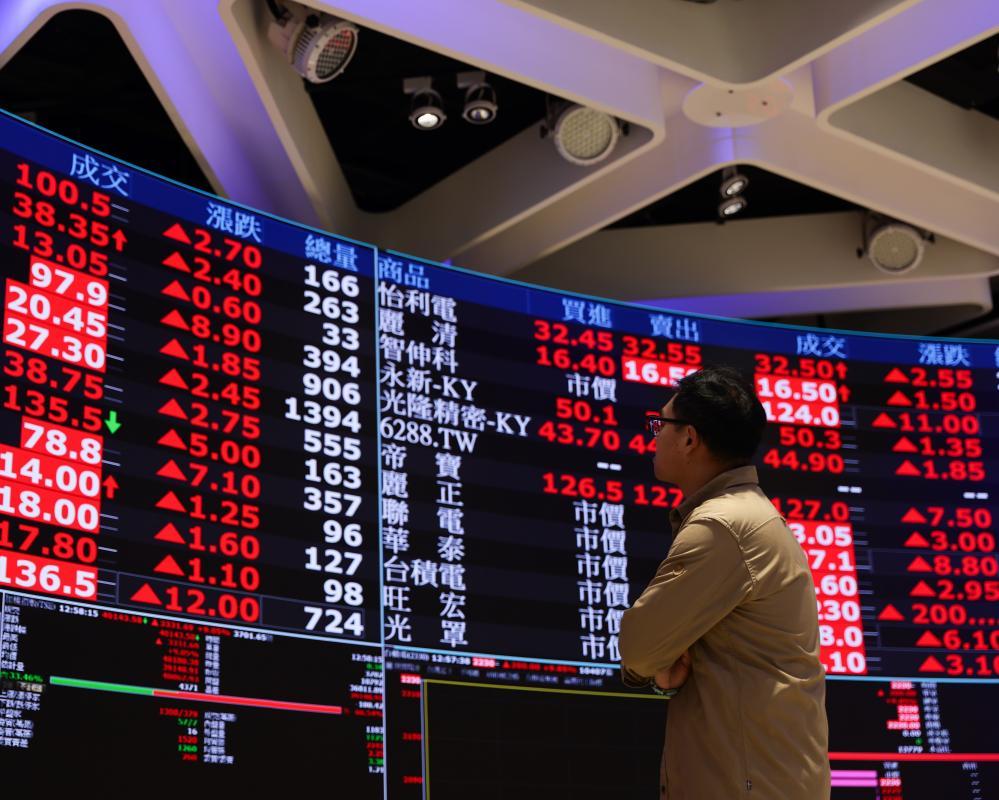
Stocks have surged in Taiwan, South Korea, Japan and Australia, as the AI trade lurches back into life.
The Taiwanese TW50 index has surged by 9.5%, away from the seven-month high touched yesterday. In Seoul, the Kospi index has jumped by 6.5%, led by chipmakers SK Hynix and Samsung Electronics.
Tokyo’s Nikkei gained almost 4%, and Australia’s S&P/ASX 200 has risen by 1.8%.
That followed a surge on Wall Street last night, where Nvidia’s shares rocketed by 31.5% – adding around $950bn to the company’s value as Huang returned to the company’s HQ.
Related: Jensen Huang reinstated as Nvidia CEO after Trump intervenes
Huang’s return “removes an important source of uncertainty,” said Charu Chanana, chief investment strategist at Saxo in Singapore, adding:
“His return restores strategic continuity at Nvidia and reduces the immediate risk of disruptions to its supply chain and technology roadmap.”
But while Wall Street recorded its best day since April 2025 (when Donald Trump paused his Liberation Day tariffs), doubts over the high valuations of AI companies, and questions over whether the industry will generate revenues to sustain their high spending on data centres, remain.
As does the political backlash against Huang’s return, and the role played by Donald Trump’s White House in pressing Nvidia to take its former CEO back.
Democrat senator Elizabeth Warren has called Huang’s restoration “reckless,” and warned that the banking committee she will head next year will be digging into whether Nvidia has complied with export controls.
She also said the Trump administration “needs to explain to Congress what ‘input’ was given and by which senior officials in the United States government to support his reinstatement.”
Republican lawmakers also roundly criticized the Nvidia board’s decision to reinstate its chief executive, Jensen Huang, even after Donald Trump said he spoke “directly and indirectly” with board members and “convinced them” to bring him back.
Pete Ricketts, a US senator from Nebraska, wrote on X that Huang’s “behavior does not support reinstatement”, a reminder of his alleged affair with a Chinese spy.
Related: Republican senators criticize Nvidia’s decision to reinstate Jensen Huang
The agenda
-
9am GMT: IFO survey of German business confidence
-
11am GMT: CBI Distributive Trades survey of UK retail
-
2pm GMT: US house price data
Updated