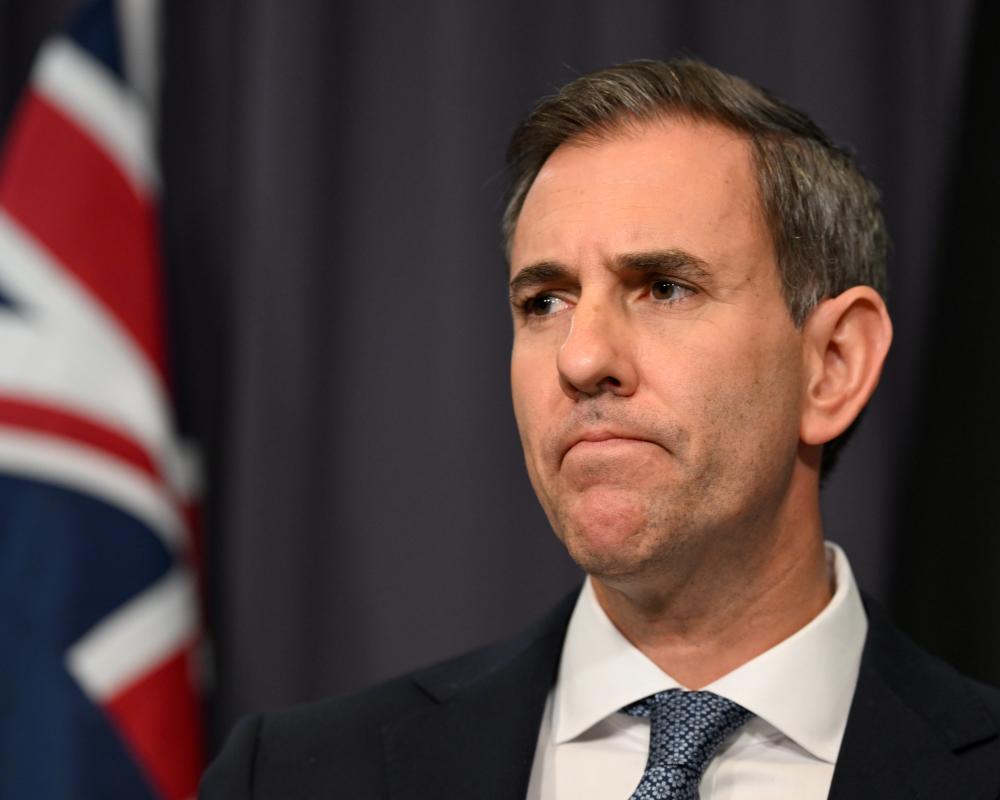
Chalmers says economy facing ‘serious moment’
The treasurer has said Australia’s economy is facing an “especially difficult” period while pointing to government forecasts that things will get better in 2027.
Jim Chalmers was asked if the country faced an “economic emergency” when speaking to reporters in Canberra just now. He said:
This is a very serious moment for our economy, and we will respond in substantial ways.
Chalmers said the combination of economic issues Australia was facing had motivated his statement on Monday, which he described as “probably the most substantial preview, that I’ve seen in this building, of a mid year update”.
But he noted that Australia’s jobs market had enjoyed a “better experience” than other countries and pointed to Reserve Bank predictions that wages would grow faster than prices next year.
2026 has been an especially difficult year for people. We expect this inflation, for a range of reasons, to hang around for a bit longer than anyone would like.
But we also expect inflation to come down in the target band in 2027. We expect real wages growth, in the Treasury and RBA forecast, to return in 2027. We expect our economy to continue to grow.
Updated
Chalmers: ‘no amount of savings will make inflation go away’
Jim Chalmers has said no amount of budget cuts would fix Australia’s inflation as he promises rising prices will be the main priority of next month’s budget update.
The treasurer has told reporters he stands by promises to find significant savings, as foreshadowed in a grim parliamentary statement earlier this week.
I said on Monday, and I say again today, there’s no amount of responsible cost of living relief or budget savings, which will make this inflation challenge go away overnight, and that’s because it has a number of drivers, primarily, in this case, automotive fuel.
And so we will do what we responsibly can, to hand down a budget update next month, which has substantial savings.
He pushed back at commentary that government spending has caused resurgent inflation, defending past cost-of-living policies such as electricity rebates and fuel excise cuts.
I would encourage people not to make the mistake of concluding that budgets are the primary driver of prices in our economy …
If you look at the last four years, public final demand growth halved while private final demand growth tripled. And that tells us there are other factors at play here.
People shouldn’t pretend, unfortunately, as I have seen in recent weeks and months, that there are no global factors at play here. Of course there are. Budgets are not the primary determiner of prices in our economy.
Updated
Chalmers says inflation jump is an unsurprising ‘global phenomena’
The treasurer, Jim Chalmers, has said new data showing surging prices was a “unwelcome but unsurprising reminder” of pressure on Australians.
Chalmers said the leap in inflation to 4.9% in October was due to oil and fuel prices, which he said had been widely predicted.
He told reporters in Canberra:
If you look around the world, October saw inflation go up in most major advanced economies, and interest rates are going up around the world as a result.
We did have an inflation challenge in Australia before the war in the Middle East, but the war is making it much worse, and a lot of this inflation is a global phenomena, as a consequence.
Inflation is still much lower than its peak in 2022, but it is still too high.
The Reserve Bank’s preferred trimmed mean measure of inflation – which takes out the most volatile prices, including fuel – lifted to 3.8%.
Read more here:
Related: Inflation rate jumps to 4.9% as Australia’s cost-of-living crisis intensifies
‘We fixed this law’: Greens claim victory over pensioner carve-out for private health rebates cut
The Greens leader, David Shoebridge, has celebrated after successfully pressuring Labor to carve out pensioners from cuts to private health insurance rebates for over-65s.
Many people over 65 – who are not pensioners – will lose their additional private health insurance rebates, putting them on par with everyone else. All pensioners will be carved out.
Shoebridge said the proposed full cuts would have left people going hungry. He said in a statement:
The Greens have been clear for months now, these changes to the private healthcare rebate cannot go after pensioners. Today we fixed this law to make sure it will not …
I hope this gives some real relief to people, that when people need our support, the Greens were here for them …
Cutting support to people who need it the most will never be supported by the Greens.
Updated
NSW government ‘significantly scaling up’ fire ant response after ‘complex’ infestation found
The NSW government is “significantly scaling up” its response to a fire ant infestation detected in Auburn over the weekend, after finding “a larger and more complex infestation than initially identified”.
The first fire ant nest was successfully treated, but authorities have identified more ants and a colony type requiring further treatment.
The Auburn detection involves the polygyne social form of red imported fire ants, the National Fire Ant Eradication Program confirmed on Tuesday night.
The NSW government said in a statement:
Unlike colonies with a single queen, these colonies contain multiple queens and can support a higher concentration of ants and nests within a relatively small area, making them complex to treat.
This type of colony has not previously been detected in NSW and is rare even in south-east Queensland, where fire ants are more widespread.
Tara Moriarty, the NSW agriculture minister, said:
This fire ant type is different to what has occurred in the past and is seemingly the result of infested imported goods.
Our government is boosting our on-ground resources and establishing a taskforce to focus on tracing the supply chains that have led to this occurring …
We’re asking the community to work with us by reporting any suspicious ants or earth mounds and cooperating with our teams as they check businesses, residences and public lands the area.
Updated
‘Unwelcome but unsurprising’: Chalmers responds to inflation data
The treasurer, Jim Chalmers – who will probably face some more hostile questioning from the opposition today in question time – says the latest inflation data ticking up from 4.3% to 4.9% was widely anticipated.
He said the global oil price was the biggest influence on the monthly figures, with automotive fuel prices rising 6.3% in October.
In the government’s defence, Chalmers says “every major advanced economy has had a rate rise” since September.
This is another unwelcome but unsurprising reminder of the pressure Australians are under.
We had an inflation challenge in our economy before the conflict in the Middle East but the war is making it worse.
This inflation challenge is the primary influence on the budget update we will finalise in the coming weeks and release in December.
Updated
Victorian Labor proposes new AI workplace rules
With just a handful of days until polling day, Victorian Labor has made a handful of announcements around AI and the workplace.
Labor promises to force employers to disclose when they’re using AI in the recruitment process and to give applicants the right to know if an automated decision was made. They’re also requiring the use of AI in recruitment to be tested for discrimination and they will make companies legally responsible if discrimination occurs because of AI.
There are also announcements for gig workers. This follows the death of HungryPanda delivery driver Feng Jianming in Melbourne’s CBD. They said they will work with WorkSafe to look into making the following changes:
-
Giving WorkSafe to audit potentially dangerous algorithims that reward dangerous speed.
-
Covering riders when they are hurt on the job, and stopping the platforms from fining riders for refusing dangerous deliveries.
In the statement, the premier, Ben Carroll, said: “Platforms must be on the hook for managing safety risks, too – they share a responsibility.”
Updated
Coalition, Greens and crossbench rally against government over home births access
The independent senator David Pocock, the opposition, the Greens and other crossbenchers have come together to put pressure on the government over an impending rule change that could be detrimental for women accessing home births in Australia.
This takes a bit of explaining so bear with me here – it’s important.
From 1 January a longstanding professional indemnity insurance exemption for privately practising midwives attending home births will expire.
In Australia, a planned home birth legally requires two midwives – the first midwife must be endorsed but the supporting second midwife does not have to be. Just 5% of midwives in Australia are endorsed.
The concern is this will mean women – particularly in rural and regional areas – will lose access to a home birth.
Pocock has put forward a motion (for which he has the numbers) to call on the government to extend the indemnity insurance exemption for two years, and work with women, midwives and the sector to come up with a better solution. He has told the Senate:
In just over five weeks, the ability for Australian women to choose to give birth at home will be severely compromised.
While the government has supported the development of a new insurance product, we’re hearing overwhelmingly from midwives across the country that it is not fit for purpose. The insurance is prohibitively expensive for many second attending midwives and requires them to be endorsed, despite the primary already being endorsed.
Updated
National apology to LBGTQ+ veterans a ‘milestone’
GLBTI Rights in Ageing Inc (GRAI) has welcomed the deputy prime minister and defence minister’s apology to LGBTQ+ veterans this morning, calling it a milestone after years of campaigning.
GRAI chair, David Gibson, who was discharged from the Australian army due to his bisexuality, was in the House for the apology.
In a statement he said:
For many veterans, the apology marks a milestone after years of pressing for recognition, sharing their experiences with the Royal Commission into Defence and Veteran Suicide, and giving evidence to the Senate inquiry. The legislative reforms that followed offer Australia a way to recognise both their service and the harm they experienced.
Updated
Inflation jumps to 4.9%
Surging fuel costs have helped drive inflation to 4.9% in the year to October, from 4.3%, as cost-of-living pressures peak in the lead-up to Christmas.
The latest figures from the Australian Bureau of Statistics come two days after Jim Chalmers, the treasurer, stood up in parliament to warn Australians that economic conditions would get worse before they got better.
The Reserve Bank’s preferred gauge of underlying price pressures, the trimmed mean measure of inflation, lifted to 3.8%, from 3.6% in the month before.
Economists are hopeful that inflation will ease through 2027 to be back below 3% in a year’s time.
And amid fears of a more severe economic downturn, financial markets before the release of the latest data were pricing in an RBA rate cut by August.
Updated
Deputy prime minister apologises to LGBTQ+ veterans
There has been a lot going on in parliament today, while the Australian and Solomon Islands prime ministers were holding a press conference, the deputy PM and defence minister, Richard Marles, was giving a long overdue national apology to LGBTQ+ veterans.
Until as late as 1990, the ADF maintained a policy prohibiting homosexual members from serving, resulting in discharges and convictions because of consensual same‑sex activity.
A parliamentary committee in July recommended the government issue a national apology to LGBTQ+ veterans and service personnel who experienced discrimination at the hands of the Australian defence force.
Marles told the House:
It is a shameful chapter in the history of the Australian defence force. And it is one that we must confront with honesty …
Lifting the [homosexuality] ban could not hand back careers. Careers that in some cases, had barely begun, or some that had been decades in the making the [homosexuality] ban could not hand back incomes … or even the right to call themselves a veteran at all. Some never told their families why they came home early. Some have never marched on Anzac Day.
To you I say: you and your families offered this nation everything that service asks. In return our nation offered condemnation, derision, and suspicion. This country did not keep faith with you. But today it says sorry.
Updated
What’s in the Solomon Islands treaty?
Solomon Islands will not allow its territory to be used for any foreign military or security base under a landmark treaty sealed with Australia.
Under the agreement, Honiara has committed that its sensitive infrastructure shall remain “free from militarisation, any form of foreign interference or unauthorised access”.
This is a major win for Australia, which has been working to stop China from gaining a military foothold in the region.
Canberra was alarmed when Solomon Islands and Beijing signed a controversial security pact in 2022.
Solomon Islanders will also have improved visa arrangements, being able to stay in Australia for longer periods. New opportunities in Australia’s early childhood and aged care sectors will open.
Building on the Albanese government’s successful sport diplomacy, this treaty includes a sweetener for an “expanded soccer partnership” to develop and deepen opportunities for local talent.
Labor used the planned new NRL team based in Papua New Guinea to seal its alliance with Port Moresby.
Updated
‘Massive win’: Monique Ryan celebrates private health insurance backdown
The crossbencher and medical doctor Monique Ryan has celebrated the government’s backdown to carve out pensioners from its private health insurance legislation.
It means people over 65 – who are not pensioners – will lose their additional private health insurance rebates, putting them on par with everyone else.
Ryan said her commissioned analysis of the policy by the Parliamentary Budget Office showed it was “a cash grab from pensioners”:
Fantastic to secure a massive win for older Australians today! From the moment this measure was announced in April, I’ve been fighting to secure affordable private health insurance for older Australians.
It’s been wonderful to work across the Parliament to successfully oppose a poorly conceived, unfair and unreasonable bill.
Updated
‘I welcome the motion of no confidence’: Solomon Islands PM Matthew Wale
Matthew Wale says he would welcome a motion of no confidence, and that the decision to sign today’s treaty was taken with his entire caucus and cabinet.
Wale faced a no confidence motion in September, before the Pacific Islands Forum, which was then withdrawn.
Wale is unfazed when asked if he could withstand any future challenges:
So far as my leadership is concerned, the decision to sign this treaty is a decision taken by my caucus and my entire cabinet, there was unity to sign and that is what we have done. I welcome the motion of no confidence and I look forward to it.
Updated
Matthew Wale can’t comment on end of the China pact
Why? Because he says there was a non-disclosure agreement attached to it.
Wale ordered a review of the pact with Beijing signed in April 2022, under his predecessor, Manasseh Sogavare.
Wale’s decision reverses Sogavare’s alignment with Beijing, in favour of Australia.
Wale is asked what the reaction from China has been that the pact, which expires in April 2027, will not be renewed. He also won’t say.
Unfortunately there is a nondisclosure clause in the treaty with China, security pact, and the police an agreement so I am unable to talk about that. We have ongoing discussions with China.
Updated
The days of uncertainty in Pacific are ‘gone’, Solomon Islands PM says
Matthew Wale has taken a far different approach to relationships in the Pacific region from his predecessors – he’s far more friendly with Australia and far less friendly with China.
The Solomon Islands PM has welcomed the agreement signed this morning, saying it makes his nation a trusted and reliable partner in the region:
Solomon Islands has been for a number of years, a source of uncertainty and doubt in the region, those days are done. Gone. We don’t want to be there again.
That comes by being trusted by our neighbours and it is important to not only Australia and New Zealand of course, and the entire Pacific Islands region so we thank you sincerely for the work and the effort you put into it and the speed, you can move mountains.
He says the agreement was signed ahead of schedule.
Updated
Australia and Solomon Islands sign ‘historic’ treaty to help fund free education
The prime minister, Anthony Albanese and his Solomon Islands counterpart, Matthew Wale, are speaking to the media after signing a treaty.
Albanese says the “historic” agreement will strengthen security with Australia to support Solomon Islands to “strengthen its police force and improve border security”. He jokes:
When we last stood here together, it was a cold and rainy Canberra day. I remember you saying, “The man who brings a bit of drizzle is your best friend!” Prime minister, you brought much more than that today. What you brought, together with 17 members of your cabinet, is a determination and an ambition to take the relationship between our two great nations to a new level.
Under the new treaty, Albanese says Australia will help the Pacific nation fund its free education policy, and provide more opportunities for Solomon Islanders to work in Australia in areas such as aged care and childcare.
Updated
Pensioners and private health insurance rebate for over 65s – how did we get here?
You might be thinking: hang on, didn’t the Senate literally throw out the bill to decrease private health insurance rebates for over 65s just last month?
You would be correct. The Coalition, Greens and crossbenchers voted together to block the bill in the Senate, though the next day Labor reintroduced it without any changes into the house.
So how did we get here?
The government has been locked in negotiations with the Greens ever since, who have said from day one they would pass the bill, but only with carve-outs for pensioners.
Labor said: well, that would cut into the $3bn of savings which would go to more aged care beds.
The Coalition have said flat out they would not support the bill. The original policy was put in place by the Howard government when the budget situation was a bit healthier.
Anyway, Labor realised there was absolutely no other pathway and have swallowed that bitter pill, while still promising to spend $3bn on more aged care beds.
It’s a big win for the Greens, and a bit of a win for Labor – who at least get a version of their legislation through.
Updated
Labor agrees to Greens demand to carve out pensioners from private health insurance bill
Labor has agreed to a major concession by the Greens to carve out pensioners from its bill to decrease private health insurance rebates for over 65s.
That means two of Labor’s four bills – digital duty of care, private health insurance, gas reservation scheme and trust tax changes – will now pass with the support of the minor party.
The government was facing a lot of flak from the Greens, opposition and broader community for the policy, which is said would save around $3bn. It promised to invest that money into more aged care beds.
In a statement, the health minister, Mark Butler said:
It was intended that the government would invest the $3 billion saved through this measure to deliver more residential aged care beds, more Support at Home Packages, shorter wait times and better care for older Australians. The full investment into aged care announced in the Budget will continue.
The Government also recognises the realities of the Senate, and reaching agreement was necessary to secure passage of the Bill and deliver these important investments into aged care.
All pensioners, people eligible for a full or part-rate pension payment in at least one fortnightly payment period in a given financial year, including a service pension or veteran payment, will be carved out.
Related: What do we know about Labor’s controversial private health insurance plans?
Updated
Zali Steggall and Allegra Spender update party name after acronym concerns
Crossbench MPs Zali Steggall and Allegra Spender have updated their party name from Community Strong Australia to Community Strong party, after community consultation as they officially registered with the Australian Electoral Commission.
The original name reportedly raised concerns due its acronym – CSA – which is also used as shorthand for “child sex abuse”.
The party has already secured $3m in pledged donations ahead of new electoral funding and donation rules that take effect on 1 January. They said they are operating separately to Climate 200, and have promised that any representatives elected under the party will have a free vote.
Steggall said:
The $3m already pledged is a fantastic start, but we need to build on that momentum. The major parties have enormous resources and established political machines. We are building something new, and we need people who believe in it to get behind us.
Updated
In pictures: Solomon Islands prime minister arrives at Parliament House
Updated
Military welcome for Solomon Islands PM outside Parliament House
I just got a bit of a jump scare at the sound of a cannon firing!
It’s part of the ceremonial welcome for Solomon Islands prime minister, Matthew Wale, who has just arrived at Parliament House.
There’s a 19 gun salute, followed by a military guard of honour to welcome him.
We’ll bring you some pics of that shortly.
The two leaders will soon sit down to ink a new treaty, after it was revealed the Pacific nation would not renew a landmark agreement with Beijing after it expires in April next year.
Updated
Coalition ‘instinct’ is to repeal digital duty of care bill, Hastie says
The Coalition is sticking to its guns that the digital duty of care bill – which should pass the Senate in the next 90 minutes or so – is “heavy handed censorship” and that the opposition would be inclined to repeal it if it wins government.
Andrew Hastie tells RN Breakfast that there are some good elements to the bill but the trade off is too high.
This bill is heavy-handed censorship, and that’s a conversation that we’ll have, but our instinct and our posture will be to repeal it.
The online harms and the way they’re vaguely defined pose a risk to people’s political communication.
The US ambassador had a similar argument, that the online harms laid out by the government are too “vague”.
The government says the bills won’t impact political communication or misinformation, with Anika Wells saying last month that “if adults listen to manosphere podcasts, or people post their views about the government, or make memes, or want to say the moon landing was fake – they can continue to do so without restriction”.
Updated
Labor ‘crab-walking away’ from renewables-only position on AI datacentres, says Hastie
Andrew Hastie says the government is “slowly crab-walking” away from its position that AI datacentres should be powered by renewables only.
The Liberal frontbencher was on the AI inquiry that yesterday handed down its report (which you can read about here).
The Labor-chaired committee recommended the government establish national requirements for AI infrastructure “including access to reliable and competitively priced energy, water, telecommunications connectivity, computing capacity and secure supply chains.”
Hastie, speaking to RN Breakfast earlier, noted that the recommendation didn’t include a specific requirement for renewable energy.
I think they’re slowly crab-walking away from their renewables only position. I think they’re realising that AI is energy intensive. We have an abundance of natural resources here that could power the AI revolution and that’s why the committee was ultimately agnostic on power sources.
But I think ultimately if people want to build AI they need to build more energy into the grid so that it doesn’t compromise regular Australians and their security when it comes to power.
Updated
Early election not on the cards, says Wells
Anika Wells says there hasn’t been any discussion (that she’s been a part of) for an early poll next year.
The government has until May 2028 to hold the election, but Angus Taylor and the Coalition have talked about being prepared for one as early as next year.
The communications minister tells ABC News Breakfast it hasn’t come up in conversations.
I don’t recall that being a point of discussion. I can’t obviously account for the entire building, but I think we’re really focused – it’s an absolute chock-a-block last week of sitting here in the parliament and we’re really desperate to get some good measures delivered.
Asked point blank: “You can’t see your boss rushing to the polls at some point next year?”
She replies:
No … Not that I can see into his mind, but certainly not the impression I got!
Updated
Wells says AI investment and creative protections not a ‘zero-sum game’
Weighing into the gigantic debate that is AI companies wanting to scrape Australian data to train models versus creatives who want to protect their work, Anika Wells says it’s not a ‘zero-sum’ game.
But she says copyright laws do need to change.
Wells tells RN Breakfast that creatives are at present not being paid for work being scraped by AI, so regardless the system does need improvement. The question is how. Artists are still seriously concerned the government will sell them out and weaken copyright rules.
Related: Kate Bush and Grace Jones urge Australian government not to legalise AI ‘theft’
Wells says:
I reject this sort of zero-sum game where building Australian sovereignty in AI must come at the expense of creatives or at diminishing the rights of creatives. At the moment, yes, we want deals, but we want creatives paid properly for their work. And the situation that we find ourselves in at the moment is that they’re not. They have no control and often no payment for their work.
Updated
Wells says meeting with US ambassador ‘really useful’
Anika Wells says she won’t hypothesise what the United States will do, if anything, after the US ambassador raised “objections” to the digital duty of care bill.
As my colleague, Josh Butler, wrote below, the ambassador said vaguely defined harms and penalties will “push platforms to censor lawful speech”.
Wells, speaking to RN Breakfast, says as she did yesterday that the two have spoken and that they’re “ironing out” differences of opinion.
It’s not for me to hypothesise what another nation’s administration might want to do. I did meet with ambassador [David] Brat yesterday morning. It was our first meeting together. It was really useful.
I think we both understand each other’s positions and we’re ironing out where there are points of difference. Like I said, we won’t take a backward step from protecting Australian kids and helping Australian parents, and they won’t take a backward step from their position.
Updated
US ambassador criticises Labor’s digital duty of care bill
The US ambassador to Australia has raised “objections” to Labor’s digital duty of care bill, saying he was “concerned” it would hurt US tech businesses.
“Vaguely defined ‘harms’ backed by penalties of up to 5% of global revenue, will push platforms to censor lawful speech,” David Brat wrote on the US embassy’s X page, after a meeting with the communications minister, Anika Wells.
The bill has not yet passed, but is in the final stages of Senate processes. Wells said she met Brat yesterday, with US tech companies some of the most prominent to be captured by the laws; Wells has previously said Donald Trump’s Truth Social platform would be subject to the laws but that the government had committed to “constructive dialogue” with the US, including during her Tuesday meeting with Brat.
“I think we would say there are points of differences, and we’re ironing them out,” Wells said of her meeting with Brat.
But the US ambassador, posting a photo of that meeting – where both were smiling – wrote online that “free speech is the foundation of a free society, and protecting it is a U.S. priority”.
Today I met Minister for Communications Anika Wells and laid out the Trump Administration’s well-known objections to the Digital Duty of Care Legislation. Vaguely defined “harms,” backed by penalties of up to 5% of global revenue, will push platforms to censor lawful speech.
As Australia’s largest foreign investor, the U.S. is concerned with regulations that impose disproportionate compliance burdens on American companies relative to competitors.
Updated
‘On the road to economic ruin’: the new Coalition catchphrase
The Coalition is sharpening its lines and slogans, and trying to get itself into shape for an election as early as next year.
Its smelling blood in the water with Labor and the prime minister’s support sinking.
Angus Taylor, speaking to journalists in the press gallery corridor, is keen to use the phrase that the country under Labor is “on the road to economic ruin”.
In five minutes, he uses it four times.
I tell you what’s down though – real wages, incomes, our standard of living, the biggest collapse. The biggest collapse of any developed country in the world. And we’ve got inflation data out today, the expectation is it will be high again.
I think the country is on the road to economic ruin.
Updated
Coalition welcomes Solomon Islands dropping China pact
Liberal leader, Angus Taylor, has welcomed Solomon Islands scrapping its pact with Beijing and signing a treaty with Australia – with the leader, Matthew Wale, in Canberra today.
The landmark agreement, signed between Honiara and Beijing in 2022, will not be renewed after the five-year deal expires in April next year.
It was signed in the weeks leading up to the 2022 federal election under the then Morrison government, which Penny Wong called Australia’s “worst foreign policy blunder in the Pacific since the end of World War II”.
Speaking to ABC News Breakfast, Taylor is asked how a Coalition government would stop that happening again. Taylor says the problem was actually Solomon Islands’ leadership at the time:
Well, you do have to nurture these relationships. It’s important. Obviously, it depends on who’s leading, and we have a leader there now who is determined to drop that arrangement. And that is a good thing. We welcome it very much.
Updated
Good morning
Krishani Dhanji here with you for what is – probably – the second-last sitting day of the year.
(The sitting week technically ends tomorrow, but if the government secures an 11th-hour deal on its key bills, it could end up passing them with amendments in the Senate late Thursday and recalling the lower house on Friday.)
As we reported earlier, Solomon Islands’ prime minister, Matthew Wale, is in town today to sign a new treaty with Australia, after it was revealed the Pacific nation would end its security pact with China. Even the opposition was positive about the deal, with Andrew Hastie crediting the government with the “win”.
Inflation data will come out today, something we (and the rest of the country) have been laser focused on, and is likely to be less of a win for Labor. We’ll bring you all the reaction to that too.
I’ve got my coffee, I hope you’ve got yours – let’s get stuck in!
Updated
Inflation expected to jump when latest figures released today
The government’s economic management will be back in the spotlight today, with official figures at 11.30am expected to show inflation jumping to 4.8% in the year to October.
That’s well up on the 4.3% annual rate in September, and will be nearly double the Reserve Bank’s official target of 2.5%.
Once again, it’s rising fuel costs that are driving the headline inflation number in the wrong direction.
Nab’s economists reckon fuel costs will contribute 1.2 percentage points to annual inflation, which they predict will be 4.7% (so slightly below the consensus forecast).
The ban of card surcharges from 1 October will also add a bit to price pressures, although how much is unclear.
Only 16% of firms charged surcharges, but there was evidence that the introduction of the ban was used by a wider range of businesses as an excuse to pass on other cost increases to their customers through higher prices.
The RBA will be focused on what is happening to underlying price pressures. The so-called “trimmed mean” inflation measure, which removes the most volatile prices, is expected to bump up to 3.7%, from 3.6%, according to the consensus forecast.
The better news is that analysts believe this should mark a high-water mark for inflation.
“An outcome in line with our forecast would be no comfort to the RBA, but we expect October to mark the peak for headline inflation and to overstate the underlying momentum in trimmed mean,” NAB said.
The best evidence of this is that financial markets are pricing in rate cuts next year.
Updated
Chalmers notes ‘serious moment for our economy’ but downplays recession fears
The treasurer, Jim Chalmers, has downplayed any fears of an incoming recession while acknowledging it is a “very serious time” for Australia’s economy.
This week, Chalmers presented a special economic statement warning unemployment would climb above 5% alongside slower economic growth for the next two years. He flagged modest cuts in next month’s mid-year budget update, including to the public service.
Chalmers told the ABC’s 7.30 program on Tuesday evening that it had been a “very difficult year” for Australians, which had been reflected in the polls and political commentary:
I take responsibility for the fact that we’re pushing hard reforms through the parliament at the same time as people are under pressure … But I’m not focused on the commentary or the columns in the newspapers. I’m focused on doing the right thing for the right reasons. Not just acknowledging the pressures that people are under, but taking responsibility for responding to them.
Chalmers maintained neither the treasury or reserve bank were forecasting a recession or “expecting our economy to go backwards”, but added:
There are risks and pressures and challenges all around our domestic economy and indeed right around the global economy. This is a very serious moment for our economy.
Updated
Solomon Islands to end China security pact, sign new Australia treaty
Solomon Islands will end its contentious security pact with China, in a major diplomatic win for Australia.
Guardian Australia has confirmed the landmark agreement, signed between Honiara and Beijing in 2022, will not be renewed after the five-year deal expires in April next year.
In a statement, the Solomon Islands government confirmed its prime minister, Matthew Wale, will travel to Canberra to sign a treaty with Australia on Wednesday, reported to be worth almost $1bn.
To keep China at bay in the Pacific, the Albanese government has since inked a number of security agreements, including mutual-defence pacts with Fiji and Papua New Guinea.
Updated
Welcome
Good morning and welcome to our live news blog. I’m Martin Farrer with the top overnight stories and then it’ll be Krishani Dhanji with the main action.
Updated