Here is a summary of today's news
-
At around 3pm, some departing flights at airports across Britain were disrupted, after air traffic control provider NATS experienced a technical issue. As of 630pm, some 625 flights were cancelled to and from UK airports following the issue, flight monitoring website Flightradar24 said.
-
Around the same time, NATS said it apologised to customers and that its flight system was “starting to recover” after a fix was implemented following a technical issue – but delays have continued with some airports suggesting that disruption could last for the rest of the day.
-
Andrew Bailey, the governor of the Bank of England, faced a Treasury select committee, at which he insisted that the Bank of England doesn’t have a “secret plan” to raise interest rates.
-
Saudi Arabia said operations at several energy facilities in the kingdom’s south were halted after attacks ignited fires in the region bordering Yemen (where the Houthis are based).
-
The three-month copper contract on the London Metal Exchange hit a record high of $14,617 a ton this morning, surpassing the previous record set on Monday.
-
Gas prices were rising this morning, putting pressure on European countries who need to stock up their storage levels before the winter. European gas price reached their highest levels since January 2023. The month-ahead UK gas price is now up more than 3% at 188p a therm, over the highs seen yesterday.
-
The FTSE 100 share index dipped by 0.2%, or 20 points, to 10,801 points, with banks among the big fallers. Energy firms BP (+0.9%) and Shell (+0.35%) are higher, though.
The transport secretary Heidi Alexander said she is “seeking assurances that lessons will be learned” following the air traffic control issue that has led to at least 600 flight cancellations so far.
“Pleased @NATS have fixed the issue, and huge thanks to those working to get people moving”, she said in a post on x.
“It will take time to fully resume flights, so continue to check with airlines.
“I am seeking assurances that lessons will be learned and systems that support aviation are up to the job.”
Updated
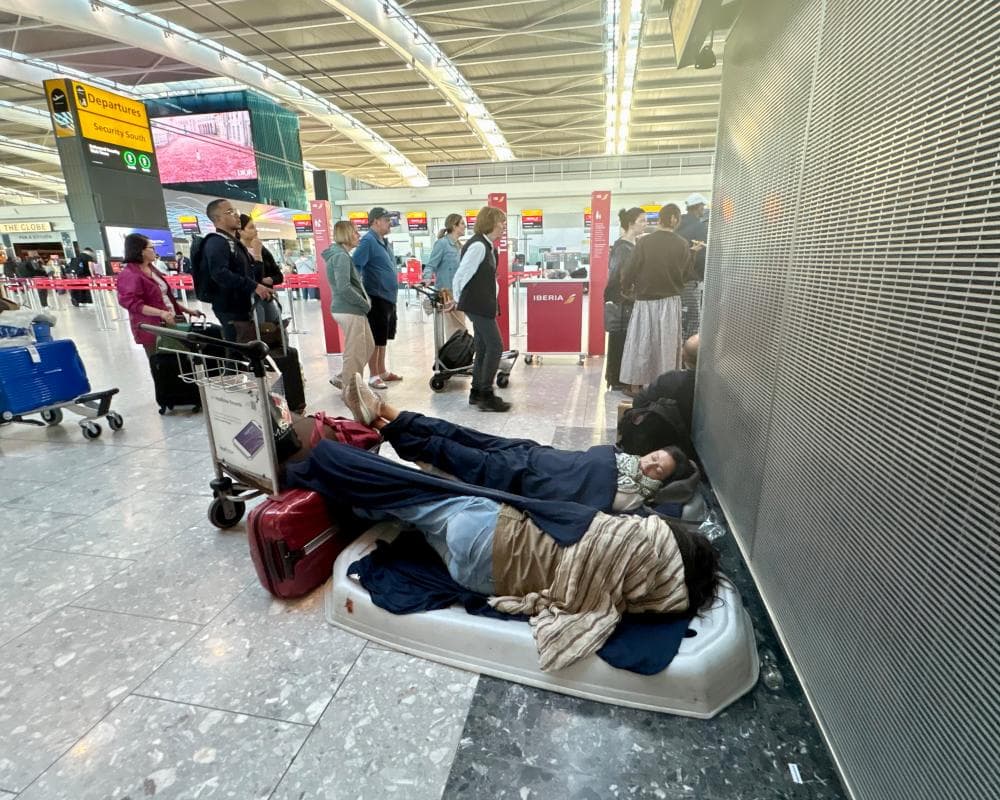
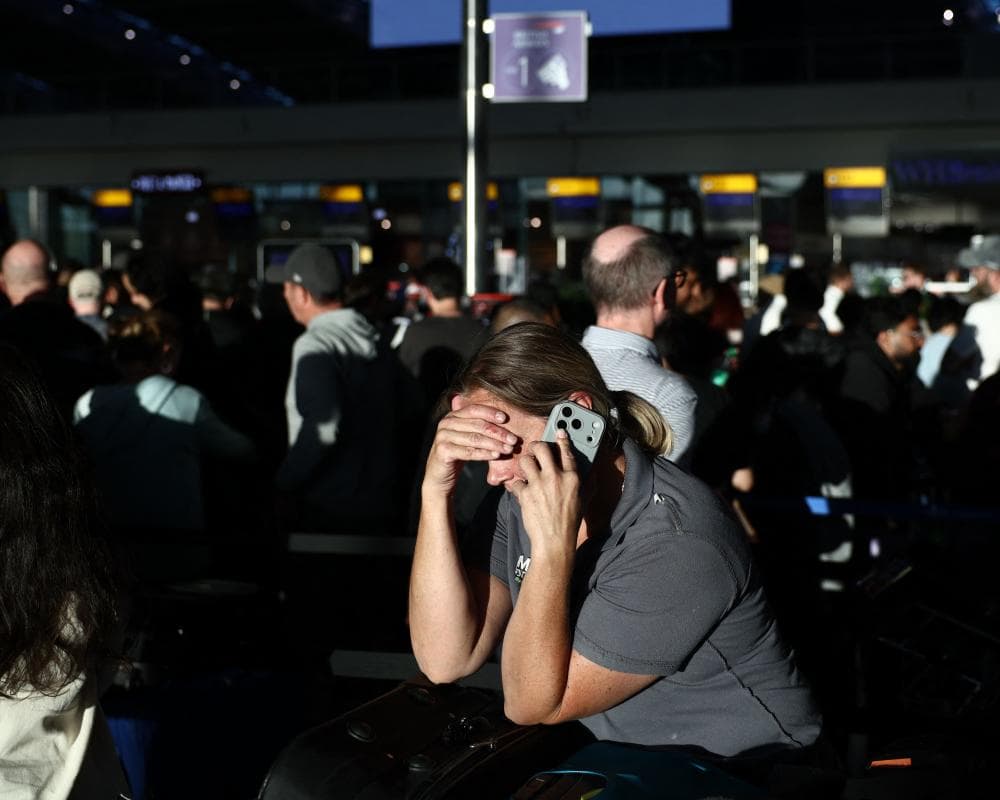
With more flights facing delays or cancellations, Britain’s airports are heaving with passengers, many of whom are crowding around departure boards, hoping for signs that their flight may leave the country this evening, or waiting in queues to speak to staff about their next steps.
Here are some pictures from around the country:
A note for readers with travel plans this evening: while “a fix” has been implemented after air traffic control issues, airports are still dealing with the fallout and many flights are still being impacted.
British Airways urged customers whose flights have been cancelled not to travel to the airport and said they can make changes to their booking on ba.com. Ryanair and easyJet tell passengers to check its website for updates.
625 flights cancelled in the UK over technical issue
Another update from Flightradar24, which says that 625 flights have been cancelled at airports in the UK over the air traffic control issues.
The flight-tracking tool said this included 218 easyJet flights and more than 130 British Airways airlines.
A spokesperson for British Airways said: “While Nats has informed us that their air traffic control system fault has been resolved, the severity of the issue means there will be a significant knock-on impact for customers and colleagues.
“We were forced to cancel or divert more than 100 flights on Tuesday afternoon, inconveniencing tens of thousands of customers.
“This incident was entirely out of our control and incredibly frustrating for our customers and colleagues, with aircraft and crews ending up out of place.”
Updated
Passengers on a British Airways flight from London to Shanghai were turned around and forced to disembark at Cardiff airport after the place faced a “technical issue”, according to Flightradar24.
The flight, which departed Heathrow at 12:03pm was over Romania before it turned back to the UK. It landed in Cardiff just before 5:30pm, more than five hours after its departure.
It’s likely the plane did not return to Heathrow over to the air traffic control issues, according to Flightradar24.
Passenger Chi Chen travelled from Bristol to Heathrow airport as he was meant to be flying to Naples to meet a friend.
The 43-year-old said he made it all the way through security before discovering his flight was cancelled.
“I was due to be flying out at 6.15pm (on Tuesday),” he told the Press Association. “They only announced the cancellation at around 3.30pm.”
He said British Airways emailed him offering an alternative flight at 6.05am on Thursday, which involved flying to Brussels first. “I can’t accept it,” he said.
Number of flights cancelled now stands at 425 amid travel chaos
The number of flights cancelled amid travel disruption has now exceeded 400, as NATS said its flight system is “starting to recover”.
Some 425 flights were cancelled to and from UK airports as of 5pm following the issue, flight monitoring website Flightradar24 said.
NATS said earlier in a statement: “We have implemented a fix and our flight system is starting to recover.”
Updated
A look at Heathrow’s live departure board hints at the scale of the disruption. While a number of green flights are still marked as “on time”, there are many that have simply been cancelled, leaving passengers scrambling for solutions.
It’s not just UK airports that have been disrupted either; flights that hoped to land in the country have also faced delays or cancellations.
One social media user earlier wrote: “Venice to Bristol EZY2832, all been dumped off a plane back to the gate with zero communication. Already 3 hours delayed, what’s the plan?”
Updated
Passengers have vented their frustrations on social media about the delays to their flights, stating there had been “zero communication” from airlines.
One woman told EasyJet on X: “I appreciate it is difficult, but the lack of communication at Alicante re delays is abysmal”.
Another user said: “Flight from Porto to Gatwick cancelled. No sign of any easyJet staff for those that have gone through security and need to leave the airport”.
Shortly after 4.45pm, one man told the airline: “Stuck on runway at Gatwick still after meant to take off at 2:20pm. At least EasyJet have offered us a snack of up to value £2.80! Can’t even buy any food or beverages and I’m starving”.
Many social media accounts messaged the airline with their flight numbers requesting updates, one account saying: “Venice to Bristol EZY2832, all been dumped off a plane back to the gate with zero communication. Already 3 hours delayed, what’s the plan?”
Some departures from Newcastle Airport have been delayed amid the flight disruption, according to a Newcastle Airport spokesperson.
“We are aware of a technical issue affecting Nats which is impacting some flights at airports across the UK”, the spokesperson said in a statement.
“While some departures from Newcastle are experiencing delays, our operations have not been affected to the same extent as those at some airports in the south of the country.
“Passengers are advised to check with their airline for the latest flight information.”
NATS "apologise sincerely" and say flight system starting to recover
Nats said its flight system is “starting to recover” after a fix was implemented following a technical issue.
In a post on X, it said: “We have implemented a fix and our flight system is starting to recover.
“We are continuing to work closely with our airline and airport customers on recovery.
“We apologise sincerely for the disruption to people’s journeys today and they should continue to check with their airline.”
The state of play in UK flight disruption today
Time for a quick recap…
Flights around the UK are facing delays and disruption due to an air traffic control issue which has affected a string of airports including Heathrow and Gatwick, and recovery may take time.
According to aeroplane tracker Flightrader, there have been “nearly 300 cancellations so far this afternoon”, with British Airways and easyJet most affected.
Departures from London airports are most severely affected, with few take-offs since a fault was reported early on Tuesday afternoon.
The air traffic control service Nats said at 1.46pm that it was “investigating a technical issue which is causing some disruption to flight departures”.
Nats added: “Our engineers are on site and we will provide an update as soon as we can. We apologise for the delay this will cause to journeys, passengers should check with their airline on the status of their flight.”
The UK’s biggest airport, Heathrow, said planes were continuing to arrive, although Eurocontrol said some inbound flights were being held at airports abroad, with disruption likely to continue until the evening.
Nats later added that its engineers are “working urgently” to fix the problem, but warned that “recovery will take some time”.
Ryanair has revealed that 65,000 of its passengers have been delayed up to 8 hours, and called for the head of Nats to quit.
Here’s our news story on the disruption:
Related: Flight delays and disruption across UK after air traffic control technical issue
I’m handing this blog over now to my colleague Charlie Maloney.
Flightrader 24 has posted on X:
Nearly 300 cancellations so far this afternoon as NATs systems return to normal.
British Airways: 96
easyJet: 92
KLM: 20
Lufthansa: 12
Swiss: 11
Nearly 300 flights cancelled due to air traffic problem
Nearly 300 flights have been cancelled as a result of the UK air traffic control issue, FlightRadar24 has said.
The worst affected airports are Heathrow, Gatwick, Manchester and Birmingham.
The air tracker found 352 flights to and from Heathrow were delayed out of its daily average of about 1,300.
Meanwhile 281 Gatwick flights were delayed out of its 850 total operations average. This was 249 out of 650 for Manchester, and 101 out of 300 for Birmingham, the Press Association report.
Updated
Ryanair calls for NATS CEO to quit
Budget airline Ryanair has blasted “overpaid failing NATS CEO Martin Rolfe” over today’s disruption, and demanded (not for the first time) that he quits his job.
According to Ryanair, over 65,000 of its passengers have been delayed today, with more than 50 flights cancelled, after today’s air traffic control technical problems.
Ryanair COO, Neal McMahon, says:
“How many more failures do passengers have to suffer before overpaid failure NATS CEO, Martin Rolfe, accepts responsibility for his repeated mismanagement and resigns? Over three years after NATS’ catastrophic 2023 system meltdown, it’s clear that nothing has changed, with UK passengers once again suffering avoidable ATC delays of up to 8 hours today due a critical NATS ATC system failing. Families travelling on holiday, people travelling for work and thousands of visitors to the UK have once again paid the price for NATS’ abhorrent failure.
The astonishing part is that NATS continues to charge airlines and passengers more each year while delivering a worse service. Following the 2023 collapse, we were told lessons would be learned. We were told “resilience would improve”. We were told the systems had been fixed. Yet here we are again. This is a pattern of repeated failure with Rolfe in charge getting paid over £1.4m in bonuses p.a. while he delivers failure after failure.
The UK Government, the CAA and the NATS Board must stop making excuses for repeated NATS failures and appoint a new leader capable of running the UK ATC system without repeated failures. Its time for overpaid failure Martin Rolfe to go.”
Back in March, Rolfe argued that the criticism over the 2023 technical meltdown was unfair, as Nats had only suffered four incidents in 12 years.
Heidi Alexander: Passengers will be frustrated
Transport Secretary Heidi Alexander has posted on X about the disruption, saying:
I’m aware of a technical issue impacting flights at airports including Heathrow and Gatwick. Technicians have identified the issue and are fixing it as we speak.
I know this will be frustrating for passengers and I’m sorry. Please check with your airline for latest advice.
Disruption at London City Airport
London City Airport has confirmed it is experiencing disruption to departing flights, following the NATS technical problem today.
A spokesperson for London City Airport said:
“Due to an air traffic control issue affecting airports across London, London City Airport is experiencing disruption to departing flights.
“Passengers should check their flight status with their airline before travelling to the airport.
“We apologise for the inconvenience and thank passengers for their patience.”
Lung disease drug success for AstraZeneca
Away from today’s flight disruption, a lung disease drug being developed by AstraZeneca for COPD has performed well in late-stage clinical trials, a welcome boost to Britain’s biggest pharmaceutical company following several setbacks recently.
Chronic obstructive pulmonary disease is a long-term lung condition that makes breathing harder over time through chronic inflammation of the airways, and can also lead to a chronic cough and excess mucus.
The company’s tozorakimab drug, administered once every four weeks, showed a reduction in moderate and severe COPD exacerbations (which lead to more than 2,500 emergency department visits a day in the US) in former smokers of up to 34%, and in current and former smokers by 30%, compared with a placebo. A total of 2,306 patients were involved.
The drug led to a reduction of 43% in exacerbations in patients with the highest level of of blood eosinophil, a biomarker. The data was presented at the European Respiratory Society Congress in Barcelona.
Frank Sciurba, professor of pulmonary and critical care medicine at the University of Pittsburgh and chief trial investigator, said:
“These unprecedented results, along with its favourable safety profile, underscore tozorakimab’s potential as an innovative treatment for the millions of people living with COPD who remain at risk despite treatment with inhaled standard of care.”
COPD is the third-biggest cause of death worldwide, excluding Covid-19. Only half of COPD patients live more than 3 ½ years after their first severe exacerbation.
AstraZeneca estimates peak annual revenues of $5bn for the treatment, which would make it one of its biggest selling drugs, while analysts at Morgan Stanley have pencilled in $6bn.
Updated
Wizz Air: NATS needs urgent reform
Airline Wizz Air have lambasted NATS for today’s technical failure.
Wizz Air says it is “extremely disappointed” by the UK’s air traffic control issue.
The company adds that a critical national infrastructure provider should not repeatedly bring the aviation system to a standstill, declaring that NATS is simply not fit for purpose in its current form.
Updated
Less happily, budget airline easyJet reports that the UK air traffic control system failure is causing delays to flights across Europe, with some flights unable to operate (Reuters reports).
Updated
Happily, the impact at Cardiff Airport due to the air traffic technical issue is “currently minimal”.
A spokesperson for Cardiff Airport said:
“A technical issue affecting Nats Air Traffic is causing some disruption to flight departures across parts of the UK.
“The impact at Cardiff Airport is currently minimal though we’d encourage passengers to check directly with their airline or travel operator for the latest information on the status of their flight.”
Anna-Marie Duthie, travel insurance expert at financial ratings company Defaqto, has sent over some advice for passengers affected by today’s flight disruption:
“If there is a significant delay to your flight, your airline should be covering the costs of essentials you’ll need during that delay. Such as food and drink, phone calls and if necessary overnight accommodation including transport to the hotel.
Insurers and Airlines could class issues as ‘extraordinary circumstances’, which ultimately means it is a situation beyond their control and could not have been foreseen or avoided. As a result, you may not be entitled to compensation as it is not considered to be the airlines’ ‘fault’ and therefore they are not liable.
That being said, the above refers to ‘compensation’. Transport providers and tour operators do have a responsibility to either provide a reasonable alternative or a full refund should a flight not go ahead as planned. If a replacement flight is offered but is delayed, depending on the distance being travelled, the Civil Aviation Authority do set out under what circumstances you would have a legal right to claim for compensation.
Travel Insurance may also cover you if you cannot claim costs back from the airline, operator, or credit card but that will all depend on whether your policy includes cover for delay, travel disruption, missed connection or abandonment.”
Flightradar24 also shows that a Japan Airlines flight from Toyko to London is being diverted to Paris Charles de Gaulle airport.
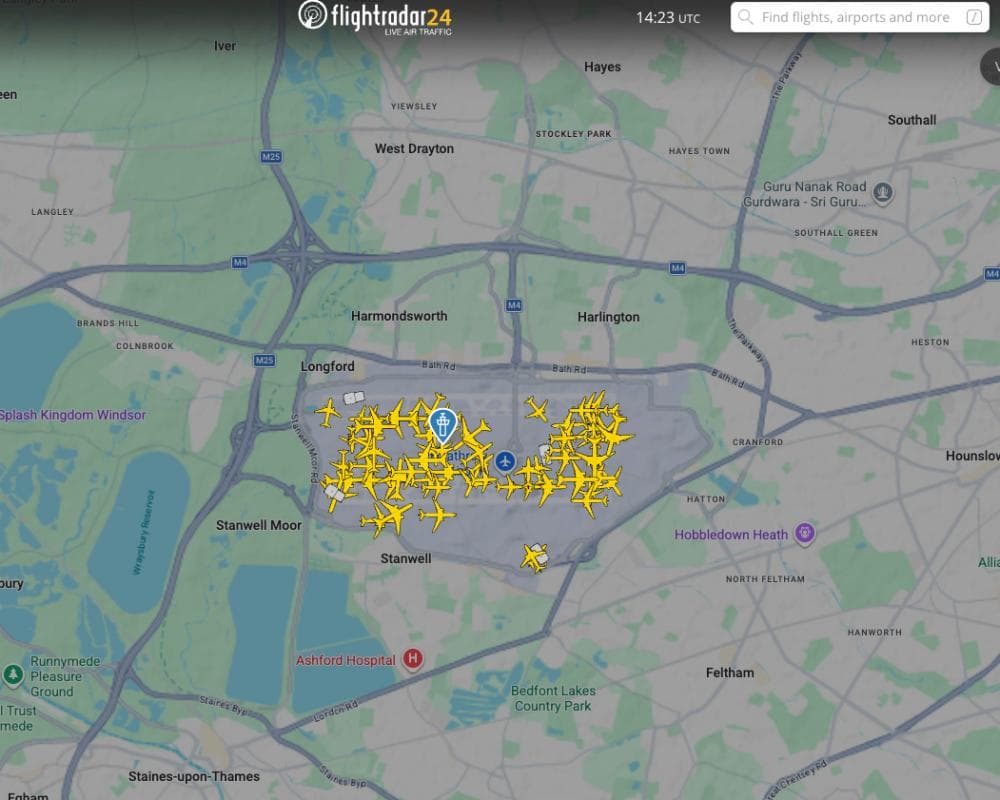
The flightradar24 app suggests that a lot of planes at Heathrow Airport in London are pretty much static on the ground right now, with nothing obviously taking off or landing at this moment…

NATS: recovery will take some time
National Air Traffic Services have confirmed that the technical problem scuppering flights today is within its flight processing system.
It says staff are ‘working urgently’ to fix it, but warns that ‘recovery will take some time’.
Posting on X, it says:
ℹ️ Technical issue
We have identified that the issue was in our flight processing system. Our engineers are on site and working urgently to resume normal operations as quickly as possible. We recognise the ongoing disruption to travel, for which we sincerely apologise.
Flights are still departing and airspace is open, but recovery will take some time. We will provide further updates as soon as possible.
Passengers should check the status of their flight with their airline. We will provide further updates as soon as we have confirmed information, at https://nats.aero and on X at @NATS.
Updated
BA: We're being disrupted
British Airways has confirmed that it is “experiencing some flight disruption” as a result of a technical issue at NATS, and is in touch with customers.
A number of flights from Heathrow this afternoon are delayed, or even cancelled.
The airports departure page shows that certain flights to cities including Bengaluru, Hamberg, Madrid, Derry and Amsterdam are delayed.
Cancelled flights include services to Amsterdam, Zagreb, Berlin, Belfast, Edinburgh, Dubrovnik, Pisa and Valencia.
Birmingham Airport has said the air traffic technical issue is affecting airspace in the south of the UK.
A Birmingham Airport spokesperson said:
“There is currently an air traffic technical issue affecting airspace in the south of the UK, which is impacting a significant number of departing flights across the country.
“We apologise to customers whose journeys have been impacted.
“Passengers are advised to arrive at Birmingham Airport (BHX) in line with their airline’s check-in requirements and to contact their airline directly for the latest flight information and updates.”
Edinburgh Airport is hoping NATS can fix the technical problem fast!
They’ve posted on X:
We are aware of a technical issue affecting which may impact operations. We are working closely with air traffic control, airlines and other partners, and hope @NATS can resolve the issue as quickly as possible.
Manchester and Stansted airports are also affected by the UK’s air traffic control technical issue, Reuters report.
ITV: Heathrow, Gatwick, Southend, Isle of Man and Jersey Airports all affected
Heathrow, Gatwick, Southend, Isle of Man and Jersey Airports are all affected by today’s disruption, ITV News report.
A spokesperson for Jersey Airport said:
“UK air traffic control is currently experiencing issues which is impacting flights across the UK including services between Jersey and UK.
Passengers are advised to check the latest flight information directly with their airline.”
NATS apologises for delays
Britain’s National Air Traffic Services have apologised for the problems affecting flight departures today.
Posting on X, NATS confirms there is a ‘technical issue’:
ℹ️ Technical issue We are investigating a technical issue which is causing some disruption to flight departures. Our engineers are on site and we will provide an update as soon as we can.
We apologise for the delay this will cause to journeys, passengers should check with their airline on the status of their flight. We will provide updates on https://nats.aero
Some UK departing flights disrupted by technical issue
A technical problem with air traffic control is disrupting some flights across the UK.
Some departing flights at airports across Britain were disrupted on Tuesday after air traffic control provider NATS experienced a technical issue, Heathrow Airport said, adding that arriving flights were not currently affected.
Heathrow said it was working with NATS to resolve the problem as quickly as possible, Reuters reports.
Back in 2023, a technical problem at NATS led to widespread disruption across UK airports…
Related: Airlines call for compensation reform after ‘staggering’ air chaos revelation
Updated
Bailey: Food inflation has been lower than expected
Labour MP Julie Minns turns the Treasury committee’s attention to agriculture, and the impact of recent hot weather.
She explains that she recently visited the UK’s largest sheep auction, and saw that lambs are being sold earlier than usual – which means farms are receiving lower prices, but are forced to sell because the pasture hasn’t been there this year.
Andrew Bailey replies that the agricultural sector is important, and the Bank has noted that yields have been lower on cereal crops, such as winter wheat, spring barley and oats.
Internationally, El Ninos have historically affected the prices of rise, coffee, cocoa and palm oil.
Bailey says, though, that food prices haven’t risen as fast as expected yet:
Food price inflation has come in under where we thought it would.
However, I think unfortunately this is another area where the risks are. On the upside, we have built into our forecast stronger, stronger food inflation by the end of the year.
Bailey: No secret plan to raise interest rates unconditionally
Bailey then insists that the Bank of England doesn’t have a “secret plan” to raise interest rates.
He says he sometimes get quite frustrated that some of his comments are interpreted as unconditional statements. They are conditional, he insists, because the world is uncertain.
Governor Andrew Bailey then tells MPs that mortgage rates in the UK have risen faster than in most, if not all, other major countries.
He says:
UK mortgage rates now are typically at the moment about 75 basis points [three quarters of a percentage point] higher than they were at the point when the conflict broke out.
I think with the possible exception of Japan, although that’s a little hard to map, that’s the largest increase in mortgage rates in the G7.
Watch the Bank of England hearing here
You can watch the Treasury committee hearing with some of the UK’s top central bankers here:
Q: What would it take for Bank of England policymakers to change course on rates?
Bank of England policymaker Alan Taylor argues that has already course-corrected, even though “even though it may look like we’ve done nothing in terms of changing Bank rate”.
He points out that before the Iran war began, the markets was expecting two, maybe three cuts this year.
Instead, rates have been on hold all year – which Taylor dubs “an active decision to maintain restrictiveness.”
Deputy governor Dave Ramsden takes an alternative view, pointing out that wage growth has actually been below the Bank’s forecasts this year.
He argues that the global inflationary picture is much more of an upside inflation risk, rather than the ‘benign domestic picture’.
That’s why Ramsden was happy to vote to hold interest rates at the Bank’s last meeting, while Greene voted for a rise.
Bank of England policymaker Megan Greene then tells MPs that the the length of time the oil price has been high worries her, given the dangers of 2nd round effects (where high prices push up wages, which push up prices).
Greene argues it is better to act now on interest rates, and change course if the inflation shock is lower than she fears.
She explains:
If you think that you might be in a situation with higher energy costs and more second round effects and act accordingly and determine actually that’s not the case, then you can course correct, you’ll stay on top of inflation.
Updated
Bailey: Oil price could be higher....
Treasury committee chair Dame Meg Hillier begins by asking the Bank of England about the economic consequences of the ongoing Iran war.
BoE governor Andrew Bailey responds, pointing out that the conflict is “obviously” a high level of high level of energy prices.
And he warns that oil price (which approached $100 a barrel today) could rise higher.
Bailey says:
I think it’s fair to say that we’ve got higher energy prices. They could be higher still.
Bailey adds that pipelines are helping to move oil out of the region, but points out that the Houthis have attacked the Red sea area, which is where the Saudi pipeline goes to.
And he touches on crack spreads – the price difference between crude oil and its refined products.. That spread has widened, and it’s not all due to the Iran war.
Bailey explains that Russia has “quite a concentration” of refining capacity, which Ukraine has been successful at attacking.
Quite a bit of the crack spread is actually not to do with, you know, the Strait of Hormuz.
Updated
Bank of England hearing begins at parliament
Over in parliament, some of the Bank of England’s top policymakers are starting to be questioned by MPs on the Treasury Committee.
Happily, there’s a range of hawks and doves from the BoE, so we might hear about the disagreements at the central bank about interest rates.
Governor Andrew Bailey (who has recently been the ‘swing voter’ on the monetary policy committee is accompanied by deputy governor for Markets and Banking, Sir Dave Ramsden, as well as two external members – Megan Greene and Professor Alan Taylor.
In July, Greene voted to increase the Bank Rate by 0.25% while the other three witnesses were in the majority voting to hold rates. Taylor, though, is among the most dovish of the committee, and was voting for interest rate cuts earlier than many other colleagues last year.
Pleasingly, Taylor and Greene are at opposite ends of the table – reflecting their positions on the hawks-and-doves-ometer.
The committee says:
The session will focus on July’s Monetary Policy Report, and the MPC’s most recent decision to hold the Bank Rate at 3.75%.
MPs are likely to question witnesses on the potential inflationary impact of the ongoing war in Iran and how the MPC considers recent developments in AI.
Updated
Before today’s UK bond sale took place, strategists at RBC had said some investors might be wary of buying into long-dated debt due to last week’s global drops in fixed income prices, “which continues to reinforce the risk of trying to catch a falling knife here“.
However, they said UK-specific factors were more positive and had contributed to a narrowing of 10-year gilts’ yield premium over German debt.
About the UK's 'moron premium'....
The jump in UK borrowing costs has reignited talk that the UK is suffering from a ‘moron premium’ on its debt.
This term was coined by Dario Perkins of City research firm TS Lombard back in 2022 after Liz Truss’s mini-budget sparked a bond sell-off, and tends to be trotted out whenever UK bonds are under the cosh.
Yesterday, chancellor John Healey cited Liz Truss, austerity, and Brexit as causes of the UK’s borrowing challenges.
Related: John Healey backs growth but says Labour must be honest on spending
But, in a note titled “Diagnosing the cause of the UK’s moron premium”, Simon French of Panmure Liberum argues that the real cause of this excess yield premium is the UK’s inflation problem, due – he argues – to an inefficient supply side of the economy,,
French argues:
If something broke in the Gilt market in 2022, as Healey claims, then it was higher global inflation revealing the UK as a high beta economy for that theme.
Truss and Austerity did not make the UK economy high beta, and whilst Brexit did add inflationary frictions into the UK’s trading regime it has been less significant than the frictions created in domestic-orientated supply.
It would be easy to dismiss this as political framing from Healey, but for the fact that an honest diagnosis is necessary to unwind some of the luxury beliefs that gum up the supply side of the UK economy. “Control” - still an ill-defined concept by this government - will need to be a Trojan Horse for supply side reform if the UK government’s moron premium is to be reduced.
[‘high beta’ is a financial term for heightened volatility, such as a stock which moves up and down more rapidly than the wider market].
At least there were plenty of bids.....
Matthew Amis, investment director for rates management at Aberdeen Investments, is encouraged that there was strong demand for UK debt at today’s sale – even though buyers demanded a high interest rate.
Amis explains:
“With rising government bond yields, in particular long-end maturity bonds, today’s 30-year syndication was a key health check for the gilt market. UK long issuance has been much reduced in recent years, with the last 30-year syndication coming back in 2025.
“A poorly received gilt syndication would have put further pressure on gilt yields and in turn government finances. Despite this negative build-up, the re-opening of the 2056s gilt was well received by the market. UK primary issuance continues to be well-received and today’s syndication shows demand for gilts at these yields remains in good health.”
According to Reuters, the UK received more than £85bn of bids for the debt on sale, allowing it to choose the most attractive offers when selling £4.25bn of debt (however, even those offers can’t have been terribly eye-catching, as the UK agreed to pay such a high yield on this debt).
UK pays highest borrowing rate since 1998 in 30-year bond sale
Newsflash: The UK has paid a record high borrowing cost to sell 30-year government debt this morning, as bond market turbulence puts pressure on the public finances.
The UK has sold £4.25bn of gilts maturing in 2056 at a yield, or interest rate, of 5.8168%, Reuters reports.
This appears to be the highest yield for any gilt sale since the UK’s Debt Management Office was created in 1998.
Significantly, it is above the 5.4047% yield which bonds of this type were sold for in May 2025.
It’s not a massive surprise, as last week’s bond market sell-off pushed up the yield on 30-year UK bonds to the highest since 1998. But such high borrowing costs will eat into the UK’s headroom to keep within its fiscal rules, adding to the challenge facing chancellor John Healey.
Related: How will bond market turmoil affect your mortgage, pension and savings in UK?
The bond sell-off has been caused by several factors, including fears that higher inflation will force central banks to lift interest rates, concerns that some countries are not controlling their spending, and competition from AI companies issuing debt to fund data centre rollouts.
Updated
The British government has signalled its backing for rail freight by setting a new target to grow the volume of goods carried on UK trains by 40% by 2040.
The target had been sought by private freight train operators concerned about their future under the new Great British Railways, where they will be competing for space on the tracks with publicly owned passenger services.
Transport secretary Heidi Alexander said GBR would have a “clear mission to help grow our economy by moving more of the goods British businesses rely on”.
She said the target would give the rail freight industry certainty to invest and support jobs across the country.
Meeting the target is expected to mean around £15bn more goods moved by rail annually, saving up to one million tonnes of CO2 a year by taking lorries off the roads, according to the Department for Transport.
The Railways Bill to set up GBR is now in the committee stage in the House of Lords, and will give the new arms-length body running the railways clear duties to support freight growth.
Maggie Simpson, director general of the Rail Freight Group, said the sector was “ready to fulfil government’s bold targets for growth, making an even stronger contribution to the nation’s productivity, development and resilience.”
In three hour time, MPs on the Treasury select committee will be quizzing the Bank of England’s top brass.
Professor Costas Milas of the Management School at University of Liverpool has some questions for them to fire at governor Bailey:
-
In light of turbulence (albeit receding) in bond markets, what Andrew Bailey and the MPC are planning to do for Quantitative Tightening (QT)? Will they continue with an annual pace of gilt sales of £70bn, or perhaps, they are more minded to slow down the pace?
-
Does Andrew Bailey and the MPC still believe that QT “inflates” UK yields by only 20 to 30 basis points? If this is still their view, in contrast to my BoE Staff Working Paper joint with Michael Ellington (Liverpool University) and Ryland Thomas (BoE) which finds a higher impact on yields of up to 40 basis points, why not continue with £70bn of QT also for the next 12 months? Not least because the lower the pace of QT, the lower the depressing impact of QT on inflation (our BoE paper finds that QT suppressed inflation by 1.4 percentage points).
-
How about the recent idea of swapping long-term debt with short-term one? This idea was put forward by e.g. Financial Times Alphaville yesterday which has the potential of relieving pressure on long yields.
[Reminder: QT is the process of selling bonds which the Bank bought during recent crises]
Updated
Optimism among US small business owners has dropped, as they are hit by rising prices.
The NFIB Small Business Optimism Index dipped in August to 98.7, down 1.1 points compared with July.
NFIB chief economist Bill Dunkelberg explains:
“Uncertainty remains elevated among small business owners as they face a mixed set of challenges with weakened sales, supply chain disruptions, and inflation pressures.
“While expectations for the overall economy dimmed, Main Street owners remain largely positive in the health of their own businesses.”
Gas prices highest since 2023
Ouch! European gas price have continued to rise, and are at their highest levels since January 2023.
The month-ahead UK gas price is now up more than 3% at 188p a therm, over the highs seen yesterday.
Continental European prices are also the highest since January 2023, at €75.70 per megawatt hour, which will fuel fears of a winter gas crisis in Europe.
Related: ‘Winter panic’: EU gas stores at their lowest level in 13 years
South Africa's economy shrinks in Q2
Newsflash: South Africa’s economy is on the brink of recession after contracting in the second quarter of this year.
New data shows that South Africa’s GSP fell by 0.2% in April-June, ending a run of six quarters of growth in a row.
Mining, trade and manufacturing drove down economic activity on the production side of the economy, while a sharp rise in imports and subdued investment constrained growth on the expenditure side, reported South Africa’s statistics body, adding:
Following six straight quarters of growth, the trade industry wobbled in the second quarter, shrinking by 1.9%.
This was due to a decline in wholesale trade, motor trade and the food & beverages industry. Consumer activity remained relatively upbeat, reflected in stronger retail trade and accommodation. Motor trade was dragged lower by softer fuel sales, but new vehicle sales continued to strengthen.
Middle East developments are “clouding the outlook again”, reports Achilleas Georgolopoulos, senior market analyst at Trading Point:
Yemen forces took over from Iran, attacking Saudi Arabian oil facilities, confirming that, despite reports of an imminent agreement between Oman and Iran about the Strait of Hormuz, the termination of the seven-month-old regional conflict remains elusive.
Expectations that the US President might try to sort out this conflict soon, so he can almost entirely focus on the critical November 3 midterm elections that could upset the current balance in the Senate, have yet to be confirmed.
Oil is the focal point for markets today, reports Neil Wilson, Saxo UK investor strategist, with bond yields up and stocks trade broadly lower.
Brent crude trades higher for a third straight session, approaching $100 amid reports that Yemen’s Iran-backed Houthis have hit energy facilities in Saudi Arabia. Operations at energy sites near to Yemen have been halted.
It comes after reports that Saudi Aramco’s Jizan refinery was hit, whilst Iran said it’s close to doing a deal with Oman to manage the waterway. With Brent approaching $100 markets are pricing in a longer war and more disruption to global energy markets. Brent rallied +2% to above $99, where it’s closed the gap to the 24 July close.
A sense today of disruption and conflict being a feature rather than a bug, and the implications for global markets that follow from structurally higher inflation dynamic alongside fiscal pressures. It’s unclear whether there is a way out for Trump here. Look for a breach of $100 to potentially get driven up on technical momentum to $102, the 23 July peak.
UK mortgage rates highest since June
UK mortgage rates have risen again today, as the recent bond market turbulence hits borrowers.
Data provider Moneyfacts reports that the average two-year fixed residential mortgage rate is at its highest since 7 June, while the average five-year is at its highest since 10 May.
This follows the rise in swap rates last week, which made it more expensive for lenders to borrow.
Here’s the details:
-
The average 2-year fixed residential mortgage rate today is 5.65%. This is up from 5.63% the previous working day.
-
The average 5-year fixed residential mortgage rate today is 5.70%. This is up from 5.68% the previous working day.
Lenders are also withdrawing some products from the market. There are currently 7,417 residential mortgage products available, down from 7,485 yesterday.
Philip Scott, partner, banking & finance at legal firm Walker Morris, has warned that businesses should be concerned too:
“The recent increase in bond yields and market expectations of higher interest rates is not just a concern for homeowners. Businesses across the UK should also be paying close attention because movements in the wider debt markets ultimately influence the cost and availability of corporate finance.”
“For companies with existing facilities approaching maturity, refinancing may become more expensive than anticipated. Businesses considering acquisitions, capital investment or expansion plans may also find that the economics of those projects look different as borrowing costs rise.”
“While lenders remain open for business, we are likely to see greater scrutiny around cashflow forecasts, leverage levels and covenant compliance. In that environment, preparation becomes increasingly important.”
Updated
Oil over $99 a barrel...
Oil is getting jolly close to the $100 a barrel mark, for the first time since July.
Brent crude, the international benchmark, is now up 2.2% and just touched $99.25 a barrel.
Novartis shares slide after drugs trial disappointment
Swiss pharmaceuticals group Novartis is heading for its worst day on the stock market ever, after releasing disappointing medical trial data.
Novartis reported this morning that its experimental drug for a muscle wasting disorder failed in a late-stage study.
The drug is called del-desiran. Novartis had been testing whether it helped patients with myotonic dystrophy type 1 (DM1), but found that it did not demonstrate statistically significant improvement versus a placebo.
Shreeram Aradhye, president, development and chief medical officer, Novartis, explains:
“Despite decades of research, there are still no approved treatment options for DM1, and patients and caregivers continue to face a significant daily burden.
“Developing therapies for a complex disease like DM1 remains challenging, and setbacks are part of scientific progress. As we continue to evaluate the full HARBOR dataset, we remain committed to identifying the most appropriate development path for the del-desiran program and advancing innovative approaches for people living with DM1 and other serious neuromuscular diseases.”
Novartis’s shares are down 10%, which would be their biggest daily fall on record.
The company was created by the merger of Swiss chemical and pharmaceutical companies Ciba-Geigy and Sandoz in 1996. The Sandoz family remain its third-largest shareholder, through their Foundation, founded by sculptor and painter Édouard-Marcel Sandoz.
Updated
Gas prices rise amid growing nervousness over storage
Gas prices are rising this morning, putting pressure on European countries who need to stock up their storage levels before the winter.
The month-ahead UK gas price is up around 1% at 184p a therm, close to yesterday’s highs when gas hit its highest since January 2023.
Continental European gas prices are up 1.3%.
Rupert Thompson, IBOSS chief economist, reports that European gas prices are being pushed up by growing nervousness over “the relatively low storage levels ahead of winter.”
UK government borrowing costs are a little higher this morning.
The yield, or interest rate, on 10-year UK bonds has risen by 2 basis points (0.02 of a percentage point) to 5.19%. Thirty-year gilt yields are also up around 2bps at 5.83%.
These are small moves, and yields remain lower than last week – when 10-year yields hit their highest level since the 2008 financial crisis.
But they’re also a reminder of the pressures which higher oil prices, and resulting higher inflation, put on the public finances.
Copper hits record high amid US hoarding
Boom! The copper price has hit a new alltime high this morning.
The three-month copper contract on the London Metal Exchange hit a record high of $14,617 a ton this morning, surpassing the previous record set on Monday.
Copper is generally seen as a gauge of economic growth prospects. But the current rally is also being attributed to hoarding in the US, as importers try to stock up before Donald Trump imposes new tariffs on copper (as some people anticipate).
Updated
Saudi Arabia: energy sites near Yemen halted after attacks
Saudi Arabia has now said operations at several energy facilities in the kingdom’s south were halted after attacks ignited fires in the region bordering Yemen (where the Houthis are based).
Bloomberg has the details:
The strikes took place on Tuesday and wounded a number of people, the state-run Saudi Press Agency reported, citing officials at the energy ministry that it didn’t identify. It didn’t name any of the facilities. The Saudi energy ministry and Saudi Aramco didn’t have any further comments.
A series of attacks have targeted Saudi Arabia’s southwestern region since Yemen’s Iran-backed Houthi militants said they would blockade Saudi Arabia’s oil flows in response to Riyadh’s siege of the Yemeni capital, Sana’a. Oil facilities in Jazan, where a 400,000 barrel-a-day refinery has been shut since an earlier attack in July, were hit again on Monday.
Related: Yemen: enchanting, complex, and much misunderstood
The summer heatwave has dampened demand at British homeware retailer Dunelm, sending its shares sliding.
Dunelm reported this morning that trading had been significantly softer in the first six weeks of its new financial year (which began at the end of June). It blamed “the extended period of unusually hot weather”.
Dunelm, which sells home furnishings such as bedding, curtains, furniture, beds and mattresses, added that “we have seen better trading following cooler weather”.
Shares are down 8%, putting Dunelm at the bottom of the FTSE 250 index of medium-sized companies listed in London. The company also reported a 3.1% rise in sales in the last financial year, but profits were flat.
Tariff wars rear up as Canada retaliates against the US
Trade war tensions have also risen today, as Canada imposes retaliatory tariffs on US goods.
The tariffs kicked in this morning, targeting sectors including steel, dairy, appliances, agricultural equipment, pulp and paper, and electronics.
The move is in response to the US’s decision to impose a 50% tariff on $20bn of Canadian goods last month.
Susannah Streeter, chief investment strategist at Wealth Club, says:
“Trade tensions and geopolitical stalemate are adding to inflationary concerns – pushing prices up across a large basket of commodities, which will feed through to household and business costs. The moves are adding to the note of caution reverberating on financial markets, as investors assess the likelihood that interest rates may have to stay higher for longer to keep a lid on consumer prices.
Tariff wars have reared up again after Canada slapped billions of dollars of retaliatory tariffs on American goods, after talks with the US administration collapsed. The former trade allies have turned foes, with President Trump turning up the heat, and the latest measures are likely to add another layer of uncertainty for businesses and consumers. Canada’s retaliatory tariffs on around $20 billion of US goods came into effect today, with duties ranging from 15% to 50%.
Related: Canada’s retaliatory US tariffs take effect as trade dispute grows
Europe's stock markets dip at the open
European stock markets have opened in the red, as the rising oil price weighs on sentiment.
The FTSE 100 share index has dipped by 0.2%, or 20 points, to 10,801 points, with banks among the big fallers. Energy firms BP (+0.9%) and Shell (+0.35%) are higher, though.
Other markets are weaker, though – France’s CAC has dropped by 0.4%, and Spain’s IBEX is 0.2% lower.
Germany has been hit by a surprise drop in exports, knocking hopes that its economy was rebounding.
German exports fell by 0.8% in July compared with the previous month, data from the federal statistics office showed this morning.
This was due to a fall in shipments to European Union countries.
There is a renewed inflation risk coming from energy markets, warns Naeem Aslam, CIO of Zaye Capital Markets.
Oil has now risen for a third consecutive session, and the market is increasingly questioning whether higher energy costs could feed into transportation, manufacturing and consumer inflation.
That matters for both U.S. and European equities because more expensive oil can squeeze corporate margins while simultaneously forcing central banks to keep monetary policy restrictive. Energy companies may benefit from higher crude prices, but airlines, industrial companies, retailers and other fuel-sensitive businesses face a less favourable cost environment.
Introduction: Oil heads back towards $100 a barrel
Good morning, and welcome to our rolling coverage of business, the financial markets and the world economy.
The global economy faces the prospect of $100 a barrel oil again, as the conflict in the Middle East continues.
Brent crude has risen back over the $98 a barrel mark already this week, its highest level since 24 July. Oil has been pushed up by reports that Yemen’s Iran-aligned Houthis attacked energy facilities in Saudi Arabia.
Saudi authorities said operations at some energy facilities had been halted today following attacks by Yemen’s Iran-aligned Houthis that wounded more than 70 people.
The attacks add to the pressure on oil and gas production in the region, which remains badly disrupted by the ongoing Iran war.
Yesterday, the Financial Times reported that Saudi Aramco’s oil facilities in the Saudi Arabian city of Jizan – where one of the country’s largest refineries is based – have been attacked
Earlier today, Iran threatened to create a new restricted zone in the Gulf if the US pressed on with its ‘economic warfare’ against Tehran.
Such a zone would, presumably, further undermine US efforts to reopen the strait of Hormuz.
Mohsen Rezaei, the secretary of Iran’s Supreme National Security Council, said Iran had “ fundamentally recalibrated” its posture towards US forces.
Rezaei posted on X:
In recent days, Washington has received a clear warning from Iran’s new missiles. Economic warfare will be met by a maritime exclusion zone across the Persian Gulf to the blockade perimeter. The operational posture toward U.S. warships and bases has been fundamentally recalibrated.
Shipping traffic through the Strait of Hormuz has already slowed this week – just seven commodity vessels sailing through the Strait of Hormuz on Monday, down from eight on Sunday. Before the war began, about 130 ships a day would cross the strait.
This is all a headache for central bankers, as high oil prices create inflationary pressures through the economy. Later today, MPs in London will question Bank of England governor Andrew Bailey, and colleagues, about their recent decision to hold the Bank Rate at 3.75%.
MPs are likely to question witnesses on the potential inflationary impact of the ongoing war in Iran and how the MPC considers recent developments in AI, the committee says.
The agenda
-
7am BST: German trade data for July
-
7.45am BST: French trade data for July
-
2.15pm BST: Bank of England policymakers appear before the Treasury select committee