It is “self-serving” for AI companies such as OpenAI and Anthropic to talk of slowing things down, argues investor Michael Burry.
Posting on X, Burry (famous from The Big Short) suggests four reasons why Altman and Amodie might benefit from talking about a jab on the brakes:
LLMs are not AI and won’t be AGI. There is nothing AI to slow down.
Competition is coming up fast, slowing benefits incumbents.
IPOs need hype & puffery; “we are so awesome it could become dangerous” is hype & puffery
Cover for real uncontrollable slowing growth as IPOs look to be pushed out
Updated
For markets, the key question is whether this is the first sign that the extraordinary AI investment cycle might eventually moderate, says strategist Jim Reid of Deutsche Bank.
He feels this is unlikely, though, telling clients:
The competitive race between companies and countries remains intense, and it’s difficult to imagine firms voluntarily stepping back while rivals continue to push ahead. It is hard to see China standing still. Indeed, that’s something President Trump said yesterday in response to the weekend news. He didn’t seem in favour of any kind of pause.
I suppose another way of looking at it is that if leading executives are openly discussing the risks of increasingly powerful systems, it could be them trying to get across how transformative they believe the technology may become and help advertise the power of their product. So rather than signalling less spending, it could simply be that a greater share of AI investment is directed towards safety, monitoring and governance alongside the continued build-out of compute infrastructure. The debate may therefore alter the composition of AI capex more than its overall scale.
Will AI CEOs actually slow down?
Dario Amodei’s pacing proposal has drawn heavy skepticism from critics and researchers who allege that AI firms are attempting to preempt more stringent government regulation and retain the status quo of power within the industry.
Rahm Emanuel, former congressman and chief of staff to Barack Obama, posted online:
“I can tell you when the last time a CEO or an industry at large asked to be regulated: never. That’s what makes Dario’s letter so striking – it’s an admission that we’re driving down a dark, winding road on wet pavement with the headlights off.
And where’s President Trump? Looks like he nodded off again.”
More here:
Related: AI CEOs say they need to slow the pace of development. But will they?
Trump, on a visit to his golf course in Ireland, played down the warnings and said “very negative forces” were “bringing up things that won’t happen”.
You can read Dario Amodei’s call for an AI slowdown here: We Must Pace the Frontier.
In it, Amodie lays out a three-step plan
building AI “at a balanced rate that aims to ensure its safety” by “ensuring companies take adequate time to align and safeguard their models, and for third party evaluators to confirm this”.
industry-wide coordination to guarantee common safety standards and restrict “unchecked AI progress”.
global coordination, between democratic states and “authoritarian governments”
Amodie writes:
“The steps do not need to be taken strictly in order, and some of them may be much harder to achieve than others, but I’ve found them to be a useful framework in thinking about what needs to be accomplished.”
OpenAI Pre IPO market-cap contract falls
The anticipated value of AI developer OpenAI has dropped over the weekend, following the call for a slowdown in the industry.
OpenAI is currently a private company, but broker IG are running a contract where traders can bet on the company’s value.
Tony Sycamore, market analyst at IG, reports:
IG’s OpenAI Pre IPO market-cap contract, which had rallied from about $1.38 trillion to $1.64 trillion after the release of Astra, has fallen back to $1.57 trillion on the news — a pullback of about $70 billion from that high.
[Astra was released to approved users on 3 September].
That IPO might not come as soon as expected, either. In an interview published over the weekend, Sam Altman said a stock market float this year would be “ill-advised.”
Introduction: AI-linked Asian stocks slump after slowdown call
Good morning, and welcome to our rolling coverage of business, the financial markets and the world economy.
Investors are reassessing the value of companies driving the artificial intelligence revolution after several leading AI figures called for a slowdown in development for safety reasons.
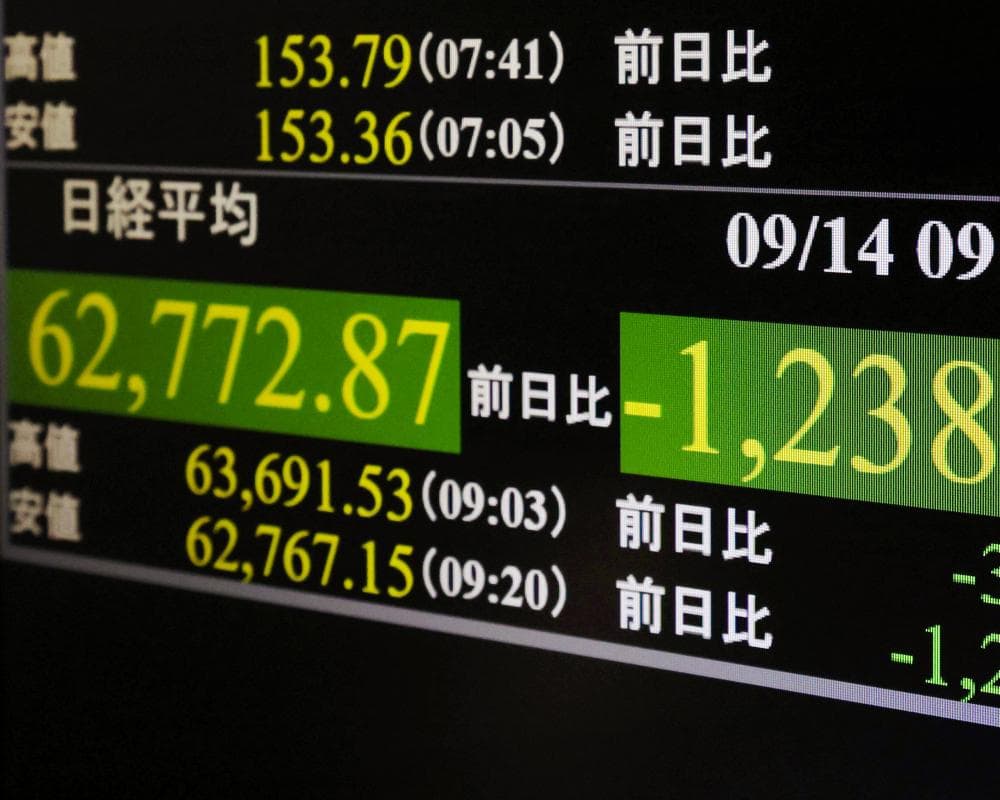
Shares in AI-linked companies in Asia dropped when trading began today, dragging South Korea’s KOSPI index down by 3.7%. Chipmaker SK Hynix has slumped by 5.75%
SoftBank, a major AI invester, fell by as much as 13% in Tokyo after OpenAI’s chief executive officer Sam Altman said that the ChatGPT-maker won’t go public this year (SoftBank owns a stake in OpenAI).
Taipei’s Taiwan Semiconductor Manufacturing Company dropped by 1.2%.
Traders’ optimism about AI has taken a hit after the CEO of Anthropic, Dario Amodei, appealed for the AI industry to “slow down” – a call which was quickly backed by both Altman and Elon Musk.
Related: OpenAI boss and Elon Musk back calls to put brakes on ‘reckless’ AI development
Amodei said “building [AI] too fast is reckless”, and warned that a swarm of AI agents could cause hundreds of billions of dollars of damage by “taking over the entire internet” in future.
Although Amodie’s claims have been disputed by some AI experts, investors are pricing in a slowdown to AI development which would make it harder for the industry to pay for its rapid rollout of data centres.
Ipek Ozkardeskaya, senior analyst at Swissquote, says there is a “sour mood in the markets this morning”, explaining:
So if the AI race slows materially, the key question becomes: who pays for all that infrastructure? The leases, debt and power commitments remain even if expected compute demand and revenue growth slow. And that could bring credit risk increasingly into the AI story, particularly for highly leveraged data-centre operators and lenders exposed to projects built on aggressive assumptions about future AI demand, at a time when interest rates – hence borrowing costs – are expected to rise.
What’s interesting is that the slowdown may come not because Big Tech is out of cash, or because investors won’t play along. It comes from the actual people who develop these models.
The agenda
11.30am BST: India’s inflation report for August
1.30pm BST: Canada’s inflation report for August
4.15pm BST: ECB president Christine Lagarde gives speech in Vienna, Austria
Updated