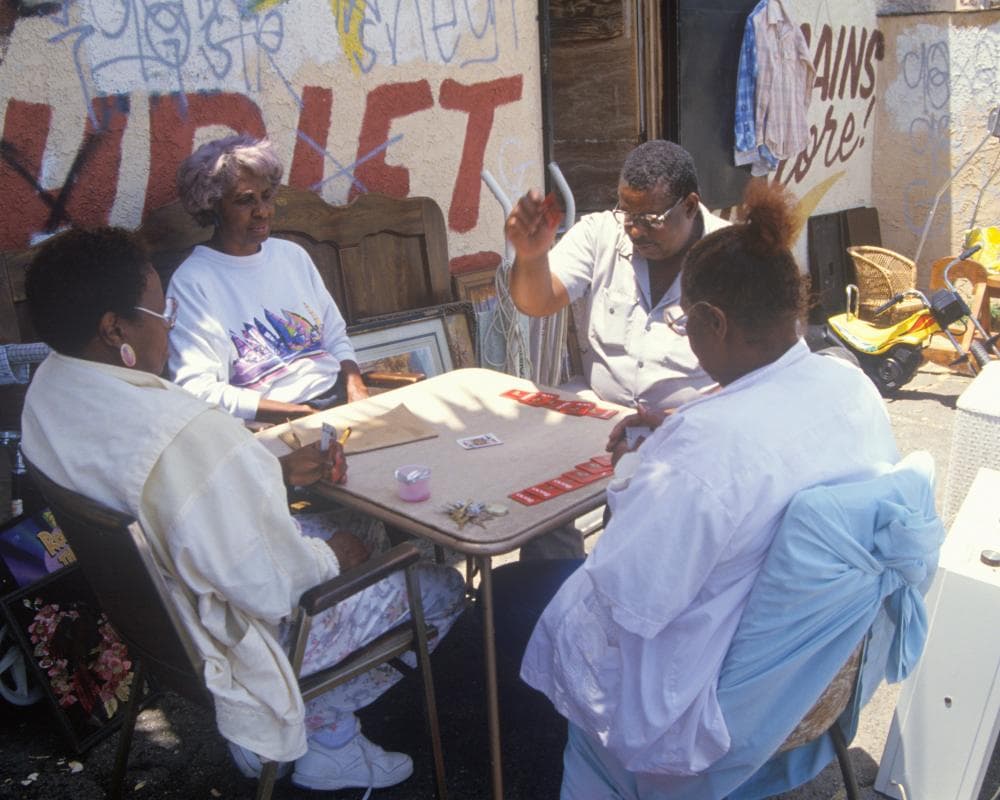
At family reunions and cookouts growing up, Rachel Young-Love was captivated by what she called the “special table”. It was the loudest, the most crowded. Everyone seated at it was either embroiled in smack talk, eyeing their partner to covertly check if they were on the same page or sweating to make sure they played their hands just right.
Her relatives were playing the card game spades, “one of the highlights of the event”, she said, and the stakes – bragging rights until the next gathering – were high. It wasn’t until she was an adult that Young-Love learned to play, and even still she had to bide her time before she was allowed a seat at the spades table.
For generations, spades and bid whist, the original game from which it’s derived, have been mainstays of Black gatherings, with bid whist typically reserved for the more seasoned players. Many family reunions aren’t complete until a game of spades is played – and some families take their games so seriously that they hold proper tournaments, with a specially made trophy for the champions. The games are commonly played at cookouts, in college dorm rooms and in army barracks. Playing spades is often used for fundraisers, as a way to combine a beloved competition with a charitable cause.
Though there are differences in gameplay among regions, states and families, the popularity of spades and bid whist is lasting. A standard 52-card deck, purchased absentmindedly at a grocery store or gas station, can bring together an intergenerational group of people from different backgrounds.
Spades is played by taking “tricks” or “books” – the preferred term changes depending on the group of players – which are won by placing the highest card in a round. Traditionally a four-person, two-team game, players rely on their partners heavily – one is expected to sense that their teammate needs help and to adjust their gameplay accordingly. Players individually make bids, positing the number of tricks they will get that hand. Sometimes, a player may make a “nil” bid, which means they will not take any tricks. If the player does take a trick during a nil bid, they cost their team 100 points in the process. “Bags” are any extra tricks made beyond a team’s initial bid. Collecting 10 bags also leads to a 100-point penalty. The first team to reach 500 points wins. It’s a complex game, to say the least.
Like Young-Love, Tony Jackson Sr grew up being intrigued by the table full of boisterous players, slamming cards and talking smack. “My first time, I had to pay my dues like everybody else,” said Jackson Sr, who learned to play as an adult when he was in the military. “I stepped to the table, didn’t know what I was doing – I knew just enough to be dangerous to my partner, and I suffered the humiliation of getting beat down because of my personal mistakes in the game.”
But Jackson Sr’s experience of being allowed to play despite not fully knowing the game is relatively unique. Many people who don’t know how to play either game report that their elders refuse to teach them.
“This has been one of my frustrations,” said Lamont Jones, a lawyer and “bid whist ambassador” who’s written a book on bid whist. “People act like if you don’t come out the womb knowing how to spot the kitty in bid whist or knowing not to cut your partner’s book in spades that something’s wrong with you.”
Making traditional games accessible is at the core of Love, Peace & Spades, a Los Angeles-based organization, where young and old alike gather to learn and play spades, bid whist and other games that organization founder Kevito Clark calls “Black family heirlooms”.
Xhercis Méndez, the director of education for Love, Peace & Spades, was taught to play spades after expressing interest in the game at a family gathering, but she knows that experience is relatively unique. In hosting events for Love, Peace & Spades, she has found that some people are “afraid to learn because they don’t want to get clowned, because it feels high stakes”. Through the organization, Méndez and Clark have worked to “create an environment where we hold on to what’s important about that kind of cultural play while also creating an invitation to step up to the table that doesn’t feel scary”, she said.
The Charles H Wright Museum of African American History, in Detroit, has hosted judgment-free community events where players of all levels, including those who have never been allowed at the spades table, can gather to play the game. Yolanda Jack, the museum’s manager of community engagement, said that the event was an opportunity for people to play the game in an environment that was “not fraught with trauma”.
“[We wanted to] allow people to be able to learn without being afraid of making a mistake,” Jack said. “Because, you know, if you were to play the wrong card or if you reneged, God forbid, you really are putting yourself in a bit of a kind of a disadvantage in the game. And you may never be allowed to play with those particular individuals again.”
The event combined serious players and those who were beginners, allowing them to fellowship together in a space in which they knew they would be able to focus on having fun.
“You could see the people excited and happy and genuinely not worried because they knew there was no fear,” Jack said. “When Big Mama and Uncle Joe are playing and everybody is serious, that’s not the time to ask any questions.” Learning to play is a rite of passage.
‘A rich tradition’
Pullman porters, Black men hired by railroad companies to work on the Pullman Company’s sleeper cars in the years following the civil war, popularized both spades and bid whist. They were “respected cultural ambassadors, who helped determine which jazz and blues records would be hot”, Jones said. They disseminated aspects of Black culture and were a force in fueling the Great Migration, by distributing copies of the Chicago Defender and the Pittsburgh Courier, important Black newspapers, to Black people at their stops.
“When they got together for layovers and such, they were playing bid whist,” Jones said. “There are regional sorts of card games: people play bourree in Louisiana, and euchre, it’s sort of a midwest game.” Jones said that “spades is a wonderful gateway game to the tradition of card games”, but bid whist is “an older, richer, more strategically elaborate game”.
“They’re both branches of the tree of the original partnership, trick-taking game, and that game is called whist – I like to call it ‘original whist’,” Jones said. “Spades and bid whist are especially beloved in the Black community.” When he was learning to play bid whist in law school, Jones and others would remark that they “were just trying to follow in the tradition of the great Thurgood Marshall”.
“It’s special to me that bid whist is the card game of choice of Michael Jordan and Magic Johnson and Thurgood Marshall and Willie Mays and Ella Baker and Sophia Gibson and Jesse Jackson and Barack Obama,” he said. “It’s got these sort of deep roots. The fact that it and spades are part of this cultural tradition that’s so meaningful in Black communities.”
The longevity of the games and their importance in Black culture are why Love, Peace & Spades sees them as worth preserving and passing on to future generations, Clark said.
They are “a very important tool for connection, getting young folks present with each other, present with their elders. I feel like we’re at a moment in time where, if and whenever there’s an opportunity to strengthen community bonds, we should be doing that work.”