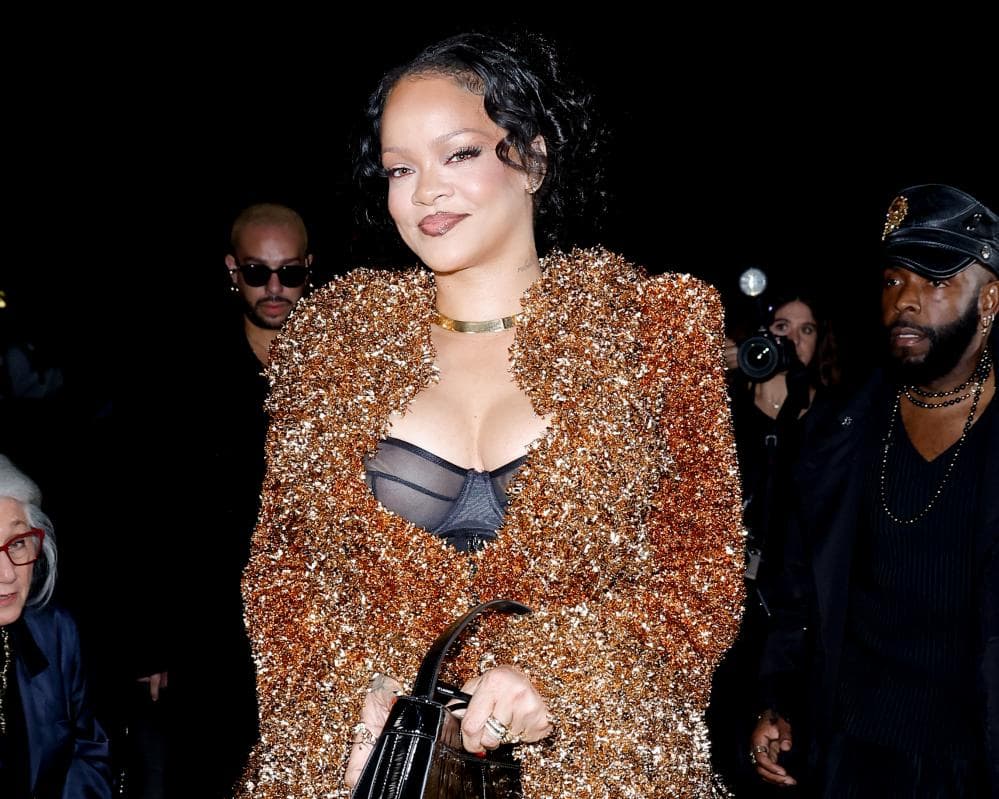
It’s a trend which might have been expected to be kept under the radar – or at least under a T-shirt. But high fashion’s recent endorsement of underwire bras could not have been more visible.
This fashion month, underwear as outerwear was omnipresent on catwalks, with underwire bras in red and black satin at Prada and black and silver at Tom Ford. At the Matieres Fecales show, Rihanna wore a bra from her own Savage X Fenty range peeking out of her unbuttoned jacket.
Elsewhere, Anya Taylor Joy wore a Balmain fuchsia underwire bra, with a cardigan and a floral jacquard skirt while promoting her new series. Model Kaia Gerber recently wore a wool crepe Alaïa bra top on the red carpet, which featured an exposed underwire as part of the design.
At the VMAs, Tyla wore a blue snakeskin-print by Mowalola with a matching low-rise skirt. Mowalola Ogunlesi, the London-based designer behind the look, says her thinking was that “I’m finding power in femininity and treating lingerie as something complete in itself, rather than something that needs to be hidden or layered”. An underwire bra was the basis of the outfit because, she says, “it sculpts the body in a unique way”.
This latest crop of high fashion underwire bras aren’t usually push-up bras – those specially designed to squish breasts together, as during the Hello Boys heyday of the Wonderbra in the late 1990s. Rather, they appear to aim for more universal appeal, creating a somewhat lifted shape without going full Jessica Rabbit. Other advocates include Lily Allen, who has been wearing underwire bras as tops for the past couple of years, and mega-girl-group Katseye, whose recent Saturday Night Live performance wardrobe mainly consisted of bras – some of which were so skimpy they did not really have cups, but were, nevertheless, underwired.
Charli xcx wore an underwire bra as a top to party with Madonna at the VMAs, having previously worn underwire bras in her live shows, on the cover of Rolling Stone and in Interview magazine. Even when she wears a shirt, her bra is part of the outfit – it might be bright purple, poking out of an unbuttoned black vest.
It is a very 2004, very revealing, indie sleaze-influenced look. Unlike, say, a sporty crop top, which could enable celebrities to show off their abs – a clear driving force for the trend – it is a boudoirish look which feels like a rejection of the pilates princess crop tops and comfy bralettes, which have been on trend for the past handful of years. The omnipresence of the aesthetic suggests that something is up within visual culture.
Like the rest of us, bras have been behaving strangely since Covid. Kristen Classi-Zummo, apparel industry adviser at market research firm Circana, reports just one notable bump in US bra sales in the third week of March in 2021. “We can really pinpoint it to the week vaccines rolled out,” she says. “People started replenishing bras, intimates, socks.”
Since then, the market has stagnated and “we haven’t seen the industry pick up”.
She puts this down to a few factors: the continuation, to some extent, of work from home culture, an “overall casualization with how we’re dressing”. This has affected bras more than some other categories, says Classi-Zummo because there is a sense that “whereas maybe before she needed five bras in rotation, now maybe she only needs two or three. Bras have consistently been struggling.”
At the same time, even as bra sales have plunged, and even as many women have stayed loyal to underwire bras during that downturn (underwire bras now make up about 52% of the market, down from 57% in 2022, says Classi-Zummo), the past handful of years has been driven by wire-free comfort. This has been the case since the earliest days of the pandemic, when market research firm NPD reported that, while overall bra sales fell 1% in the second half of 2020, sales of wireless bras were up 14%.
Partly, the rise of comfortable bras came from innovation. New technologies, such as silicone gel cups, aimed to ensure that even those with large busts “can have the same features – padding, lift – without the wire”, says Classi-Zummo. It also echoed broader pandemic-accelerated trends towards comfort and casualisation in dress – seen also in the adoption of elasticated waistbands over so-called “hard trousers”.
Many celebrated the rise of wire-free bras as a feminist triumph. Prior to that, gripes about bra discomfort were so widespread that they became common fodder for female comedians. In 2014, for example, Sarah Millican had a popular bit about always needing to know what time any night out would end, so “I know what time I can take my fucking bra off”.
Underwire bras feature two loops of hard material, usually a cord of metal or resin, under each breast. Many wearers will be familiar with the downsides: ill-fitting wires digging into the ribcage or popping out of the side of the bra, and stabbing you in the armpit, when bras are past their prime. Or the sense of constriction as the ribcage expands – but the underwires and the bra band do not – after a big meal.
For all of the recent technical progress in supportive wire-free bras, however, Larissa King, FIT assistant professor of fashion design, intimate apparel, says that, in general, there is still an aesthetic difference with an underwire. “Underwires work together with the bra band to cantilever the weight of the wearer’s breasts and distribute the weight around the chest wall,” she says. “If fitted well, the wires also help reduce the pressure on the wearer’s shoulders. Wires also help to define and separate the breasts. Wireless bras can be very comfortable and supportive, but they tend to give a different shape to the bust – often rounder and less defined.”
Financially speaking, the underwire bras’ current high fashion moment has yet to perk the mass bra market up. In the 12 months ending August 2026, both underwire and wire-free bra sales declined in the US, according to Circana, with underwire falling five times as fast as wire-free, continuing on its post-pandemic trajectory.
The fashion industry is hoping this moment will make an underwired bra uptick happen among general shoppers, and is already promoting new styles, according to Edited, a retail intelligence platform which tracks new products arrivals at mass retailers’ websites. In August, mentions of “push” and “underwired” were up 60% and 28% month on month.
Anecdotally, the sight of so many high profile women in “proper” bras does seem to be having an impact on those of us who wear our bras the old-fashioned way – under our clothes. My friends report being underwire-curious again, finding themselves poring over the Agent Provocateur website for the first time in a decade. A recent New York feature, about one writer’s quest to find her “first (bright, flashy) underwire bra in years” was a case in point. She had been, she wrote, a “strict bralette loyalist” who “would have told you underwire bras were a prison”. Recently, though, she had started feeling “an insatiable hunger for hoisting cups” and “strict reinforcement”.
Many I spoke to connected the trend with the decline of body positivity. “For a while, there was this big marketing push on body positivity and comfort, and we saw this shift away to softer fabrics. Now again, as we’re starting to see this shift back to sexy,” says Classi-Zummo.
This is coupled with other aesthetic developments – the shrinking of celebrity bodies in a GLP-1-influenced era, the rise of tight, tweaked faces, paired with artificially cushiony lips; the general suggestion that one must be largely taut and thin, but also soft and cushiony in precisely the “right” places.
For King, the return to fashion of a structured bra ties in to “the current high fashion fixation on hyper-feminine, exaggerated and super-stylized body proportions”, seen on catwalks in recent seasons. “Think corseted waists, padded hips and derrieres and prominent breasts.” It also signals that we are “moving fully away from pandemic-era aesthetics”.
Thanks to AI and social media image manipulation, she says, “the bodies that we see online are bearing less resemblance to the bodies we see in person on average people, and I think the luxury fashion market is playing into that disconnect by pushing silhouettes to extremes. I think this trend will evolve from the high-fashion version into a less extreme version at other levels of the market.”
In the new world of underwire bras, designers are at least trying to bake more comfort into design. According to a Victoria’s Secret spokesperson, its construction has moved on since the aughts. The company’s Body By Victoria Flex Factor bra, for example, has an underwire made of flexible titanium, designed to bend to the body.
“We’ve seen her expectation of comfort evolve – she still wants lift, shape and support, but she wants it to feel incredible too,” said the spokesperson, speaking of the customer base as an individual female they were on intimate terms with – as many in the bra industry do.
What remains to be seen is what “she” will do next: will the customer who gleefully shed her restrictive bra a few years ago find the new underwire trend uplifting enough to buy into?