After one weekend of the Prem season the feeling was we had crossed the Rubicon. A remarkable 52 tries, eclipsing the previous record for round one despite the fact that fewer matches were played added further weight to the argument – a criticism and a compliment – that the English club game is creeping closer towards a form of basketball.
Then came round two and 41 tries. A sizeable number, certainly compared with seasons of yesteryear, but equally giving a sense that defences had their day in some cases. Sale’s gritty victory over Saracens was a dogfight, Leicester’s win over Newcastle wasn’t pretty and while Bristol ran in six tries against Northampton, their success owed everything to defensive steel.
Related: Saracens’ Brendan Venter takes aim at ‘autocratic’ Prem over media duties
So perhaps the shark has not been jumped just yet and defence may not be optional after all. Indeed, there was a consensus in pre-season that rugby is cyclical, trends will come and go and attacking impetus will be en vogue for a time before defences get back on top. “The game ebbs and flows,” said Exeter’s director of rugby, Rob Baxter. “There were some really high-scoring games last season but it wouldn’t surprise me at all to see some real dogfights and nailbiters this season, I think that’s the way the game is heading.”
Courtney Lawes, who has returned to the Prem with Sale after two seasons in France, was of a similar opinion, having watched the English top flight from across the Channel. The manner in which Sale dug in against Saracens, despite losing Jacques Vermeulen to a 20th-minute red card, appears to support his point.
“A lot of tries, 40 points, 30 points each way, that’s quite interesting,” Lawes says. “It’ll be interesting this season. It might be the team that’s got the best defence that actually wins the league. When you’ve both got 50 or 40 points on the board, that’s a pretty open game, isn’t it? So defences have got to tighten up. I understand why the attacking game is important, but if you can equally have a good defence, then you’re going to win more games than the boys that are only interested in attack.”
Two rounds is not enough to draw conclusions. There have already been, and will continue to be, blowouts when teams simply try to outscore opponents. But as the Northampton director of rugby, Phil Dowson, says: “I see a lot of comments around ‘it’s becoming basketball’ but I don’t think there’s any lack of intent in defence. I don’t think we’re not defending.”
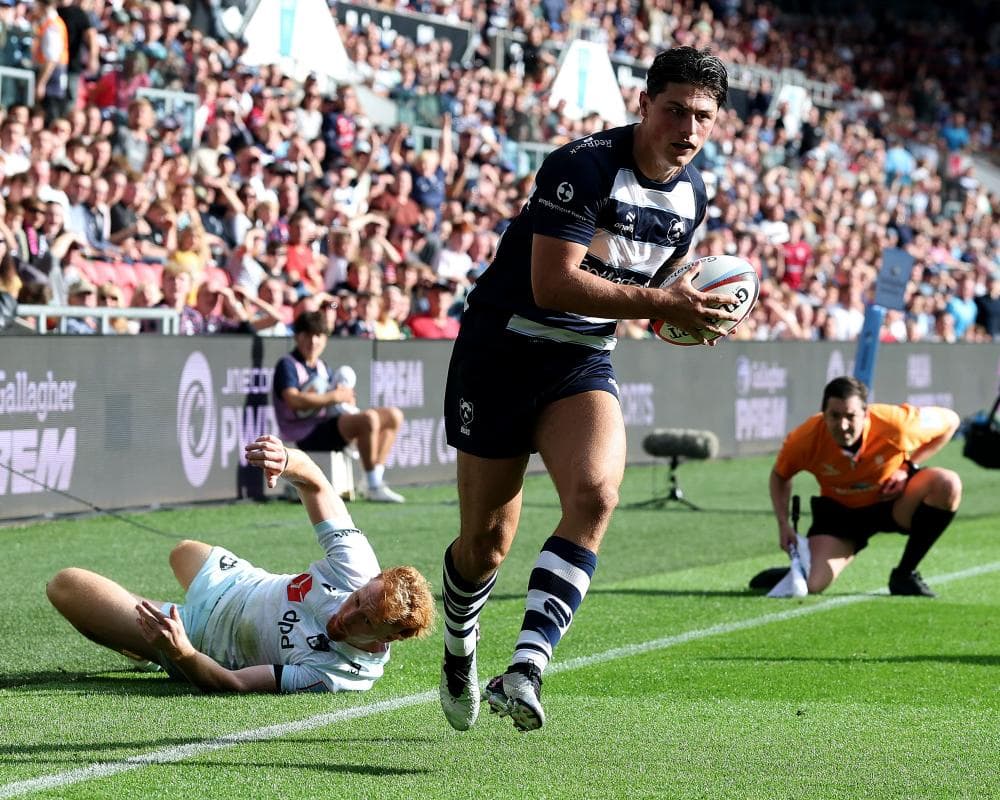
Northampton’s defeat at Bristol is a fascinating case because it was far from the exhibition many thought possible given how lethal both attacks can be: yet there were still 10 tries scored. Perhaps a greater attacking intent, brought about by a number of factors including the absence of relegation, a collective drive to deliver a more entertaining product, refereeing changes and improving pitches, has all meant more tries are scored. Perhaps Bristol can defend remarkably well against Saints and still concede four tries.
“I’ve no doubt in my mind that, like in the NFL, it ebbs and flows between attack and defence,” says Dowson. “Sometimes the attack is very popular and sometimes the defence comes out on top. When Shaun Edwards came in at Wasps and changed the game when I was playing, that was a step-change in defence. Everyone complains, ‘It’s 9-3, 12-6,’ now we’re going, ‘Oh it’s 48-32’ – what do people want? That’s the question isn’t it, what do we want the game to look like?”
That is indeed the question and the pre-season view of Leicester’s Geoff Parling showed it is not easy to answer. “The product on the pitch in general is decent,” Parling said. “Lots of tries scored, although I would say that doesn’t necessarily equal a good game for me. I think 9-8 can be a beautiful game, in the right way, a genuine gladiatorial contest with physicality going at each other. I think try-scoring in general is a good thing, but it doesn’t necessarily mean it is a good game.”
If rugby is naturally cyclical, the World Cup looming next year is impossible to ignore. The England head coach, Steve Borthwick, has instructed referees to alter interpretations of certain laws in an effort to better prepare his side for Australia next year. In the first two rounds the number of offside penalties was eye-catching while, according to Oval Insights, there were 15 penalties for holding on in the first round, 18 in round two. Not a massive jump, but a step in the right direction in Borthwick’s eyes given how fiercely the breakdown is contested at international level. Indeed, Fitz Harding’s performance for Bristol against Northampton will not have gone unnoticed.
“We try to correct [the breakdown] every day, every minute of the game, all the time because that’s the game,” Dowson said after the match. “I don’t know how many lineouts, between 12 and 15, I don’t know how many scrums, but 200 breakdowns, so whenever you get tackled the ball is in that situation. They did a very good job, Fitz Harding was exceptional.”
It is too early to tell whether Borthwick’s influence is bearing fruit, but he may have been happier after the second round of the Prem than the first.