Like Ingrid Bergman and Sophia Loren, the German actor Elke Sommer was part of the postwar crossover wave of European stars who pepped up the tail end of the Hollywood studio era. Sommer, who has died aged 85, matched them for glamour but not dramatic prestige. Her sex-kitten image gave her a decade in the limelight playing exotic continental paramours for leading men and glamorous assassins in the 1960s.
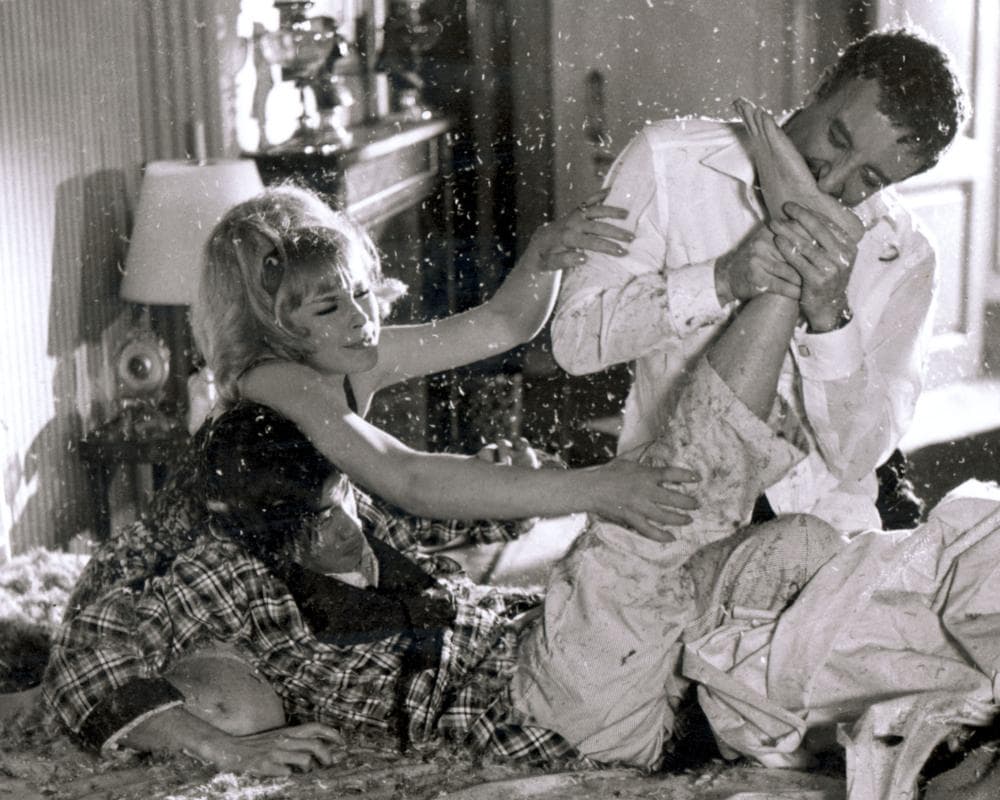
With her beehive hairdo and an upturned nose she was initially self-conscious about, Sommer brought freshness and gameness to her most celebrated role: as Maria Gambrelli, the maid whom Peter Sellers as Inspector Clouseau goes out of his way to exonerate of murder in the 1964 comedy A Shot in the Dark. In the words of the trailer: “Number one sexpot, I mean suspect.”
She fed off what she remembered as the improvisational “courage” of Sellers, a “creative powerhouse” in scenes such as the interrogation where Clouseau sets himself on fire by stowing an ignited cigarette lighter inside his raincoat. In return, Sellers tried improvising a marriage to his co-star, even though their relationship was purely professional. Sommer declined: “I said, ‘Peter, I like you very much as a person, but I don’t love you.’ He said: ‘But that’ll come,’” she later told the BBC arts show Arena.
Often slotted into light comedies, Sommer – while only in her mid-20s – held her own against many of the heavyweights of the genre: Sellers, Dick Van Dyke (in 1965’s The Art of Love), Bob Hope (Boy, Did I Get a Wrong Number! in 1966) and Dean Martin (The Wrecking Crew, 1969). Nicknamed “the Brute” on the celebrity tennis-tournament circuit because of her fiendish backhand topspin, she was also atypically athletic for a 60s ingenue.
Her toned physique got maximum exposure in the 1966 Bond rip-off Deadlier Than the Male. Playing one of a pair of bikini-clad bickering hitwomen, who dispatches her victims with bullet-firing cigars, Sommer fired up the young Quentin Tarantino; it was the first film he ever saw in a cinema, aged five, he said later. Keeping her fans happy with a steady supply of pin-up shots, including two Playboy pictorials in 1964 and 1967 (the first shot by her first husband, the Hollywood gossip columnist Joe Hyams, whom she married in 1964), she worked within the established parameters of the time for female studio actors.
But the fixation on her looks, and the diminishing returns for arm-candy roles, eventually curtailed her Hollywood career. The adventurous and accomplished Sommer – who spoke seven languages – in the end was unimpressed by the limited range the industry made available to her: “I’ve merely been decoration too many times in the past in films,” she told the LA Times in 1986.
She was born in Berlin, the only daughter of Peter von Schletz, a Lutheran pastor of aristocratic stock, and his wife, Renata (nee Topp). Despite her father’s background, the family grew up in poverty in a one-bedroom basement apartment after being evacuated during wartime to the village of Nierdendorf in 1942, when Elke was an infant. This hardship was deepened by the death of her father in 1955.
So the fee Sommer received for her first film, the 1959 Italian comedy The Friend of the Jaguar, was a godsend. In 1957, she had been working as an au pair in London (one of the children she looked after was the future ’Allo ’Allo star Vicki Michelle), while waiting to enrol at a language school; she intended to become either an interpreter or a teacher of classical languages. But she won a local beauty contest while on holiday in Viareggio, Italy, which led to her being cast by the director Giuseppe Bennati in The Friend of the Jaguar, as a German tourist.
Adopting her stage name, she was then cast in the high-society comedy Men and Noblemen (1959) for the Bicycle Thieves director Vittorio De Sica. Her linguistic skills opened up further opportunities, and she also chalked up further jobs in France and the UK, as well as her native industry. MGM distributed the German child-prostitution drama The Girl and the Prosecutor (1962) in the US, leading to Sommer’s big Hollywood break: starring opposite Paul Newman in the studio’s Nobel-themed espionage caper The Prize (1963), as the Swedish chaperone to his dissolute author. She won a Golden Globe as most promising newcomer.
The tacky The Wicked Dreams of Paula Schultz (1968) – starring Sommer as a defecting Olympic pole-vaulter who hops the Berlin Wall – took the momentum out of her Hollywood push. “It seems to view the cold war as a vast conspiracy to get people undressed,” sneered the New York Times. In the 70s and 80s, she returned almost exclusively to European features, including a pair of scream queens for the Italian horror maestro Mario Bava, in Baron Blood (1972) and Lisa and the Devil (1974), and a role as a double entendre-spouting Russian archaeologist in Carry On Behind (1975).
Sommer also pivoted towards TV, singing and theatre; her 1970 stage debut was headlining the US tour of the musical version of Irma la Douce. An avid painter since her teens, she shared her love of the easel in 1985 in the 13-part TV series Painting with Elke Sommer. Also a car enthusiast, she did some of her own precision driving for Deadlier Than the Male, and hosted a TV show about high-performance cars, The Exciting World of Speed and Beauty (1986).
The socialite Zsa Zsa Gabor assumed the worst about Sommer’s decelerating career, insinuating in a 1993 magazine article that Sommer was reduced to living in “the worst section of Los Angeles”. The actor sued for libel, receiving $3.3m in damages – though Sommer may have initiated the spat with comments the previous decade about the size of Gabor’s posterior when she was mounting a horse on the TV show Circus of the Stars.
After divorcing Hyams in 1981, Sommer married the German hotelier Wolf Walther in 1993. He died a few months before her. She is survived by her stepson, Sebastian Walther.
• Elke Sommer, actor, born 5 November 1940; died 28 October 2026