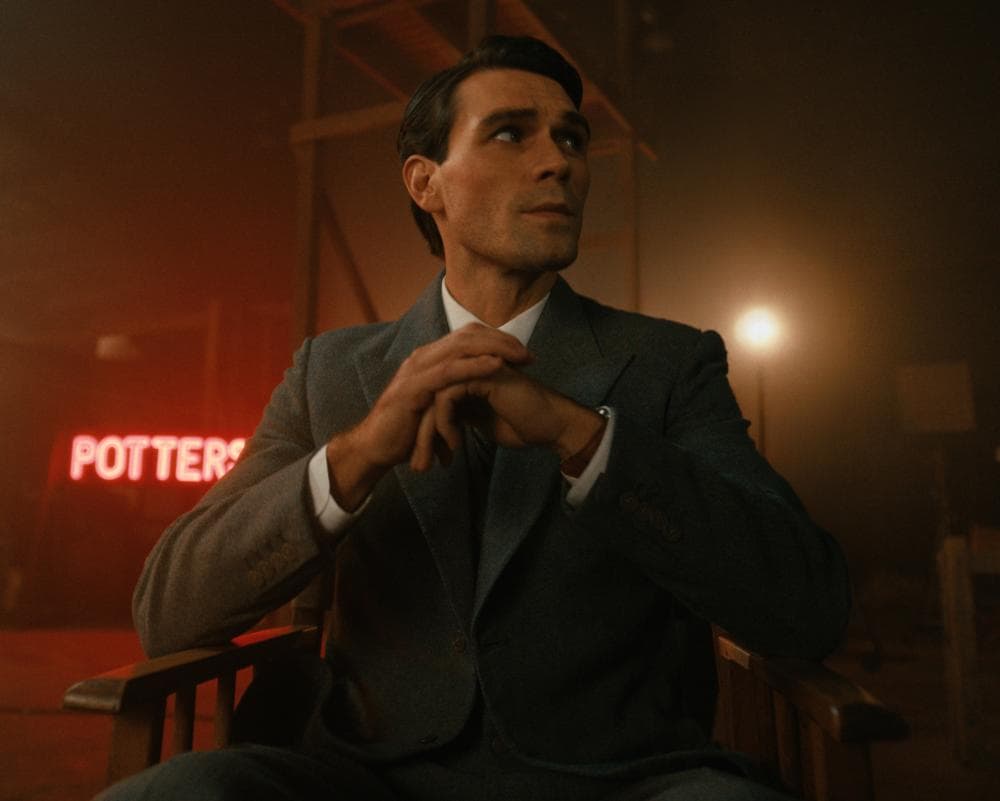
The last time New Zealand actor KJ Apa took on a midcentury American pop-cultural icon, he was playing a nominally sexy yet often weirdly bloodless version of Archie Andrews, the feckless teen next door on the comic-book riff Riverdale. He also frequently ceded scenes to his scene partners, whether former teen idols like Luke Perry or newer, more dynamic personalities like Camila Mendes or Madelaine Petsch. Now he’s taking on an even more beloved and therefore trickier part: James Stewart, the Pennsylvania-accented avatar of decency who starred in dozens of classic films and spent decades as a box office mainstay. Yes, Archie has been promoted to a Jimmy Stewart biopic.
The movie, called just plain Jimmy, focuses on Stewart’s willing military service during the second world war and its immediate aftermath. Here, Apa is in far less danger of being outshined by his co-stars; it’s competing memories of the real Stewart, available through so many great, good, and watchable-because-of-him movies, that he has to worry about. The substantial and perhaps only surprise that Jimmy has up its sleeve is that Apa does a reasonable imitation of one of the most immediately distinctive movie stars of all time. Plenty of people can approximate that famous voice, less clipped and urbane than so many of his costars, but Apa gets some of his gangly physicality, too. In scenes of distress (whether real-life or acted out on a movie set), he captures the way Stewart could look and sound as if he was about to topple over with overflowing emotion when he got himself worked up for a big scene. It’s not a note-perfect recreation, or even a particularly surprising one, but Apa does disappear into it.
A generous read of the way Aaron Burns directs the rest of Jimmy would be that he’s aiming for something congruent with the mid-1940s era where much of the movie takes place: melodrama that’s unafraid to be corny and lushly colored. It seems more likely, however, that Burns has been hired to do the honeyed support-the-troops version of Stewart’s life, with everything about his fascinating career reoriented to highlight his noble military service. At first, it’s practically presented as his true lifelong dream, especially in the face of a father (Neal McDonough) who plainly says he’s not cut out to be a military pilot. The movie picks up shortly after Stewart wins the best actor Oscar for The Philadelphia Story in 1941, which means that MGM executive Louis B Mayer (Jason Alexander) is more than willing to disappear his draft notice. (In real life, he was also considered underweight for military service, though he got around that.)
Stewart insists on serving his country anyway, becoming a bomber pilot and a captain, in command of a squadron whose mission commitments are bumped up as the war proceeds. This means that Stewart keeps losing more of his men, about which he feels enormously guilty. Though he takes some respite in the company of the Englishwoman Lady Julia (Kara Killmer), he clearly suffers from PTSD, which continues well after the conflict as he returns to Hollywood and his pal Frank Capra (Max Casella) convinces him to make It’s a Wonderful Life, the focus for the film’s final stretch.
Jimmy actually opens with a brief snippet of Capra pitching a skeptical Stewart that project before jumping back five years; it lingers long enough for Capra to say that he firmly believes It’s a Wonderful Life – a movie he has not yet shot! – will be talked about for 100 years. (Maybe it took the film-makers great restraint to wait a mere 80 before attempting to prove their own hoary screenplay right.) Nothing is portrayed with any kind offhand grace in Jimmy; it’s all diagrammed out in a way that’s not designed to explain things to an audience unaware of Stewart so much as underline it all for an audience that very much knows the story. When Stewart encounters weariness and resistance from his men, he gives them a movie-style speech, riling up for the cause.
This tendency also gives the action, even the battle sequences that should be harrowing to seed Stewart’s transition from aviator’s wonder to mentally rattled soldier, a strangely inert quality. Despite the fate of the world hanging in the balance, the movie doesn’t even threaten to come alive until Stewart is readjusting to civilian life. Though the real Stewart was clearly proud of his service and remained affiliated with the military, his post-war career also went to some fascinatingly complex, shaded, and sometimes dark-hued corners. Jimmy doesn’t seem interested in all that; it mostly wants to portray Stewart pouring his off-camera angst into making It’s a Wonderful Life, which he cited as a personal favorite. Given Capra’s irascible and vocal patriotism, portrayed with Joe Pesci-style energy by Casella, it’s all part of the movie’s schematic approach to Stewart’s life and career; It’s a Wonderful Life is the ideal movie to reflect and ultimately refute postwar trauma. Again, the movie spells it right out: “I can’t sell hope right now, Jimmy, not with you,” Mayer tells him. Ultimately, the star rises to the occasion, choosing the independently financed Capra film over playing himself in a Mayer-approved war-themed biopic. (Jimmy also echoes another exercise in behind-the-scenes redundancy opening the very same day: the young Sylvester Stallone chronicle I Play Rocky.)
In this movie’s telling, Stewart’s art feels secondary to him exorcising his wartime demons. It makes sense that Burns and screenwriter Justin Strawhand wanted to choose a smaller portion of the star’s life to convert into a narrative arc. Yet they haven’t avoided the juddery suddenness of a cradle-to-the-grave biopic – the portrayal of Stewart’s lifelong spouse is particularly cursory – before cramming what they have selected into a vaguely faith-based (and tacitly pro-war) framework. Despite Apa’s surprisingly surehanded evocation of the man in question, Jimmy falls somewhere between cosplay and stolen valor.
Jimmy is out now in US cinemas and in the UK and Australia at a later date