No actor showed the commercial potential of blue-chip British classical training like Patrick Stewart. With style, technique and the most minutely self-aware, almost vaudevillian sense of mimicry, Shakespearean thesps can turn their hand to American movies and high-end American television and show the American method actors how it’s done – sometimes, even, at the beginning of their screen careers, at a competitively low wage.
Stewart was one of the thoroughbreds of the Royal Shakespeare Company’s 1970s stage generation who had also had classy small screen roles, such as his intimidating Sejanus in I, Claudius opposite Derek Jacobi. But he effected a warp-speed leap to pop culture stardom by getting the role of Jean-Luc Picard, captain of the Federation starship USS Enterprise, in TV’s Star Trek: The Next Generation, the hugely successful reboot of Star Trek that ran from 1987 to 1994, spawning four separate feature films and then another series, Star Trek: Picard.
Stewart was athletic, commanding, sonorous – and bald (though in a distinctively virile way). William Shatner’s Captain James Kirk had been a more clean-cut JFK of the space-exploration world, an action-romantic lead, but Stewart’s Picard was a more complex figure, slightly nearer in spirit – with that exotic name of his and the hairless head – to the alien figures and indigenous planet-dwellers who were now a regular feature of intergalactically diverse Star Trek cast. (Alan Rickman’s haughty actor turned sci-fi icon Alexander Dane in the 1999 space comedy Galaxy Quest was perhaps a little inspired by Stewart.) A whole new generation of Trekkers found a charismatic new leader to rally round.
Related: Patrick Stewart – a life in pictures
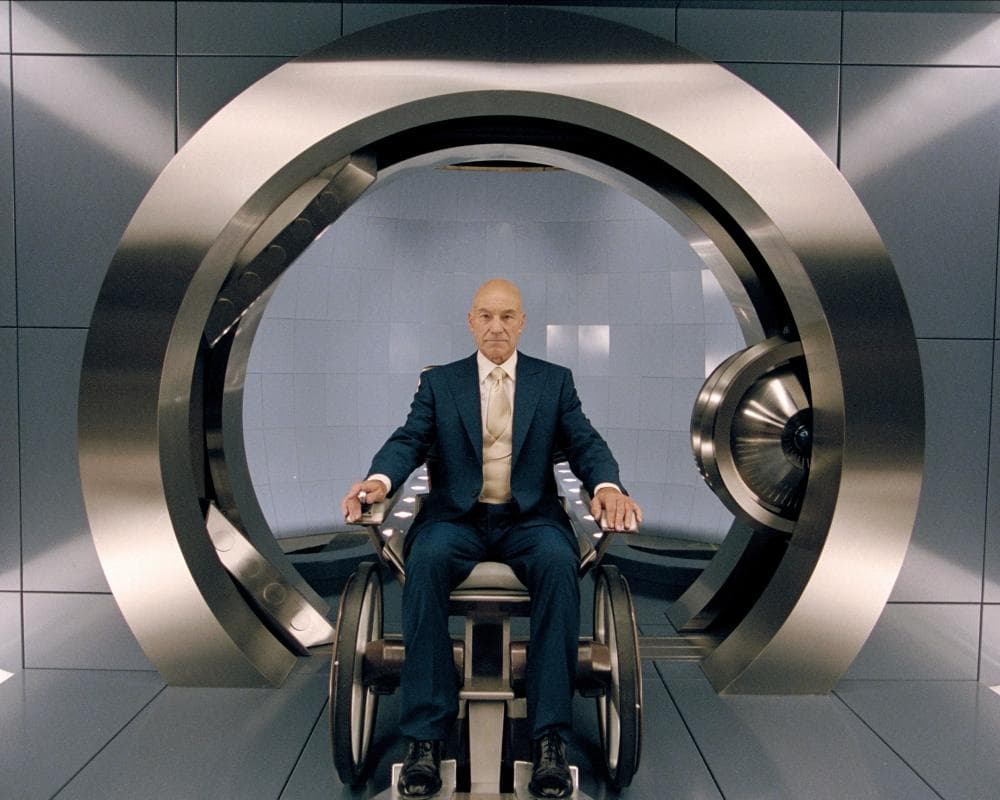
And with that remarkable coup in the bag, Stewart went on to conquer the world of superhero-dom; he transferred the pop-culture capital he had amassed in Star Trek to the Marvel Cinematic Universe. Stewart became a character-actor-slash-star of the multiplex as the wheelchair-using eminence Professor Charles Xavier, or Professor X, in the X-Men franchise at the beginning of the 00s as the Marvel brand began its colossal box-office dominance. As Xavier, Stewart played opposite Ian McKellen as Magneto, that other RSC Galactico who good-humouredly wore the Lycra and delivered the lines with resounding conviction. And in fact the role of Professor Xavier, the mentor and tutor to the mutants, probably allowed Stewart to draw even more on his Shakespearean background: he often had a wise and kingly mien as Xavier, especially when the franchise showed him as a kind of exiled monarch.
It should be said that Stewart had some form in sci-fi and fantasy way before this. He was Guenevere’s father, King Leodegrance, in John Boorman’s visionary Excalibur in 1981 and the adviser to Paul Atreides, Gurney Halleck, in David Lynch’s distinctive version of Frank Herbert’s Dune in 1984.
But for me his most satisfying non-franchise movie role, and the one that allowed him to be vehemently and compellingly bad in a way Star Trek and Marvel didn’t, was Jeremy Saulnier’s horror-thriller Green Room, in which Stewart plays a neo-Nazi leader who, along with his brutish rank and file, tries to attack a rock band who have barricaded themselves into the green room of the scuzzy bar they’ve just played and where they have discovered something awful.
Stewart’s face could transform into a threatening mask: he could look handsome and refined but also leonine and aggressive, and the mellifluous voice could deliver a nasal edge of threat. Stewart was a unique charismatic force on screen.