If there were a Golden Lion award for the most Italian film in Venice competition it would go to Edoardo De Angelis’s squawking domestic spat of a picture which contains an imperious matriarch, a pained Catholic priest, an argumentative family, and food, so much food. Bowls are stirred and pans are brandished. Pots are seen rattling angrily on the stove. The festival organisers like to deploy a little judicious home cooking when it comes to the selection and De Angelis is already a favoured guest, having opened the 2023 event with his war drama Comandante. But I fear they may have miscalculated with this one. It’s overdone, on the turn and too liberally salted with tears. It’s liable to provoke the occasional stab of heartburn.
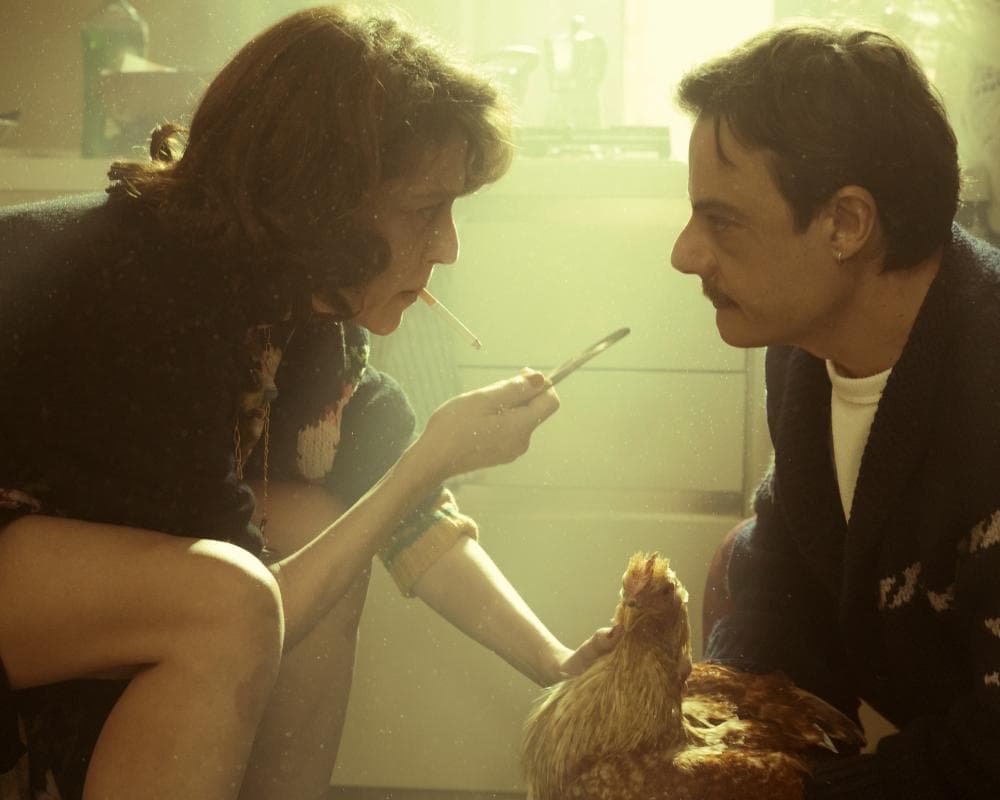
At the head of the table sits the incorrigible Angela (Vanessa Scalera). She’s up from Naples (where she was presumably once a girl from the backstreets, begging in rags) to supervise Christmas Eve dinner at her son’s book-lined apartment in Milan. Angela’s a relic of the old world, breezily unreconstructed and openly disgusted by the woke state of her grandchildren. “One’s a gay dancer and the other’s a vegetarian,” she scoffs. They in turn are perturbed by the fact that she has brought in a live chicken to be cooked as the main course. Who’s going to catch it? Who’s going to kill it? What even is this creature, exactly? “It’s not a hen, it’s a capon,” sighs middle-aged Anto (Lino Musella), who dearly wishes his mother had never come at all. She’s a beautiful woman, he says, but she smells.
If Angela blows in as the embodiment of humid, fetid old Naples, then Anto represents the Milanese middle class. He’s the moderately successful editor of literary fiction, braced for the imminent arrival of a famous author, which might mean the deal of a lifetime, assuming Angela doesn’t stick her spoon in. The pained Catholic priest has blessed every room of the flat but it’s not nearly enough, the family tensions keep rising. Now Anto’s bohemian sister is blithely lighting cigarettes as she helps prepare the salt cod, and that cursed, flapping capon keeps getting under everyone’s feet. “It can’t fly,” Anto says. “But at this time it would have thrown itself off the balcony.”
Shot up close and personal with a small handheld camera, The Fire Within You seems intent on prompting a similar response in the viewer. That’s mostly intentional, a consequence of the drama, although it’s perhaps a given that a film about a claustrophobic family gathering eventually turns a little oppressive itself, and there’s only so long we can spend in these cramped quarters, amid the pistoning elbows and spitting frying pans, before we start to worry that we might lose an eye. The dinner is a disaster; the yellow wallpaper closes in. Anto loathes Angela but he is a mama’s boy at heart and much closer to her than he cares to admit. And so when the film belatedly changes gears, swinging from fraught farce to anxious mercy dash, you can be sure that he’s going along for the ride.
Might this win the top prize? God forbid, let’s pray not, because it’s an indulgent bubbling stew of national stereotypes. Still, De Angelis’s film is at least acted with gusto and contains a core of human truth in its depiction of the clotted, knotted intimacy of the typical Christmas gathering. It shows us that families can be hazardous and exert an irresistible magnetic pull. Nobody gets out in one piece, except maybe the capon.