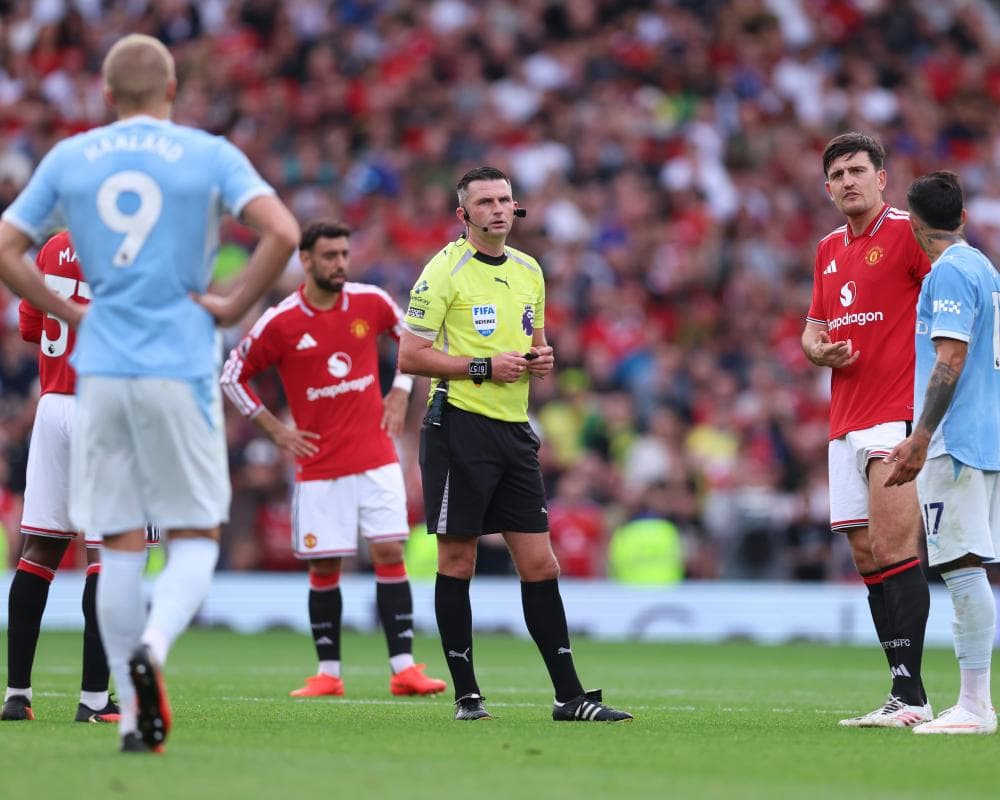
There was a disappointing outcome on a big decision in the Manchester derby and no one will feel it more than the video assistant referee Matt Donohue. On Sunday night, Pro Ref confirmed Donohue had made a mistake in allowing Erling Haaland’s goal in City’s 1-0 victory to stand when Enzo Fernández had been in an offside position.
When a VAR considers a decision such as this they start from the point at which the goal is scored and work backwards. Here, when Haaland scores, the flag is raised by the assistant referee for offside. The VAR automatically checked that on-field decision and used a semi-automated system to show Haaland was onside. The decision was then made to overturn the call and award the goal.
Related: ‘An error of judgement’: Pro Ref admits mistake in awarding Haaland’s derby winner
Before Haaland scores, however, an offside Fernández, marked by Lisandro Martínez, has challenged for the crossed ball with a diving header. The VAR needs to look at this aspect and make a two-part assessment. The first question is: does Fernández make a clear attempt to play the ball? The second: did that action affect the ability of Martínez to defend the cross? In this case, the answer to both questions was yes. The goal should not have been awarded.
I think Donohue looked at the Fernández situation and did not recognise it was an offence. He is a highly skilled VAR but referees are human and the fact he has got it wrong will hurt. He will learn from it but I would defend the performance of referees more broadly this season.
We’re 39 games into this season and they have started really well. We’ve seen some very good examples of officials dealing with holding offences, the ball is in play for longer and referees are managing goal kicks and throw-ins too. More stuff is thrown at them every season to deal with.
In the game at Manchester United, Haaland’s goal wasn’t the only incident to cause debate with a real split of opinion on what sanctions should have been imposed. With regards to the coming together between Bruno Fernandes and Phil Foden, which led to the City player being sent off, I’ve heard two reds, two yellows and two dustings-down.
Let’s be clear: Foden sticks his studs into Fernandes’s midriff after the United captain had kicked at him with a toe. Michael Oliver shows Foden a deserved red card for violent conduct. Fernandes had provoked Foden by moving his right toe into Foden’s backside but in my opinion, had Oliver seen it, he would have given Fernandes a yellow card because it was a pretty petulant act of unsporting behaviour. Whereas Foden’s kick was violent conduct, I would argue Fernandes’s was not.
The laws on violent conduct describe when a player “uses or attempts to use excessive force or brutality against an opponent when not challenging for the ball”. Did Foden use excessive force or brutality against an opponent? I think he did. But Fernandes didn’t. There was no brutality in that. There was no force. Clearly the referee didn’t see the act of petulance but in terms of the bigger decision, the officials got it correct. Even Enzo Maresca said in his press conference that Foden was rightly sent off.
The previous day there was another incident with lots of noise around it: the decision to award Sunderland a penalty against Arsenal. Dan Ballard and Ezri Konsa go to ground in the Arsenal box and the verdict from John Brooks was penalty kick. You could quite clearly see that Konsa was holding Ballard and really focusing only on his opponent and not the ball. The VAR, Stuart Attwell, then checked the decision and had to determine whether the referee made a clear and obvious error.
Ballard has got a little bit of Konsa’s shirt too and there’s a bit of tugging but that in itself, with all the bits and bobs going on, doesn’t jump out as a clear and obvious error, so they stay with the on-field decision. What is important to note is the light touch from VARs this season.
Lots of people will say penalty. Others will say, not for me. Attwell was right to say check complete, confirming the penalty. If a penalty hadn’t been awarded, however, there would have been no intervention either because it’s not a clear and obvious error. It’s what we would term a check complete either way.
• Chris Foy is a former Premier League referee