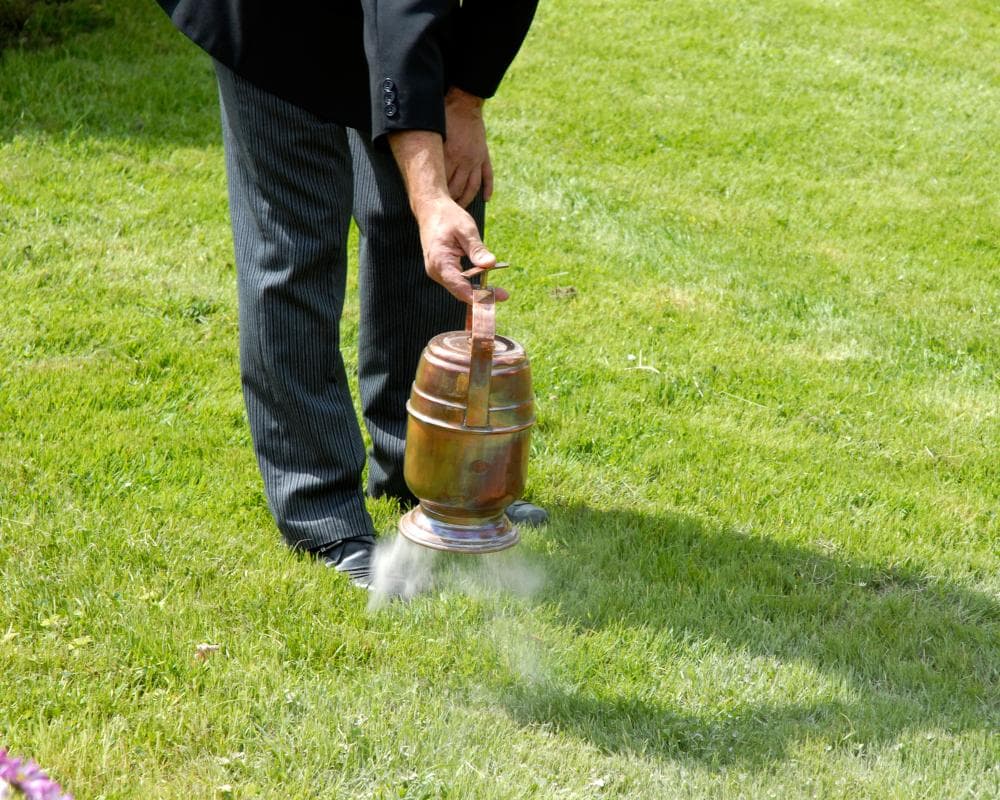
With reference to the letters (19 October) on what people have done with loved ones’ ashes, there is another way to leave a lasting legacy, which does not seem to be widely mentioned beyond the medical professions. If you live within 50 miles of a teaching hospital, you may donate your body for medical training and research. If parts of your body can be used, what is left can be cremated and returned as a casket of ashes, and it does not preclude a funeral or memorial ceremony.
There are various limitations, as with organ donation, depending on time limits and diseases prior to death, but the signing up process is sensitive and straightforward, and, similarly to organ donation, you can carry a card and have this recorded on your medical notes. If your loved ones are comfortable with this, it will give them sustenance to know that many others may in future benefit.
Sylvia Chainey
Riding Mill, Northumberland
• I too sympathise with Rachael Stirling, who ate some of her mother’s ashes (Letters, 16 October). My beloved husband died in 2003, aged 49. I was beyond grief; I was in the process of moving into the house we had renovated and planned to live in together and his absence made it all seem pointless. However, when I collected his ashes and scattered them on a beautiful clifftop, I saved a handful. In the little garden I was in the process of planting a quince tree he had given me, and I put that handful of ashes in the hole before I added the sapling’s roots. Over the years since, the tree has thriven and burgeoned and produced a sometimes staggering harvest of glorious golden quinces; and with every mouthful of their fragrant pink flesh I imagined a few atoms of my husband returning to me. It gave some comfort.
Virginia Orrey
Cowes, Isle of Wight
• We would never have dreamed of eating Dad’s ashes, but my mother wasn’t keen on keeping them on the mantelpiece, either. After some deliberation, she chose a more practical solution: scattering them over Dad’s newly planted onion patch. The result was a spectacular crop of enormous, delicious onions. We consumed them with relish. Is this eating second‑hand ashes?
Roger Wortley
Newcastle upon Tyne
• Sorry to be arriving late at the feast, but I was struck by the fact that the letters responding to Rachael Stirling’s consumption of her mother’s ashes all came from Wales. As an exiled Welshman I’ve returned home in the past to scatter my parents’ ashes on a windy coastline only to see them float off in the wind, heading directly for others picnicking on the beach. Embarrassed at the time, I see now that this would only have been a light snack for them.
Rob Wood
Nottingham
• I’ve never chosen to eat a loved one’s ashes, and I’m not sure I’d partake if offered. On the other hand, in 2020 our close family scattered our mother’s ashes on a Lakeland summit (in July, in a howling gale, it being Cumbria). When the urn was passed to me, it immediately became obvious that I lacked even the most rudimentary ashes-scattering technique (such as not adjusting for wind speed or direction); and as a result I inadvertently sampled Mum’s ashes when a sharp gust blew my solemn handful straight into my face. Surely Mum’s own inimitable way of reminding her younger son not to be so serious all the time.
James Argles
London
• Have an opinion on anything you’ve read in the Guardian today? Please email us your letter and it will be considered for publication in our letters section.