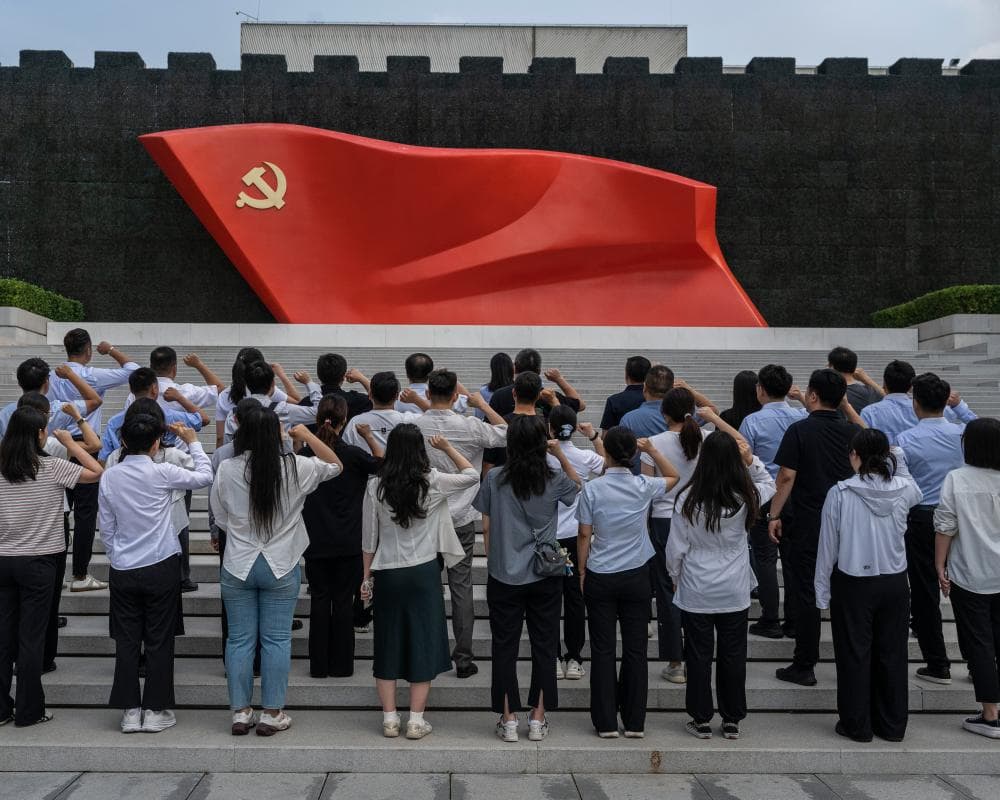
When Xi Jinping came to power in 2012, he pledged to stamp out corruption all through the ranks of the Communist party. More than a decade later, the pace of investigations has not slowed. Last year, China’s disciplinary authorities opened investigations into more than 1 million people, including more than 100 officials at or above ministerial or provincial level.
As Chinese Communist party (CCP) officials prepare for an important meeting this week discipline – and party loyalty – is high on the agenda. For those who try to read the tea leaves of elite Chinese politics, concern about the apparent lack of discipline is dominating CCP discussions.
The “fifth plenum” starts on Monday and is set to focus on “major issues on advancing the party’s full and rigorous self-governance”, according to a Chinese state media. In party-speak, “governance” is a byword for discipline, loyalty and anti-corruption.
Related: Taiwan charges five men over plot to run over comedian for his Xi Jinping jokes
As Xi continues to crack down on corruption, the fact that investigations nearly always result in a conviction begs the question over whether targets are truly guilty of corruption, or are they just political rivals to the people in charge.
Kerry Brown, director of the Lau China Institute at King’s College London, explained that in Xi’s worldview, which is obsessed with discipline and loyalty, there may not be much difference between the two. “If you’re corrupt, you’re not politically loyal. If you’re politically loyal, you’re not corrupt,” Brown said.
He added that in the CCP system, “corruption is not just material things”, but also “spiritual corruption”, which includes political disloyalty.
Some analysts argue that the reason that the anti-graft drive is so enduring is because corruption is a feature rather than a bug of an authoritarian, top-down political system with a sprawling bureaucracy that governs 1.4 billion people.
Neil Thomas, a senior fellow at the Asia Society thinktank, said: “Xi has made the party less corrupt and strengthened his control, but he knows that tougher punishment cannot fully resolve the problem of officials putting their own interests ahead of the party’s.
“Xi’s answer is to keep tightening discipline, making anti-corruption a permanent method of governing with no obvious point at which he can declare the job done,” Thomas said.
The job may be never ending, but the plenum is an opportunity to refocus the party’s energy on discipline. The fifth plenum is the fifth of seven gatherings that normally happen in every five-year cycle between CCP congresses. The plenums bring together more than 300 members of the CCP’s Central Committee, the most senior officials in the party hierarchy.
The upcoming meeting is particularly significant because it is likely to be the last substantive meeting before next year’s 21st Party Congress, where a new Central Committee will be chosen, and where Xi is expected to be anointed for a fourth term as the head of the CCP.
Eliminating anyone who poses a risk to his authority or to the party’s credibility is a key priority for Xi. And potential threats are everywhere. Nearly 15 years after Xi took office, according to CCP proclamations and a host of recent investigations, the problem is still not stamped out. “It is a deeply ingrained part of [Xi’s] worldview,” said Brown. “Everyone else is corrupt”.
In the past, Xi has warned that the party could “lose its ruling status and inevitably be eliminated by history” if it could not get its house in order. “This is by no means an exaggeration,” he said.
The current focus on party governance comes amid a host of high-profile investigations against senior party and military leaders.
In January, Zhang Youxia, China’s top general and a man second only to Xi in the military hierarchy, was placed under investigation; he was expelled from party last month, having already been removed from the military’s top ruling body, the Central Military Commission (CMC)
A host of other purges means that the CMC, which normally has seven members, has been reduced to just two: Xi and Zhang Shengmin, the CMC’s head of discipline.
Other recent scalps include Ma Xingrui, the former party secretary for Xinjiang, and Huang Qifan, the former mayor of Chongqing.
Huang had long been known as the ultimate survivor in Chinese politics because of his connections to the scandals in the early 2010s in which Xi’s political rival, Bo Xilai, the former Party boss for Chongqing, was embroiled in the death of the British businessman Neil Heywood. Bo was ultimately convicted of bribery and embezzlement, for which he is serving a life sentence, but Huang survived. No longer.
Some China analysts have asked whether the recent purges, which have reached the highest echelons of the Party and military ranks, indicate instability in the regime. But Xi likely sees it differently. Corruption investigations demonstrate who is in charge. Plus, Brown added, they are “the most easy and natural tool by which to enforce unity and discipline”.