After the car stopped rolling and came to rest on its side, Rob Pike remembers being “hyperfixated” on the rainwater pouring down his face. When he tried to wipe it away with his arm, he realised it wasn’t water. “I look at my arm and it is covered in blood. The next moment, it hit me: oh my gosh, we crashed.”
He was in the back seat next to his best friend, Daniel McCoy. “I look up to my left to see if Daniel’s OK. He’s probably about a foot away from my face and … he’s not OK. I’m looking at my dead best friend and I wish that wasn’t my last memory of him, seeing how broken he was.” They were 17.
“I lost control,” he says. “I am screaming at the top of my lungs. I’m yelling, I’m crying.” Even though he knew that Daniel was dead, he hoped for a miracle. “You spend your life watching Home and Away and Neighbours and you see people getting pulled out of cars and having CPR. If I can scream loud enough, then maybe somebody might come along and save his life.”
A woman had rushed out of her house when she heard the crash and run towards Pike’s screams. She found the car in the bushes. Pike remembers begging her: “‘Please help Daniel. You gotta do something.’ And then she gets down on her hands and knees, in the mud, in the rain, and she looks inside. And I remember her saying: ‘There’s nothing we can do for him. He’s already gone.’
“All of a sudden, I am very aware that I’m trapped in this car. I start freaking out. I’m trying with all my might to pull myself out of this little back window. I’m cutting my hands and I can’t get out.”
The woman stayed with Pike for about 15 minutes, trying to calm him down, until the fire engine and ambulance arrived. “I remember thinking, as soon as they arrived: ‘Everything’s going to be OK.’” The next two weeks are a blank.
Pike grew up in a mining town in the far north-west of Western Australia, with five older half-brothers and half-sisters. He was particularly close to one of his brothers, who taught him to play cricket and football in the back yard. When he was 12, the family moved to Baldivis, a small town about 50km south of Perth.
Life was good. “I was in my final year of high school, I had good friends and I knew what I wanted to do in my life. I had two options: I wanted to go into the Defence Force or I wanted to go and play AFL football for the best AFL football team in Australia, the Fremantle Dockers.” He grins – Fremantle is one of only three AFL teams never to have won a premiership.
On the day of the crash in Baldivis, on 17 August 1999, he was in lessons until lunchtime. His friends Christian Iezzi-Carrello and Adam Stribling, who were a year older and already at university, picked him up from school to go to play golf. “We weren’t any good,” he says. “We just loved getting out there, mucking around, getting in the golf carts – you know, being a little bit silly and having a good time.” McCoy was off sick that day, but Pike was pretty sure he’d want to join them. So he said the words that would later torture him: “Hey, let’s go get Daniel.”
It started to rain, so they went bowling instead. “As much as that day was a horrendous day, I’ll always remember that afternoon and those two games of 10-pin bowling as a fun time with my friends,” he says. “And I’m very grateful for that memory.”
Iezzi-Carrello, the driver, suddenly realised the time. It was nearly 4pm and he had to get to his part-time job at McDonald’s. “So we rushed out of there. We ran out of the building, across the car park, jumped into his car and took off.” It was now pouring with rain. “We were zipping in and out of traffic. We were probably going between 10 and 20 kilometres over the speed limit.” It didn’t cross his mind to object. “At 4.16, everything’s fine. At 4.17, I am the most scared I’ve ever been in my life.”
They were laughing and joking and listening to the radio. Then the car hit a big puddle of water and Iezzi-Carrello lost control. “I can go back to that moment right now,” says Pike. “I can remember closing my eyes and almost in slow motion thinking to myself: this is gonna be bad.” The car aquaplaned, went into a spin, smashed into a tree and split in half.
Pike woke up in Fremantle hospital after a fortnight on life support. At that point, he had no memory of the accident. “I had tubes and cords that were connected to me, keeping me alive. I had one going down my throat and I couldn’t speak. I’m in a back brace, almost like I’m strapped to the bed. I can’t move.”
His father was sitting by his bed. “He must have seen the fear on my face because he grabbed me by the hand. And I remember him saying: ‘Hey, Bob, I’m here.’ I remember that calming me.” His father was silent for a while. “Then he goes to me: ‘Bob, I got to tell you something. Christian, Adam and Daniel have died.’” Iezzi-Carrello and Stribling had been flung out of the car and died on impact.
Pike thought he was dreaming. He started pinching his arm and his chest, hard enough to leave bruises, trying to wake himself. “And I never woke up out of the nightmare. This is real; my friends have gone.”
No one told him the extent of his injuries. He was told he’d had more than 300 stitches and that he’d broken his back. He knew he needed to wear the back brace or risk severing his spinal cord. But he felt cramps and itches in his feet, and he could feel himself wiggling his toes, so he was confident he would eventually walk again.
About four weeks after the accident, he felt an unbearable itch in his foot that he simply had to scratch. “So I’m trying to contort my body to reach down under the blankets. All I feel are bandages. That’s the moment where I’m like: oh my God, what’s this? I rip the blankets off and then, even in this back brace, I sit up, because I need to see. I look down. Now, what I’m expecting to see is two feet and 10 toes. But all I see is bandages where both my legs finish just after my knees. I reckon that was one of the worst moments.” More than half of people who lose a limb experience phantom pains, including itches.
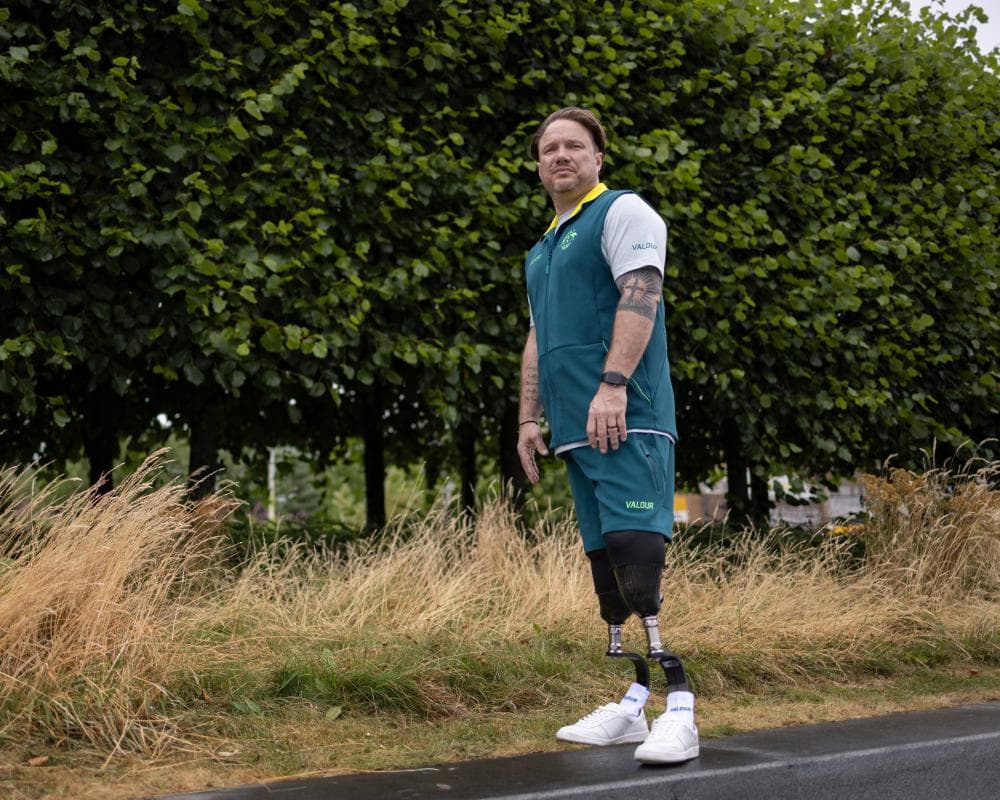
The doctors hadn’t amputated his legs; they had been severed in the crash. When the car hit the tree, the back panel sliced through his legs. “It actually took both my feet. So my feet, still in the shoes, ended up going in the front half of the car, jammed under the front seat, and my body was in the back half of the car.” This panel trapped him inside and saved his life. “It was so tight on my legs that it acted as a tourniquet. Ask any emergency services person: if there is an amputation in a car crash, nine times out of 10, that person dies at the scene because they can’t stop the blood flow.”
His dream of playing for the Dockers was over. “I’m lying in this bed and I’m like: well, that’s not my future any more. You can’t play football because you don’t have feet.”
Over seven weeks in hospital, he had to go through the embarrassment of nurses seeing him naked, bathing him and cleaning him up after he went to the bathroom. “I feel like I’ve lost everything. I’ve lost my friends. I’ve lost my legs. The last thing I had was my dignity and there it goes.”
He cried himself to sleep every night. He had “massive survivor’s guilt” and wished he could exchange his life for one of his friends’. “You almost create this rationale within your own mind: they were a little bit more popular, so less people would be sad if I’d died.” He couldn’t bear the fact that it was his words that had put McCoy in the car. He started making a plan to end his life.
One night, there was a knock at the door of his hospital room. It was McCoy’s parents. He tried to compose himself for their sake, but he couldn’t. “Daniel’s dad puts his arms around me and I bawl my eyes out. He’s saying: ‘It’s gonna be OK, Bob. We’re gonna get through this.’ And I’m thinking to myself: it’s not gonna be OK. I’m not gonna get through this because I’ve checked out. I don’t want to be here any more.
“He grasps me by the shoulders and looks me in the eyes and he goes: ‘Bob, we are so happy that you are alive.’ And those words hit me in my heart.” He knew he couldn’t do anything to add to their pain. He had no choice but to live.
“I remember saying to myself: ‘I can’t give up.’ And I would say it every day, multiple times a day for the first three to four months, over and over.” One day, he realised he’d only had to say it five times instead of 100. Eventually, he didn’t have to say it at all. “I’m not living for them any more,” he realised. “I’m living for me.”
Pike learned to use his prosthetic legs before his stumps had even fully healed; he was determined to walk into his end-of-year school celebration. He started playing cricket again. He got a girlfriend.
To friends, he was the lucky one, the brave one. But he was still full of guilt and very self-conscious about his disability. There were false reports in local newspapers that the boys had been drinking before the crash and that the car was stolen. People would accost him in the street to ask: “What were you guys thinking?” He started self-medicating with alcohol, binge-drinking every weekend to mask “this brokenness within me”. After six months, he finally accepted that he needed therapy.
The other thing that saved him was wheelchair basketball. His dad persuaded him to try it. “I was very ignorant. I’m like: a bunch of disabled people playing basketball?” He went to a game and was “blown away. What I’m watching is athletes flying around this court, hitting each other, smacking each other. And I’m like: yes, this is awesome!”
It helped fill the gap left by football and he loved the physicality of it. “No one was like: I can’t hit you because you’ve got no legs.” He threw himself into the sport and ended up playing for Perth Wheelcats and Australia, then moved to Spain for a couple of years to play professionally. Today, he is the head coach of the Wombats, the Australian women’s 3x3 wheelchair basketball team. We meet in Glasgow on the opening day of the Commonwealth Games; they will go on to take the bronze medal.
Pike, 44, is married with two children. He is proud to be on the board of the Paraplegic Benefit Fund of Australia, which supports people with spinal cord injuries, and to do road safety advocacy. Reliving the worst day of his life is tough, but it helps give his friends’ deaths meaning. “I can share it with 16-, 17-year-old students and hopefully inspire them to be better drivers, but also better people.” He says that he is a “nicer, more empathetic” person since the accident.
He still has setbacks. During Covid, more than 20 years after the crash, he woke up with “extreme panic attacks”. All he could think was: “I’ve gotta get out.” He slept outside on garden furniture for two weeks, then took off the window in the front room and slept on a recliner for a month. He had another panic attack when he was driving. “I remember feeling: oh my gosh, I’m trapped to my legs and I’m trapped in this car. And then – it’s strange how the mind works – I actually feel like I’m trapped in this world.” He saw a tree and, for a split second, it seemed like a way out. That was when he knew he needed to see a psychiatrist again.
“You think you’re done,” he says, referring to his initial therapy after the crash. “But what the psych said to me is that your body protects itself. And then when it feels like it’s in a safer space, things start to come to the surface, which was my trauma of being stuck in the car.” Now, he says, “I’ve come through the other side. And I feel like I’m a pretty complete, whole person, and I’m in a really positive place.”
Life still throws curveballs. Towards the end of our conversation, he casually mentions that he had a heart attack three months ago. He thought he’d pulled a muscle; he ended up “going into complete heart failure” and being hospitalised for 12 days. It turned out he has hereditary high cholesterol – his dad had a heart attack in his early 50s. “I thought I could just be healthier and eat well and go to the gym. I learned the hard way that it doesn’t matter how fit you are. If your cholesterol is an issue, it’s an issue.”
These days, he believes in counting his blessings. “It’s very easy to look at what you don’t have. We should be looking at what we do have. I don’t think we’re called to just sit there and exist and wait till the end. I think we’re called to go out there and live life and be kind and be the best person we can.”
• In the UK and Ireland, Samaritans can be contacted on freephone 116 123. In the US, you can call or text the 988 Suicide & Crisis Lifeline at 988 or chat at 988lifeline.org. In Australia, the crisis support service Lifeline is 13 11 14. Other international helplines can be found at befrienders.org