Afternoon summary
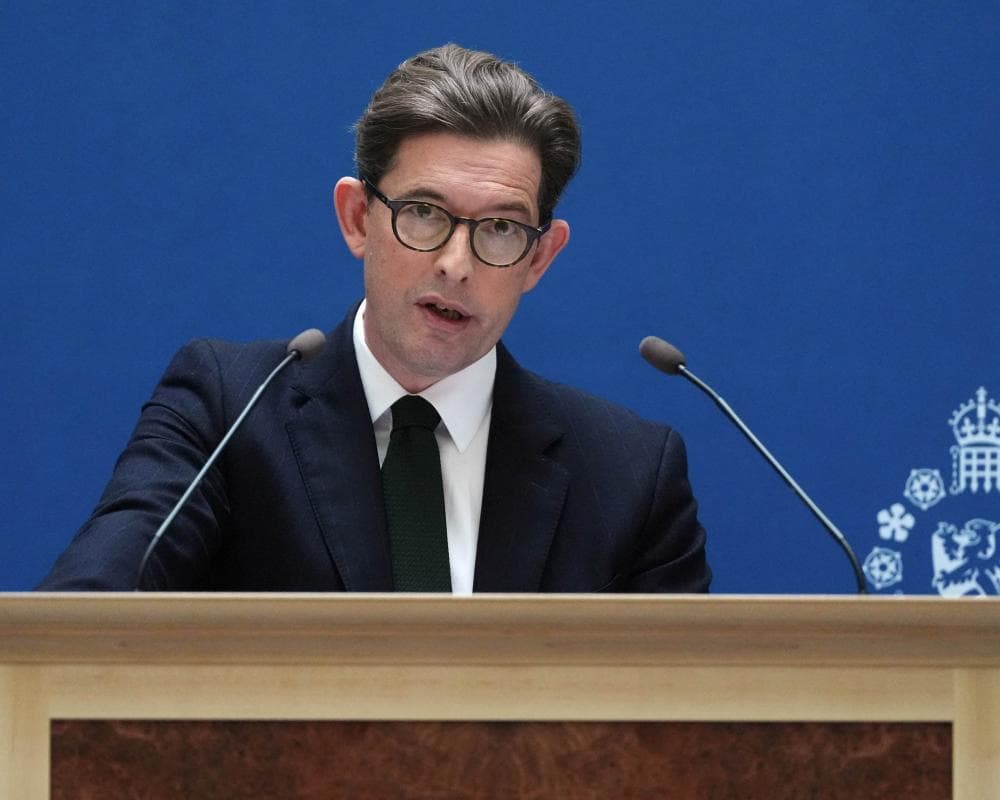
Ken McCallum has said that Moscow did attempt to interfere in the 2016 Brexit referendum with anti-EU coverage on RT and Sputnik media and via troll social media accounts. But there was a big difference between “what may have been attempted and what actually resulted”, he added. (See 1.15pm.)
For a full list of all the stories covered on the blog today, do scroll through the list of key event headlines near the top of the blog.
Streeting says, if Sinn Féin opposing new Troubles bill as 'veterans' charter', he's 'delighted'
Wes Streeting, the defence secretary, is still giving evidence to the defence committee. Asked about the Northern Ireland Troubles bill, he said that the new amendments being tabled (see 2.34pm) considerably improved it from the point of view of the armed forces. He went on:
And so we are in a much stronger place, to the extent that I think Sinn Féin have condemned these amendments and the bill as a veterans’ charter, which as far as I’m concerned is the highest plaudit possible, and I’m absolutely delighted that that’s where we’ve got to.
We have worked intensively with the Northern Ireland secretary [Chris Bryant] and his team to get this bill to a much better place, that deals with what I think is my personal moral obligation to people who’ve served.
Ed Davey under pressure to defend his leadership at meeting with his MPs
Liberal Democrat MPs are holding a private meeting later where they are expected to thrash out disagreements about Ed Davey’s leadership. For months there has been persistent, low-level grumbling about Davey’s supposedly ineffectual leadership. This is a long way off the sort of firing squad revolt the Tory 1922 Committee used to specialise in. So far only two relatively junior frontbenchers have resigned.
But it must be a bit serious because at the Times they have activated a loyalty spreadsheet. This is from Aubrey Allegretti on the state of play.
Lib Dem leadership showdown:
- 4-hours has been carved out in MPs’ diaries for their meeting at 5pm today, to accommodate requests from more than 40 people to speak (and breaks in proceedings for votes). Roz Savage, as chair of the parliamentary party, will chair the meeting.
- So far, I’ve counted 21 MPs who’ve explicitly - or at least appeared - to back Ed Davey. That leaves a *lot* still undeclared. The rebels need 18 (or 25% of MPs) to force a no-confidence vote.
- Davey’s critics are digging in - and hoping his performance tonight swings sceptics in their favour. They say even if he survives tonight, it’s a matter of “when, not if” he goes.
- Davey’s allies accuse the rebels of “trying to create chaos at a pivotal moment, with the timing of the next general election up in the air”. He has spoken to some MPs to encourage them to speak in support of him tonight.
- Some MPs privately think Davey should go, but are divided over who should replace him - further splintering the rebels.
But my colleague Peter Walker reckons Davey is safe for now.
From what I hear there is almost no chance of Ed Davey facing any kind of no confidence vote at tonight’s meeting of the Lib Dem parliamentary party. Some MPs are dissatisfied with him, even if it’s hard to gauge how many. But there seems a willingness to listen to what he has to say
Two other reasons why anything dramatic feels unlikely:
• There is no consensus among the malcontents - or anyone else – about who they might want to replace Davey.
• The Lib Dems aren’t generally very good at this sort of thing.
Streeting tells MPs committing to spending 3% of GDP on defence without plan to fund it would risk Truss-type backlash
The government could trigger a Liz Truss mini-budget-type economic incident if it committed to spend 3% of GDP on defence by 2030 without saying where the money will come from, Wes Streeting has suggested.
Streeting used the argument as he gave evidence to the Commons defence committee, where he as pressed to confirm that the government will raise defence spending to 3% of GDP by 2030.
The defence investment plan (Dip) currently sets out a path to spending 2.7% of GDP on defence by the 2027-28 financial year. John Healey resigned as defence secretary when Keir Starmer refused to commit to 3% by 2030. Healey is now chancellor, but he has not yet explained how he will raise defence spending to the 3% level he treated as a resignation issue.
Streeting told the committee he never expected Healey to set out a pathway to 3% at the budget later this month and that plan was always due in the spending review, now reportedly expected next autumn.
And he defended the chancellor’s decision not to rush. He said:
We have had very bitter recent experience of a former prime minister making unfunded commitments to spend more, tax less, and borrow more all simultaneously, and it led to enormous loss of confidence, people’s mortgages going up, and a level of fundamental loss of confidence in Britain among investors, and this country is still recovering from that.
But Streeting also said that he was “confident that we will get there”, arguing that this confidence was justified “from the choices that Labour’s already made in government through to how strongly, as a matter of principle, the chancellor felt about this”.
Updated
Pat McFadden accuses Tories of hypocrisy over pensions triple lock, saying many of them accept current version unsustainable
Pat McFadden, the work and pensions secretary, has claimed he has a file “as thick as my morning porridge” with quotes from Tories arguing against the pensions triple lock.
He made the claim in a Commons statement explaining the plan announced by Andy Burnham at Labour conference to replace the current triple lock with an adjusted version that will be less generous.
The Conservatives opposed the move when it was announced and, in the Commons, McFadden’s Tory shadow, Helen Whately, claimed this policy was a “U-turn in waiting” and that it would be abandoned by Burnham because of its unpopularity.
But McFadden told Whately that plenty of her colleagues were in favour of the Labour policy. He told her:
The shadow foreign secretary [Tom Tugendhat] has called it simply not affordable and described it as a Ponzi scheme. The shadow justice secretary [Nick Timothy] actually wrote the 2017 manifesto that pledged to replace it with a double lock.
But my favourite is Lord Gove, who told LBC that if Andy Burnham changed the triple lock, he would, and I quote, “declare that I will be campaigning at the next general election exclusively for Stella Creasy in Walthamstow”. So I look forward to seeing him at the end of the Victoria line at the next election. with a red rosette on.
McFadden said these were not isolated examples.
I have a file as thick as my morning porridge full of quotes from the Tories saying that the triple lock is unsustainable and will have to be changed. They say it in private, they say it before they join the frontbench, and they say it after they leave it.
McFadden also said that, if the Tories remained committed to restoring the triple lock in its current form, they would have to explain at the next election how they would fund that. (Labour plans to legislate before the next election to change the triple lock uprating mechanism from 2030.)
Although the Tories oppose what Labour is planning, at the Tory conference last week Kemi Badenoch refused to commit to restoring the current triple lock if Labour has got rid of it before she takes office.
Updated
Foreign Office minister tells MPs nearly 240 Iranian people and entities now subject to sanctions over hostile acts
Stephen Doughty, the Foreign Office minister, told MPs earlier that the UK has now sanctioned nearly 240 individuals and entities in relation to threats to the country posed by Iran.
A further two Iranian officers from the Islamic Revolutionary Guard Corps (IRGC) were sanctioned yesterday, he said.
In response to an urgent question, Doughty also confirmed that 34 other foreign ministers have joined Ed Miliband, the foreign secretary, in issuing a joint statement condemning “in the strongest terms Iran’s use of violent attacks, including the acts of lethal plotting, arson, sabotage, cyber-attacks, and other hybrid activities against us and our partners”.
And Doughty said that yesterday he had summoned the Iranian ambassador to the Foreign Office to tell him, “candidly and forcibly” that Iran’s activities were unacceptable.
Doughty said:
We have sanctioned nearly 240 individuals and entities in relation to Iran whose actions threaten our people and security and will continue to keep all those tools under review and will not hesitate to take further action where appropriate.
Updated
Veterans to get more protection under significant amendments to Northern Ireland Troubles bill, ministers claim
Later in the Commons, MPs are expected to pass a motion allowing them more time to consider the Northern Ireland Troubles bill before it has to be passed. The bill was introduced in the last session of parliament, which means it is subject to the carry-over procedure.
The bill replaces legislation passed by the last Tory government which in effect gave immunity to terrorists and members of the armed forces accused of crimes during the Troubles, provided they gave evidence to a Legacy Commission trying to establish the truth about unsolved Troubles-era murders. The Conservative law was hugely unpopular in Northern Ireland, and the Labour alternative – which is similar – has also been widely criticised.
In an article in the Times today, Chris Byrant, the Northern Ireland secretary, and Wes Streeting, the defence secretary, highlight amendments being made to the bill which they argue will reduce the risk of retired soldiers being subject to vexatious investigations. Under one change, in future the attorney general would have to approve any serious, Troubles-related prosecution.
They say:
By setting up a fair, workable system to deliver as many answers as possible, we will help communities to heal so that we can finally turn the page on one of the darkest periods in our recent history.
More than a quarter of the families seeking answers from the Legacy Commission are veterans’ families. Nearly one in five are the families of police officers. No one should be in any doubt how important this is.
And describing the way the legislation has been changed, they say:
Over the last few months, we have listened to veterans, victims’ groups, including those representing service families, and the wider defence community to hear their concerns. We are responding by making sure the Troubles bill properly protects all those troops who served with honour.
Under the previous government’s scheme, terrorists would have enjoyed the same immunity as veterans – something so abhorrent it should never have been considered in the first place. And so we will not only repeal it, we will make clear – in black and white – that there is no equivalence between paramilitaries, who waged campaigns of violence, murder and destruction, and the lawful actions of our armed forces sent to stop them.
For too long, our servicemen and women have had to fear the knock at the door, the call from an unknown number or the ping of an email notification, as they bear the brunt of incidents being reinvestigated years or decades after the events in question. The bill spells out that there can be no duplication of previous investigative processes unless it is essential, and that witnesses cannot be contacted unless it has been clearly demonstrated that there is compelling new evidence. Nor will veterans be forced to traipse to Northern Ireland to attend hearings. And any decision to prosecute a serious Troubles-related crime will now require the consent of the attorney general.
Reoffending 'off the charts' because of prisoner early release scheme, Tories claim
The Tories have claimed reoffending is “off the charts” due to the prisoner early release scheme.
In an urgent question in the Commons, Nick Timothy, the shadow justice secretary, said the majority of prisoners were not being tagged before release, despite assurances from the government that the tagging system would be the “toughest in history”.
He said:
The justice secretary [Alex Norris] told the country that proper safeguards would be put in place with a presumption that all released prisoners would be tagged.
He called it the toughest tagging regime in history, but that was nonsense.
I have some advice for him and his ministers – it is better to work out how to implement your policy before it starts, not after. We know a majority of prisoners are not being tagged before release, and we know reoffending is off the charts already.
Jake Richards, a justice minister, said that Timothy should be showing more contrition because prisoners were having to be released early as a result of the Tories leaving a system where the prisons were full.
Kemi Badenoch has welcomed a poll giving the Tories a three-point bounce since their conference, and putting them just one point behind Labour.
In its write-up of its latest regular, weekly poll, YouGov says:
Our latest figures show Labour on 24% of the vote, down three points on last week’s poll, while the Conservatives are up three points to 23%, their highest level since we restarted our voting intention tracker in January 2025. Reform UK take a 21% share in this week’s poll, their joint-lowest on our tracker this parliament.
Speaking to reporters today, Badenoch suggested the fall in Reform UK’s ratings showed the public had been taking a “long look” at Nigel Farage’s party and “don’t like what they see.”
Asked whether she was confident her party could continue to rise in popularity, or whether it was just a temporary, post-conference blip, Badenoch told the Press Association:
I am confident that the momentum will continue, because people are seeing the Conservative party has changed under my leadership and there’s much more to come, this is just the beginning.
We left office two years ago, it was a historic defeat for the Conservative party. We made a lot of mistakes.
I have been showing the public that I understand what went wrong; apologised and acknowledged those mistakes. But we are the only party with common sense and a plan to unite the country.
Asked what she thought the poll suggested about Reform UK, she said:
I think the public have been taking a long look at Reform and they don’t like what they see. What I need to show them is that if they don’t want a Labour Government there is only one credible alternative.
And this is from Luke Tryl, the More in Common pollster, on the significance of the YouGov poll figures.
Few interesting things here of which the most important thing I’d say is the level of volatility should be a further warning of risks a snap election. Lab’s conference bounce disappears in a week. Second conferences still matter at least short term. Third battle for the right is now wide open.
How MI5 chief's comments undermine Tory claim Burnham was spreading 'conspiracy theories' about Brexit referendum
The statement from Ken McCallum confirming Russian interference in the Brexit referendum is a bit awkward for Katie Lam, the shadow communities secretary. On Sunday she wrote an open letter to Angela Rayner, the communities secretary, about Andy Burnham saying Russia did interfere in the 2016 vote. Lam said in her letter these claims were “unproven” and in a post on social media she said: “The prime minister is spreading conspiracy theories about the Brexit referendum.”
(You can argue that the claim Russia decided the outcome of the referendum is a conspiracy theory, but this is not something Burnham did say in his Rest is Politics interview, or ever has said.)
Rightwing extremists increasingly likely to consider terrorist attacks, MI5 chief says
Ken McCallum, the head of MI5, has also said that extremists holding anti-immigration opinions are becoming increasingly likely to consider carrying out terrorist attacks against immigration centres and asylum hotels in the UK. Dan Sabbagh has the story.
Related: Rightwing extremists increasingly likely to consider terrorist attacks, MI5 chief says
MI5 chief Ken McCallum confirms Russia did interfere in Brexit referendum - but says it had little impact
Dan Sabbagh is the Guardian’s defence and security editor.
MI5 chief Ken McCallum said today that Moscow did attempt to interfere in the 2016 Brexit referendum with anti-EU coverage on RT and Sputnik media and via troll social media accounts. But there was a big difference between “what may have been attempted and what actually resulted”, he added.
The head of the Security Service said that he agreed strongly with what the prime minister had said on Sunday and Monday, when he raised the issue of attempted Russian interference a decade ago – though Burnham then backed off when he was challenged by the Conservatives as to whether this meant he regarded the Brexit vote as illegitimate.
McCallum did not put any new evidence into the public domain but cited already known concerns about Russian broadcasters who “came in pretty strongly around the time of the referendum” in favour of Brexit. He also said that “there was a second line of interference attempted through [internet] trolls”.
However, he argued there was no evidence to suggest the result of the Brexit vote had been swayed as a result of the effort, which is generally believed to have been marginal, and said that it would be to Russia’s benefit if the issue was talked about further.
He explained:
It is up to us how far we allow our adversaries to divide us.
I’m a little bit worried that if we all stay in this debate for another few days, the Russian trolls who didn’t appear to do all that much at various points over the years, they’ll be delighted they are front page news once again despite the comparative unimpressedness of what they do at all points along the journey.
I am a little bit anxious that we don’t play into our adversaries’ hands by making these trolls look 10ft tall.
UPDATE: McCallum said:
There is a really important difference between interference attempted and outcome swayed … It’s quite important to focus on the difference between what may have been attempted and what actually resulted.
It is a matter of public record including in select committee reports published in 2019 – the DCMS [digital, culture, media and sport] committee did a bit and the intelligence and security committee did a bit also – that in 2016, before you even get to any secret intelligence … it is openly on the record that Russia Today and Sputnik and other Russian media organisations came in pretty strongly around the referendum.
And it is also a matter of open source record that there was a certain amount of interference attempted through trolls and bots and so forth.
I agree strongly with what the prime minister said yesterday, we did see a hack and leak thing inside the 2019 general election campaign.
Updated
Zia Yusuf says he does not agree with Suella Braverman's claim minority ethnic people can't be English
Zia Yusuf, Reform UK’s home affairs spokesperson, has said he does not agree with his colleague Suella Braverman’s assertion that black people cannot be English.
Asked about her views in an interview on Sky News, Yusuf said:
In my view Ashley Cole is the best English fullback in history, and I won’t take any other position. So in my view, Ashley Cole is English. I think the argument that he’s not English doesn’t hold water with me.
Yusuf made the same argument about Britons of Asian heritage.
Nasser Hussain, who I grew up watching when I went to the cricket, the idea that those people aren’t English is an alien concept to me.
I would respectfully disagree with people, who make the opposite argument.
Braverman, Reform UK’s education spokesperson whose parents came to the UK from Mauritius and Kenya respectively, says she is British but not English. She recently explained:
To say I’m English is to take a ‘laissez-faire, anything-goes’ attitude to ethnicity, citizenship and identity. It also denies me my Asian heritage. The liberals (many of them in today’s Conservative party) take this cosmopolitan approach to Englishness. They’re terrified of being called racist so they say that anyone, as long as they’re born here, can be English.
I take the conservative approach. Englishness is an ethnicity. There have been English people for centuries and we need to recognise this more if we are to start taking a more muscular approach to citizenship and nationality. And no, it’s not racist to say this.
After 12.30pm, there will be two urgent questions in the Commons, and two ministerial statements.
The UQs are on the prisoner early release scheme, and on the threats posed by Iran.
And the statements are from Pat McFadden, the work and pensions secretary, on the pensions triple lock, and from Uma Kumaran, a Foreign Office minister, on the Falkland Islands.
Miliband acknowledges ‘difficult’ relations between US and Ukraine’s allies
Ed Miliband has also admitted that Donald Trump’s decision to buy Russian diesel, and his call for Volodymyr Zelenskyy to be replaced as Ukrainian president, has strained diplomatic relations with Washington.
Speaking at the Warsaw Security Forum, Miliband said:
Within the bounds of diplomacy we should acknowledge it’s been a very difficult few days.
He said Zelenskyy had shown “extraordinary leadership over the last four-and-a-half years in the most difficult of circumstances” since Russia’s invasion.
He added:
I was with him in Ukraine last week as we went to the site where 22 innocent civilians were killed, including five children. He feels every death personally and I think we should praise his leadership today from this forum.
Updated
Miliband says Europe needs to revive debate on what it does with frozen Russian assets
Ed Miliband, the foreign secretary, is speaking at the Warsaw Security Forum with his counterparts from Germany, Poland and Norway. Jakub Krupa has been covering it in detail on his Europe live blog.
As Jakub reports, Miliband said the EU should review its policy on dealing with Russian assets frozen under sanctions imposed since the war in Ukraine starts. He said:
Europe has big decisions to make, including on Russian sovereign assets. I think we need to return to this issue.
Britain is willing to do this alongside the European Union, because we know that every wrong message that is sent to President Putin is a message that sets back our security and sets back the Ukrainian cause, and we need to send the right messages.
Most of the frozen Russian assets are held in bank accounts in Belgium. Some European leaders want to see them seized to fund a loan to Ukraine, but the Belgians are resisting. They argue this would be against international law, and they are fearful of Russian retaliation.
Farage denies Reform would let troops shoot small boats after Jenrick’s ‘lethal force’ claim
Nigel Farage has denied that a Reform UK government would authorise lethal force against migrant crossings in the Channel, hours after Robert Jenrick, his Treasury spokesperson, said the Royal Marines should be permitted to fire on the boats. Jessica Elgot has the story.
Related: Farage denies Reform would let troops shoot small boats after Jenrick’s ‘lethal force’ claim
SNP invites Burnham to its party conference, saying his defence of union has made constitution 'central question' in politics
Andy Burnham is reportedly planning to go to Scotland on Friday. The SNP has invited him to attend its conference, which is starting in Aberdeen on Thursday.
In his own conference speech Burnham made a passionate defence of the union, and the SNP says this means he accepts Scottish independence is the central question in political debate.
In a statement, the SNP’s deputy leader Keith Brown said:
The SNP would like to invite Andy Burnham to SNP conference as part of his visit to Scotland …
Andy Burnham made Scottish independence the focus of his conference speech with his time in Downing Street fast becoming defined by the UK’s constitutional future - it is the central question on these islands.
SNP conference is the perfect and natural place for Andy Burnham to set out the logical extension of his words - an agreed legal process.
Updated
Standards watchdog warns Burnham of growing concern that wealthy donors exercising 'undue influence' on politics
Andy Burnham has been warned that progress on beefing up ethical standards in public life is “stalling”.
The comment came in the first annual report to the PM from the Ethics and Integrity Commission, the body set up last year to replace the Committee on Standards in Public Life.
Doug Chalmers, the former deputy chief of defence staff and master of Emmanuel College, Cambridge, has to report every year to the PM on “the health of standards in public life” and he has delivered his first update in the form of an open letter.
In it, he says:
A number of positive steps have been taken since the July 2024 general election towards strengthening England’s standards system, but progress is at risk of stalling. Your personal leadership is needed to accelerate standards reform and to ensure that the core values and standards expressed in the principles of public life remain at the heart of government and our public services.
In particular, Chalmers says there is a growing concern that wealthy donors are exercising an “undue influence” on UK politics because parties are ever more reliant on them for money.
He says:
The longstanding debate around the merits of a universal annual cap on permissible donations is receiving increased attention from parliamentarians and the media in light of the trend for large donations to originate from a small number of donors.
Political parties play a vital role in our democracy and need significant sums of money to function, yet the reliance on large donations from a limited number of sources creates the risk that donors may exert undue influence, or may be perceived to do so, which is damaging for trust in politics.
Chalmers does not mention Reform UK in his letter, but his comment seems in part influenced by the alarm generated by the news last month that two cryptocurrency billionaires are between them giving £72m to Nigel Farage’s party.
Whether the donations will comply with a new election law going through parliament remains to be determined, but ministers are under pressure to tighten the law further, with some MPs saying the amount an individual can give to a party should be capped.
In his letter, Chalmers says a cap is “likely to affect the major parties in different ways” and he says any reform should not be seen as partisan. “This will also ensure reforms have democratic legitimacy and are more likely to endure,” he says.
The letter also urges Burnham to press on with action to strengthen standards in other areas, including local government and lobbying.
Updated
Here are pictures of ministers arriving for cabinet today.
IMF raises UK growth forecast as economist says Healey should ‘stay the course’
John Healey should “stay the course” and continue repairing the UK’s public finances, the International Monetary Fund’s top economist has said, after the fund lifted its growth forecast for Britain, Heather Stewart reports.
Related: IMF raises UK growth forecast as economist says Healey should ‘stay the course’
Andy Burnham will take Britain back into European Union, Neil Kinnock claims
Good morning. In his long statement to MPs yesterday, Andy Burnham was evasive when asked whether he wanted his planned renegotiation of Britain’s relationship with the EU to result in a Labour-led government, after the next election, rejoining. In response to one question about this, Burnham told a Tory MP he was “getting way ahead of himself” with the question. But one well-placed observer is not being so coy.
Neil Kinnock, the former Labour leader and one of three people Burnham has named as his political mentors, has given an interview to la Repubblica, the Italian newspaper. He told it that he believes Burnham does want to, and will, take the UK back into the EU.
Kinnock said: “Andy makes the declaration of his determination to change the relationship, and it’s obvious that his objective is to join again.”
Asked again if he thought Burnham would be the person to take the UK back into the EU, Kinnock replied:
Yes, sure, sure, sure. His commitment is authentic. He really does understand from the grassroots up why restoring what I think of as normality in our continent is vital for every party economically, politically, culturally, all in security terms, and is able to articulate it in language that people can understand. So yeah, he is definitely.
Asked about Burnham playing down his desire to revisit the referendum result during the Makerfield byelection campaign, Kinnock claimed this was just a matter of deciding when to have this debate.
Andy’s not changed direction. He’s always been a committed pro-European. In the byelection, he rightly didn’t make a noise about it. That’s tomorrow’s debate. Simply because the byelection wasn’t about Europe. It was about winning Makerfield in order to enable him to become leader of the party. That’s all it was about.
Kinnock was interviewed by Antonello Guerrera who asked how, as someone who inherited a leftwing party and dragged it to the right, Kinnock felt about a sucessor taking Labour to the left. Kinnock said he thought Burnham’s approach was right.
It’s common sense. It’s not left and right. Andy’s view of the engagement of the state is about what Winston Churchill did in the 1950s, and I don’t remember Churchill being thought of as on the left. Andy’s a socialist, but he’s a very common-sense socialist. He’s very rational. He’s cool, not just with his dark blue T-shirt, but in his thinking, and he’s advanced a hell of a lot in the last 10–12 years in terms of his understanding of the absolute importance of utility, of usefulness in politics.
That’s what puts us, basically, he and I, on the same spot. Of course he’s on the left. I’m on the left. We’re socialists, but we are prompted by the usefulness of the application of ideas.
We have got a lobby briefing later and no doubt No 10 will clarify that its understanding of Burnham’s position on rejoining the EU is not quite the same as Kinnock’s. Kinnock is a former vice president of the European Commission, and an ardent pro-European, and perhaps there is some wishful thinking in what he says. But he is also a good friend of Burnham, and an astute observer of Labour politics. You will have to decide for yourself if he is right.
Here is the agenda for the day.
9.30am: Andy Burnham chairs cabinet.
Morning: Burnham attends meetings with business leaders in No 10.
Noon: Downing Street holds a lobby briefing.
After 12.30pm: MPs debate the remaining stages of the courts and tribunals bill.
3pm: Wes Streeting, the defence secretary, gives evidence to the Commons defence committee.
5pm: Ed Davey, the Lib Dem leader, attends the regular weekly meeting of Lib Dem MPs, after two frontbenchers stood down amid concerns about his leadership.
Also today, another round of prisoner releases is happening under the prisoner early release scheme in England.
I’m afraid we are no longer able to have comments open below the line every day on this blog. If you want to contact me, please email politics.live@theguardian.com. You can use this email to flag up corrections, comments for publication, questions or complaints.
Updated