Here is a summary of today's news
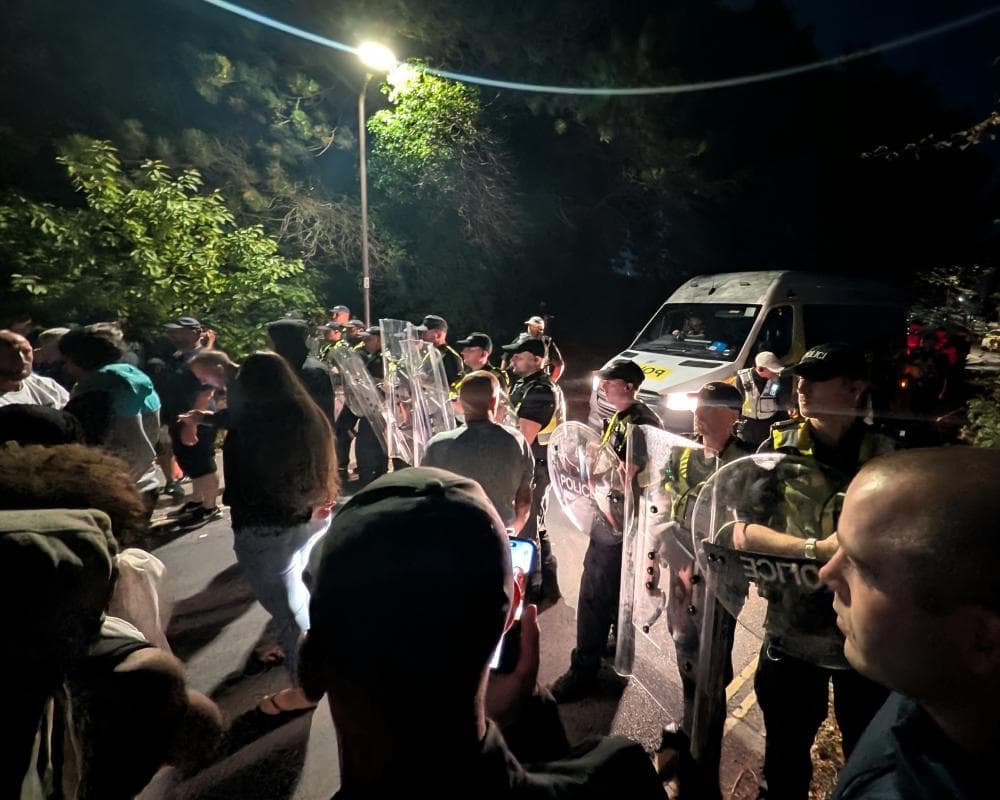
Some protesters showed “intimidating and thuggish behaviour” this weekend, Sarah Jones, the policing minister said. She said on Sunday a boat carrying approximately 120 people reached British shores “significantly further west” than most previous boat crossings. At 8pm, Jones said, a group of more than 200 protesters reached the harbour, seeking to block the coaches from leaving.
The Tories have described the government’s local government reorganisation U-turn as a “total humiliation”. In her statement, Zöe Franklin, the Lib Dem local government spokesperson, says services are at risk.
John Healey gave a statement in the Commons where he declined to rule out tax rises and said he cannot comment on the budget be because responding to speculation will ‘only fuel more speculation’.
Opposition parties criticised Healey for sounding too much like Rachel Reeves in his speech on his economy. Andrew Griffith, the new shadow chancellor said Healey “sounds increasingly like continuity Rachel Reeves”.
Zack Polanski is facing unexpected internal opposition in his bid to fight the Holborn and St Pancras byelection for the Greens, with a local councillor saying he is also seeking the nomination and that the seat needs a local MP, not “a politician you’ll only see on a leaflet”.
Downing Street had refused to deny an Observer story saying that Andy Burnham intends to ensure that the Sun newspaper does not get any special editorial favours from him as PM.
Updated
Police officers were pushed off motorbikes and had stones and bricks thrown at them as they “became the target” for anti-migrant protesters in Portsmouth, a federation chief has said.
Spencer Wragg, chairman of Hampshire Police Federation, said one of the officers injured was a rookie who had only finished training school three days earlier.
The force has said it is investigating potential assaults as well as criminal damage after official vehicles were smashed during a stand-off as demonstrators tried to stop migrants being driven away to Kent.
“It appears that the police last night became the target for some of the protest,” Wragg said. “Thankfully there are no serious injuries to officers, but the professionalism they showed in the face of provocation and immense pressure was admirable.”
Far-right activists gathered in two disruptive demonstrations in Dover and Portsmouth over the weekend, attempting to obstruct asylum seekers arriving on small boats from France. Many wore all black and balaclavas.
The action was seemingly organised by Daniel Thomas, an agitator better known as Danny Tommo, who has close ties with the far-right extremist Tommy Robinson. Thomas was recorded on the ground saying Portsmouth was now ‘ground zero’ for small boat crossings, and has threatened further action.
Lucy Hough speaks to political correspondent Ben Quinn:
Updated
Policing minister Sarah Jones claimed the Conservatives are behind “the frustration we see in our communities today”, as she spoke to MPs following protests in Dover and Portsmouth.
Referring to previous Conservative governments, the Labour minister continued: “Let us never forget that the frustration we see in our communities today is a product of chaos and crisis in the years that preceded the general election of 2024.”
Sarah Jones, the policing minister, told the Commons that the government “remain alert” for small boat crossings on lesser used stretches of the Channel.
“The gangs are never going to go quietly”, Jones said. “They are responding to the impact our work is having and we will adapt in turn.”
Minister says some agitators were 'intimidating and thuggish'
Some protestors showed “intimidating and thuggish behaviour” this weekend, Sarah Jones, the policing minister said.
But she added she did not seek to “minimise” legitimate concerns people had about small boat crossings.
“This government has taken action to fix the broken system we inherited and crack down on the people smugglers,” Jones said, pointing out that system-wide arrests were up 70%.
Updated
Sarah Jones added that “work is ongoing to establish any lessons and to ensure that intelligence is shared at pace” across law enforcement systems.
Jones said the protestors had began to disperse at 4am and no arrests were made on the night.
“There can be no excuse for threatening behaviour or serious disruption,” Jones said. “Disorder of any kind will never be tolerated.”
Updated
Sarah Jones, the policing minister, said “investigations are ongoing” into the disorder in Portsmouth.
“Where criminality is identified, those responsible should expect to face the consequences”, Jones added.
She said on Sunday a boat carrying approximately 120 people reached British shores “significantly further west” than most boat crossings.
At 8pm, Jones said, a group of more than 200 protestors reached the harbour, seeking to block the coaches from leaving.
Updated
In the Commons Sarah Jones, the policing minister, is making a statement about the anti-migrant disruption in Dover and Portsmouth. I am finishing now, but Charlie Maloney is taking over to cover the statement.
Zia Yusuf, Reform UK’s home affairs spokesperson, has been in Portsmouth today. In a statement on social media, he claimed Andy Burnham was to blame for the disorder in the city because people were responding to the consequences of the government’s asylum policy.
While he was there, Yusuf was confronted by Daniel Thomas, a far-right agitator closely linked to Tommy Robinson. Thomas helped to organise the protests and he told Yusuf that he was not happy about Nigel Farage condemning the protesters for wearing balaclavas. Sky News has video of the encounter.
As Sky reports, Thomas told Yusuf:
You have to tell Nigel [Farage], he cannot – he did this before, when we had a million people on the streets of London ... he called us knuckledraggers ... Nigel needs to be very careful with his words.
From my colleague Jessica Elgot
New – Marc Stears, the director of UCL Policy Lab, is joining Number 10 as a special advisor to Andy Burnham.
Close to Ed Miliband, Stears has done a lot of work and research recently on the splintering progressive vote, especially stressing the importance of climate.
Sarah Jones, the policing minister, will be making a statement about the far-right, anti-migrant protests in Portsmouth shortly. Pippa Crerar and Kiran Stacey are talking about them on the latest episode of the Guardian’s Politics Weekly UK podcast. It’s just out.
Related: Is the UK about to see the rise of the far right? – podcast
Council leaders say reorganisation U-turn will create 'significant uncertainty' for staff
But other local government leaders have criticised the reorganisation U-turn on the grounds that it is creating uncertainty.
This is from the Local Government Association, which represents all councils in England.
Councils across the country will hold different views on the local government reorganisation (LGR) programme, for what it means for their areas, and the announcement of today’s review. But there is no excuse for the government’s mishandling of this process.
Today’s announcement, however, will have caused significant uncertainty, after councils have invested scarce public money and countless hours in the government’s LGR programme. People’s jobs, lives and wider commitments have been affected. Staff, councillors and their families cannot be expected to put their lives on hold while ministers undertake a review which is a mess of their own making. Particularly at a time when local services remain under real pressure, this is no way to treat local government.
The LGA represents all parties in local government. Normally it reaches a consensus view before it comments on political issues. On this occasion, it said it could not reach a consensus, and it said this was a “majority view” of its leadership.
Mike Short, head of local government at Unison, the union representing many local government workers, made a similar point. He said:
This pause prolongs the uncertainty felt by local government employees. Their jobs, futures and the services they deliver are in even greater limbo.
And Jonathan Carr-West, chief executive at the LGIU (Local Government Information Unit), a council thinktank, said:
What began as the most ambitious change to local government in a generation now looks in danger of becoming a colossal white elephant – a huge drain on time, resources and goodwill.
Those councils undergoing local government reorganisation have been trying to implement a massively complex project, under intense pressure and to very challenging timescales. LGIU’s concern is not the merit or otherwise of the LGR decisions – many others have made well-argued cases both for and against the many proposals that were submitted.
Our overriding concern is that local government leaders, staff and councillors have strained every sinew to meet the deadlines set by MHCLG. Today’s announcement – whatever the reasons behind it – rides roughshod over thousands of hours of work.
County councils in England were particularly opposed to the proposed local government reorganisation because county councils operate in a two-tier system (with district councils), and the main purpose of the plan was to replace two-tier councils with unitary councils (on the grounds they are supposedly more efficient).
Today the County Councils Network issued a broadly positive statement about the reorganisation U-turn. Its chair elect, Sean Matthews, said:
Many of our members had serious concerns [about the reorganisation] and felt the decisions taken over the last six months would not deliver any of these aims – with the previous Starmer government shifting substantially from its own criteria to create new authorities covering populations of 500,000 or more. Others were concerned how decisions were made, the robustness of the process and the underpinning evidence.
The CCN called on the new administration in government to take ownership of the programme – reviewing the decisions made and only proceeding with proposals that can deliver sustainable councils and protect services. We are pleased they have taken ours, and our councils’ concerns on board by announcing a pause and review of the programme today.
Many of our members will be relieved that the decisions they viewed as damaging to local services and financially unsustainable have been withdrawn or are being reviewed. For our councils that do want to proceed with reorganisation in their area, we will support them in their next steps and we will be seeking further clarity from government in the coming days.
Lib Dems claim local government reorganisation could put 'essential services and vulnerable people at risk'
The Tories have described the government’s local government reorganisation U-turn as a “total humiliation”. David Simmonds, the shadow local government minister, said in a statement:
This is yet another total humiliation for this Labour Government, who have once again been exposed breaking the law in an attempt to force their top-down programme of local government reorganisation on communities.
Ministers are only backing off because they have been found out in the face of relentless Conservative opposition to their gerrymandering. Their behaviour shows that [Andy] Burnham and [Angela] Rayner’s promise to empower local communities is completely hollow: their intention was always to dictate downwards.
And, in her statement, Zöe Franklin, the Lib Dem local government spokesperson, says services are at risk.
This is an embarrassing and chaotic climbdown, which has resulted in already cash-strapped councils wasting huge sums on plans the government told them were legally watertight.
Many local authorities, on the frontline of delivering vital services such as adult social care and Send support, were relying on this reorganisation to survive financially. Many are now left with nothing, potentially putting essential services and vulnerable people at risk.
Farage claims Reform UK triggered council reorganisation U-turn by using judicial review court challenges
Reform UK politicians are normally the first to complain about the courts being used to obstruct the wishes of an elected government. But Reform councils in Norfolk, Suffolk and Essex launched judicial review proceedings to block the local government reorganisation plans that were going to abolish those county councils and Nigel Farage, the party leader, has claimed that it was these moves that triggered the government U-turn announced today.
In a statement, Farage said:
Reform UK not only argued that this government’s plans for local government reorganisation were an unmitigated disaster, but we once again put our money where our mouth is.
Earlier this year we took on the government and forced them to give the vote back to millions of people after Labour tried to cancel democracy. Now, thanks to our judicial reviews in affected Reform-led councils, the government has backed down on their plans yet again.
Only Reform had the backbone to stand up to these reckless plans. This is yet another embarrassing defeat for Labour. Only Reform backs real democracy.
List of counties and areas in England where local government reorganisation plans have been cancelled or shelved
Here is the list of the four counties where local government reorganisation plans have been scrapped: Essex, Hampshire, Norfolk and Suffolk.
And here are the 14 counties and areas where local government reorganisation plans have been put on hold pending a review.
Derby and Derbyshire
Devon, Plymouth and Torbay
East Sussex and Brighton
Gloucestershire
Hertfordshire
Kent and Medway
Lancashire, Blackburn with Darwen and Blackpool
Leicester, Leicestershire and Rutland
Lincolnshire, North Lincolnshire and North East Lincolnshire
Nottingham and Nottinghamshire
Oxfordshire and West Berkshire
Staffordshire and Stoke-on-Trent
Warwickshire
Worcestershire
There are two other areas where the government was considering reorganisation but had not yet taken a decision over a proposed way ahead: Cambridgeshire and Peterborough, and West Sussex. In these areas, reorganisation is also on hold.
In the Commons, Angela Rayner, the communities secretary, has just given a statement about her plans to cancel some local government reorganisation plans, and to delay others. (See 2.20pm.) Lindsay Hoyle, the speaker, said it was relief to have an announcement that had not been briefed to the media in advance.
On the subject of Liverpool, the Department for Transport has confirmed that Liverpool city region is getting £86m to bring its bus services under public control. In a news release, the DfT says:
Millions of passengers across the Liverpool city region are set to benefit from better, more reliable bus services as the city becomes the first to bring its network under public control under this government.
In a huge boost for local growth, the government will provide £86.3m of funding until 2029 to deliver better services for passengers, as well as a share of a new one-off £3m pot to help mayors take control of their services.
This funding will give the combined authority the power to plan bus networks to run services where they are needed most. Like in London and Greater Manchester where bus services are franchised, this also means local leaders in Liverpool will have more say over routes, branding and fares, which could mean cheaper journeys across the city.
No 10 refuses to deny report saying the Sun won't be getting any favours from Burnham while he's PM
Downing Street had refused to deny an Observer story saying that Andy Burnham intends to ensure that the Sun newspaper does not get any special editorial favours from him as PM.
That suggests Rupert Murdoch’s favourite tabloid won’t be getting exclusive interviews, or special articles for publication carrying Burnham’s byline.
The Observer report was written by Tom Baldwin, a former Labour communications director, who explained:
Although neither Burnham nor his official spokespeople have said anything explicit since he entered No 10 about ending cooperation with the newspaper, three separate sources close to him have privately said he intends to maintain a stance of granting the tabloid “no special favours”.
His position is understood to be causing “consternation” within the headquarters of the newspaper’s owner, Rupert Murdoch’s News UK, where executives have long since been used to the Sun getting access and securing influence at the very highest level of government.
Burnham’s decision is understood to relate to the Hillsborough tragedy. He grew up near Liverpool and had friends who were at the Hillsborough match, and campaigning for justice for the families of victims became one of the big causes of his political career. As a young culture secretary, Burnham gave a speech at the Hillsborough 20th anniversary memorial in 2009 which was instrumental in persuading him that the government had to redouble its efforts to ensure the full truth came out.
No paper did more to smear the Hillsborough fans than the Sun, which falsely claimed that their behaviour was to blame for the crush that led to 97 people being killed. Although the paper has apologised, and all those involved in that reporting have long since moved on, the paper is still reviled on Merseyside.
Asked about the Observer story at the Downing Street lobby briefing, the PM’s spokesperson did not deny the claim that the Sun would not be getting special favours from the new PM. Asked repeatedly about the story, the spokesperson just said that Burnham would be engaging “with a wide range of media, including new forms of media”, as he has been doing already.
Lucy Powell, the deputy Labour leader, has issued this statement following the moving of the writ for the Holborn and St Pancras byelection. (See 2.41pm.)
Labour has hit the ground running in Holborn and St Pancras. We’ve been out every day speaking to local residents about their priorities and it’s clear that Andy Burnham’s message of hope is really cutting through. Since this byelection was announced we’ve had thousands of conversations on the doorstep right across the constituency and Labour activists and supporters will be speaking to thousands more in the coming days.
While others talk, Labour is delivering the progressive change people in Holborn and St Pancras want to see. We’ve taken early action to give people vital breathing space on the cost of living, and we’re taking on the long term challenges people really care about, like ending rough sleeping, tackling youth unemployment and making sure we finally fix our social care system.
In the Commons Rishi Sunak, the former prime minister, has just asked a question during questions to the Ministry of Housing, Communities and Local Government. Florence Eshalomi, the homelessness minister, was replying and, in a pointed jibe about Keir Starmer, she said it was good to see a former PM still playing an active role in the Commons.
Labour moves writ for Holborn and St Pancras byelection to be held on Thursday 8 October
In the Commons Anneliese Midgley, the Labour chief whip, has just moved the writ for the Hoborn and St Pancras byelection. That means it will be held on Thursday 8 October.
Rayner cancels some local government reorganisation plans for England, and delays others, after Burnham requested rethink
Decisions on flagship local government reorganisation have been withdrawn as the government launches a review of the plans following new legal advice, the Press Association reports. PA says:
The Ministry of Housing, Communities and Local Government (MHCLG) said the review is to ensure the process is robust and aligns with the new government’s aim to “rewire the state”, and follows “updated and privileged legal advice”.
At least eight councils have launched legal challenges or were considering to do so due to opposition to the government’s choice of footprints for new councils.
Reform UK-led Kent county council is set to consider a judicial review at a meeting on Tuesday after it did not receive a response from the government to a letter setting out concerns.
Plans for reorganisation in Essex, Hampshire, Norfolk and Suffolk have been withdrawn in the light of new legal advice.
Decisions on 14 further areas will be reviewed and paused alongside the cases of Cambridgeshire and Peterborough, and West Sussex, which are yet to have a decision confirmed.
The government will also confirm that local elections in May 2027 will go ahead on existing council boundaries, saying it remains committed to effective and sustainable local government and simplifying these structures.
Communities secretary Angela Rayner is expected to tell parliament on later: “As we are now more determined than ever to devolve power closer to the people we represent, it’s only right that as a new secretary of state I make sure that everything we do is working towards that plan to change Britain, without delay.
“The prime minister told the House last week he was ‘prepared to look at local government reorganisation’ and he asked me as his communities secretary to ‘do that’.
“In that context, in light of legal advice, I want to satisfy myself firstly that the right process is in place, that it is robust, and of course complies with the law.
“And, secondly, I want to fully test whether our proposals for local government reorganisation meet the priorities of a new administration and a new prime minister, and any additional considerations.
“I do not take this lightly. I recognise the huge amount of work that has already gone into progressing reorganisation in each of these areas and I am very grateful for it.”
MHCLG said reorganisation in Surrey will not be affected by the review and the two new unitary authorities, East and West Surrey, will go live in April 2027.
MP calls for circumcisions by non-health professionals to be banned, as Commons debates amendments to health bill
Chris Osuh is a Guardian community affairs correspondent.
A proposal to ban anyone who is not a healthcare professional from performing circumcisions has been launched in parliament after the deaths of baby boys in the UK.
Sam Carling, Labour MP for North West Cambridgeshire, has tabled an amendment to the government’s health bill.
At present, anyone can legally circumcise in the UK. The amendment calls for non-therapeutic male circumcision to become a “regulated activity,” and follows coroner’s inquests and criminal prosecutions drawing attention to the risk of unregulated circumcisers.
Circumcision is routinely performed for religious and cultural reasons in some Black, Jewish and Muslim communities in Britain. Community organisations have been warning of the risks of the lack of regulation.
In a prevention of future deaths report published in January, the government was urged by a coroner to take action to avoid similar tragedies to the death of Mohamed Abdisamad, a baby who died of a streptococcus infection in February 2023, a week after being circumcised.
Since 2001, circumcision has been a factor in the deaths of seven boys.
Carling said:
The need to strengthen the regulation of non-therapeutic male circumcision could not be clearer. The tragic death of Mohamed Abdisamad in 2023, and other tragic deaths and serious injuries in recent years, have shown that the legal framework in this space is simply not good enough.
My amendment would enact the recommendations of the coroner in Mohamed’s case, who was clear that the status quo, in which anyone can perform a circumcision with no requirements on infection control measures or aftercare, would lead to future deaths.
Carling’s amendment would require circumcision to come under the inspection regime of the Care Quality Commission, and for integrated care boards to produce annual data on prevalence and complications of non- therapeutic male circumcision.
MPs will be debating report stage amendments to the health bill this evening, and it will get its third reading tomorrow.
Yvette Cooper, the new health secretary, is tabling a series of government amendments to the bill intended to strengthen local accountability and increase support for maternity services. Explaining the changes, a government source said:
Mandatory local government representation will be restored on the integrated care boards which manage health services around the country, reflecting Andy Burnham’s devolution agenda.
And a new role of maternity and neonatal commissioner will be created by the bill, reflecting Cooper’s personal prioritisation of maternity services and developed alongside the government’s maternity advisor Michelle Welsh (MP for Sherwood Forest).
Updated
Polanski faces challenge to be Greens' candidate for Holborn and St Pancras, as most Greens on local council back rival
Peter Walker is a senior Guardian political correspondent.
Zack Polanski is facing unexpected internal opposition in his bid to fight the Holborn and St Pancras byelection for the Greens, with a local councillor saying he is also seeking the nomination and that the seat needs a local MP, not “a politician you’ll only see on a leaflet”.
Hamza Chowdhury, a Green councillor on Camden council in north London, said in a post that he had received nomination from six other Greens, meaning seven of the 10 Greens on the council oppose Polanski being selected.
Among those backing him is Lorna Russell, the group leader in Camden for the Greens, who are the official opposition to Labour.
Polanski, the leader of the Greens in England and Wales, announced on Thursday that he would seek the nomination to fight the seat vacated by Keir Starmer, setting up a high-stakes byelection against Labour.
Local party members will vote later this week to select a candidate, and the Guardian has been told that they are broadly supportive of Polanski standing.
But such high-profile opposition is notable, especially given Chowdhury argued that Polanski, who currently lives in east London, would be unable to properly represent the area if he won.
Chowdhury wrote on Instagram:
I know Camden because I live it every day. I know the challenges facing our communities, our estates, our broken lifts, our unpicked bins, our unclean roads and endless housing register waiting list because these are the places I have grown up and continue to call home.
We don’t need another MP who arrives during an election campaign, puts out a few leaflets, makes a few promises and disappears once the votes are counted. We need an MP who is present, accessible and visibly part of the community all year round.
I am asking Green party members for the opportunity to represent your home truly and properly. I’m not asking you to vote for a politician you’ll only see on a leaflet. I’m asking you to choose someone who is already here.
Updated
The Sarah Jones statement about Portsmouth (see 1.18pm) will be the second of three ministerial statements this afternoon. There are no urgent questions.
At 3.30pm, before Jones, Angela Rayner, the communities secretary, will make a statement about local government reorganisation. That should last about an hour, and after Jones finishes, at about 5.30pm, Emma Reynolds, the chief secretary to the Treasury, will make a statement about economic growth.
Policing minister Sarah Jones to make statement to MPs on Portsmouth anti-migrant disruption
At the Downing Street lobby briefing the PM’s spokesperson condemned the behaviour of anti-migrant protesters who blocked roads in Portsmouth yesterday. He said: “Thuggish behaviour is unacceptable, we condemn it unreservedly.”
This was stronger than the initial response released by the Home Office yesterday, but in line with what Emma Reynolds, the chief secretary to the Treasury, said in interviews this morning. (See 8.59am.)
Sarah Jones, the policing minister, will give a statement to MPs on the disruption later this afternoon.
Asked if the government regarded the protests as “far-right”, the PM’s spokesperson said that dealing with them was an operational matter for the police, but that “any behaviour that is intimidatory and a cause of disruption to passengers and travellers is unacceptable”.
No 10 hits back at US ambassador to Israel, Mike Huckabee, after he accuses UK government of 'Jew hate'
At the weekend Mike Huckabee, the US ambassador to Israel, posted this on social media about the UK.
The Brits have lost it. The Jew hate of their government knows no boundaries and knows no facts
Huckabee was commenting on a tweet from the Israeli government criticising Ed Miliband, the foreign secretary, for comments about Israel’s record in Gaza.
Asked about Huckabee’s comment at the Downing Street lobby briefing, the PM’s spokesperson said:
We completely reject that assertion. We’re committed to protecting Jewish communities in the UK and continue to engage with community leaders and groups.
The government is investing almost £380m over three years, to protect Jewish communities, crack down on antisemitic extremism and hostile state activity, and tackle antisemitism in schools, universities and local communities.
The spokesperson would not say if the government had formally complained to the US authorities about Huckabee’s remark.
Jaguar Land Rover has announced thousands of job cuts in a “body blow for workers” as it grapples with tough trading conditions, Donald Trump’s tariff wars and the fallout from a cyber-attack. Rob Davies and Alex Daniel have the story.
Related: Jaguar Land Rover confirms plan to cut 4,000 jobs over two years
Asked about this at the No 10 lobby briefing, the PM’s spokesperson said:
We understand that this will be an uncertain and concerning time for affected workers, their families and the wider communities.
And we know that current market conditions are challenging for the automotive sector globally. That’s why we’ve taken significant action to back the UK’s automotive industry by lowering electricity bills for manufacturers, providing £4bn of capital R and D funding to manufacture zero-emission vehicles and launching a £2bn electric car grant to encourage people to buy Evs.
The business secretary [Jonathan Reynolds] is in close contact with JLR and he will be meeting them early this week.
The spokesperson also confirmed that Reynolds has been “clear on his ruling out of any form of bailout”.
Hamish Falconer, appointed by Andy Burnham as minister for EU relations, has had his first official meeting with his EU opposite number, Maroš Šefčovič. In a social media post, Falconer says he wants “a more ambitious partnership”.
Opposition parties accuse Healey of offering 'more of the same' in his first major speech as chancellor
Opposition parties have criticised John Healey for sounding too much like Rachel Reeves in his speech.
This is from Andrew Griffith, the new shadow chancellor.
John Healey sounds increasingly like continuity Rachel Reeves. Warm words about growth will not make growth a reality or cover up the enormous damage Labour have done to businesses and family finances.
Healey failed to end uncertainty by ruling out more tax rises, failed to set out a serious plan to reform welfare, and failed to commit to funding defence properly – the very issue he resigned over as defence secretary. Even as Jaguar Land Rover cuts jobs, he offered no pause to Labour’s job-destroying employment red tape and no measures to get ruinously high energy bills down.
This is from Robert Jenrick, the Reform UK Treasury spokesperson.
On the day 4,000 people are losing their jobs, Healey gave a dire and dreary speech that will change absolutely nothing. John Healey is beginning to make even Rachel Reeves seem inspiring.
And this is from Ellie Chowns, the Green party’s Treasury spokesperson.
Once again Britain is promised a new economic vision for the future – and once again we are delivered more of the same, from another government unwilling to truly grasp the nettle on wealth inequality and deliver for our communities.
The Green party is clear that the biggest priority must be building economic prosperity that is sustainable, equitable, and genuinely meaningful – not simply chasing ever-more growth for its own sake, regardless of impact.
Healey's speech - snap verdict
There is nothing unusual about a chancellor refusing to rule out tax rises before a budget. It is normal for a chancellor not to comment on what is in the budget until it is delivered (apart from when they do rule out specific measures in advance, which happens more often than you might think). But, in his column in the Sunday Times yesterday, Rishi Sunak, the Conservative former PM and chancellor, argued on this occasion John Healey should rule out tax rises now. Sunak argued that the rise in government borrowing costs means that the government’s headroom has been slashed, that Healey already has to find £4.7bn to fund the defence investment plan, and that as a result the country faces weeks of speculation about possible tax rises.
In his column, Sunak went on:
The uncertainty will deter investment and chill economic activity, the last thing needed if we are to foster the sense of optimism that Burnham rightly wants and the growth the country so urgently needs.
Chancellors are loath to tie their hands before a budget. I spent weeks before each fiscal event answering almost every question with, “You wouldn’t expect me to comment on that ahead of the budget.”
Yet Healey should reject such reticence. He should make clear that he’ll not increase taxes in the budget and that if adjustments need to be made, he’ll cut spending. That would provide the certainty needed in an increasingly uncertain world. Research shows that improving the budgetary position by spending cuts rather than tax rises is both more durable and better for growth.
When Kemi Badenoch keeps challenging the government to rule out tax rises in the budget, she is trying to cause trouble by generating a negative headline for the PM when he ignores her. By contrast, in his column, Sunak sounded like someone trying to constructive advice based on what might be good for the country.
If so, Healey did not take it. To be fair, in his speech today the chancellor clearly signalled that he is not about to embark on a big, tax-raising spree. (See 9.57am.) This was consistent with the message the Jonathan Reynolds, the business secretary (in the audience for the speech) gave in an interview on Sky News yesterday. “There is no taxation answer that will meet the British people’s expectations on social care or defence or public services,” Reynolds said. But a hint about controlling spending is not the same as a firm commitment not to put up tax, and so Healey’s refusal to rule out tax rises is a story. (It is already the lead on the Telegraph’s website.)
That would not matter much if there were other big stories in the speech. But there weren’t; it was quite dull, and while it conveyed seriousness, it did not project authority. Most of it not only could have been said by Rachel Reeves, the previous chancellor, but actually was said by her (in terms of the arguments being made, if not the words and phrases). As new PM, Burnham has successfully signalled that he is a change from his predecessor. Healey hasn’t.
Updated
Ministers told to axe many consultations, and tolerate more legal risk, so they can drive through change more quickly
In his speech, towards the end, John Healey gave a bit more detail of how he intends to cut the burden of business regulation by 25%. (See 10.25am.)
He said that, as well as taking forward the recommendations of the Fingleton review to speed up the construction of nuclear power stations, he would apply those findings to some other sectors. He said there would be a review of the costs involved in rail infrastructure projects.
And he said he wanted to “end the consultation culture at the Treasury and beyond” by getting ministers to speed up decision making. He said new guidance has gone out today to ministers on this from the Treasury and the attorney general, Ellie Reeves.
The Treasury has now published this guidance, which has been sent to ministers as a letter from Healey, Reeves and Louise Haigh, the first secretary of state. It is potentially quite radical.
It starts by saying that in the past “administrative frictions” have stopped the government acting on behalf of the British public.
We want to be clear that the government will act with the full agency that sits with the executive, and which flows from our command of a majority in the House of Commons … We are also determined to overcome the administrative frictions that past administrations have allowed to accumulate, often with good intentions but which have served to slow the work of government, and which we must not allow to frustrate the speed of change.
Healey, Reeves and Haigh then go on to propose three changes.
Ministers are being told to reduce the amount of consultations they hold before decisions are taken and implemented. The letter says that “habitual, box-ticking consultation” has become a problem, and it says that “thousands” of unnecessary consultation requirements should be scrapped. It also implies formal consultation should be the exception, rather than the norm.
Consultation culture has turned a sensible mechanism for sourcing external input into an industry of dither and delay, which too often fails to hear from those whose perspectives are most relevant to the issue under consideration, and can drag policies to a lowest common denominator outcome.
We will end this trend by reasserting that there is no general duty of consultation, and that the default position should be that ministers reach decisions and proceed to act on them …
Habitual, box-ticking consultation does not serve people or business and is a distraction to government …
New general guidance will be circulated by officials and more detailed guidance on approaches to public participation will follow in due course. Within this parliament, we will then go further and seek to unwind the thousands of unnecessary consultation and reporting requirements that have come to litter the statute book.
Ministers are being told that a “high” risk of a policy being ruled unlawful should not necessarily stop a policy being implemented. The letter says No 10 wants ministers to feel that they are “trusted” to take decisions even when there is a legal risk, and advice to government lawyers is being changed accordingly. It says:
In support of this approach, we will this week update the legal risk guidance that is used by government lawyers, and which amongst other changes will be clear that it is wholly proper for ministers to take decisions where there is a tenable legal argument even where there is a high legal risk, as well as encouraging lawyers proactively to suggest alternative options where there is a significant barrier or risk to a proposed policy.
Ministers are being told that the government will extend the list of projects exempt from judicial review (JR), building on decisions already taken to stop infrastructure projects being blocked by JR.
The arguments in the letter echo complaints about Whitehall and the civil service more usually heard on the right. When Suella Braverman was attorney general, she also encouraged government lawyers to worry a bit less about the risk of government decisions being found unlawful in the courts. Braverman is now a Reform UK MP, and at its party conference last week Reform also suggested elected politicians were being obstructed by officials – but using much more extreme language.
Updated
Q: [From Katherine Forster from GB News] It sounds from what you are saying taxes are going to go up in the budget. And what do you think of the British Chambers of Commerce today saying the pension triple lock should be scrapped so that more money can be spent on Neets (young people not in education, employment or training)?
On tax, Healey said Labour would stick to the promises it made in its manifesto. He repeated his point about not wanting to fuel more speculation by commenting on the budget.
On the BCC, he said:
I agree with them what they were saying about youth unemployment. You heard me talk about it today -a scar, a blight on the future of those million young people … It cannot be right that we write off a young generation in that way. And so Alan Milburn is doing important work. We’ll base our plans on his full recommendations. But as the prime minister has said, there is a need to bring down welfare costs.
Updated
Healey says he cannot comment on budget be because responding to speculation will 'only fuel more speculation'
Q: [From Helia Ebrahimi, Channel 4 News] How are you going to deliver change on defence, the cost of living and social care. And would you devolve responsibility for corporation tax to local government.
Healey say he won’s speculate on what will be in the budget.
Addressing Ebrahimi, and also Beth Rigby, given her question a moment ago, he says:
If I respond to speculation now, that will only fuel more speculation. And it’s quite right, and every chancellor would say, that’s for the budget.
I’ll set out my plans and the future route for government for this country at that budget.
Updated
Healey declines to rule out tax rises in budget
Healey is now taking questions.
Q: [From Sky’s Beth Rigby] The markets expect interest rates to go up. So is the government really turning the corner? And can you assure people you won’t put taxes up in the budget?
Healey says global problems are making “our task in government harder”.
He goes on:
What I am doing today is setting out plans, a direction for growth … that will see growth in more places in future.
I want to be the chancellor that gets things done, and I want to see growth driven from more places across the UK.
I want to be the chancellor also that recognises, tough as it is, Britain has huge resilience, great latent potential and relative strengths in relation to the way that we are dealing with the fiscal challenges we face.
He does not address the tax question directly.
Healey says he wants to cut burden of business regulation by 25%
Healey says he wants to cut the burden of business regulation by 25%.
I will take an axe to the thicket of consultation, litigation and administration that has a stranglehold too often on private investment.
So I confirm today my commitment to reducing the burden of business regulation by 25% by the end of this parliament.
And today I announce this [the extension of] the reforms of judicial review from energy to all major infrastructure so that vexatious legislation and vexatious litigation and challenge can’t block economic growth.
Updated
Healey says changes to Treasury's green book rules will 'skew investment to projects with more long-term potential'
Healey says he will change the Treasury’s green book rules to enable to back more regional investement.
He says:
Investment has increased by 4.9% since the election alone.
But we need to do more. So first, I’m making changes to the Treasury green book, reducing the discount rate from 3.5% to 3%, and that will skew investment towards projects with more long-term potential, meaning that more places across the UK will get a fair hearing.
This builds on a process that started when Rachel Reeves was chancellor.
Healey says he is also announcing that the I’m announcing today that South Yorkshire and Liverpool cityregions, the North East England. region and the Cardiff Capital Region will all become the latest strategic partners of the National Wealth Fund.
Healey allocates £150m from British Business Bank for start-ups in north of England
Healey confirms he is announcing an allocation of £150m from the British Business Bank, £150 million for scale-ups in the north of England.
In its news release, the Treasury has given a bit more detail about what this will do.
The new fund, from money already allocated to the British Business Bank, will provide larger investments of between £5m and £15m and is expected to back university spinouts and other ambitious businesses across the North, from Liverpool and Manchester to Leeds, Sheffield, Hull and Newcastle.
The British Business Bank will commit up to £150m, with the proposed fund intended to attract additional private investment. By bringing public and private capital together, it will give some of the north’s most promising companies the backing to grow, create jobs and build their future in the communities where they started.
Healey says he will set out 'roadmap to fiscal devolution' in budget
Healey says Andy Burnham set out in his statement to MPs last week what he thought had gone wrong
The fundamentals of our economy [were] hollowed out through a series of past policy decisions, political power was centralised, weakening the relationships between the people, the businesses and the institutions who can make things happen beyond Whitehall. The economic enablers were privatised and outsourced, leaving accountability to a thicket of arm’s length bodies and regulators, too often without the predictability or the pace that underpins a thriving market economy. And our country was deindustrialised as the cost to make anything, to build anything here soared, and our dependence on unreliable sources grew, including in areas critical to our national security and sovereignty.
The government is committed to “a fundamental shift, a shift that starts with putting power and resources with local leaders to build infrastructure, boost private investment and deliver local industrial strategies”.
He says he wants growth in the future to be “written in more places”. (See 9.29am.)
At the budget, he says, he will set out “a roadmap to fiscal devolution, a permanent transfer of power and resources from Whitehall to regions with greater business rates retention for local councils and strategic authorities [and[ grants from central government replaced by a share of local income tax for every mayoral strategic authority beginning in 2028”.
Updated
Healey says he wants to 'draw the line' under ever-rising costs for business
Healey says he wants to take decisions that improve business confidence.
Let me be clear, I recognise that the costs of business, its energy bills, regulation, burdens, planning constraints, labour costs, have grown since Covid and I want to draw the line.
And whether it is the cost of business or the cost of living, the only way we deal with these in the long term is growth.
I want to see this country as a country of wealth creation. I want our government decisions and policies to raise the levels of confidence and investment and profit in British businesses.
Healey says making 'Great Britain growth Britain again' is 'central' to his mission as chancellor
Healey says he wants to make ‘Great Britain growth Britain again”.
Fiscal credibility is indivisible from growth.
It was the heart of those G20 discussions just the other day in North Carolina, because growth is the sustainable pathway out of indebtedness into prosperity.
And while Britain’s growth trajectory has been weak, this now must change. This is essential. It is possible. It is central to my purpose as chancellor.
Ask an economist what growth is and you’ll get a number. But ask the country and you’ll get a different answer. A young person getting a new job in a company that’s on the up. A sole trader winning a new contract that pays for a holiday with their kids. A business winning a new export order, giving the community around it a new lease of life.
And I dedicate myself to this mission as chancellor to make Great Britain growth Britain again, with more investment, more innovation and more jobs.
Healey says there's 'nothing progressive' about paying debt interest, and being 'true to our values' means controlling spending
Healey stresses the government’s commitment to fiscal discipline.
On my first day in the Treasury, I said that fiscal discipline was my first priority of chancellor. It underwrites every promise this government makes.
And the prime minister and I are in lockstep in our commitment to meeting the fiscal rules at the upcoming budget, to balancing the books with a buffer to protect against uncertainty, to controlling borrowing to bear down on inflation, and reducing long term pressures on our public finances.
And this isn’t about lines on a graph or numbers on a spreadsheet. It’s a matter of values.
And there’s nothing progressive about the government spending £1 in every ten on debt interest.
You know, if debt interest were a government department, it would be the second biggest in Whitehall after health, bigger than defence, the Home Office and justice put together.
That’s why staying true to our values means being honest about the need to control government spending.
Updated
Healey starts by stressing the government’s commitment to growth. And he strikes a positive tone, stressing “our belief in Britain’s future”.
He goes on:
Because the UK is home to nearly half the most innovative companies in Europe. We’re world leaders in life sciences, in defence, technology and creative industries, financial services, our science and research base is world beating, our capital markets are some of the largest and most vibrant anywhere in the world, and the UK stock market is hitting all-time highs.
He says he is building on the work done by Keir Starmer. and Rachel Reeves restoring Britain’s fiscal discipline.
He blames Liz Truss for setting that back.
UK debt costs were historically around the G7 average until Liz Truss’s mini budget crashed the economy and collapsed confidence in Britain’s fiscal strength.
So since 2022, we have been paying that trust penalty as we battle to re-establish belief in Britain and the UK’s fiscal sustainability.
The Labour government is now telling “a new story” about Britain, he says. (See 9.29am.)
John Healey is just starting his speech. He is in the West Midlands, and he says he is pleased Richard Parker, the Labour West Midlands mayor, is in the audience. Jonathan Reynolds, the business secretary, is there too, along with Healey’s fellow Treasury ministers.
This is from Faisal Islam, the BBC’s economics editor, on John Healey’s speech.
New Chancellor John Healey about to give his debut speech in West Midlands setting the scene for the Budget trying to sustain an upbeat tone on the economy, given upticks in consumer and business confidence and decent comparative GDP figures so far in 2026, but faced with turmoil in global bond markets and just a few miles away biggest manufacturer JLR shedding jobs… tricky balancing act. One term to look out for - “Pufin” which means Public Finance institutions such as the British Business Bank and National Wealth Fund, which have room to expand investments, while less constrained by borrowing rules.
bottom line - this doesn’t seem to be laying ground for significant tax rises as the equivalent speeches in 2024/2025 did… but he’s just about to start…
'Even Reeves had more vision' - opposition parties not impressed by advance briefing on Healey's speech
The Conservatives and Reform UK have claimed that advance briefing about the John Healey speeches suggests he does not have a proper policy for growth.
This is from Andrew Griffith, the shadow chancellor.
This is a policy-light word salad from a chancellor who seemingly does not understand how growth is created. It will do little to comfort hard-working families and businesses across the country who are worried about more tax rises or the fact that government borrowing rates are near a 28 year high.
And this is from Robert Jenrick, the Reform UK Treasury spokesperson.
Even Rachel Reeves had more vision than this guff. Days after a market meltdown, when grip and direction are required, John Healey has revealed himself to be an empty vessel with no idea about how to rescue our economy.
And the Lib Dems are criticising Healey’s stance on Europe. Here is the advance comment on the chancellor’s speech from Daisy Cooper, the Lib Dem deputy leader and Treasury spokesperson.
The chancellor can’t seriously talk about ‘turbocharging innovation’ or helping British manufacturers sell abroad whilst ignoring the Brexit trade barriers choking our exporters.
Huge swathes of our economy were left to rot by an incompetent Conservative Party, but now Labour are following the path of stagnant growth with their commitment to Brexit red lines that will see British businesses continue to be wrapped up in red tape as they have been since the damaging Brexit deal.
Healey says he wants growth story 'written in more places'
John Healey is about to deliver his speech on the economy. Here are extracts that were released overnight by the Treasury.
On the UK turning the corner
A new story about Britain. An optimistic story. One of resilience. Pride. Huge latent potential. A country turning a corner. A country whose people, businesses and communities are ready to seize the opportunity of new technologies and new ideas.
On what makes good growth
Ask an economist what growth is and you’ll get a number. But ask the country and you’ll get a different answer. A young person getting a new job in a company that’s on the up. A sole trader winning a new contract that pays for a holiday with their kids. A business winning a new export order, giving the community around it a new lease of life.
The prime minister laid out a clear diagnosis of what has gone wrong in the past. The solution is a fundamental shift that starts with putting power in the right places.The next chapter of Britain’s growth story will be written in more places.
On the importance of wealth creation
Instead of getting in the way with complexity and red tape, we need a strong, strategic centre wired to enable local leaders and their ambitions.
That’s why we created No 10 North, working on a dual mission with the Treasury, removing obstacles so that local leaders and businesses can pull together to drive growth and productivity.
I want to see wealth creation in this country. I want to see businesses make a profit. And to create the conditions for that we need an active, accountable state at all levels to remove blockages and create the conditions for more investment.
Updated
Minister condemns ‘thuggish’ far-right, anti-migrant protesters in Portsmouth
Good morning. John Healey is giving his first major speech on economic policy since he became chancellor seven weeks ago. It is meant to be the main government news of the morning and, as Pippa Crerar writes in her preview story, Healey will argue the government’s plans to boost growth across the whole country will enable the British economy to “turn a corner”.
Related: Chancellor to argue UK economy can ‘turn corner’ despite bond market turmoil
Healey’s deputy, Emma Reynolds, the chief secretary to the Treasury, has been giving interviews as part of the build-up.
But, as well as taking questions about growth and tax, Reynolds has also found herself taking questions about the latest far-right protest about immigration, triggered by a large boat carrying migrants arriving for the first time in Portsmouth.
Related: Hundreds of far-right protesters descend on Portsmouth after small boat arrival
Commenting on the behaviour of the protesters, who blocked roads and some of whom were masked, Reynolds said:
This is thuggish and intimidating behaviour. This is not peaceful protest.
Obviously, as a politician, I absolutely support people’s right to peaceful protest. But this crosses a line and I just want to take the opportunity to thank the police and other emergency services who have brought this under control.
We do not want to see this kind of behaviour anywhere, frankly.
Here is the agenda for the day.
Around 9.30am: John Healey, the chancellor, gives a speech on economic growth in the West Midlands.
11.30am: Downing Street holds a lobby briefing.
2.30pm: Angela Rayner, the housing secretary, takes questions in the Commons.
After 3.30pm: Emma Reynolds, the chief secretary to the Treasury, is due to make a statement to MPs.
Afternoon: MPs start debating the remaining stages of the health bill.
And Chris Bryant, the Northern Ireland secretary, is today meeting the Northern Ireland political leaders, as MLAs (members of the legislative assembly) return to Stormont after the summer recess.
I’m afraid we are no longer able to have comments open below the line every day on this blog. If you want to contact me, please email politics.live@theguardian.com. You can use this email to flag up corrections, comments for publication, questions or complaints.
Updated