Early evening summary
For a full list of all the stories covered on the blog today, do scroll through the list of key event headlines near the top of the blog.
Rayner says government will give councils new powers to 'strengthen public control of social housing'
It is a good day for local government at the Labour government. As well as the announcement about mayors and councils getting control of the warm homes programme (see 4.58pm), Labour has announced that councils are getting new powers “to strengthen public control of social housing” and to tackle homelessness.
Angela Rayner, the housing secretary, will announce the plans in her speech tomorrow. But someone else is also giving a speech tomorrow, and Labour has presumably decided that, if Rayner is going to get any media coverage, her new policy needs to be out tonight.
Explaining the plans, Labour said:
The measures will be set out in Rayner’s speech and will be legislated for as amendments to the social housing bill, which is currently in the Commons, and will include:
A new requirement to notify - reducing much-needed social homes from leaving the sector by requiring housing associations and other providers to notify the council when they are selling a social home, while also doubling the time for this before a home is sold to maximise opportunities for councils, or other social housing providers, to buy the home.
A new duty to collaborate - compelling public services to work together to prevent homelessness and support those who are at crisis point, mandating early identification of those at risk of or experiencing homelessness, ensuring they are referred into the right support. Learning from Scotland and Wales, where such a duty is already in place, the government says this will ensure people get the right support they need and support the new national effort to end rough sleeping.
A new power of referral - a power for local authorities to refer a homeless household to housing associations and other providers to be housed unless the private provider has a good reason not to do so. This measure will help tackle the number of families in temporary accommodation, which is at a record high - almost 180,000 children are currently living in temporary accommodation.
Alex Norris says he wants to beef up rehabilitative value of community sentences
Improved rehabilitation services will offer offenders a “shot at redemption”, Alex Norris, the justice secretary, has said. As the Press Association reports, Norris pledged a series of improvements to prison rehabilitation, including drug-free living units, help getting prisoners into accommodation and a new training scheme getting offenders to build homes.
In his speech to the conference, Norris said:
We have given probation officers - those unsung heroes of our criminal justice system - the toughest set of tools ever to manage offenders: curfews, tags, exclusion zones, and world-first new restriction zones to ‘lock in’ offenders to a small area.
And I am going further. I will prioritise unpaid work which is tough and visible. Because punishment must be seen to be done. Offenders in the community must reckon with their crimes, they must give back. And today I can also announce we will work to strengthen the rehabilitative value of community payback by equipping offenders with skills and routes into employment. Tough work, yes, but work with purpose too.
Sadiq Khan, the Labour mayor of London, is a strong opponent of the plan for a third runway at Heathrow. At a Politico fringe meeting, he joked that Andy Burnham’s comments on this in his BBC interview were scripted by him. Burnham was critical of the plan before he became PM and yesterday, while dodging the question, he hinted he was still opposed.
How opposition parties are responding to Healey's speech
Here are comments from the other main parties on John Healey’s speech.
From the shadow chancellor Andrew Griffith
John Healey’s new age of British industrialisation looks set to be powered by his own hot air.
He is a month away from his first budget and failed to say how he was going to tackle our out-of-control welfare bill, increase defence spending to 3% of GDP, scrap Labour’s fuel duty hike, or put forward a credible plan to get our economy growing and young people into work. He did, however, dedicate time to praising his disastrous predecessor Rachel Reeves.
From the Lib Dem deputy leader and Treasury spokesperson Daisy Cooper
Yet another Labour speech that was high on vibes, low on detail, and silent on economic growth.
Anecdotes about Gordon Brown’s red tie and the chancellor’s favourite pub snack won’t pay people’s energy bills or bring down prices at the pump.
From Ellie Chowns, the Green party’s Treasury spokesperson
The chancellor used his speech today to repeatedly stress a message of new leadership offering new hope – yet when it came to the substance behind the rhetoric, Britain was once again left with more of the same. From the continued commitment to rigid fiscal rules to the hard-line emphasis on chasing growth over all else, this may as well have been another speech by Rachel Reeves.
From Richard Tice, Reform UK’s deputy leader
Delusional Chancellor forgets that Govt debt costs now way higher than at GE24 & way higher than Truss time.
Labour are bankrupting Britain
From Kirsty Blackman, the SNP’s economy spokesperson
People are genuinely frightened about the next wave of the cost of living tsunami that is headed our way this winter. The public know that they are about to be hit with energy, fuel and food prices that are simply unaffordable.
After a 30-minute speech from the UK chancellor - what people still don’t know is if Andy Burnham’s government has any plan to help.
In an interview with Matt Chorley for Radio 5 Live, John Healey, the chancellor, refused to say that Labour would commit to keeping the pensions triple lock in the next parliament. He just said that was a matter for the manifesto.
Miatta Fahnbulleh says control of £15bn warm homes plans to be devolved to mayors and councils
Labour’s £15bn home energy upgrades scheme will be devolved to mayors, councils and communities, energy secretary Miatta Fahnbulleh said, as she gave a full-throated defence of climate policies. The Press Association reports:
Fahnbulleh said the warm homes plan would be devolved to give mayors, local government and communities the power to upgrade “millions” of homes.
The warm homes plan provides funding and cheap loans for insulation, clean heating, solar panels and batteries for five million homes, to cut bills and greenhouse gas emissions, and lift people out of fuel poverty.
Fahnbulleh said high energy bills were the result of Britain being exposed to global fossil fuel markets, saying the country had a privatised energy system designed to benefit shareholders, not families or businesses.
For a fair and affordable energy system, she said, the public needs to be in control, and “public control cannot just mean national control, it has to be local control because power should always sit close to people”.
Fahnbulleh told the conference:
The government will devolve the warm homes plan, the biggest investment in home upgrade in British history.
Instead of decisions being made in Whitehall, we will give mayors, local government and communities the power to invest millions of pounds in their place, to upgrade millions of homes, to renew estates, to train up young people for skilled jobs, to boost local businesses in their supply chain, to lift up their community.
This will be the great homes upgrade.
Updated
Ed Miliband has confirmed that his viral encounter with TikTok personality Feroz Khan in New York did not happen by accident. At a Politico fringe event, Miliband revealed that he had to do two takes.
Here is an assessment of John Healey’s speech by Heather Stewart, the Guardian’s economics editor. She says the chancellor offered “an upbeat vision of a reindustrialised Britain with fresh opportunities for young people, but he gave little sense of how he intends to pay for Andy Burnham’s radical plans”.
Related: Healey offers upbeat vision but sheds little light on how it will be paid for
Jonathan Reynolds announce plan to close 'bogus self-employment loopholes'
In his speech to the conference earlier, Jonathan Reynolds, the business secretary, announced that the government would close the “bogus self-employment loopholes” that deny workers basic rights.
He said:
Loopholes in our employment laws being used to define workers as self-employed when they are clearly not, denying basic employment rights, undercutting businesses who are doing the right thing, and leaving people with the sense that playing by the rules doesn’t pay.
Everyone can see this isn’t right. It is a fundamental question of fairness … This Labour government will put an end to it.
Explaining how this would work, Labour said:
Reynolds announced a formal consultation, due to be published in the coming weeks, on how to clamp down on abuses, give greater legal certainty to workers and potentially extend core employment rights to those often excluded from them. It will consider proposals to have a legal assumption of worker status when a case is brought to tribunal and to de-emphasise the personal service test when assessing status in order to clamp-down on misuse of substitution clauses. This could help workers such as parcel couriers, delivery drivers and gig economy workers.
Mahmood signals plans to tighten residency rules for foreign workers to be watered down
Rajeev Syal is the Guardian’s home affairs editor.
Shabana Mahmood has signalled that she is considering watering down her plans to make it harder for foreign workers to claim permanent residence in the UK amid growing demands for a U-turn from cabinet colleagues and unions.
In a speech to Labour conference, the home secretary said the government will “come to a position that balances fairness for those who came here legally” after acknowledging that “some have said elements of these reforms are not fair”.
Her comments follow demands from Angela Rayner and Unison’s general secretary Andrea Egan to drop changes to indefinite leave to remain which would penalise foreign overseas care workers looking after the UK’s older citizens.
Mahmood told conference:
As we restore control and fairness to our asylum system, we must do the same for legal migration too. Fair to those who seek a new and better life here, like my parents did, and fair to those already here, including British workers, and especially the young.
That same principle underpins my reforms to the right to live here indefinitely, ensuring settled status is earned, by those who have shown a consistent commitment to this country.
I know that, throughout our consultation process, some have said elements of these reforms are not fair. To that: let me say this. We will come to a position that balances fairness for those who came here legally, and fairness to British citizens across this country.
Mahmood confirms that she is announcing a new legal route for refugees that prioritises Afghan women and girls and Palestinians.
Related: UK to open new refugee resettlement routes for Afghan women and Palestinians
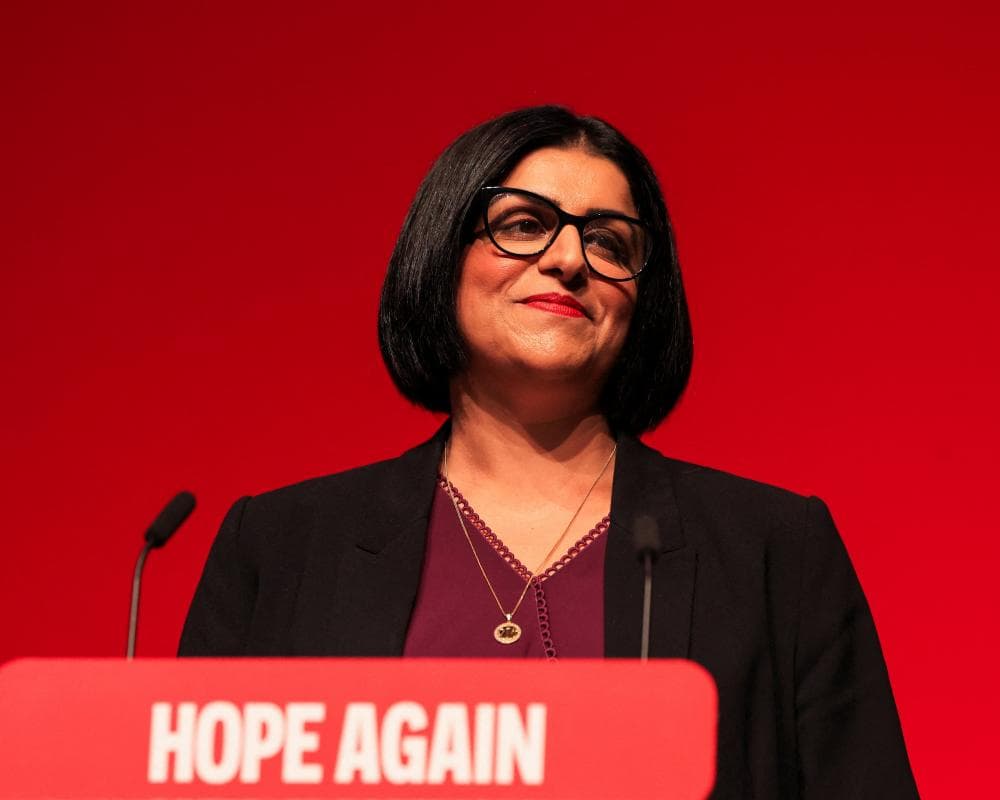
Shabana Mahmood tells Labour conference why her migrant background makes her so committed to fairness
Shabana Mahmood, the home secretary, is addressing the conference now.
She says the job of a Labour government is to make the country fairer and she explains why that matters to her.
My parents came to this country from rural Kashmir because they knew that they would get a fair shot at a better life here, a fairer shot than they could ever expect back home, where past was present and where your birth dictated your future.
They were largely welcome to this country because most Brits thought it was right to welcome people who came here legally, build a new life and contribute to our nation. There were exceptions to that welcome. Of course, this was the 1970s, but they were exceptions and not the rule.
Fairness is what unites us in this country, and a fair society unlocks the very best of us. Because when people think this country is fair, they are more open and generous to others. When we are secure in ourselves, we are more tolerant to [others] because the existence of one group does not threaten another.
And so a proud Muslim like me can be a proud Brit and a Brummie too.
When fairness isn’t present, the opposite is true. When this country feels unfair, people turn inwards. A Britain that is unfair is one that is smaller and colder for those who look like me.
So my job is to create that fairness in our immigration system and on our streets.
Updated
Shelagh Fogarty ended by asking what nightclubs in Liverpool Burnham used to visit as a teenager.
Burnham replied:
I was always football in Liverpool and music in Manchester.
He admitted he was a woolyback – a local nickname for people who come from near Liverpool, not from the city itself.
He recalled going to the Haçienda in Manchester. But he said he was “turned away more times than I got in” because he did not pass the dress code.
Burnham says social care reform perhaps his most important ambition - as he admits he's not certain it will happen
Asked if he regarded social care reform as the most important thing he would do in government, Burnham replied:
One of the things for sure, but maybe the main thing, because it is very, very personal for me.
Burnham said he would put forward a plan. He went on:
I don’t know whether people will feel able to back it.
For too long, politicians had refused to put forward proposals if they seemed too difficult, he said. He said he was not going to do that. He was going to offer an answer.
It might be possible to get support to get it through, he said.
If it’s not, I will accept the consequences,
Updated
Burnham hints government will act to stop protesters wearing balaclavas
Q: Will you ban protesters wearing balaclavas?
Burnham hints that he will take action.
The scenes that I’ve seen in recent weeks people wearing black balaclavas, black clothing, on British streets – you don’t want to necessarily reach for extreme measures, but when people are causing fear and intimidation in communities, you have to prevent them doing that.
Burnham said one option might be “localised provisions where there’s an ongoing problem”.
He went on:
But I don’t want to see a Britain where people are wandering around the streets causing fear with black balaclavas on.
Q: Are you on Team Rayner or Team Mahmood in the dispute about indefinite leave to remain?
Burnham says he’s on both teams.
The government is consulting on the issue, he says.
Burnham says he has been asking Home Offices for details about Piddington camp in light of concerns
The next question comes from a man from Piddington who says his son won’t want to go out if more than 1,000 asylum seeker are housed in a military base near the village. He asks why they can’t be kept on the base.
Burnham replies:
I have been asking questions of the Home Office about the precise arrangements, related to this particular location, but also to others as well, where we have legitimate concerns.
Obviously, measures must be put in place to ensure that things can be managed properly and safely. So I am going through those things, at the moment.
But asylum seekers need to be housed in way that is “fair to everywhere”, he says.
And he says the government is ending the use of asylum hotels, which was unpopular.
Burnham says he was evasive when asked about Heathrow 3rd runway yesterday to avoid prejudicing process
Q: Why did you not say yesterday whether you were or were not in favour of a third runway at Heathrow?
Burnham says he had to be cautious because this is a live consultation, that could lead to a planning application. He says he had to be sure he did not prejudice the process.
He also says there are “strong views on either side”.
Q: Did you discuss President Trump’s proposed diesel export ban with him when you met him last week?
Burnham does not anwer exactly, but he says they discussed all issues relating to the supply of goods from the Middle East.
Q: Did you ask for exemptions for the UK?
Burnham says he always makes the case for the best deal for the UK.
Burnham says 2030 is target date for social care reform to start
Asked why he was not moving faster on care, Burnham said he had to “work within the manifesto that I inherited”.
He said he would give more detail of his proposals to fund the plan tomorrow.
He said 2030 was the target date for his social care reform plan to start.
The next question is about social care.
Burnham says he saw how the care system worked when his late father was in a home.
The carers were excellent, but the system let them down, he says.
You cannot deliver a care system of quality in 15 minute slots. You just can’t because the minute people’s needs got beyond the simple and head towards the more moderate or even severe, then things just completely break.
Burnham also pays tribute to foreign care workers, implying the proposed permament settlement rules that would make them wait for 15 years will be revised.
He says:
There are lots of people working in our care system who’ve come from abroad. I think it’s really important that we say to them that we recognise what they are doing day in, day out. We could not do without them. The care system may well not function were they not there.
Burnham says he will chair Cobra meeting later to discuss RAF Fairford suspected bomb plot
Burnham says he will be chairing a meeting of the Cobra emergency committee later to discuss the RAF Fairford suspected bomb plot.
The first question is about defence spending.
Burnham says tomorrow he will give details of how defence spending will go up.
I inherited a defence investment plan. It’s a good plan, but there was a shortfall.
But I will make that [up] and we will make sure we have a fully-funded plan. And, of course, we will need to go further. I went to honour our Nato commitments … We have a commitment to 2035 [to raise defence spending to 3.5% of GDP by that point.]
And what I’ll set out tomorrow is how we do that.
Later, he says there will be more on defence spending in the budget. Asked if that means he won’t give the defence plan in his speech tomorrow, he says defence will be mentioned tomorrow.
Shelagh Fogarty asks if appointing John Healey meant defence spending would rise to 3% of GDP by 2030. Burnham says he appointed Healey specifically because of his commitment to defence, but he does not clarify the 2030 point.
Burnham takes part in LBC phone-in
Andy Burnham is starting his LBC phone-in now.
He says he thinks people do not believe the country is in the right place. He says his speech tomorrow will set out plans for change.
I will lay it out as clearly as I possibly can. It will require some significant changes, but I’m doing it with the best of intentions.
I am coming into this job not just because I wanted the job. It’s what I do with the job and what I think needs to be done to get the country back where I want it to be [that matters].
Heidi Alexander says trains could be could be publicly owned under Great British Railways
New trains could be publicly owned under Great British Railways to reduce costs and “best serve taxpayers”, transport secretary Heidi Alexander told the Labour conference.
As the Press Association reports, the rolling stock and infrastructure strategy will set out a new policy for future train procurements. A case-by-case approach will be taken when considering private investment, leasing, or public ownership for new trains, the government said.
In her speech to the conference, Alexander pledged to “address the hidden challenges that hold the railway back”.
She said:
For nearly three decades, most passenger trains haven’t been owned by the train operators themselves, but by rolling stock companies known as Roscos.
Roscos bought the train and leased them back to operators.
The train operating companies saved money upfront, but it also brought significant long-term costs.
In 2024, franchised train operators spent over £4bn leasing and maintaining trains they didn’t own – £4bn, that is about a third of the total day-to-day running costs of operating railway services.
Every Rosco contract includes financing and transaction costs and investment returns, costs which are ultimately borne by taxpayers and passengers.
So, as we set up Great British Railways, we will explore whether the state can directly own the new trains we order.
Because I say again conference, who should the railway serve? If GBR owning trains would best serve taxpayers and passengers. Then we should do it.
YouGov has released polling on how Labour members rate the performance of cabinet ministers. Andy Burnham is top of the league, with 94% of members saying he is doing a good job.
Members were surveyed this month, but before the conference started.
Here are the figures.
Healey tells Labour money New Labour had in 1990s 'is simply not there now'
The Labour MP Liam Byrne still gets criticised for the note he left in the Treasury after the 2010 election to his Tory successor saying “there is no money”. The note (often wrongly remember as saying there is no money left) was a joke, written when Byrne expected to be succeeded by a Tory with whom he had a friendly relationship, but the Lib Dem David Laws got the job instead. Laws gave it George Osborne and David Cameron and they spent years quoting it as alleged proof that Gordon Brown had bankrupted the country.
In his speech today John Healey used a similar line. I did not quote it earlier, so here it is.
Now I know the nineties is having a bit of a revival,
To Andy’s excitement, Oasis are going back on tour.
To Angela’s joy, Gladiators is back on Saturday night TV.
But I have to level with you, Conference.
The money New Labour had in the nineties is simply not there now.
Economic growth under Gordon was more than double the Tory years that followed.
And Britain has it harder now.
We had 14 years of flatlining Tory growth and living standards – when Cameron’s austerity gutted our public services.
When Johnson’s Brexit hammered our exports.
And Truss’s mini Budget crashed the economy and collapsed confidence in Britain’s fiscal strength.
They lost control of Britain’s finances.
They left a legacy of sky-high debt costs – for families and for government.
Updated
Rolls-Royce gives details of £300m investment announced by Healey
John Healey said Rolls-Royce is today announcing an investment worth £300m in the UK. (See 12.37pm.) It will cover manufacturing and engineering facilities in Derby, Bristol, Glasgow, Rotherham and Warwickshire.
Rolls-Royce has got the details in a news release.
Andy Burnham is doing a phone-in at 3pm with LBC, the station has said. Shelagh Fogarty will be presenting.
Healey's speech - verdict from the commentariat
And this is what journalists and commentators are saying about John Healey’s speech.
From my colleague Pippa Crerar
John Healey not letting anybody leave the Labour conference hall with any doubt he’s committed to the fiscal rules. But zero detail as to how he’ll do it.
Pippa also quotes what Healey said at 12.25pm.
From the i’s Kitty Donaldson
Leaked note shows how Labour conference is instructed to clap Chancellor John Healey’s remarks on young people ahead of welfare battle next year.
(And they did)
From the Economist’s Matthew Holehouse
Words absent from Chancellor’s conference speech: tax, China, European Union, Hormuz, oil, gas, universities, productivity, gilts, America. 13 union(s), 7 miner(s). Curious.
From my colleague Jessica Elgot
John Healey‘s speech as chancellor so far has been a bit like an after dinner speech with nice anecdotes and rhetoric but little to say. But perhaps the most important thing to underline to the members - “the money is simply not there.”
From James Heale at the Spectator
Most striking part of Healey’s speech - his warnings on debt. For all the talk of hope, he can read a balance sheet
From ITV’s Robert Peston
Healey is stressing at considerable length that he will adhere to fiscal discipline in his forthcoming budget. It is redolent of Gordon Brown’s “prudence with a purpose”’
Healey says his priority is to revive economic growth on a foundation of fiscal discipline. The challenge will be to avoid the kind of tax rises to deliver those stronger public finances without choking off enterprise and growth. Not that simple
From the Daily Mail’s Jason Groves
John Healey talking a lot about hope but basic message to Labour is there’s no money left - and won’t be without growth: ‘The money New Labour had in the 90s is simply not there now... Labour isn’t just here to cut the cake in a different way, we have to bake a bigger cake’
From Lewis Goodall from the News Agents podcast
John Healey: “The money New Labour had in the 90s- just isn’t there now.” The political preparation for a budget Labour really won’t much like starts now. Sits uneasily with this.
Goodall includes a picture of the conference’s Hope Again slogan.
From George Eaton, editor of the Arguably Substack
“Without growth, there is no social democracy,” says John Healey, citing Tony Crosland. He’s right – and that’s why Labour needs to be far more radical on planning reform/Europe/AI adoption to boost growth.
From LBC’s Natasha Clark
Healey trying to play down tax rise fears by saying he wants growth to provide the extra money. But he knows that will take time, hence his warning that they don’t have enough money as when he was last in the Treasury. Echoes Burnham from last week, we can’t do everything we want to do. Happy vibes meet economic reality next month and we’re all still living off the (small) victory coat tails of Labour replacing their PM without too much of a hiccup and seeing a baby poll bounce ...
Healey vows to stick to fiscal rules in budget built on hope
Here is Richard Partington’s story about John Healey’s speech.
Related: Healey vows to stick to fiscal rules in budget built on hope
John Healey's speech - snap verdict
There is no other party in British politics that relishes its own past as much as Labour. Even when they liked their previous leaders, the Conservatives were not inclined to go on about them at party conference. The liberals have to go back more than 100 years to recall their glory days, and even the most ancient Lib Dem peer doesn’t have a memory that good. Other parties are short on hero figures in history. But Labour, in some respects, is the most conservative party on the block – constantly harking back. Only among this tribe would a tie once worn by a chancellor more than 20 years ago gain the status of a relic.
So, in that sense, Healey’s speech was perfectly crafted – rich with sentimental references to the party’s history, and the nation’s too. But wallowing in nostalgia will only get you so far, and at times it felt this was serving as cover for the fact that Healey did not have a lot new to say. That is not necessarily the chancellor’s fault; he was a surprise appointment in a new government, and a lot of issues remain unresolved.
There were a smattering of smallish announcements in the speech. But the main takeaways were messages that we have already heard from the government, but which Healey felt were important enough to repeat to the Labour conference: that the cost of servicing debt is crippling (see 12.20pm), that he’s fully committed to the fiscal rules (see 12.25pm), and that welfare reform is a “moral duty” (see 12.31pm). This platform is hard to distinguish from Rachel Reeves’.
Perhaps the most interesting line came at the end, after Healey referenced Tony Crosland (another Labour history lesson). Healey said:
That’s the lesson for our generation. And Labour isn’t just here to cut the cake in a different way.
We have to bake a bigger cake and make sure that it’s fairly shared.
This is a much wiser lesson than Boris Johnson’s cakeism. But it begs the question, how? On this, Healey did not really provide answers.
Healey stresses importance of growth in speech peroration
Healey ended his speech with a passage about growth.
It was 70 years ago at a Labour conference that Tony Crosland published his book on the future of our party [the Future of Socialism].
He wrote it then believing that economic growth will take care of itself, and that Labour’s job was simply to share out the proceeds.
Twenty years later he realised he’d been wrong. The growth doesn’t just happen. We have to work for it. We have to create the conditions for it and without growth there is no social democracy. You can’t fund ends without the means.
And that’s the lesson for our generation. And Labour isn’t just here to cut the cake in a different way.
We have to bake a bigger cake and make sure that it’s fairly shared.
So whether it’s the cost of business or the cost of living, the only long term answer is growth. Good growth in every postcode, a dual mission from the Treasury and No 10 North.
Healey said London should not have to “shoulder the economic burden alone”. The government wanted growth in every postcode, he said.
Growth wasn’t just a graph or spreedsheet, he said. It was about whether a family could afford to go on holiday.
At the start of his speech, Healey talked about having a miner’s lamp on a shelf at home and he came back to that as he ended his speech.
When you leave this conference, remember that miner’s lamp, those workers didn’t carry it for themselves. They carried it for those beside them. They carried it for their community. They carried it for the ones who came after.
That is our job now, to light the way for a generation that’s been told there is no way through.
Good work, fresh hope, a new age of industry and the solidarity that has always carried this country forward.
Healey said the government would not let AI leave workers behind.
AI is the greatest innovation of our time. It’s a general purpose technology that will simply transform our society at every level.
Every business, every community, every hospital, every school, everywhere can benefit from adopting AI.
It’s at the centre of a groundswell of new world-leading British tech companies, and it’s the driving force with which this new age of industrialisation can be built.
Yes, we need to face the serious risks to national security, to personal data and to our children’s well-being, and it will change our labour market in fundamental ways.
But I give you this commitment. We won’t let AI leave Britain’s workers behind, and we will make sure that Britain wins in this AI revolution.
Healey says he will revive union learning fund axed by Tories
Healey gives credit to the GMB union for getting the shipyards investments “over the line”.
He says he is proud of the partnership with unions. And he defends having a union figures on the Bank of England’s court, saying “Britain’s economic success is built on the success of working people”.
That’s a reference to this row.
He also says he will re-establish the union learning fund, a scheme set up by the Tony Blair government to fund workplace learning but axed by the Tories.
I’m proud of the fact that last time 180,000 workers every year got new training through that fund, and we’ll do that again.
Better skills, better prospects for British workers – because of the decisions taken by this Labour government.
Updated
Healey says the government has committed £6bn for contracts for British shipyards, including the new docks for submarines on the Clyde. (See 7.54am.)
Healey says Rolls-Royce is today announcing investment worth an extra £300m in its British factories in Derby, in Bristol and Glasgow, and in Rotherham.
And he says that is an example of what he means by proposing a “new age of industrialisation”. (See 7.54am.)
Healey announces new local apprenticeships service
Healey says, as a downpayment on the Milburn report, he is announcing a local apprenticeships service
He says it will be “led by mayors, targeted at these young people, delivering thousands more apprenticeships for these young people with local teams – a bit like football scouts for apprenticeships – local teams who will go to local firms that have never taken on a trainee and say ‘We’ll help you do it.’
Every mayor will be able to take part.
And there will be £100m in funding for the scheme, funded by savings from the DWP.
Healey says it's 'not progressive to allow bigger and bigger benefits bill'
Healey says the Alan Milburn report on Neets, out soon, will show the scale of the challenge facing young people.
He goes on:
Our social security system must always be there for those who can never work.
But for everyone else, benefits should be a bridge to work, to wider participation, to a better life, not a trap that people can’t escape.
And, conference, it is simply not progressive to allow a bigger and bigger benefits bill, and a system which offers an income but doesn’t offer a future.
So once again, as a Labour government, it falls to us to act.
And this is more than a just an economic must. This is a moral duty.
I refuse to write off a million young people like the Tories have done.
Updated
Healey turns to Nigel Farage.
It’s not just the shadow chancellor. Look at Reform UK - dodgy donors, fantasy funding behind every plan and Nigel Farage.
He wants you to think he’s a man of the people. But when it comes to the economy, he’s Liz Truss with a Bitcoin account.
(Actually, Truss probably has her own Bitcoin account.)
Healey says there's 'nothing progressive' about losing control of borrowing and he and PM 'united' on sticking to fiscal rules
Healey explains why fiscal responsibility matters.
On day one as chancellor I said my first duty is fiscal discipline, and I’ll tell you why.
It underwrites every promise this government makes on growth, on jobs, on national security and on public services. We can’t succeed without it.
And that’s why the prime minister and I are united in meeting the fiscal rules, balancing the books with a buffer against uncertainty, controlling borrowing to bring down inflation, and reducing long term pressures on our finances, and confidence.
That commitment is so important. There is nothing progressive about losing control because it’s always working people who pay for it.
Updated
Healey confirms he is committed to the fiscal rules.
He goes on:
As Andy has argued, this country has seen political power centralised, economic control privatised, Britain de-industrialised.
And the result? Too many people today feel that Britain hasn’t been working for them, for their family and for their area.
Healey says Liz Truss's mini-budget 'still causing pain to people today'
Healey says his new Tory shadow, Andrew Griffith, helped Liz Truss with her mini-budget.
Healey goes on:
Even now, [Griffith] still claims there were lots of good things in [the mini-budget].
So I say to them, your reckless actions are still causing pain to people today.
You left crumbling public services and you left Britain spending more on debt than the Home Office, defence and justice put together.
Healey recalls working for Gordon Brown as his parliamentary aide in the late 1990s.
He was very junior then, and he had to lend Brown a red tie for a speech at the Labour conference.
In 1999, at Bournemouth, Gordon made his speech as chancellor with my tie. I did get it back. He signed it and I’ve never worn it since. Until today.
Healey says the party needs to be confident.
If we don’t talk up Labour’s actions, no one else will.
So here’s my first challenge to you as your Labour chancellor. Be confident in who we are. Be confident in our past. Be confident in our future.
Let’s tell the story of how Labour can deliver change, how we can change lives and how we can change this country.
Healey says his speech will be about the politics of hope.
I want to talk about the politics of hope, our belief in a better life, a better day, our conviction that committed citizens can change the world no matter how hard the task, how daunting the odds. This is our Labour politics.
He embarks on a patriotism spiel.
We’re home to nearly half the most innovative companies in Europe. We’re world leaders in life sciences, in defence tech, in AI. Our financial services led by London, are some of the best in the world. And our theatre, our TV shows, our fashion, our music is treasured the world over.
And we have the best people. The veterans of the Royal British Legion at Remembrance, the winners of the Daily Mirror’s Pride of Britain Awards, the lifeboat volunteers of the RNLI, risking their own lives to save others in danger on the sea.
This last line gets a loud round of applause, becuse the RNLI are being attacked by the far-right because they rescue people in small boats crossing the Channel.
Healey also thanks his wife, Jackie. He says when he says Labour is his family, he means it literally. She is a third-generation Labour activist, he says.
Healey pays tribute to Rachel Reeves, his predecessor. She brought financial discipline to the country, delivered two budgets and took half a million children out of poverty, he says.
And he says Keir Starmer took Labour from one of its worst defeats to its best victories.
And he says Starmer restored Britain’s reputation globally, and stood up to Russia in Ukraine.
Chancellor John Healey addresses Labour conference
John Healey, the chancellor, is delivering his speech now.
He says it is the privilege of his life to be Labour’s chancellor.
Jonathan Reynolds, the business secretary, is addressing the conference now and – in words that sound like a warm-up act for John Healey (see 7.54am) he says:
To the communities who saw good jobs go decades ago and still don’t feel they’ve replaced them, which is as true in parts of the south as it is in the north, my message is simple we see you, we hear you, and we have a plan to re-industrialise Britain.
Labour will 'wipe the floor' with Badenoch in debate on defence because of Tories' record, Streeting claims
Wes Streeting, the defence secretary, addressed the Labour conference before Ed Miliband. Here are some of the key points from his speech.
Streeting claimed Labour would “wipe the floor” with the Tories in the debate over who was strongest on defence because of the opposition’s record. He said:
The Labour party has a proud record of standing with our political opponents in the national interest.
Clem Attlee did with Winston Churchill when he joined the wartime coalition.
Michael Foot supported Margaret Thatcher when Argentina invaded the Falklands.
And Keir Starmer supported Boris Johnson’s leadership on Ukraine.
But I am afraid we haven’t seen that responsible leadership from the current leader of the opposition.
Nor have we seen her party taking any responsibility for the consequences of their failure to fund defence …
So if Kemi Badenoch wants to go toe to toe with Labour on defence, we will wipe the floor with the Tories’ so comprehensively they will see their abysmal record reflected back at them.
Streeting compared his current job with his previous job as health secretary. He said:
Last year, I stood on this stage and spoke about a great legacy of the Attlee government. Our National Health Service. Built on a simple principle: to provide freedom from fear - fear that illness would bring financial ruin.
And that Labour government built another great institution too – Nato - based on the same principle: to provide freedom from fear – fear that tyranny would once again bring catastrophe to Europe.
Bevan created the NHS.
Bevin founded NATO.
Two institutions born of the same generation.
He described the Attlee government’s decision to build a British nuclear deterrent as “another great Labour achievement”.
He defended Andy Burnham’s argument at PMQs recently about how prioritising national security should not undermine social security. He said:
I know that more spending on defence comes with choices and trade-offs.
But our critics on the right need to understand that you don’t make your country stronger by making our people poorer.
He described the new floating docks on the Clyde being announced today (see 7.54am and 9.59am) as part of “one of the biggest defence procurement decisions in a generation”.
Updated
And here is Miliband’s peroration.
My parents didn’t just observe a country fighting for values. They taught me that I have a responsibility to fight for them to.
There’s this phrase that people use about Holocaust survivors, survivor’s guilt.
I think my parents had something else, survivor’s responsibility.
Survivor’s responsibility to pass on the message to the generations that come next that we are here to leave the world a better place than we found it, to never walk by on the other side, to never be bystanders to oppression and injustice.
Those are the reasons I joined this party and so many of you did to.
You know, they say that as you age, you become more cynical.
Not me, not you, not us. I believe in our ability to change our country, in the world for the better now more than ever.
And I promise you, I promise you that every day as foreign secretary, every day as your Labour foreign secretary, I will fight for your values. Labour values, Britain’s values.
It was a terrific speech, easily the best of the conference so far, and just what delegates wanted to hear. John Healey will have a tough job matching it.
Updated
You were right’ - Miliband tells critics Labour was wrong on Gaza
As reported overnight, Miliband told the conference that pro-Palestinian campaigners were right to complain over the past two years about Labour not doing enough to challenge Israel over its actions in Gaza.
Related: ‘You were right’: Ed Miliband tells critics Labour was wrong on Gaza
Miliband said:
I want to say to the millions of people in this country and indeed elsewhere who have been moved and outraged by the plight of the Palestinian people: we hear you.
You were right.
And under Andy’s leadership, we have reset our approach.
We call out ethnic cleansing by the settler terrorists in the West Bank.
We call out the evidence of war crimes In Gaza.
We call out Israel’s illegal occupation of Palestine.
And we match words with actions.
We will ban the import of goods from illegal settlements.
We will disrupt the supply lines of British finance, British construction and British’s services for illegal settlements.
And when it comes to the attempt to destroy the two state solution, this party, this movement, this government, says:
We will not let you succeed.
This passage got the loudest and most sustained applause of any section of the speech.
Miliband says UK will use G20 presidency next year to lead global efforts to manage AI
Miliband said the government would use its presidency of the G20 next year to push for global efforts to manage AI.
He said:
The technological progress offered by AI, as we see in our daily lives, is inspiring, but the threat it poses, according to its own inventors, is daunting.
Now some are calling for us to act, but other tech companies are saying we should leave it all to them.
But friends, the lesson of history is that we cannot leave it to corporations to put in place the guardrails to serve the public interest. It is neither their purpose nor their motive. Theirs is to maximise profits.
Friends, we cannot and will not allow that to come at the expense of our children or indeed humanity.
That’s why, as part of our G20 presidency, next year, this country will lead the efforts to manage AI.
Miliband says parties that deny danger of climate crisis would as result 'threaten national security'
Miliband says investment in defence is “an absolutely core part of this government’s foreign policy”.
And he moves on to the threat posed by the climate crisis.
We know the effects will spread across borders, and we know that future generations will hold us in infamy if we leave them with climate disaster unaddressed.
So let us therefore ask each and every party, where do you stand on tackling the climate crisis? Where do you stand on defending our way of life?
And I say to those parties that deny, delay and dissemble on the climate threat, your position would leave our country unsafe and threaten our national security.
Miliband is referring in particular to Reform UK and the Conservatives.
Miliband calls for 'stronger, deeper partnership' with EU
Miliband says Britain needs a “stronger, deeper partnership” with the EU.
If there is one lesson that I have seen demonstrated to me again and again in this job, it is this Europe is not just our geography, but so much more.
It is how we pursue our values from climate to the Middle East. It’s how we pursue our interests, from trade to defence. It’s where we build and protect our alliances, so it is not simply Britain acting alone, but Britain with others, and on economics, on defence, on security.
I say to this conference, our future lies in a stronger, deeper partnership with the European Union.
Updated
Turning to Russia, Miliband says “the future security of all of Europe is on the line” in the war in Ukraine.
He goes on:
If Putin wins, we would have allowed war and force to beat sovereignty and self-determination on our continent.
Now, I am proud that since 2022, under successive governments, Britain has stepped up our military aid, stepped up our humanitarian support, and the British people have stepped up to taking in Ukrainian refugees.
Friends, I say today we will never give in to Russia’s threats that we must stand aside and abandon the people of Ukraine.
Miliband says Britain can be 'beacon of light' and has to play its part 'rebuilding' world order
Miliband says his parents viewed Britain as “a beacon of light against the darkness, a country that stood for fundamental values freedom, democracy, the rule of law”. The postwar Labour government helped establish Nato and the United Nations, and ratified the convention on human rights, he says.
He goes on:
And I come to this conference today to tell you that it’s time to roll up our sleeves all over again, because once again the world order needs rebuilding anew.
We need to be honest about the world we confront. War has returned to Europe. Democratic norms are under threat as they haven’t been for generations. The international rule of law is being brazenly flouted. New threats have emerged from the climate crisis to AI.
There is only one response to these challenges – to fight for our values, the values my parents saw in Britain, values which today are more important than ever. Fighting for those values of democracy, the rule of law, protection for rights and freedoms is essential to tackle injustice and suffering.
But hear me well when I say this, it is also the only way to fight for our interests, because it is the real route to stability in the world and therefore peace and prosperity.
Updated
Ed Miliband says experience of his 'refugee' parents informs his stance as foreign secretary
Ed Miliband, the foreign secretary, is addressing the conference now.
He starts by talking about his values as foreign secretary have been informed by the experience of his parents.
I want to start today by telling you about the spirit that animates my work as foreign secretary driven by two refugees, a world away from us here today.
The first of them walked 100km from Brussels to Ostend with his father, leaving behind his mother and his sister, to take one of the last boats to Britain to flee the Nazi invasion. He learned English. He joined the Royal Navy, and he fought fascism.
He would tell stories of being at sea, watching the lights of the D-Day landings. And he would say it softly, but I know he always felt an incredible sense of pride that he had played his part in defending and defeating the Nazis.
The other refugee spent her childhood in hiding in Poland. She faced experiences that no child should face, the loss of her father in a concentration, as well as separation from her mother and sister.
She only survived because, unlike 60 family members, she was saved by the heroism of the bravest people, ordinary people who did extraordinary things. Then she got to Britain after the war as a teenager, learned English and built a life.
Those two refugees were my father and mother, my dad and my mum. And I want to start today by saying to you that their history, my family history, means it is the honour of my life to be your Labour foreign secretary.
Healey's fiscal headroom could be cut by around £6.5bn due to falling immigration, report says
John Healey, the chancellor, may have his fiscal headroom reduced by around £6.5bn because of the sharp fall in net immigration numbers, the Times reports.
In their story, Patrick Maguire and Oliver Wright explain:
The Institute for Fiscal Studies think tank estimated last month that the success of Shabana Mahmood’s reforms, which have led to net migration being cut to the low hundreds of thousands, could cost Healey about £4bn.
Labour sources familiar with the budget process, however, said that the figure was now closer to £6.5bn. The OBR’s migration forecasts have been consistently higher than real numbers in recent years.
Increased migration is judged by the OBR to have a positive impact on the government’s finances as most of those entering the UK are of working age who pay taxes and largely consume fewer public services. However, critics claim that this is a blunt measure and does not take into account the longer-term costs of migrants in healthcare and pensions.
Treasury officials told the Times that the numbers it was quoting were “pure speculation”, but they did not deny that falling immigration would cut government revenue.
Alex Norris, the justice secretary, is expected to announce that the government’s plans to reduce access to jury trials will be watered down, Andrew McDonald and Megan McElroy report in Politico’s London Playbook briefing. They say:
Norris is preparing to water down his predecessor’s proposals on scrapping jury trials in all but the most serious cases in the coming weeks, my colleague Sam Blewett hears from two senior officials. Expect to see an amendment to the Courts and Tribunals Bill laying out the details ahead of the legislation returning on Oct. 13.
Wig watch: Burnham indicated in the summer that his “instinct” was to find a way of “not reducing access to jury trial.” The reforms are still being described in the MoJ as “major structural reforms” — but the officials said they’re looking to move closer to the original recommendations by Brian Leveson. David Lammy, the previous justice sec, went further than Leveson, by taking his recommendation for judge-and-magistrate panels and opting for single-judge courts, among other things.
Lisa O’Carroll is a senior Guardian correspondent.
The head of the SDLP, Claire Hanna, has called for an international mediator to resolve the continuing crisis over a unionist parade in a nationalist area close to Drumcree, the site of some of the worst violence of the troubles almost 30 years ago.
Related: Protesters disperse after blocking route for loyalist march in Portadown
Members of the loyalist Orange lodge remained at Drumcree church, the starting point of the parade route through the town of Portadown with tensions simmering overnight.
An unsuccessful furthers attempt to proceed with the parade was made overnight with the Democratic Unionist party MP Carla Lockhart returning to the church at around 4am, according to local reports.
Northern Ireland secretary Chris Bryant said Hanna’s call was one of the many suggestions he had received since he arrived in Belfast yesterday calling on everyone to “double down on compromise”.
Bryant said.
The truth is everybody has got to want to seek mediation and seek compromise and that’s what I’m trying to find, whether there’s that little chink on both sides that we can use to get to a decent compromise that means everybody can walk away with their head held high and their sense of honour.
Labour conference policy announcements so far
Yesterday on the blog I listed three policy announcements press released or briefed by Labour as the conference opened.
To keep the list going, here are further announcements from the party over the past 24 hours.
4) A new export finance scheme to help exporters. Explaining it, Labour said:
British businesses will have more opportunities to win contracts overseas and bring jobs, investment and growth back to communities across the UK under new plans announced by chancellor John Healey.
The new UK Export Finance (UKEF) pilot product, Flexible Finance, is the latest step in the Labour government’s mission to back British industry and help businesses seize opportunities in some of the world’s fastest-growing markets. Under the scheme, select buyers operating in economies such as Brazil, Morocco and Mexico, will be able to access loans on more flexible terms, creating new incentives to buy British goods and services.
5) A new marine research ship. Louise Haigh mentioned this in her speech yesterday and Labour later sent out further details. The party said:
The government has committed up to £115m to build this new vessel as part of its drive to reindustrialise the UK and support our shipyards.
It will lead a new national system for monitoring the UK’s seas, bringing together marine surveys, data and technology to help manage fisheries and the marine environment more effectively.
At 85 metres long and able to accommodate more than 40 people, the vessel will carry out a wide range of scientific work. This includes assessing fish stocks, mapping the seabed, monitoring pollution, and responding quickly to marine incidents.
6) Three new floating docks for the Royal Navy’s submarine service at HM Naval Base Clyde. See 7.54am.
7) The nationalisation of Avanti West Coast services. In an announcement this morning, Labour said the government will “take control of Avanti West Coast’s services from 7 March 2027 [as] part of a wider drive to put essential services back in public control”. See 9.55am.
8) A new legal route for refugees that prioritises Afghan women and girls and Palestinians. There are more details in this story by Jessica Elgot and Rajeev Syal.
Related: UK to open new refugee resettlement routes for Afghan women and Palestinians
Avanti West Coast to be renationalised in March
Avanti West Coast will be renationalised in spring, as Andy Burnham declares “enough is enough” for passengers who have put up with a rail service “that has failed them time and time again”, Lauren Almeida reports.
Related: Avanti West Coast to be renationalised in March
Labour members would rather do deal with Lib Dems than Greens, poll suggests
Labour members would rather do a deal with the Liberal Democrats than the Green party in the event of a hung parliament, according to YouGov polling for Sky News.
In its write-up, Sky says:
Some 85% [of Labour members] would back Labour doing a deal of some kind if they were the largest party but didn’t win a majority.
This includes 75% backing a deal with the Lib Dems, 66% with the Greens, and 6% with the Tories.
It is not clear from these figures if Labour members favour the Lib Dems over the Greens for policy or personal reasons, or because they assume the Lib Dems would have more seats, implying a bigger potential majority.
YouGov, Survation and More in Common have all published MRP polls in recent days suggesting that, if there were an election now, Labour would be the largest party, but short of a majority.
The polling for Sky also found that 67% of Labour members backed Burnham saying the next election will not be held until 2029.
Getting rid of triple lock would not raise enough now to fund PM's social care reform plans, Resolution Foundation chief says
There is increasing speculation that Andy Burnham might announce plans to scrap the pensions triple lock as one means of funding his social care reforms. Yesterday Darren Jones, the former chief secretary to the PM under Keir Starmer, told the BBC that this was “an option the government should consider alongside others”. According to reports in the Daily Telegraph and in the i, other Labour figures are also privately arguing this would be a good idea. One “insider” told the i that getting rid of the triple lock but making social care free could be sold as “taking [something] away when you’re in your 60s but giving it back when you’re 80”.
But Ruth Curtice, chief executive of the Resolution Foundation thinktank, and a former Treasury official, told the Today programme this morning that getting rid of the triple lock would not raise enough to fund the sort of proposal Burnham has in mind any time soon.
She said:
The triple lock is a policy that has the value of pensions growing by more than earnings. That’s particularly unsustainable. But obviously taking it away would hurt the very generation who would benefit from free social care.
I don’t think one would be enough to pay for the other. For example, in this forecast period, we think cancelling the triple lock would save about £800m, maybe a bit less.
The numbers for the triple lock are very big in the long run. They’re not enough to deliver a free social care system in five or 10 years’ time.
Streeting thanks farmer who alerted police to suspicious activity at RAF Fairford, but says she only has a 'partial picture'
Wes Streeting, the defence secretary, has been doing the morning interview round for Labour. Mostly he has been talking about the suspected bomb plot at RAF Fairford. Yohannes Lowe is covering all the developments on that story on a seperate live blog.
Burnham's social care plan could cost far more than he says, and take 'many decades' to implement, leading expert claims
Andy Burnham’s plans to reform social care could cost far more than he is claiming and take “many decades” to be implemented, a leading expert has claimed.
Andrew Dilnot told the Today programme this morning that he was “puzzled” by some of what Burnham said yesterday, and he implied that he was unconvinced by what Burnham was offering.
Dilnot, a former chair of the UK Statistics Authority, is one of the nation’s leading economists and chaired a commission on social care reform for David Cameron’s government in 2010. Although ministers were initially positive about his plan to cap the amount individuals can be required to pay for their social care, successive governments were worried about the cost and the plan was never implemented.
In his interview, Dilnot said that he did not understand why Burnham told the BBC yesterday that his plan would cost less than £18bn a year when what he seemed to be describing – an NHS-style care service, with care free at the point of delivery – would cost a lot more.
Dilnot said he was “puzzled” by Burnham’s answer to the £18bn question because “if we were to make social care free in the same way that health care is largely free, then I think we will be talking about an amount of money well in excess of £18bn.”
Dilnot said that making the English social care system similar to Scotland’s – where personal care is free, but where people who need to go into a care home can still face huge costs for the accommodation element of their care – might cost roughly half of the £18bn mentioned. But that was not what Burnham seemed to be proposing, Dilnot said. He explained:
[Burnham] did talk about making social care free, and what he implied was that he wanted social care to be completely free.
And that’s not at all the case in Scotland, where although the policy is called free personal care, we still have exactly the problem that Mr Burnham himself has talked about of people needing residential care faced with very substantial bills.
And so I think what he’s really talking about probably is social care that looks very like the NHS, that will be entirely free.
What he hasn’t described is how he would raise the funds that he would need for that, and that would be a very substantial sum of money.
Dilnot said that, when Burnham gave a big speech on social care just after becoming PM, he left the impression there could be legislation before the next election.
After yesterday, Dilnot said, reform seems further away. He explained:
It sounds as though there’ll be some more details [of the plans] in the prime minister’s speech tomorrow at his party conference, but I think even that will continue to remain vague.
I think what we learned yesterday was that, if anything, change is now further away than had been implied or suggested.
Dilnot also said the full reform proposed by Burnham could take decades.
I also think that there was an indication in what [Burnham] said that he’s imagining something that could take many years, even many decades before it came to fruition.
So they are now, I suspect, looking at ways of beginning a move in this direction without imagining they can get there very quickly.
Tories accuses Healey of offering 'reheated announcements' and 'hot air' in conference speech
Andrew Griffith, the shadow chancellor, has accused John Healey of offering the Labour conference “reheated announcements” in his speech later.
Referring to Labour briefing overnight that three new floating docks will go ahead on the Clyde (see 7.54am), Griffith said:
These are more reheated announcements without clarity on where the money is coming from. Additional docks were announced months ago in the defence investment plan, which still has a £4.7bn black hole.
John Healey resigned warning that Labour’s failure to fund defence was making Britain unsafe. Now that he is chancellor, he still won’t fund the 3% target he walked out over.
Labour are running scared of making the tough choices needed to pay for Britain’s defence. All they can offer is reannounced docks and more hot air from Healey.
Chancellor John Healey to promise ‘new age of industrialisation’ in speech to Labour conference
Good morning. John Healey, the chancellor, is the main speaker at the Labour conference. He was a surprise appointment to replace Rachel Reeves, he is unveiling his budget four weeks on Wednesday, and some of the pre-briefing suggests when the budget does come, it will be a relatively low-key affair, with a lot of decisions postponed until the spending review next year. And so we are definitely not expecting huge announcements at lunchtime today.
But there will be some striking language. Healey is going to promise a “new age of industrialisation”.
According to the overnight briefing from Labour, he will explain that in these terms.
My politics were shaped by the industrial heartlands of South Yorkshire. Today, on the site of the Orgreave pit, is Rotherham’s Advanced Manufacturing Park. Our coal mines are not coming back. But this is how Britain’s industrial past is being remade now for the modern world. This is the new age of industrialisation. A new confidence in Britain.
And he will also announce that the government is commissioning “three new floating docks for the Royal Navy’s submarine service at HM Naval Base Clyde” to provide maintenance for nuclear submarines.
Known as Programme Euston, plans for the new docks were first set out in 2023 and are expected to upgrade Faslane’s facilities for the next generation of British submarines, the Press Association reports. The Ministry of Defence has previously said they are expected to come into service in the early 2030s, and the docks form part of a wider £15bn upgrade programme for the Royal Navy’s shipyards.
Here is the agenda for the day.
10am: The Labour conference opens. The first main speaker is Wes Streeting, the defence secretary.
10.30am: Ed Miliband, the foreign secretary, addresses the conference.
11.10am: Jonathan Reynolds, the business secretary, speaks at the start of a debate on workers’ rights and reindustrialisation.
Noon: John Healey, the chancellor, gives his speech.
2pm: Heidi Alexander, the transport secretary, addresses the conference, in a debate covering transport and insourcing.
2.30pm: Yvette Cooper, the health secretary, speaks at an IPPR fringe event. Other cabinet ministers speaking at fringe events include Lisa Nandy, the culture secretary, at a Think Labour event; Pat McFadden, the work and pensions secretary, at an IPPR event; Streeting at a BAE event; and Ed Miliband, the foreign secretary, recording a What’s Left? podcast.
After 3.20pm: Alex Norris, the justice secretary, and Shabana Mahmood, the home secretary, speak at the conference in a debate covering crime.
I’m afraid we are no longer able to have comments open below the line every day on this blog. If you want to contact me, please email politics.live@theguardian.com. You can use this email to flag up corrections, comments for publication, questions or complaints.
Updated