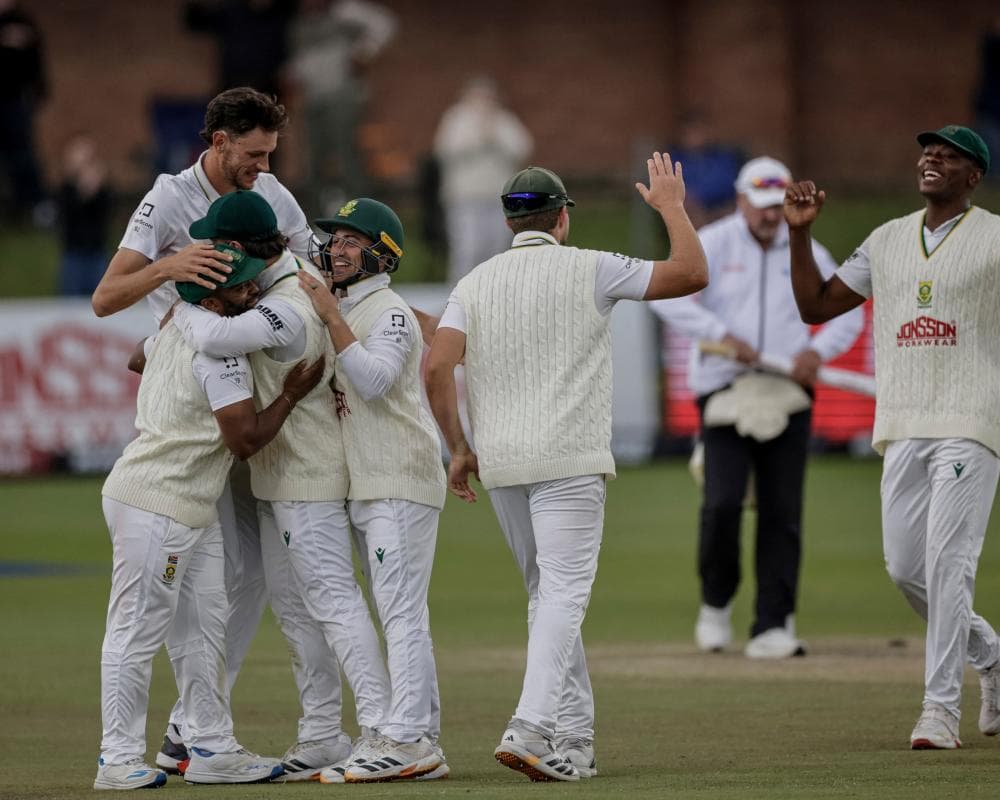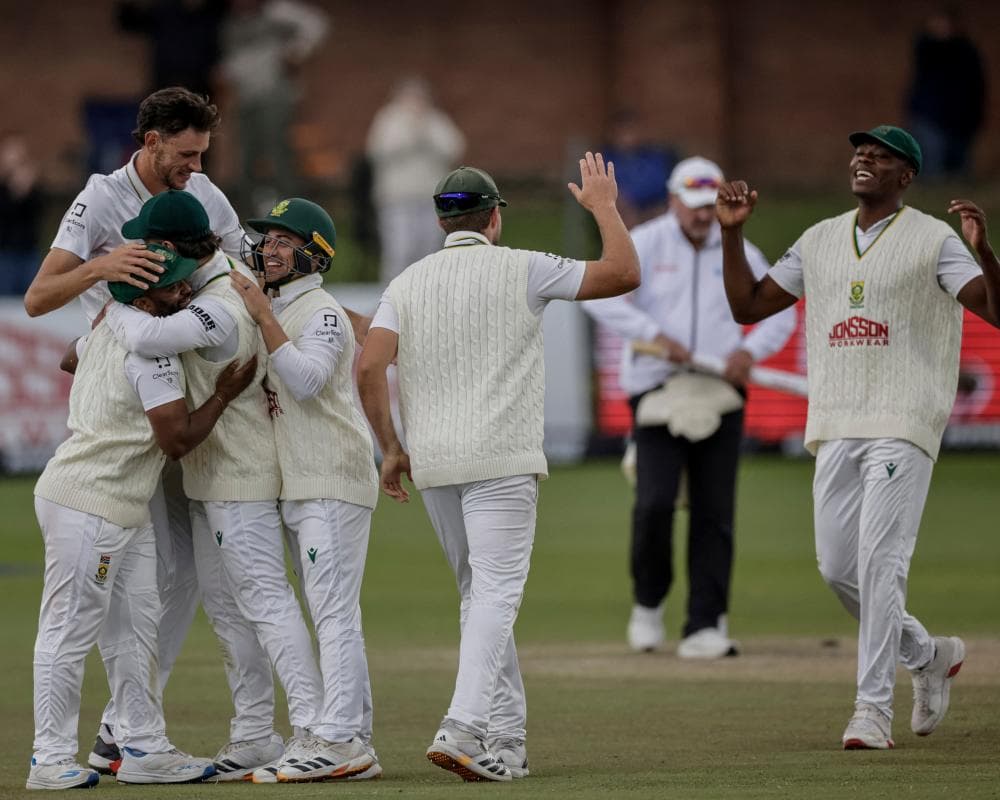
It took time, it gently frayed nerves, but ultimately South Africa sealed the second Test at Gqeberha deep into the final day, clear by an innings and 31 runs, levelling the series with one to play. In truth, although Australia made 295 and got within 28 overs of safety, they did not deserve to save this game, even if Scott Boland and Travis Head did. Letting South Africa escape from 40 for four to pass 400 was the first offence, then came Australia’s capitulation for 99 to be forced to follow on. The salvage operation was in waters too deep.
Australia got an early boost from a washed-out morning session that cut the day’s ration from 98 overs to 82. The next boost came from Boland, once again the headliner: having done it all with the ball while nobody else could match him, he then led with the bat. He had the nightwatch job in the first innings, batting briefly on the fourth morning, then had to do it a second time that evening, taking Australia to stumps at 156 for four.
On day five, though, his stay was anything but brief. With his team four wickets down and 170 runs behind, Boland settled in for the most substantial innings of his Test career, a personal best of 166 balls, while his 40 runs nearly doubled his previous best. He outlasted century-maker Head, outlasted Steve Smith, and passed the tea break after an extended session. There was the odd dabble at the wrong ball, the odd bit of luck with an edge, but the rest was an exercise in careful defence on the front foot, evasion on the back, batting out maidens with relative ease, and taking rare chances for a stylish cut.
At the other end, Head did not tarry in the 90s with a few carved boundaries through the off side, then settled right down after raising his first official hundred in an away Test - his World Test Championship final ton against India at the Oval in 2023 being defined as “neutral” in venue. By his standards it was a sedate 121 from 190 balls, and while it continued, the spectre of the draw became a little more material, even though change hovered one wicket away.
It was fitting that the day was defined by Wiaan Mulder, the shortest, least rapid and least celebrated member of South Africa’s fast-bowling stocks. Humility is at Mulder’s core, the man who declined a shot at breaking the world record score, the man who does whatever job his team asks of him: new ball in Durban with two spinners, old ball when Kagiso Rabada returns, stepping up for more overs when Anrich Nortje is injured, bowling into a serious wind, batting three when nobody else wants it, batting seven when they do, attempting to bat time when Australia wwere bowling for victory, stopping them from batting time when the tables had turned.
Here, his approach was simple and skilful: hit the seam, wait for jag. Head got plenty, shorter and faster than expected, making him jump, forced to glove down onto his stumps. Boland got a better one, fuller and decking into the gap for the right-hander, even his set defence no chance of keeping it out. An over later, Mulder repeated the dose to Pat Cummins, the ball moving a little less this time to make him play inside the line. Mulder’s 3 for 64 won’t be written on any walls, but it won the match.
That left the score 262 for eight, with Smith already gone, and while reputation would suggest that he was the most important wicket, that belies his long record of having no impact on fifth days. Showing no sign of the stiff neck that had hampered him the previous day, Smith nonetheless torpedoed his brief innings with an atrocious shot, trying to pound a pull shot off Rabada from outside off stump, hitting a catch up in the air.
With nothing needed but to bat time, it was a decision as poor as Marnus Labuschagne’s attempted six off Simon Harmer’s spin the previous day. The comparison of either to Boland’s determination is catastrophically unflattering. And while the lower order is not primarily to blame, you could equally ask why Mitchell Starc tried swinging Rabada over the leg side, instead finding fresh air and losing leg stump, or why Josh Hazlewood tried a booming drive through cover to nick to slip, stranding Alex Carey on 37 not out. Marco Jansen got that last wicket, Rabada finished with four.
With so few overs to go, and with heavy cloud starting to roll in, this was a match that could have been saved with more application from one or two players. It concluded an Australian performance riven with fundamental failures of decision-making, from players whose celebrated wealth of experience gives them no excuse for that shortfall. For South Africa it is a dramatic comeback from their own heavy loss at Durban, and a reminder that all revelry and disappointment is temporary. There will be another portion of each, however, to be doled out next week in Cape Town. The decider beckons.