Every sacked coach reacts differently. Some turn up in civvies and conduct what is essentially a job interview for their next role. Some know their fate 12 months out, grit their teeth and toe the company line. For some it’s a relief, a chance to take a deep breath for the first time in years. Some, like Michael Voss, are let go after months of bad losses. Others, like Simon Goodwin, are sacked 48 hours after an 83-point win.
Every sacking is different from the club’s perspective too. When Brad Scott and North Melbourne parted ways, his chairman said the coach was “nothing short of selfless and honourable, as befitting his character”. When David Noble exited in 2022, president Sonja Hood rejected suggestions he’d been sacked. “We came to an agreement that we would terminate the contract or that the contract would end,” she said.
There was nothing “mutual” about what happened to Alastair Clarkson. This was no “parting of ways”. As far as Clarkson is concerned, it was a kneecapping. The cornerstone of any bad breakup is tossing your partner’s wardrobe off the first floor, Carmela Soprano style. An equally bad sign is when you’re donating their clothes to Goodwill. The crux of Caroline Wilson’s interview this week was that it was as acrimonious a sacking as we’ve seen in football for decades, perhaps since Malcolm Blight at St Kilda. Clarkson, Wilson said on 3AW on the weekend, was “a broken man”.
According to many current and former coaches, a line has been crossed. Chris Scott, Chris Fagan and Luke Beveridge were all critical of the way it was handled. “I think it was a rough week for the profession,” Scott said. “I’ve often heard it’s a lonely existence and weeks like this remind me of that. Because it feels like you don’t have many people advocating on our behalf.”
Coaches aren’t working in emergency departments, or living pay cheque to pay cheque. But there are unique stresses to the job. The media scrutiny is pitiless. Matthew Nicks spent last week pondering a rat in the ranks, resisting the urge to throttle the journalist who broke the story, endeavouring to clamp down on Marcus Bontempelli, win his first ever final and hoping none of his supporters turned up in blackface. Last year, Clarkson was criticised by one leading pundit for using the word “um” 70 times in a press conference. That was his lot – trying to connect with players who weren’t born when he won his first premiership, selling patience and stability after they’d been trounced and striving to halve the number of “ums” in his sentences.
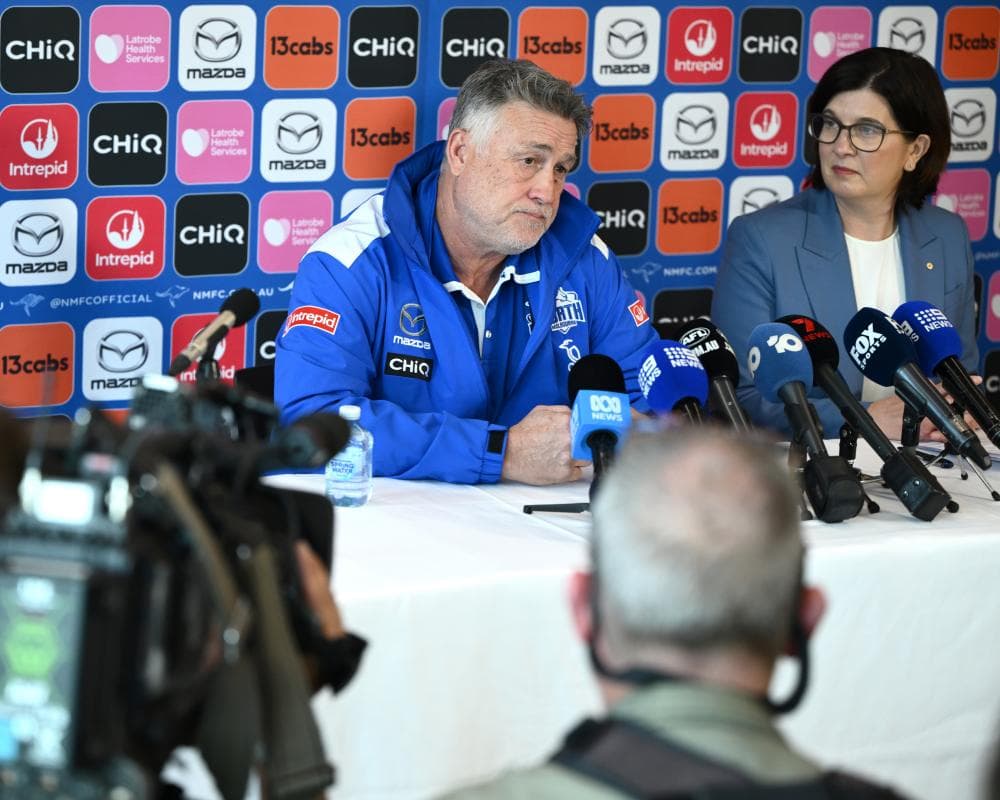
In Clarkson’s case, what sat uneasily was not that he’d been sacked, but the manner in which it was done. North’s press conference was unusual on several fronts. It was unusual insofar as the president doesn’t traffic in footy-talk or corporate-speak. It was unusual insofar as Todd Viney had been a good friend of Clarkson, and was hired to keep him in check. And it was unusual insofar as there wasn’t the usual LinkedIn nonsense normally dished up at such pressers, and the journalists seized the opportunity to probe and at times rattle the speakers.
When the sacking was initially announced, there was anger and bewilderment that North had blown the whole place up again. But whatever it lacked in tact, the presser did lay out the core problems. The shifting gameplan and the inability to defend had been there for all to see. The endless meetings, the war analogies and the unwillingness to delegate helped explain a lot of what had gone wrong.
Much of the criticism directed at Hood and CEO Jen Watt has been along the lines of “they’re too woke”, which is often code for “they’re women”. But there was nothing woke about the way Hood pushed back on the journalist who broke the Hawthorn racism story. Four years later she sacked Clarkson in cold blood. There was certainly nothing woke about that.
If anything, the most inflammatory and revelatory things in that press conference came from Viney, not Hood. But her comment “this club needs a coach who can coach for the modern game” was the one people blanched at. It was almost as if they were saying, “we want you to lie. We want you to soften the blow. You’ve broken the unwritten rule in football – ‘never piss on statues’.”
As a club leader in that scenario, you’re damned if you do, you’re damned if you don’t and you’re damned if you dither somewhere in between. But there is a middle ground here. Clarkson, who has cut, traded and pensioned off scores of footballers over the years, knows all too well the realities of the industry. Hood, who hailed his magnificence when she hired him, had to take a degree of responsibility when it didn’t work out. And the rest of us, who crave authentic language and an absence of weasel words, cannot be squeamish when the shortcomings of a coach are laid out, irrespective of their standing in the game. It leaves all involved in an invidious position. “Who’d be a coach?” Voss said earlier this year. “You’ve got to be a madman.” The same could be said for those running a football club.
This is an extract from Guardian Australia’s free weekly AFL email, From the Pocket. To get the full version, just visit this page and follow the instructions