How good a golfer was Ted Rhodes? At the 1948 US Open, he finished the first round just three shots behind the leader – and eventual winner – Ben Hogan. But there’s more to the story: Rhodes was the first Black competitor in the tournament in its modern era, during a time of widespread segregation in American sport.
Rhodes is the subject of a new book by sports historian Dan Taylor, Out of the Rough: Ted Rhodes and His Fight against Golf’s Color Barrier. The author aims to change what he sees as mainstream unfamiliarity with Rhodes, even among golf enthusiasts.
“I’ve always enjoyed doing research into people who were agents of change,” Taylor says. “It drew me to Ted Rhodes. I found his story quite remarkable, his success absolutely amazing, what he accomplished to be quite inspiring.”
Related: ‘Utterly baffled’: the 17-year-old girl who struck out Babe Ruth and Lou Gehrig
The author of multiple books about sports, mostly baseball, Taylor was also an award-winning sportscaster in his home town of Fresno, California. You can hear the broadcaster in his voice – and you can sense his enthusiasm when he talks about Rhodes.
Taylor sees Rhodes as part of a throughline of achievement for Black golfers that extends to Rhodes’s protege, Lee Elder, as well as Tiger Woods. The book notes that when Woods won the Masters at age 21 in 1997, he gave a speech honoring Black trailblazers in golf, including Rhodes.
“[Rhodes] was very determined,” Taylor says. “He had kidney problems most of his life, but he battled through it. He had pain and medical problems, but was still successful.” And, Taylor adds, “he was a fun person, very fashion-oriented. He loved to be very fashionable out on the golf course. GQ ranked him the third-best-dressed golfer all-time. He had mink club heads.”
In addition to reintegrating the US Open, Rhodes was part of a 1948 lawsuit against the PGA, which had restricted membership to white people. The PGA responded with a settlement and a promise to change, but according to the book, instead it shifted the status of tournaments from open to invitational, allowing the organization to tacitly continue segregation.
“[The PGA] had a significant Southern influence,” Taylor says. “Their leadership, for the most part, was men from the South. A high percentage of the schedule was in the 17 Jim Crow states. Country clubs, for the most part, did not permit persons of color to play. The PGA had a very firm caucasian-only membership policy.”
After the lawsuit, and the tournaments’ new status as invitationals, “to be invited to play, you had to be a member of the PGA,” Taylor says. “Gaining membership was out of reach for any African American golfer. You could not play enough events, win enough points or prize money.
He adds, “It’s unbelievable to me that … Jackie Robinson integrated pro baseball and Kenny Washington integrated the NFL [in the late 1940s, yet] it was not until 1962 that the PGA changed their membership policy.”
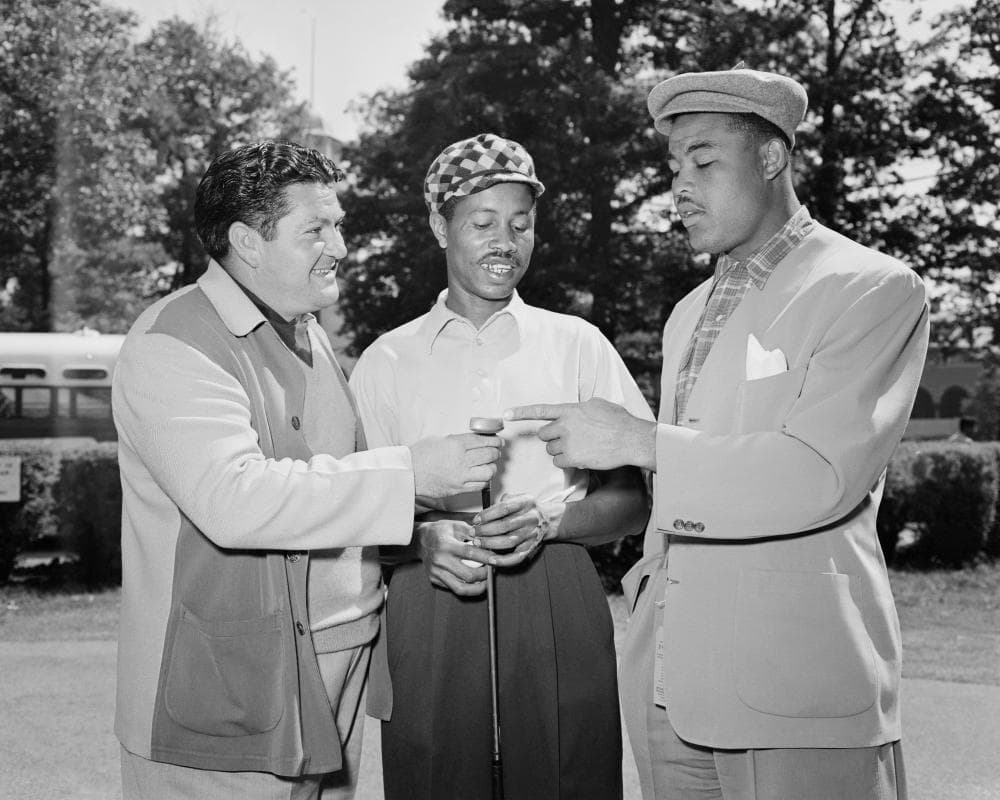
Before the PGA reversed its stance, some courses welcomed Black players for PGA events, including Phoenix Country Club for the 1952 Phoenix Open, where the Black entrants included Rhodes and a crucial figure in his life: boxing great Joe Louis. It was golf that connected them – when not in the ring, the heavyweight champ liked to go out on the links, with Rhodes as his teacher. During and after his playing career, Rhodes helped spread interest in golf among Black people through his instruction. In addition to Louis, other students included Rhodes’s wife, the acclaimed dancer Claudia (Oliver) Rhodes; their daughter Deborah, whom Taylor interviewed for the book; and tennis great Althea Gibson following her retirement from the court and pursuit of a new challenge.
When Rhodes first took up golf in his home town of Nashville, the odds seemed stacked against him. Jim Crow laws limited Black participation in the increasingly popular sport. Black people were only allowed to play on municipal courses, not at country clubs. With the PGA out of reach, the alternative was an organization for Black golfers called the United Golf Association (UGA).
Yet Rhodes showed determination from the start, fashioning a club from a coat-hanger and a ball from a cork bottlecap. When his father died and his mother had to go to work to support the family, Rhodes got a job as a caddie at Nashville’s Belle Meade Country Club. He made the first of two crucial contacts: his uncle John Lee “Pap” Bates, who was the chief caddie at Belle Meade and provided valuable mentorship in the sport.
How well did Rhodes absorb his uncle’s instruction? So well that in 1941, Rhodes traveled to Detroit to play in a tournament run by Louis, one of the most famous athletes of his day. The boxer held the Joe Louis Open as a showcase for Black golfing talent. Rhodes placed third, impressing Louis so much that the heavyweight champ hired Rhodes as his golf coach, beginning a longtime professional relationship.
“[Louis] played a monumental role in Rhodes’s professional golf success,” Taylor says. “He brought him to California … enabling him to play every day, [at] country clubs where Rhodes never had been permitted … It really changed Rhodes. It built his confidence. It built his determination to succeed.”
Louis backed Rhodes financially, paying his tournament fees and even giving him a new car each year. Taylor recalls that when he visited Deborah Rhodes, she showed him a trophy her father received for his dominant play in the Joe Louis Open. Over seven years of full-time play in the UGA, Ted Rhodes dominated the tournaments he entered, winning 79% of them.
After Rhodes and Louis served in the US military during the second world war, they reconnected in 1945, with Rhodes taking on a new pupil named Jackie Robinson. Yes, the man who broke baseball’s color barrier in 1947 also played golf, and was eager to learn from Rhodes.
“They did play golf together, through Louis,” Taylor says. “They were introduced through Louis. They played golf together from time to time. Rhodes did give golf instructions. He was a very sought-after golf teacher, although he did so non-officially. You had to be a PGA member to teach professionally.”
By 1948, Rhodes was playing in the US Open, which had no race-based restrictions, unlike the PGA. As the book recounts, he did not disappoint with his stylish attire – he showed up wearing a blue beret and two-tone shoes. His practice round was just as dazzling, as he shot a 67.
“In the practice round, the day prior to the first round, there was a big crowd following Ben Hogan,” Taylor says. “They missed out on Ted Rhodes’s low round of the day.”
On day one, Rhodes was right up there among the leading contenders. Yet he shot in the 70s the rest of the way, despite remaining in contention for prize money going into the final round.
That same year, his name was on a lawsuit aimed at breaking the PGA color barrier. The organization settled out of court and put the onus for selection on the individual clubs. In the early 1950s, Phoenix was among the pioneers. Yet there was a tense moment at the Phoenix Open – the Black entrants were initially denied locker-room access. The book suggests that this may have been defused by a local politician named Barry Goldwater, who would eventually run for president on the Republican ticket in 1964.
Rhodes would not be the first Black player to win a PGA-sanctioned event – that would be his protege Charlie Sifford in the 1957 54-hole Long Beach Open. Pete Brown would become the first Black golfer to win a 72-hole PGA tournament, the 1964 Waco Turner Open. Rhodes’s protege Elder earned his own place in history by winning the PGA’s Monsanto Open in 1974: he gained an invitation to the Masters the following year, making him the first Black man to play in the tournament. Decades later, when Tiger Woods’s father Earl Woods realized his son had potential, he asked Elder to evaluate the prodigy.
“There’s a direct line from Ted Rhodes to Tiger Woods,” Taylor says.
And yet, the author adds about Rhodes, “Here’s someone who is the Jackie Robinson of professional golf. People don’t know about him. [Professional golf] has not done anything to use him as a teaching opportunity. It saddens me. It should not be that way.”