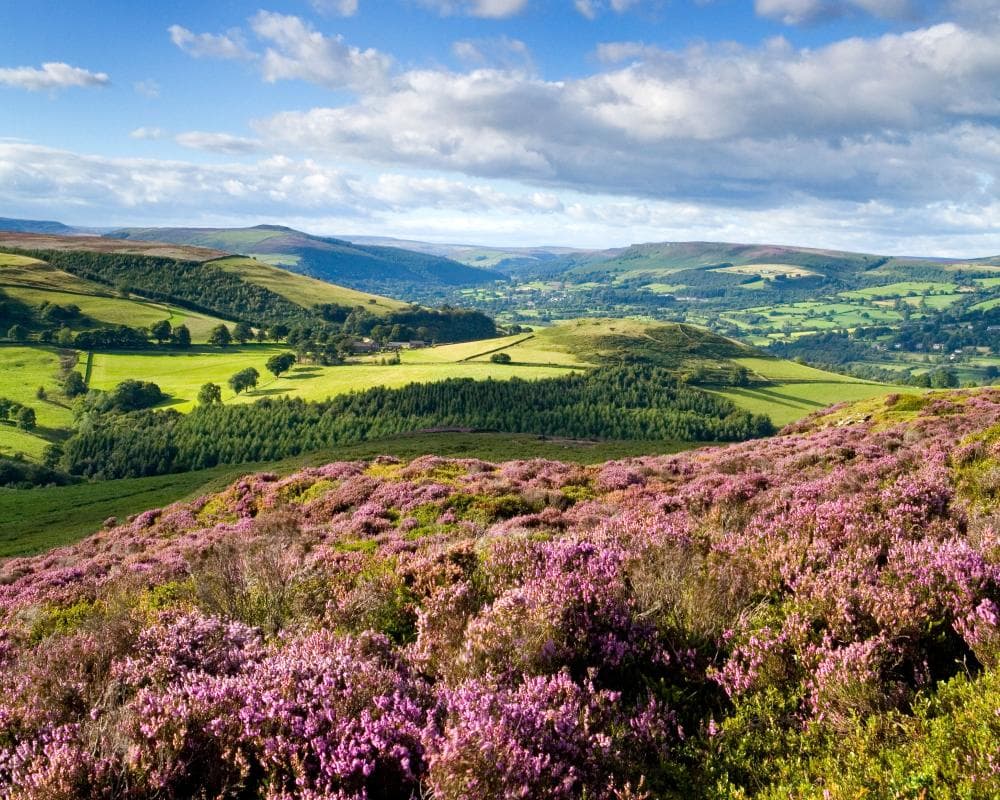
Can a landscape sigh with relief? It felt that way, pushing through bilberry and cowberry hung with pearls of overnight rain that soaked my lower legs.
On the path, dry, dusty soil had reverted to reassuring gloop. I was thrilled, at one point, to step cautiously round a puddle. Overhead, a buzzard wheeled and a small gang of swallows skimmed across heather whose purple intensity was already fading, too soon it seemed to me. To the west, a kestrel was quartering the slopes of Wet Withens.
The downward curve of the moor steepens here, as it drops towards Highlow Brook, but before it does, there’s a bench, a flat space, which in the bronze age was used for a barrow. Next to it is a henge, with its circle of small stones, the most prominent of which was long ago dubbed “the chair”.
I noticed that a raptor, perhaps the kestrel nearby, had recently been dismantling something small and furry on top of the chair, so I moved quickly on to the barrow.
The view from here is among the best I know – evidence that our distant forebears had a grand feeling for landscape. I could see in the distance the spire of St Michael’s in Hathersage, its location no less harmonious, nestling in the crook of the hills opposite, ridgelines intersecting like arms round shoulders.
The barrow itself is a jumble of stones, torn apart in the mid-18th century when the nearby turnpike was built and workmen came looking for material. This was decades before the commons were snaffled by acts of enclosure, in this case for the Duke of Devonshire. Later in the 19th century he turned it into a grouse moor.
These twisting strands of deep history show how varied our uplands have been, from sacred space, to sheepwalk, to elite playground. Now this place has a new story. An anonymous benefactor has presented Eyam Moor to the Derbyshire Wildlife Trust to be a haven for biodiversity, a gleam of light in a troubled sky.
• Under the Changing Skies: The Best of the Guardian’s Country Diary, 2018-2024, is available now at guardianbookshop.com