Alabama, Florida and Indiana all carried out executions on Thursday in an unusual instance of three states administering the death penalty on the same day.
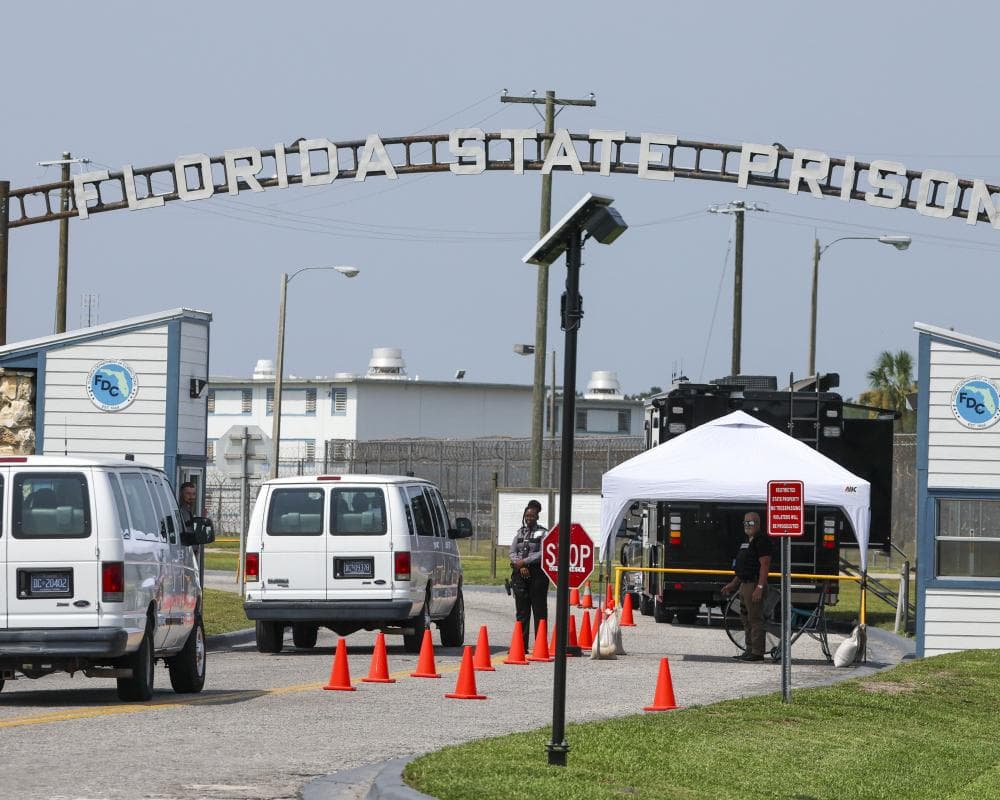
In a record-tying 19th execution of the year, Florida executed Jesse Guardado via a three-drug lethal injection. Guardado had pleaded guilty to fatally stabbing a 75-year-old woman inside her Walton county home in 2004 before stealing her jewelry box, $80 and other valuables to buy drugs. The woman had helped him get a job and housing.
Hours earlier, Indiana executed a man for killing two children in a house fire in 2010. And in Alabama, a man died by injection Thursday evening for his conviction in a fatal home robbery.
The death penalty in the US has faced renewed scrutiny since the September failed execution of Christa Pike in Tennessee, although courts have rejected efforts to halt other executions after she survived two massive doses of pentobarbital.
Thursday’s executions were taking place the same day California’s governor, Gavin Newsom, announced he would commute all 548 death sentences in his state, saying that he believed “state-sanctioned killing is incompatible with California’s values”.
Newsom’s announcement was a sharp contrast with Florida, where outgoing Republican governor Ron DeSantis has made aggressive use of the death penalty like few other governors. His state has carried out more than half of the 34 executions so far this year in the US.
It is the second time since August that three states were set to carry out executions on a single day, although it remains unusual. Prior to this year, the last time it happened was 2010.
In Indiana on Thursday, Jeffrey Weisheit, 50, was pronounced dead at 12.45am at the state prison in Michigan City, said Noelle Russell, spokesperson at the state’s department of correction.
She said he had no final words. He had acknowledged killing his girlfriend’s two children in a house fire in the Evansville area in 2010 but had hoped that governor Mike Braun would grant clemency and change his sentence to life in prison. Braun declined.
In Alabama, Michael Taylor died by lethal injection. In 1991, when he was 19, he beat two people, aged 83 and 79, to death with a metal bar during a robbery in their home in Gadsden.
Death penalty opponents had urged Alabama’s Republican governor, Kay Ivey, to reduce Taylor’s sentence to life in prison, but she declined.
Esther Brown of Project Hope to Abolish the Death Penalty said: “If the state kills Michael, it is not the 19-year-old who made the worst mistake of his life whom it kills. But the mature, well-respected, God-fearing man sitting in that cell today.”
The state went forward with plans to execute Taylor, 54, by lethal injection after a judge declared a nitrogen gas method unconstitutional. His attorneys objected to the last-minute switch to lethal injection since he selected nitrogen gas as his method several years ago, but a judge ruled against Taylor.
Alabama executed murderer Kenneth Smith in 2024 by nitrogen asphyxiation, in an episode that witnesses found excruciating, after previously failing to succeed in its attempt to kill him using lethal injection.
Related: ‘I’m not ready, brother’: US man to be put to death months after botched execution attempt
Meanwhile, in Indiana earlier on Thursday, lawyers failed to persuade the state governor to allow Weisheit to undergo brain scans to assess a history of head injuries and mental health problems. They had asked for a life sentence.
Weisheit’s last objection centered on the state’s planned use of lethal drugs purchased from a pharmacy that is facing a disciplinary hearing next week in front of the Indiana pharmacy board, the state regulatory agency.
The execution provided “long-awaited justice for Alyssa Lynch and her brother Caleb, two innocent children whose lives were stolen in an act of unspeakable cruelty”, Indiana attorney general Todd Rokita said.
The Associated Press contributed reporting