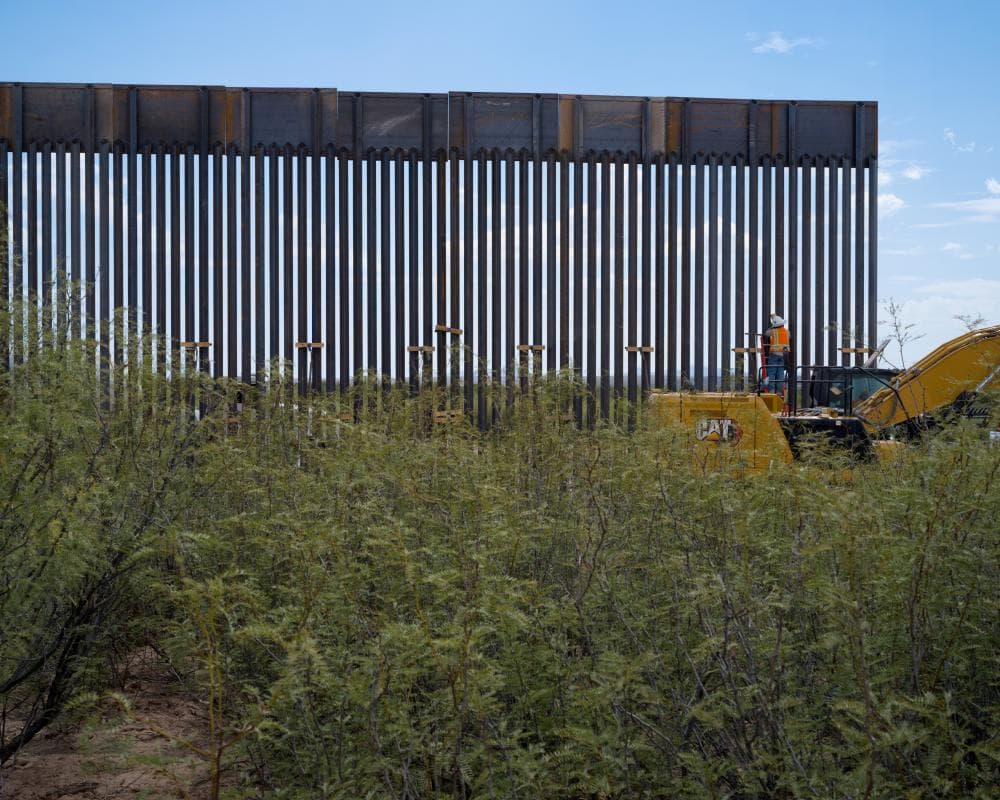
A federal judge has temporarily blocked the Trump administration from expanding the border wall and other security infrastructure across the Big Bend region of west Texas, where contentious plans to build roads and vehicle barriers through a popular national park have led to furious backlash and public protests.
US district judge Kathleen Cardone’s ruling after a Friday hearing in El Paso deals a major blow to the Trump administration’s efforts to expand the border wall through west Texas at breakneck pace, while riding roughshod over the objections of local business owners, landowners, public land advocates and politicians from both parties.
Related: A small Texas town stopped Trump’s border wall construction – for now
Plans to mar Big Bend national park with new roads and 6-ft tall vehicle barriers have drawn the most national attention since the Trump administration started advancing the border wall construction earlier this year. Images of bulldozers plowing up ground for new roads at the park in August drew outrage, prompting Rodney Scott, the CBP commissioner, to temporarily halt construction. Construction resumed in September.
Friday’s ruling came after a hearing in a lawsuit filed by the Friends of the Ruidosa church, the Center for Biological Diversity and river guide Billy Miller seeking to overturn several Department of Homeland Security (DHS) waivers that suspended dozens of environmental and historical protection laws to speed construction.
Cardone blocked the DHS waivers in her ruling, saying that the plaintiffs were likely to win and would suffer irreparable harm if construction moved forward. The ruling bars CBP from border security infrastructure construction or ground disturbance, unless it complies with the federal laws that DHS tried to suspend.
“This is a historic victory for Big Bend and everyone who loves this wild corner of Texas,” said Laiken Jordahl, a public land advocate with the Center for Biological Diversity. “No administration has the right to destroy a crown-jewel national park for political theatre.”
“But this fight is far from over,” he added. “We won’t rest until Big Bend’s environmental protections are fully restored and the illegal waiver that allowed so much destruction is gone for good.”
CBP has already awarded five contracts for Big Bend totaling more than $6bn to expand what the agency calls the “smart wall” – a mix of 30-ft steel bollard fencing, vehicle barriers and surveillance technology.
“We stand by our assessment and remain confident in our legal authorities to secure the border while preserving the unique landscape of the Big Bend region,” a CBP spokesperson wrote in an email in response to the ruling. “We are working with the Department of Justice on next steps.”
The Republican-dominated Congress included a whopping $46.5bn for border wall construction in last year’s “big, beautiful” spending bill. That massive war chest led CBP to focus much of its efforts on the Big Bend region, which contains the longest unwalled stretch along the US-Mexico border.
The plans have sparked furious responses from landowners and local political leaders, who say that unauthorized crossings are already rare there due to the region’s remoteness, the lack of nearby cities on the Mexican side and prominent cliffs that make it very difficult to cross through many stretches of the border there.