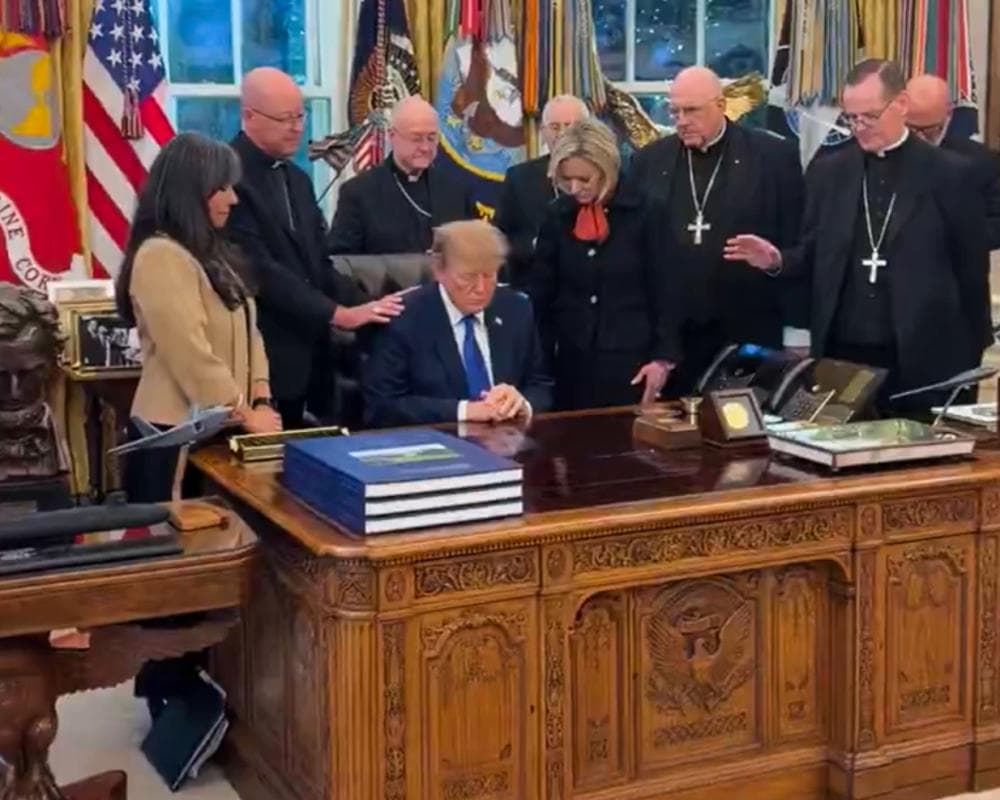
Two Catholic bishops who bowed their heads with Donald Trump in the Oval Office now say they regret it, accusing the White House of turning a private prayer into a campaign photo opportunity before next week’s US elections.
Archbishop Jeffrey Grob of Milwaukee and Bishop William Joensen of Des Moines, who were among the 12 bishops who met administration officials last Thursday, issued separate statements of regret over the weekend.
The fallout stems from the White House quickly posting video and photos of the prayer on social media, captioned as Catholic archbishops and bishops praying with the US president, less than two weeks before the midterm elections on 3 November.
Archbishop Grob issued a statement headlined A Public Apology, in which he said he felt “a heavy sadness” over the pain the images had caused, and that he had heard from people alarmed that he had unwittingly joined a political event on the eve of a national vote.
Others, he said, were hurt because of the effect of Trump’s policies on their families. “We should never have been put in that position by the White House,” wrote Grob, adding that he had harbored reservations and “wish I had heeded them”.
Bishop Joensen wrote that “many things tied to this present Administration” were “blatantly at odds with our Catholic faith”.
He said none of the bishops was unaware the meeting fell close to an election, but insisted that none had intended to endorse a party or candidate. “I wish I had been more shrewd and less simple, like those who exploited our meeting for partisan political purposes.”
Grob said the Heritage Foundation, the conservative thinktank behind the Project 2025 rightwing blueprint for the second Trump administration, arranged the meeting. The bishops, he said, were told it would be a private discussion of immigration enforcement, religious-worker visas and human dignity, with a possible chance to pray privately with the president.
After 90 minutes with domestic policy staff, they were ushered into the Oval Office, handed commemorative tokens and, Grob detailed, directed to stand behind Trump’s desk and pray. Nobody told them a video was being recorded, he said, and they never agreed to its release.
Joensen said officials connected to the White House Faith Office invited him, and that the agenda also covered fertility treatment incentives, abortion-inducing drugs and tax credits for private schools.
Archbishop James Golka of Denver, another participant, told his archdiocese’s publication that he understood why many saw the video as an endorsement but that it was “never my intention”. “I’m heartbroken that people are hurt, and that there are people intentionally using this moment to sow disunity,” he said.
Bishop Scott Bullock of Rapid City told the National Catholic Reporter that a Heritage Foundation representative had invited him and that the US Conference of Catholic Bishops was “not unaware” of the meeting. He did not say who in the leadership knew.
Trump has spent his second term fusing Christian prayers with the machinery of government, creating a White House Faith Office by executive order in February 2025 and, the same month, a justice department-led taskforce to “eradicate anti-Christian bias” in federal agencies.
The president faced criticism in April for posting an AI-generated image on his Truth Social platform depicting himself as a Jesus-like figure. He later deleted the post, and claimed it was “supposed to be me as a doctor making people better”.
At the Pentagon, Pete Hegseth, the US defense secretary, has held Christian worship services (which the Associated Press reports have been led only by evangelicals) and in March prayed for “overwhelming violence” against “those who deserve no mercy” in the Iran war.
And when the Episcopal bishop Mariann Budde urged him at his inauguration prayer service to show mercy toward migrants and LGBTQ+ people, Trump demanded that she and her church apologize, which she in turn rejected.
Archbishop Paul Coakley of Oklahoma City, president of the US Conference of Catholic Bishops, has urged Catholics to put faith ahead of politics before the vote. The bishops are due to hold their annual fall assembly in Baltimore in November, about two weeks after the election.
“We are, as ever, a pilgrim people,” Grob wrote. “And that includes bishops,”. He ended his apology with “sincere regret”.