Yemen has been plunged into a civil war that has extended to one of the world’s most vital maritime choke points and to Saudi Arabian oil sites.
What was the spark?
The semi-dormant conflict over Yemen’s future reawakened in the summer, when Saudi Arabia bombed the runway of the airport in the Houthi-controlled capital, Sana’a, in an attempt to prevent an Iranian plane carrying Yemenis who had attended the funeral of Iran’s supreme leader from landing. Saudi Arabia said a charter plane could land, but not an Iranian-owned one. The plane eventually flew to the port of Hodeidah on the Red Sea coast. The Houthis described the bombing as part of a Saudi siege of Houthi-controlled Yemen, and vowed “a siege for a siege”.
The Houthis announced a naval blockade of Saudi Arabia and sent missiles towards the country’s oil facilities. The Saudi-Houthi ceasefire in place since 2022 was over. After months of failing to help their ally Iran in its war with the US, the Houthis had opened a new front.
What did the Houthis do next?
The Houthis have sporadically used their strategic position on the coast of the Red Sea to disrupt commercial traffic, mainly linked to Israel. But its leadership decided in mid-September to escalate and to try to tighten its grip on the waterways by pushing south down the coast to the narrowest part of the waterway, the Bab al-Mandab strait. It succeeded within days.
By 16 September, they had captured the coastal town of Mocha and small islands in the strait, as well as an airport. The battle then moved into the al-Waz’yah district and the high mountain chains overlooking the strait and towards Taiz governorate, including Taiz itself, Yemen’s third city and the home town of the president of the UN-recognised government, Rashad al-Alimi.
Why did the Houthi advance succeed?
Some have blamed betrayal by Tareq Saleh, the nephew of Yemen’s former president and leader of the National Resistance Forces in the region, but others say the forces of the UN-recognised government are divided, suffer from poor command and control networks, and lack the military intelligence the Houthis possess. The Houthis also had Iranian support; by saying they would block Saudi oil from the port of Yanbu, they were aligning themselves with the Iranian war effort. But the Houthis are not pure proxies of Tehran. Their hostility to the Saudi presence in Yemen is self-standing and has religious as well as political roots.
How did the Saudis respond to the shock of the Houthi advance?
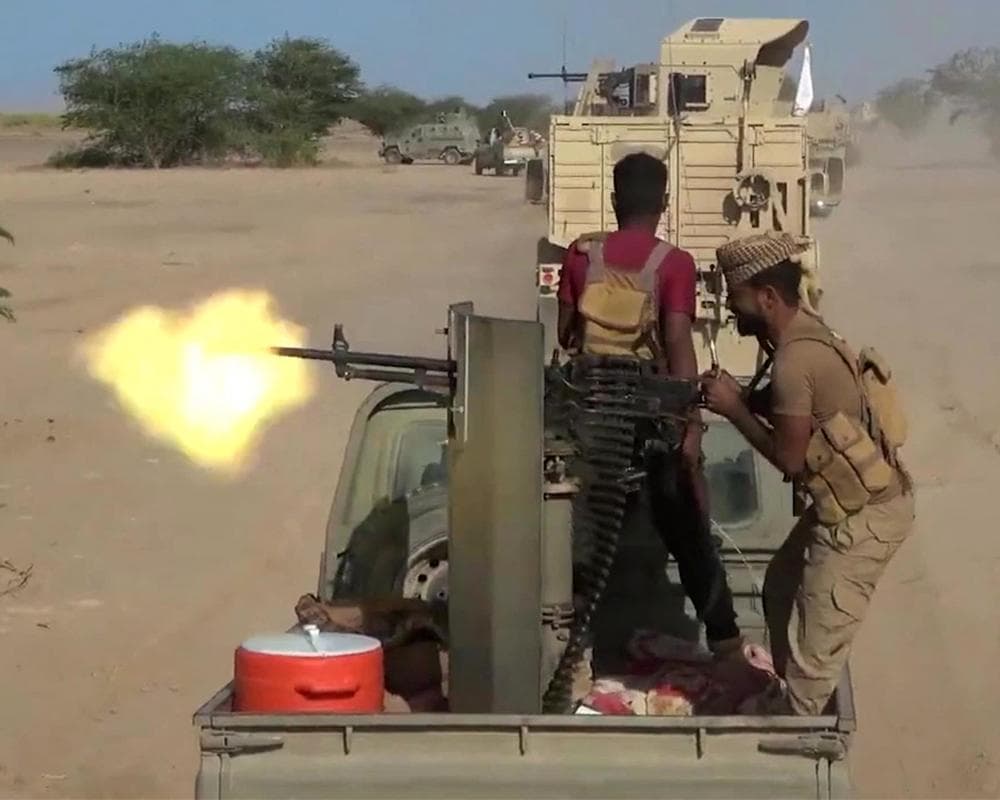
It took three weeks, but over the weekend Alimi announced a broad counteroffensive called Operation Yemen Dawn, designed to end the “Houthi coup”. It saw 100 Saudi jets fly in support of Yemen ground forces driving towards Bab al-Mandab. Fighting is happening across at least three fronts, including in the mountains west of Taiz, in Marib and in Sana’a. The Houthis have sent missiles towards at least five Saudi cities. The scale of the Houthi reverse has probably been exaggerated.
What is the relationship between the legitimate UN-recognised government and Riyadh?
The two countries share a 1,200km-long contested border, secured only after the 1934 Saudi-Yemen war. Since the British departure in 1967, Yemen has come to rely heavily on Saudi Arabia to remain an economically viable state. There are officially 2 million Yemenis working as migrants in Saudi Arabia. Many send money home and are just now being given legal status. Riyadh regularly provides grants to the Yemeni government to prevent its collapse (up to $12.6bn in the last 14 years). This heavily shapes its choice of leaders. Indeed so much of Yemen’s leadership resides in Riyadh’s hotels, instead of Aden, that critics call the administration the hotel legitimacy.
Are the anti-Houthi forces inside Yemen aligned?
No. Yemen is a maze of tribes, governorates and religious beliefs, which is reflected in its politics and militia armies. A dispute over which force can take credit for leading the counteroffensive also reflects political rivalries, but the southern forces are prominent, even though they are fighting to dislodge the Houthis from land that would not form part of a separate southern state.
The separatist political wing, the Southern Transitional Council, will test its latent support with a popular mobilisation on 23 October and this may determine whether its leader, Aidarous al-Zubeidi, can risk returning from exile. He has been charged by the legitimate government with high treason for trying to set up a secessionist state in January. Fearing arrest by the Saudis, he fled to the UAE. His aides fear his one-time military ally Abu Zara has aligned himself with Riyadh.
What is the role of the United Arab Emirates?
The UAE joined the 2015 Gulf coalition to dislodge the Houthis from Sana’a but, as Saudi methods became ever more unpopular, the UAE distanced itself. It had its own anti-Muslim Brotherhood agenda and regarded the Islah party – strong in the Yemeni government – as an offshoot of the Brotherhood. It slowly aligned itself with the southern separatists, largely as a way of gaining leverage inside Yemen, just as Saudi Arabia ironically did during the 1994 Yemen civil war. They trained the STC and National Resistance Forces. The UAE left Yemen in January 2026. It remains wary of Saudi intentions.
Why is the US so reluctant to intervene?
It has its hands full and its munitions stocks are empty due to the war in Iran. Ahead of the midterms, Donald Trump does not want to launch another forever war. After bombing the Houthis for 50 days in spring 2025, he struck a bilateral ceasefire with the Houthis – a deal that excluded Israel. He has twice rejected Saudi pleas that the fate of the strait is a matter for the world.
Is anyone else involved?
Yes. European countries, including the UK, are providing some air refuelling for Saudi jets. More importantly, rumours swirl around the new Mecca joint defence agreement, signed on 7 August 2026, by Turkey, Saudi Arabia and Pakistan.
Its purpose is clear: filling the Gulf security vacuum exposed by the US-Israeli war on Iran, but its relevance to Yemen is sketchy. There are reports Pakistan is sending weaponry to Aden.
Who will win?
Many doubt Saudi Arabia has the staying power to reach Sana’a. Saudi energy infrastructure is vulnerable. The attack on the Saudi east-west pipeline on 11 September from Iraqi territory showed how a broader regional confrontation could open multiple fronts for Riyadh. Over nearly two decades the Houthis have shown themselves to be the masters of ground combat. But Yemen is now part of an international conflict and so many assumptions are up for review.